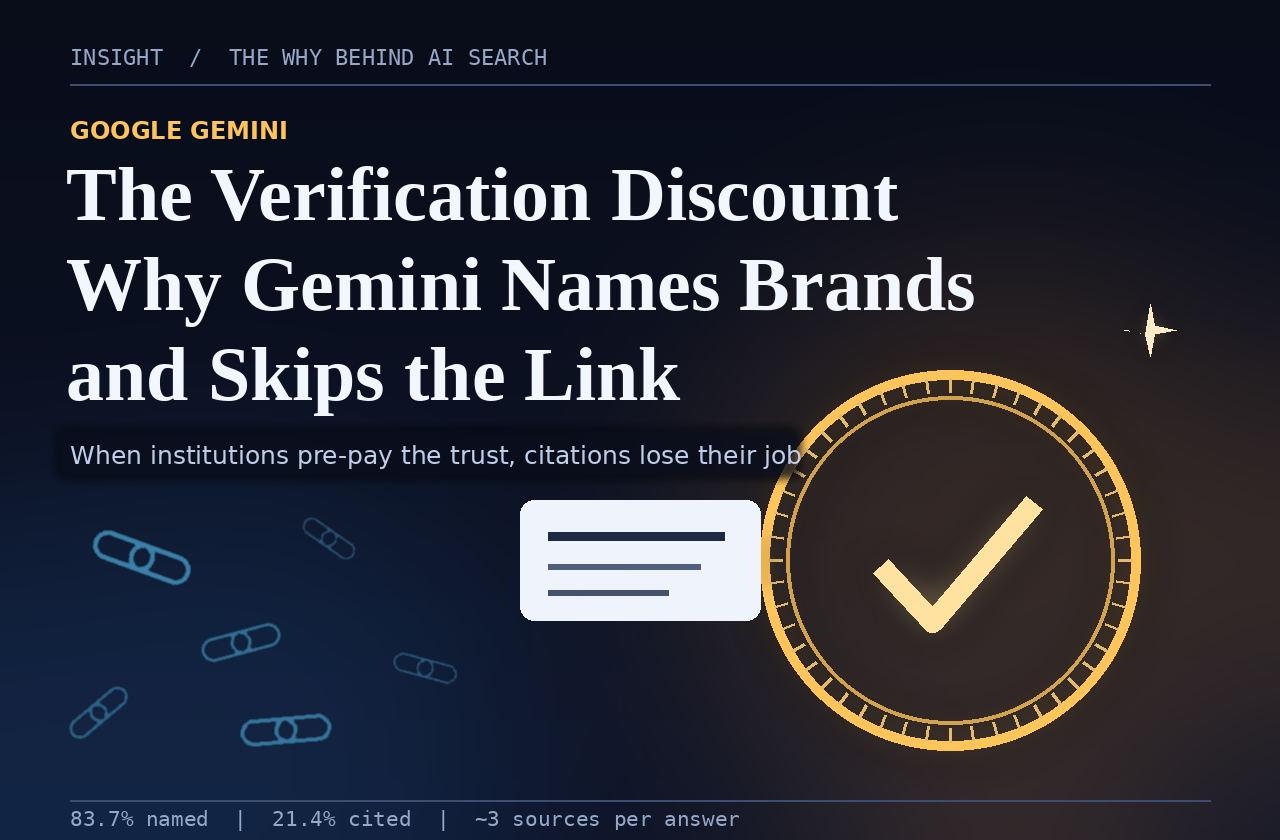
Every GEO dashboard treats a citation as the win. So why does Google’s own assistant keep handing brands something else? In Semrush’s June 2026 ghost-citations study, Gemini named brands in the answer text 83.7% of the time but linked a source in only 21.4% — the exact inverse of ChatGPT, which cited 87% and named 20.7%. This insight argues the split isn’t a quirk. It’s what happens when trust gets paid upstream: citations are insurance, and Gemini’s reading list is already insured.
The Insight: Citations Are Insurance, and Institutions Pre-Pay the Premium
Here is the mechanism most AI-visibility decks skip.
A citation link does a job: it lets a skeptical reader verify a claim the engine can’t personally guarantee. When an answer draws on fifteen mixed-quality sources — forums, blogs, whoever ranked — the links are load-bearing. They transfer the verification burden to the reader. ChatGPT’s behavior fits: about fifteen sources per answer in Semrush’s 126-million-prompt index, links everywhere, brand names rare. The engine is saying, don’t trust me, check these.
Gemini runs the opposite procurement. BrightEdge’s April 2026 analysis found roughly 26% of its citations come from government, academic and institutional domains — the highest authority share of five engines — with UGC at a rounding-error 0.2%. It answers from about three sources, not fifteen. When your references are .gov reports and standards bodies, the verification happened before the answer was written. The institution already vouched. A link adds little assurance the source hasn’t supplied, so the engine spends its scarce output on the thing the reader actually keeps: the name.
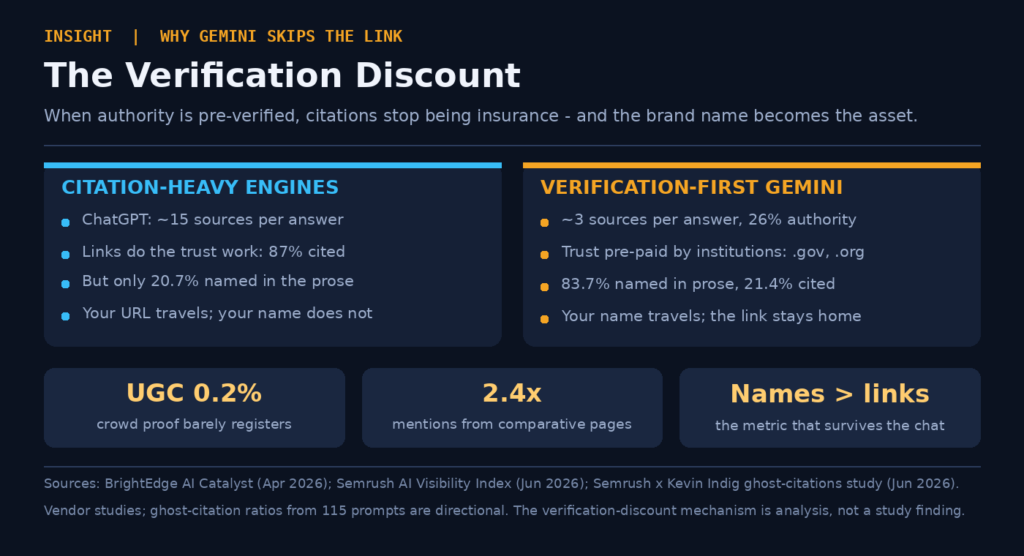
Call it the verification discount: the more credibility your sources carry in advance, the less the answer needs to prove itself with links — and the more room it has to recommend. That reframes what a brand is buying in Gemini optimization. You’re not buying a footnote. You’re buying entry into a short, pre-trusted conversation where being named is the entire payout. It also explains the format premium: the same Semrush study found comparative pages earn 2.4 times more brand mentions than informational ones, because comparison is the sentence where names do the work.
The uncomfortable corollary: a citation-only win on Gemini is the small prize. Teams celebrating source links are counting the insurance receipts while the recommendation — the asset that survives the conversation, the one Siri now repeats — goes to whoever earned institutional trust. Audit names first. Links second. And fund the boring corroboration that makes an engine comfortable saying your name out loud.