A playbook for creative ops and performance teams. November 2026.
The Economics Flipped. Your Bottleneck Didn’t.
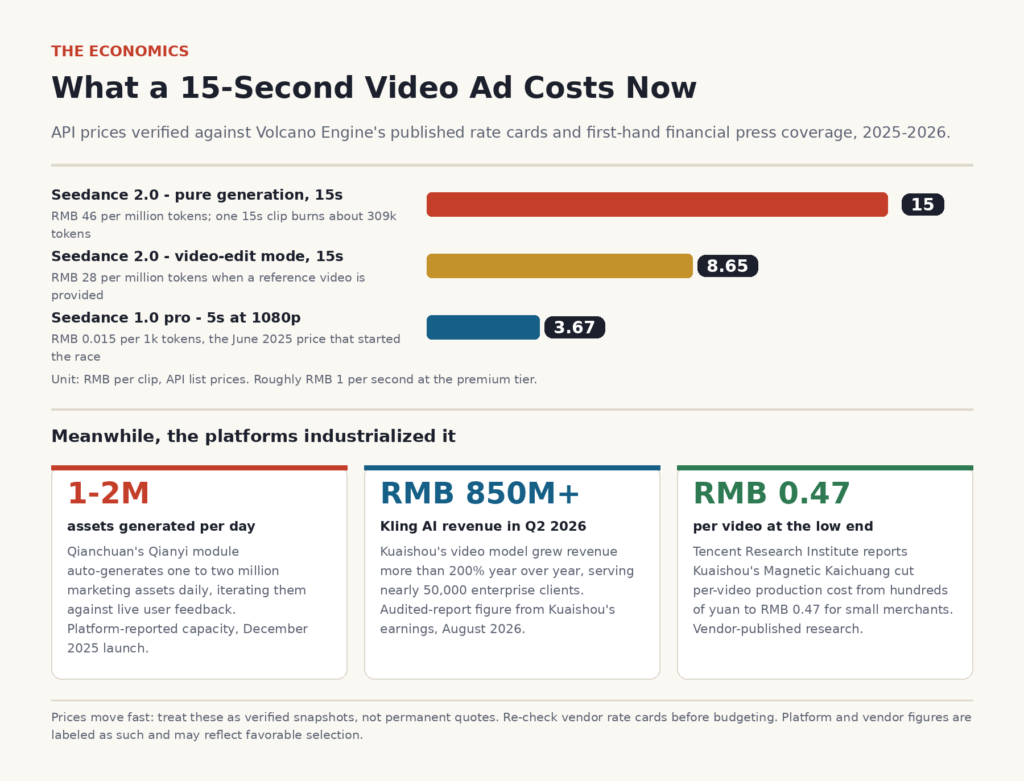
Here’s a number that should rearrange your budget meeting: a 15-second AI-generated video, produced through ByteDance’s Seedance 2.0 API, costs roughly 15 yuan. About one yuan per second. When Volcano Engine published that rate card in March 2026, the industry press called it the start of the “one-yuan-per-second era” — and they weren’t exaggerating. A year earlier, the same company had priced a five-second 1080p clip at 3.67 yuan, and that already felt like a rounding error next to a human production crew.
Meanwhile, the platforms stopped waiting for you to make anything at all. Douyin’s Qianchuan ad system now ships a module called Qianyi that auto-generates one to two million marketing assets per day, tests them against live traffic, and retires the losers without asking anyone’s permission. Kuaishou’s Kling AI — the video model behind much of this — pulled in over 850 million yuan in revenue in the second quarter of 2026 alone, growing more than 200% year over year, with nearly 50,000 enterprise clients on board.
So volume is cheap. Nearly free, at the margin. Which means the thing standing between you and a thousand usable ad variants is no longer production capacity. It’s direction — knowing what to say — and verification — proving you’re allowed to say it. Teams that skip those two inputs don’t get a creative factory. They get a garbage fountain, pointed at their own ad account.
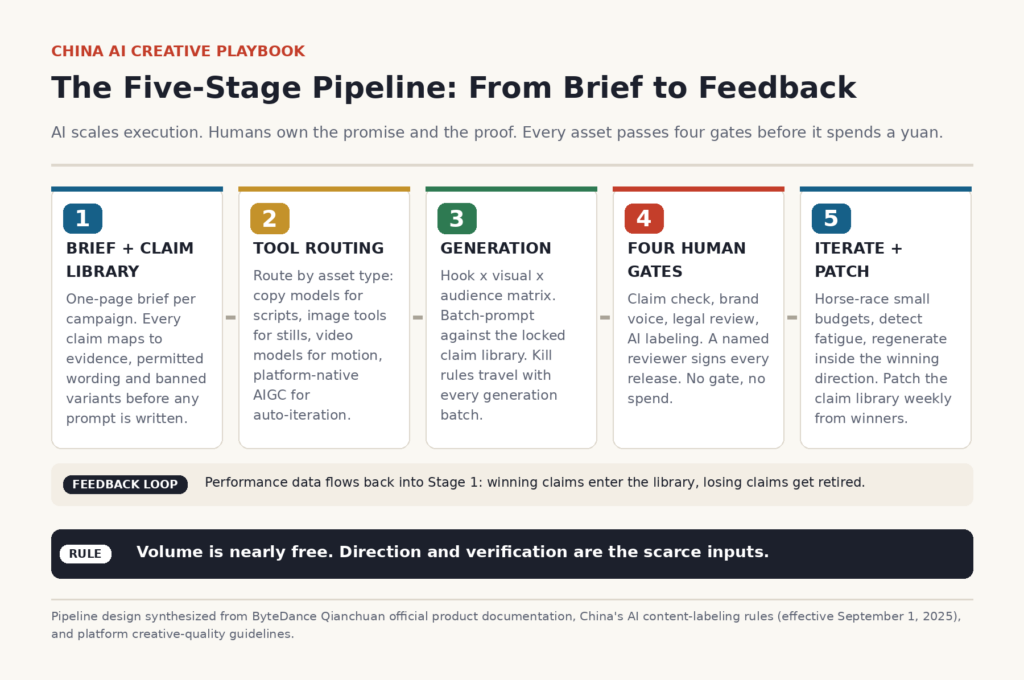
This playbook gives you the five-stage pipeline that separates the two: brief and claim library, tool routing, generation, human gates, and the iteration loop. Plus the cost math, the compliance layer that China made mandatory in September 2025, and the failure modes that eat budgets quietly.
Why Scale Without Direction Backfires
Let’s kill a fantasy first: that more variants automatically means more winners. Douyin’s own creative-quality guidance says the opposite. Its systems actively identify “homogeneous assets” — videos that differ only by a swapped background, a new music track, or a brightness tweak — and treat them as near-duplicates. Low-quality assets get their exposure throttled. Your fifty slightly-different clips don’t fifty-fold your chances; they compete with each other for the same eyeballs, fatigue the same audience faster, and teach the delivery algorithm that your account produces noise.
There’s a second trap, and it’s worse. An ungated language model will happily invent product specifications. It doesn’t know your sunscreen isn’t certified for eight-hour protection; it just knows that “eight-hour protection” sounds like the kind of thing sunscreen ads say. Multiply that confident fiction by a thousand variants and you haven’t scaled creative. You’ve industrialized false advertising — and under China’s Advertising Law and platform rules, the liability lands on the advertiser, not the model vendor.
The pipeline below exists to make sure the cheap part stays cheap and the scarce parts — claims, evidence, judgment — stay human.
Stage 1: The Brief and the Claim Library
Every campaign starts with a one-page brief: the audience, the job the product does, the single promise this campaign is allowed to make, and the proof behind it. One page. If your brief runs five pages, you’ve written a strategy deck, not an instruction a generation system can follow.
The claim library is the piece most teams skip, and it’s the load-bearing wall. For every claim, you record four fields:
- Claim — the statement itself, e.g. “charges to 80% in 25 minutes.”
- Evidence — the test report, certification, or measured data that supports it.
- Permitted wording — the exact phrasings legal has approved, in Chinese, with tone variants.
- Banned variants — the tempting exaggerations the model will drift toward: “fastest charging,” “never runs out,” “100% safe.”
Lock the library before anyone writes a prompt. Batch generation then becomes assembly: hooks and visuals vary freely, claims never do. Add a voice charter — a short document defining how your brand sounds in Chinese, which slang is welcome, which hype registers are off-limits — and you’ve given the machine a fence to play inside. Without these inputs, you’re not running a creative operation. You’re renting a very fast intern who has never read your compliance file.
Stage 2: Route Each Asset to the Right Tool
The 2026 tool menu is genuinely good, and genuinely differentiated. Route by asset type instead of picking one darling model for everything.
For copy — scripts, hooks, titles — the major Chinese LLMs (Doubao, Qwen, Kimi, Wenxin) all handle marketing Chinese fluently. Test two or three on your own claim library and keep whichever hallucinates least against your banned-variants list. That’s the only benchmark that matters here.
For video, the two poles are Kuaishou’s Kling and ByteDance’s Seedance family. Kling’s 3.0 series pushed into native 4K output and professional film-and-ad workflows; its 2026 revenue curve tells you the prosumer and enterprise market is real. Seedance 2.0’s pitch is director-grade multi-shot storytelling with synchronized audio — and a price card to match: roughly 15 yuan per 15-second pure-generation clip, or about 8.65 yuan if you feed it a reference video to edit. The older Seedance 1.0 pro remains the budget workhorse at 3.67 yuan per five-second 1080p clip.
For platform-native generation, Qianchuan’s AIGC Dynamic Creative and Tencent’s ADMuse sit inside the ad systems themselves. The trade-off is control: platform tools generate, test, and retire assets automatically — Qianchuan’s official manual says one source video can spawn ten-plus differentiated versions — but you see only aggregated performance and top-spending samples, not every asset. Great for scale-stage exploitation. Wrong place to discover your brand’s next big idea.
One planning note the pricing tables hide: scarcity. When Seedance 2.0 launched, demand overwhelmed capacity — queues ran into the hundreds of thousands, and even premium subscribers waited hours. Premium compute is a seller’s market. Build your pipeline so a queue at one vendor reroutes work to another, instead of stalling the whole campaign.
Stage 3: Generation Patterns That Produce Real Variants
The word doing the work here is differentiated. A useful variant matrix crosses three axes: hook (problem-first, proof-first, story-first), visual treatment (talking head, product demo, scene drama), and audience context (the commuter, the parent, the enthusiast — same claim, different life). Three hooks × three visuals × three contexts is 27 genuinely distinct assets from one claim. That beats 100 background swaps, and the delivery algorithm can tell the difference.
Three patterns earn their keep:
- Image-to-video for product shots. Start from approved photography, animate around it. The product stays true; only the world moves. It’s also the cheaper edit-mode pricing tier on Seedance.
- Digital-human spokespeople. Fast and cheap, but they carry consent and labeling duties — a cloned face or voice needs authorization, and the output needs its AI label. China’s regulators ran an entire enforcement campaign against unauthorized face-and-voice cloning; this is not a gray area.
- Batch prompting against the locked library. Every prompt template pulls claims from the library by reference, never by the operator’s memory. And every batch ships with kill rules attached: what performance floor retires an asset, and when.
Budget honestly. At list prices, a 27-variant video test costs a few hundred yuan in generation — before human review time, which is now your dominant cost. The teams that win at this aren’t the ones generating most. They’re the ones reviewing fastest without letting garbage through.
Stage 4: The Four Gates — Non-Negotiable
Between generation and spend sit four human gates. Each one has a named reviewer of record. “The team checked it” is not a reviewer.
Gate 1 — Claim check. Every factual statement in every asset maps back to the library. If a spec appears that isn’t in there, the asset dies. No exceptions for “it’s probably true.”
Gate 2 — Brand voice. Does this sound like you, in Chinese, at your best? The voice charter is the reference. Localized slang is fine; off-brand hype is a rewrite.
Gate 3 — Legal. China’s Advertising Law bans absolute claims (“best,” “number one”) and unproven efficacy promises, with special regimes for health, finance, and minors. Portrait and voice rights need consent — including AI clones. Your reviewer works from a checklist, not vibes.
Gate 4 — AI labeling. Since September 1, 2025, the Measures for Labeling AI-Generated Synthetic Content and the mandatory national standard GB 45438-2025 require dual labels on AI content: an explicit label users can see, and an implicit label in the file metadata. The standard is specific: image labels at an edge or corner with text height at least 5% of the frame’s shortest side; video labels on the opening frame visible for at least two seconds; metadata recording the AI-generated attribute, the provider’s name or code, and a unique content ID. Exported files keep their labels. Deleting or hiding labels is prohibited — and so is building tools that help others do it.
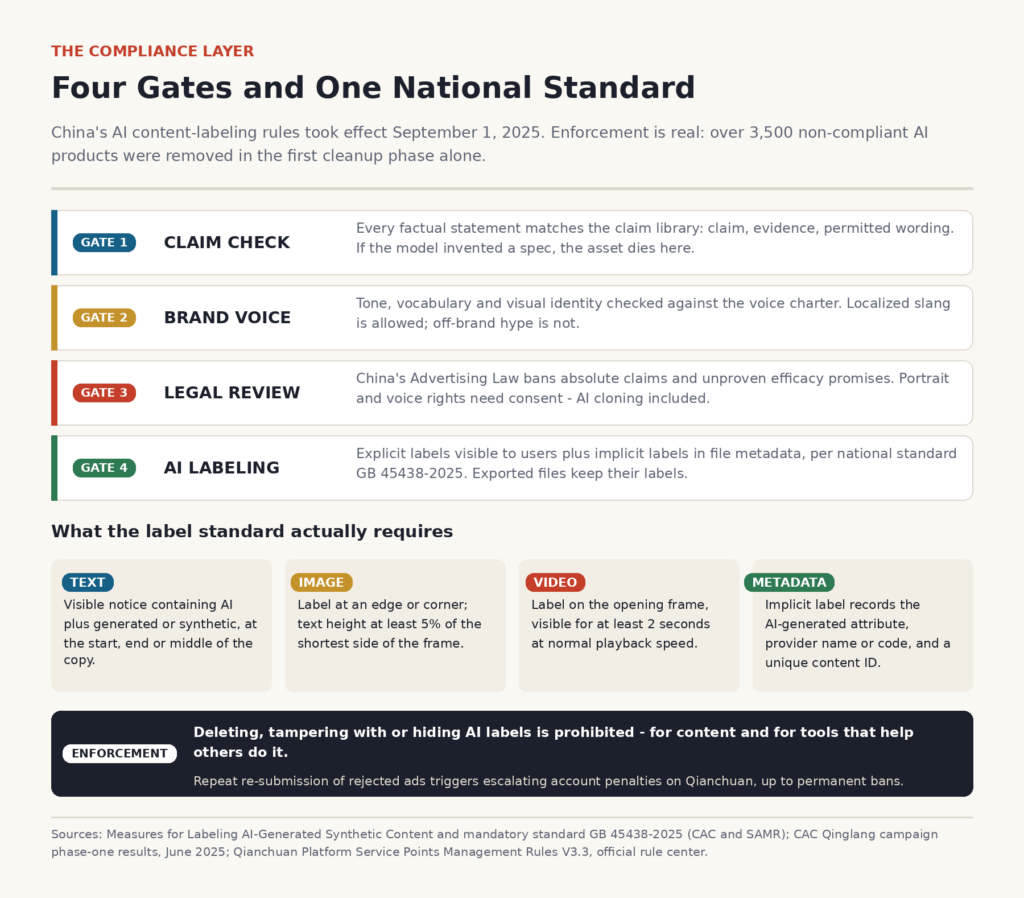
Enforcement here is not a paper tiger. In the first phase of the Cyberspace Administration’s 2025 “Qinglang” campaign against AI misuse, regulators removed over 3,500 non-compliant AI products and handled more than 3,700 accounts. Platforms enforce their own layer on top: Qianchuan’s published violation-points rules score everything from false claims to repeatedly re-submitting rejected creatives, with annual cumulative points escalating through account suspensions to permanent bans — and penalties can extend to affiliated accounts. Note what actually gets punished: not “using AI,” but low-quality duplication and defiance of review decisions. The platforms sell AI creative tools themselves. They’re punishing sloppiness, not technology.
One more platform-specific gate worth wiring into your routing: Qianchuan’s official product manual excludes pharmaceuticals, medical devices, health foods, and financial services from AIGC Dynamic Creative entirely. If you’re in those verticals, the automated lane is closed by design — your pipeline’s human gates are the only lane.
Stage 5: The Iteration Loop
Launch variants horse-race style: small parallel budgets, same claim, different executions. Let live data pick winners within days, not weeks. Then do the thing most teams forget — regenerate inside the winning direction. If proof-first hooks with scene drama won for young parents, your next batch explores that cell of the matrix, not random new territory.
Watch fatigue deliberately. Qianchuan’s own guidance for its AIGC system recommends keeping it continuously on for at least 72 hours because generation-plus-exploration needs time, and warns that frequent on-off toggling resets learning and hurts performance. Apply the same patience to your manual pipeline: judge directions over adequate windows, kill individual losers fast, and never torch a whole direction because one asset had a bad Tuesday.
Close the loop weekly. Winning phrasings graduate into the claim library as new permitted wordings; claims that consistently underperform get flagged for review — sometimes the problem is the promise, not the execution. That weekly patch is how a creative pipeline compounds instead of merely churning.
Team Design: Four Roles, One SOP
You don’t need a big team. You need four hats, and on a small team one person can wear two — just never reviewer plus generator on the same asset.
- Brief owner — writes the one-pager, maintains the claim library, decides what the campaign is allowed to promise.
- Prompt operator — runs generation batches, manages tool routing and queues, tracks per-asset cost.
- Gate reviewer — the named human who signs each release through all four gates. This is the role you never automate away.
- Analyst — reads the horse-race results, calls fatigue, writes the weekly library patch.
Write the whole thing as a one-page SOP with the gates marked as hard stops. The SOP’s job is to make the right behavior the lazy behavior: an operator who can’t publish without a reviewer’s name attached won’t skip review at 11 p.m. before a big promo.
The Failure Modes That Eat Budgets
Six ways this pipeline dies, in rough order of how often we see them:
- No claim library — hallucinated specs at industrial scale. The most expensive failure because it’s legal, not just performative.
- Rubber-stamped gates — a reviewer measured on throughput approves everything. Gates exist to say no; a gate that never says no is decoration.
- Sameness flood — background-swap variants the platform reads as duplicates, throttling the whole account.
- Label stripping — someone removes the AI label because it “looks cleaner.” That’s a prohibited act, not a design choice.
- Cost runaway — generation without kill rules. Cheap per clip is still expensive per thousand clips of nothing.
- Tool-chasing — rebuilding the pipeline every time a new model tops a leaderboard. Your claim library and gates are the moat; models are interchangeable engines.
Measure What Matters
Track four numbers weekly: cost per usable asset (post-gate, not post-generation — a rejected clip costs money and produces nothing), gate pass rate (a falling rate means your prompts or library are drifting), winning-variant rate (what share of launched assets beat the control), and creative-attributed lift against a holdout running your old creative. Compare against your human-production baseline honestly, including review labor on both sides. The generation is nearly free; the judgment isn’t. Any ROI story that pretends otherwise is selling you the fountain, not the factory.
The Takeaway
China’s ad platforms have already industrialized creative volume — millions of assets a day, priced per second, generated and retired by machines. You will not out-volume them, and you don’t need to. What the machine cannot supply is the promise your product can actually keep, the evidence behind it, the voice that makes it yours, and the signature that says a human stood behind it. Build the claim library, route the tools, generate in genuinely different directions, gate everything, and patch the library from what wins. Volume is cheap. Direction is scarce. Spend your humans where the scarcity is.