Open the average China content team’s calendar and you will find one of two diseases. The first is the poster wall: thirty festival greetings, each designed three days before the date, each met with the sound of absolutely nothing happening. The second is the treadmill: a team sprinting after every hot-search spike, shipping at midnight, burning out by Thursday, and unable to name a single asset they own from last quarter’s effort.
Both calendars are busy. Neither compounds.
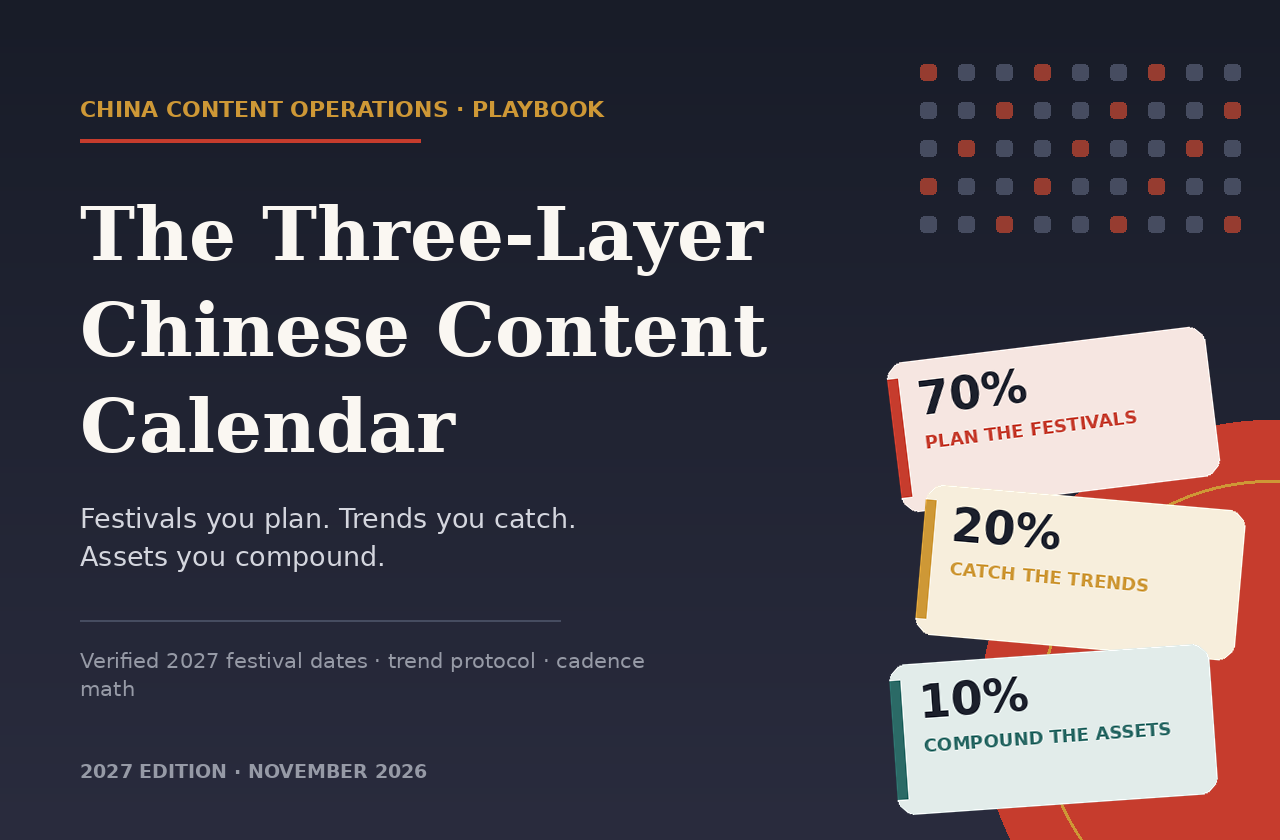
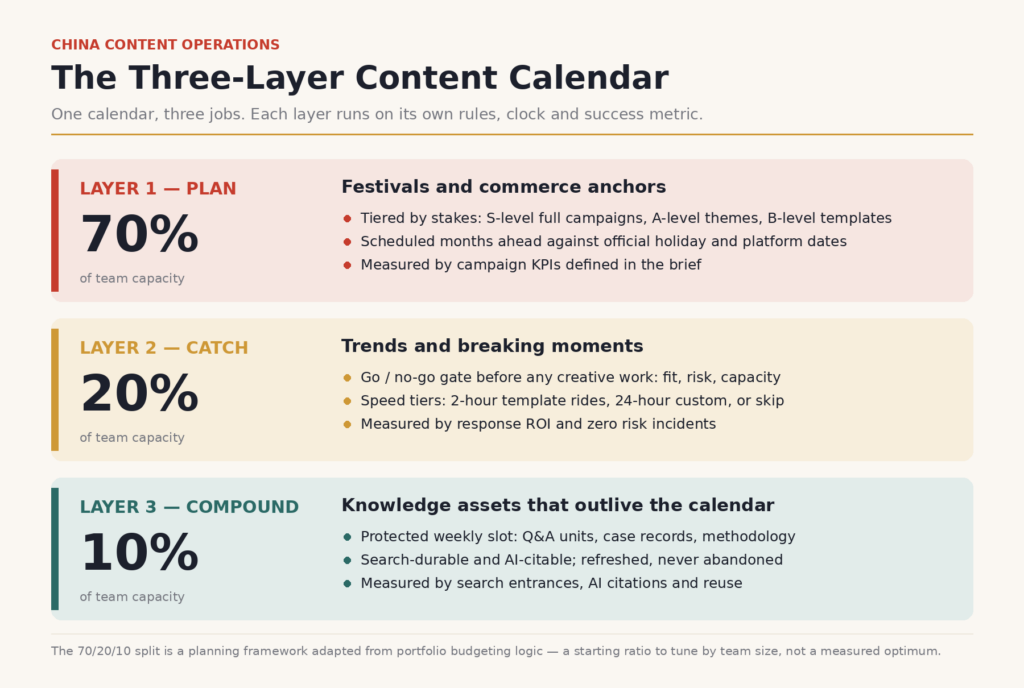
The fix is not more discipline. It is architecture. A Chinese content calendar that works is not one list of dates — it is three layers with different rules, different clocks, and different definitions of winning. Plan the festivals. Catch the trends. Compound the assets. Roughly seventy percent of capacity to the first, twenty to the second, ten to the third. This playbook walks through all three layers, the verified 2027 date map, the cadence math per platform, and the quarterly ritual that keeps the whole machine from decaying back into a poster wall.
Why One Calendar Cannot Do Three Jobs
Here is the structural problem: festivals, trends and knowledge assets obey incompatible physics. A festival is knowable months ahead — the State Council published the entire 2027 holiday schedule on November 5, 2026, almost fourteen months before the last holiday it covers. A trend is knowable for hours. An evergreen answer to a customer question is knowable forever, but pays out slowly.
Try to run all three through one undifferentiated schedule and the urgent eats the important, every time. The trend that broke this morning demotes the 618 brief due Friday, which demotes the methodology piece nobody is asking for — the one piece that would still be pulling search traffic in 2029. Splitting the calendar into layers is how you give each physics its own lane, so the loudest work stops cannibalizing the most valuable work.
The 70/20/10 Split: Borrowed Logic, Honest Label
The ratio has a pedigree. Coca-Cola’s Content 2020 strategy, presented by then-executive Jonathan Mildenhall, allocated seventy percent of investment to low-risk proven formats, twenty to innovation built on what already worked, and ten to high-risk experiments where failure was explicitly acceptable. That was a risk-portfolio argument, not a law of nature — and this playbook adapts it, rather than copies it, to content capacity: seventy percent planned, twenty percent reactive, ten percent compounding.
Be honest about what this number is: a starting allocation, not a research finding. No published study measures the optimal split for a China content team. A four-person team might run sixty-thirty-ten during festival season and eighty-ten-ten in the quiet months. What matters is not the exact ratio but that each layer has a floor you defend. The ten percent asset layer is the one teams starve first and regret last.
Layer One: The Festival Map, Tiered by Stakes
Not all dates deserve equal ceremony. Tier them.
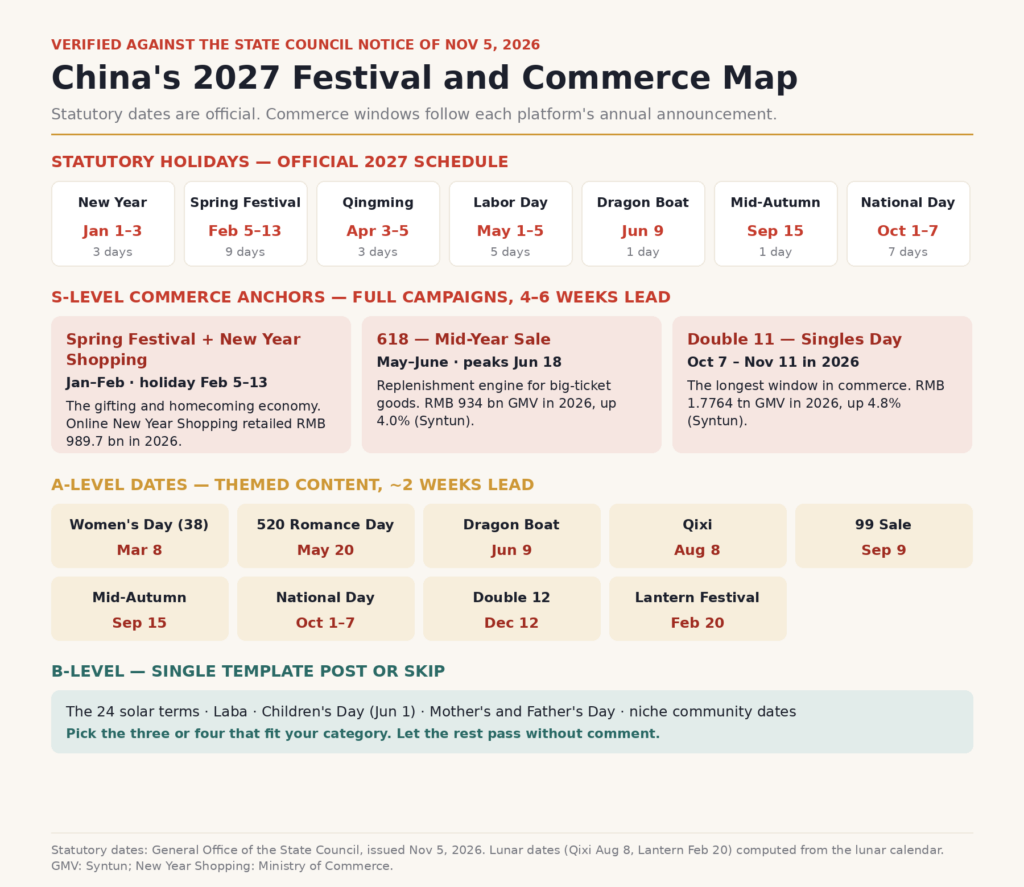
S-level dates get full campaigns with four to six weeks of lead time: Spring Festival and its New Year Shopping run-up, 618, and Double 11. These are the anchors where the money actually concentrates. Syntun’s final count put Double 11 2026 at RMB 1.7764 trillion in cross-platform sales, up 4.8% — and the Ministry of Commerce put the 2026 online New Year Shopping Festival at RMB 989.7 billion, roughly the size of 618’s RMB 934 billion. Three windows, most of the year’s promotional gravity.
A-level dates get themed content with about two weeks of lead: Women’s Day on March 8, the 520 romance date, Dragon Boat, Qixi, the 99 Sale, Mid-Autumn, National Day, Double 12. Real revenue, cheaper entry, category-specific. A beauty brand lives at 38 and 520; an electronics brand barely notices them.
B-level dates get one template post or a deliberate skip: the twenty-four solar terms, Laba, minor community observances. The rule that saves teams: S-level earns a written brief, B-level earns a template, and nothing in between pretends to be a campaign.
The Verified 2027 Date Map
The statutory layer is now official. Per the State Council notice issued November 5, 2026: New Year runs January 1–3; Spring Festival runs February 5–13, a nine-day break starting on lunar New Year’s Eve — which in 2027 falls on the twenty-ninth day of the last lunar month, because there is no thirtieth; Qingming runs April 3–5; Labor Day runs May 1–5; Dragon Boat is a single day, June 9; Mid-Autumn is a single day, September 15; National Day runs October 1–7. Make-up workdays land on January 31, February 14, May 8, September 26 and October 9 — dates your publishing schedule should quietly respect, because audiences commute on those Sundays.
Two lunar dates the statutory notice does not list, computed from the lunar calendar: Qixi falls on August 8, 2027, and the Lantern Festival on February 20. And note the collision the tier system exists to resolve: Dragon Boat 2027 lands on June 9, nine days before the 618 peak. A team without tiers will treat them as separate to-dos; a team with tiers folds Dragon Boat into the 618 campaign as a resonance beat inside a conversion window.
Commerce Nodes and Cultural Festivals Do Different Jobs
A platform sale and a cultural festival can share a week, but they do different work. 618 and Double 11 are conversion machines — deposits, price curves, livestream slots. Mid-Autumn and Spring Festival are resonance machines — gifting, homecoming, family. The teams that fail are the ones running conversion copy at a resonance moment (a discount code under a reunion story) or resonance copy at a conversion moment (a poem where the price should be). Map every date to its job before you assign it a format. And overlay the gifting calendar: Spring Festival, Qixi, 520 and Mid-Autumn are gift-economy peaks regardless of what the platforms are promoting.
Layer Two: The Trend Protocol
Twenty percent of capacity, governed by a gate — not by adrenaline. China’s attention substrate is enormous: CNNIC’s 57th report counts 1.125 billion internet users, of whom 1.074 billion watch short video. Weibo hot search, Douyin’s trending feed and Xiaohongshu topics can assemble a nation-sized audience in an afternoon. The temptation to ride everything is structural. The protocol is how you say no at scale.
The Go/No-Go Gate
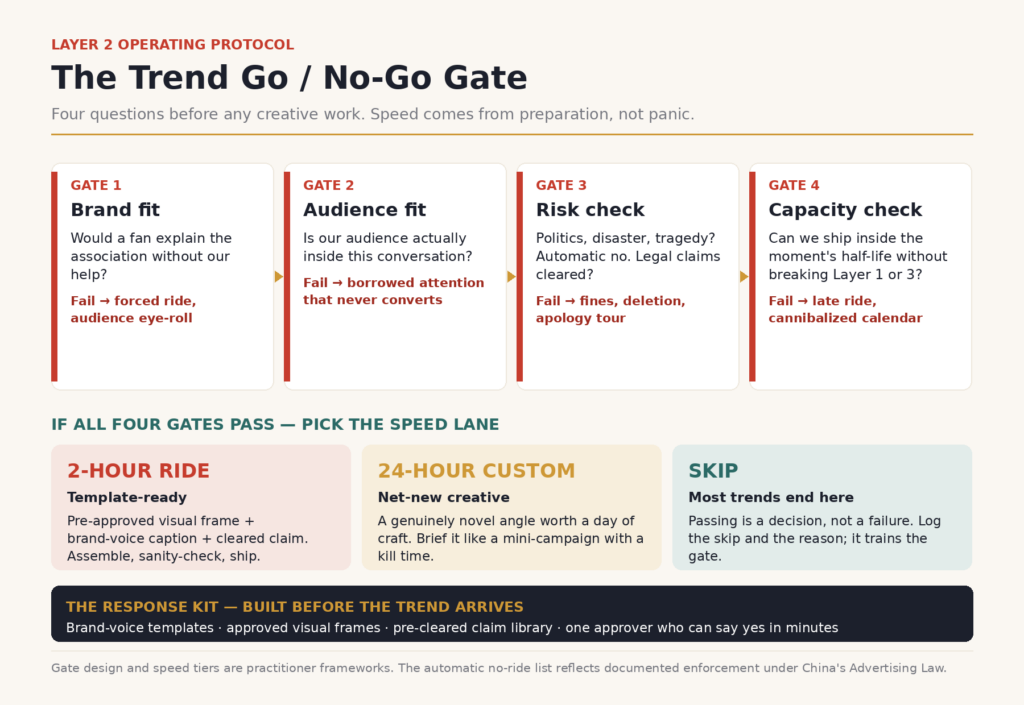
Four questions, in order, before any creative work begins. Brand fit: would a fan explain the association without your help? Audience fit: is your audience actually inside this conversation? Risk check: politics, disaster or tragedy means an automatic no — and the no-ride list is written in enforcement, not etiquette; a Dove store operator was fined RMB 800,000 in October 2026 for a Qixi video that packaged infidelity as romance. Capacity check: can you ship inside the moment’s half-life without raiding Layer One or Layer Three? Four passes earns a ride. Any fail earns a logged skip — and logging skips is how the gate gets smarter.
Speed Tiers and the Response Kit
Passed trends sort into three lanes. The two-hour lane is for template-ready formats: a pre-approved visual frame, a brand-voice caption, a pre-cleared claim — assembled, sanity-checked, shipped. The twenty-four-hour lane is for genuinely novel angles worth a day of craft, briefed like mini-campaigns with a kill time. Everything else is a skip. Notice what makes the fast lane fast: nothing is being invented under pressure. The response kit — templates, frames, claim library, one approver empowered to say yes in minutes — is built in peacetime. Speed is a preparation artifact, not a panic artifact. And fit remains distribution policy: Weibo’s anti-cheating system processes roughly 90,000 posts a day and excludes keyword-stuffing repeat offenders from hot-search landing pages entirely.
Layer Three: The Asset Layer That Compounds
Ten percent of capacity, one protected weekly slot, zero calendar dependency. This layer produces knowledge assets: question-and-answer units, case records, methodology pieces — content that answers what customers ask in March and will still ask in 2029.
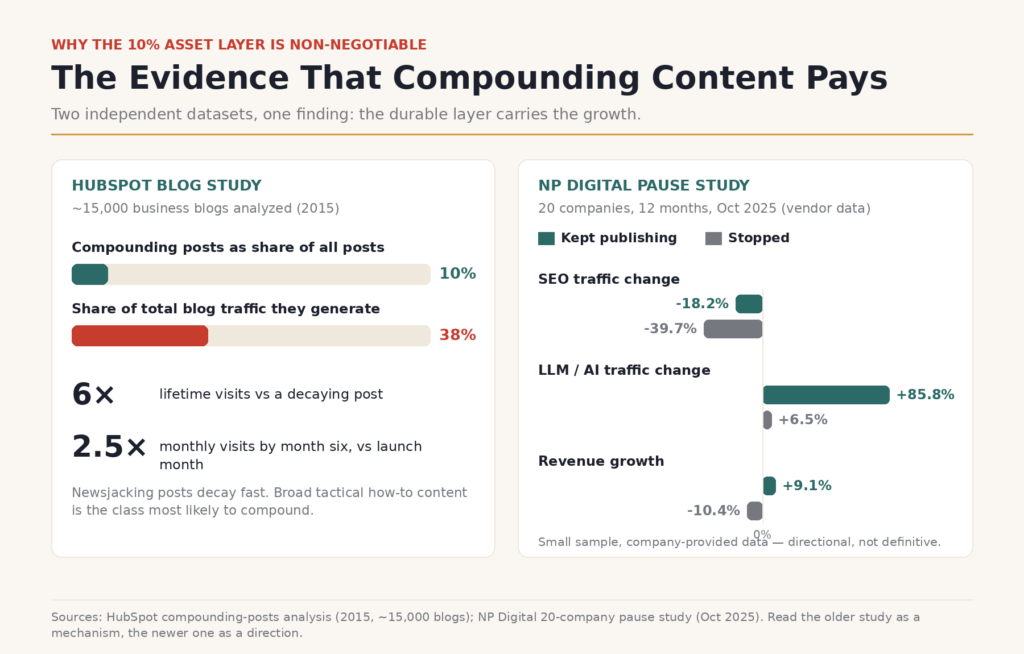
The evidence for protecting this layer is older than the AI era and stronger for it. HubSpot’s analysis of blogging data across roughly 15,000 businesses found that compounding posts — about ten percent of all posts — generated thirty-eight percent of total blog traffic, delivered around six times the lifetime visits of a decaying post, and were pulling two and a half times their launch-month traffic by month six. What compounded? Broad tactical how-to content. What decayed fastest? Newsjacking posts. Read that again with the trend layer in mind: the twenty-percent layer is, almost by definition, the decaying class. It earns attention; the ten-percent layer earns an annuity.
The AI era raised the stakes. NP Digital tracked twenty companies over twelve months — ten kept publishing, ten paused — and reported that the pausers’ SEO traffic fell 39.7% against 18.2% for the keepers, while LLM-referred traffic grew 85.8% for consistent publishers against just 6.5% for pausers; revenue grew 9.1% versus a 10.4% decline. Small sample, company-provided data, vendor study — treat it as directional. But the direction matches the mechanism: answer engines cite content that exists, stays fresh and answers cleanly. Your asset layer is not just SEO infrastructure anymore; it is the corpus AI assistants quote when your customer asks them a question you used to answer in a sales call.
Cadence Math: Per Platform, Not Per Wish
One frequency table, four different jobs. Xiaohongshu rewards steady note output — practitioner teams commonly run three to five notes a week, mixing seeding content with searchable answers. Douyin is a video treadmill where daily-or-near-daily publishing is the common operating range for commerce accounts. The WeChat official account is a depth channel: one to three substantial pieces a week beats daily filler, because opens are earned by reputation, not volume. Channels-native live schedules follow commerce nodes, not weekdays. These ranges are practitioner heuristics, not measured constants — the authoritative number is in your own analytics, and the calendar should schedule a test, not a guess.
The governing rule is minimum viable cadence: the highest frequency at which quality survives every step of your pipeline. Consistency beats volume, and one platform done well beats four done badly — a lesson written in the pause-study data, where the teams that kept a modest rhythm outperformed the teams that stopped. If capacity shrinks, cut platforms before you cut frequency, and cut promotion before you cut publication.
The Pipeline Behind the Calendar
A calendar without a production pipeline is a wish list. The flow is brief, draft, review, publish, measure — with a time budget per stage and a named owner per handoff. S-level dates get real briefs weeks ahead; B-level dates get templates that skip the brief entirely; the asset slot gets a standing brief format so it never waits for inspiration. AI compresses drafting and variant production, but keep two gates human: the claim check and the final voice pass — the same judgment-first principle the trend gate enforces. Watch the review stage hardest. Operators interviewed for this series report rework crossing twenty percent of drafts as the signal that briefs upstream are broken — a practitioner rule of thumb, but a useful tripwire: when reviewers rewrite instead of approve, fix the brief, not the reviewer. Tooling follows the same humility: start with a spreadsheet, and upgrade only when a named failure — missed handoffs, version collisions, multi-team access — actually occurs.
Measurement: Each Layer Answers to a Different Judge
Festival content answers to campaign KPIs defined in the brief: pre-sale volume, conversion, new-customer share — whatever the campaign was built to move. Trend content answers to response ROI and, more importantly, risk incidents: zero is the target, and one apology post retroactively prices every clever ride you shipped that quarter. Asset content answers to search entrances, AI citations and internal reuse — how often sales, service and the next campaign pull from the library. Run a monthly calendar review with one question per slot: did this earn its place? Recurring slots need kill criteria, or they become the poster wall by another name.
The Quarterly Rebuild
Once a quarter, the calendar itself goes on the operating table. Four moves. Re-map next quarter’s dates against primary sources — statutory dates against the State Council notice, platform windows against official announcements, because a lunar festival moves every year and your spreadsheet does not know that. Refresh the response kit: retire stale templates, re-clear claims, re-confirm the approver. Audit the asset layer: which pieces pull search and AI traffic, which need a refresh, which get consolidated. Then re-balance the split against what the quarter taught you. The rebuild is the difference between a calendar and a system: systems are maintained, calendars merely fill up.
Failure Modes and the Four-Person Team
Five failure modes recur: the poster wall (every date, no stakes); trend addiction (the gate exists on paper, nobody enforces it); asset starvation (the ten-percent slot silently donated to every emergency); platform-blind scheduling (identical content and cadence everywhere); and zombie slots (recurring content nobody can kill). The staffing answer is roles, not headcount. A four-person team can run this: one planner owns Layer One and the calendar; one reactor owns the gate and the response kit; one asset owner defends the weekly slot; one producer-editor floats across all three with the review gate. On a one-person team, collapse the roles but not the layers — the ratio might become seventy-twenty-ten of a single day’s hours, and the asset slot becomes one afternoon a week that no client emergency is allowed to book. Outsourcing follows one rule: outsource production, never judgment — the gate, the claim check and the skip decision stay in-house, because regulators fine the brand whose logo is on the post.
The Printable Three-Layer Template
Build one page per quarter with three horizontal bands. Band one, festivals: every S and A date with its tier, job (conversion or resonance), brief owner and lead-time countdown; B-level dates listed in a single template row. Band two, trends: the four gate questions printed verbatim, the speed-lane definitions, the response-kit inventory, and an empty skip log — yes, log the passes. Band three, assets: the weekly slot with its standing brief format, the refresh queue for existing pieces, and the three metrics that judge it. Underneath, the capacity split as actually scheduled — not as intended — because the gap between those two numbers is your real strategy.
The Takeaway
The Chinese content calendar is not a list of dates. It is a capacity-allocation system wearing a calendar costume. The festivals are knowable — the 2027 schedule is already official, and the commerce anchors are worth trillions of yuan across three windows. The trends are borrowable — but only through a gate, at a speed your preparation has already paid for. The assets are ownable — the only layer that gets more valuable while you sleep, and the layer AI answer engines are now actively rewarding. Plan seventy, catch twenty, compound ten, and defend the ten like it is seventy. Because in three years, it will be.