If your GPT-powered product got worse this week, the model may not be the problem. Your prompts are.
OpenAI’s developer documentation now ships official prompt templates for the GPT-6.2 family — Astra for the hardest tasks, Sol for cheaper complex work — and the migration guidance buried in those docs amounts to an admission: a large share of the prompt engineering written for GPT-5-era models actively hurts performance on the new ones. The Decoder surfaced the practical implications on November 21. Here is the checklist.
Delete “be concise”
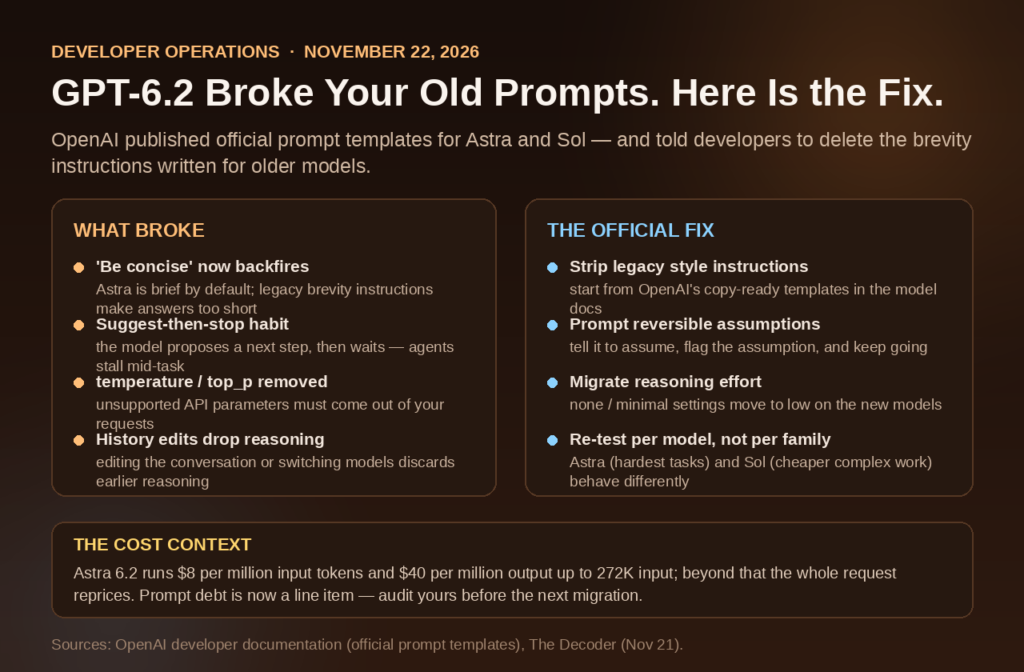
The single most counterintuitive instruction: remove your brevity prompts. GPT-6.2 Astra is concise by default. The “be concise,” “answer in one paragraph,” “no preamble” instructions teams accumulated over two years of fighting verbose GPT-5 outputs now stack on top of the model’s native brevity — and push answers into unusable terseness. OpenAI’s guidance is to start from the official templates rather than porting your old system prompt wholesale. Your prompt library is legacy code. Treat it that way.
Fix the suggest-then-stop habit
The second failure mode is agentic: the model proposes a next step, then waits for permission instead of taking it. Long-running agent workflows stall mid-task. The documented fix is to explicitly instruct the model to make reversible assumptions, flag them, and continue — reserving stop-and-ask behavior for genuinely irreversible decisions. If your agent framework was tuned around a model that asked too many questions, that tuning is now working against you.
Clean up the API surface
Two mechanical migrations come with the upgrade. The temperature and top_p parameters are no longer supported and must come out of your requests. And reasoning-effort settings need remapping: configurations built around none or minimal effort on older models should move to low on the new family. There is also a subtler trap in conversation management — editing conversation history or switching models mid-thread discards earlier reasoning, so multi-model routing strategies need to account for lost context, not just price.
Budget for the new economics
The pricing context makes this migration worth doing properly. Astra 6.2 runs $8 per million input tokens and $40 per million output up to 272K input tokens; beyond that threshold the whole request reprices. Cached input drops to $0.40 — a 60% cut that rewards well-structured, stable prompts. In other words, prompt quality is now directly a cost line: bloated legacy system prompts burn uncached tokens at full price, while template-aligned prompts with stable prefixes hit the cache discount.
The takeaway
Every model generation quietly deprecates a layer of the previous generation’s craft. The teams that treated prompts as configuration — versioned, tested, reviewed — will migrate in a day. The teams that treated prompts as folklore copied between Slack threads are about to discover how much undocumented behavior their product depended on. Audit yours before the next release, not after the support tickets.