China has spent two decades building the largest water transfer project in human history. This week, it gave the thing a brain.
The China South-to-North Water Diversion Group has rolled out Tianhe V2, an AI dispatch system that now runs day-to-day operations across the project’s eastern and central routes. The upgrade was detailed by Science and Technology Daily on November 21 and carried by CCTV and Beijing Daily the following morning — state-media coverage that signals this is being positioned as a national showcase, not a pilot.
What Tianhe V2 actually connects
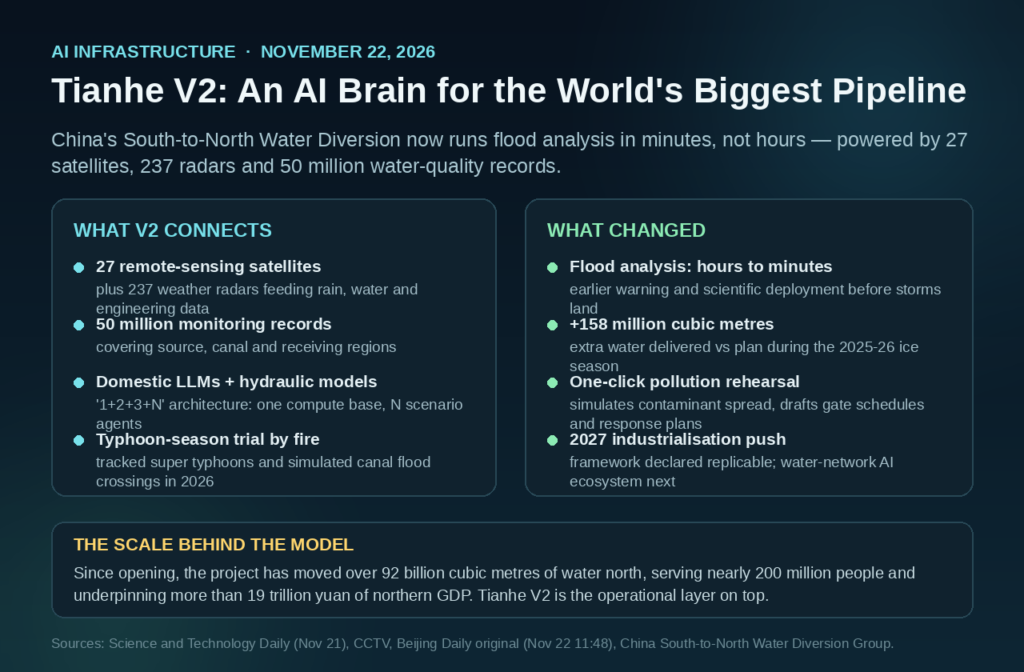
The system pulls live data from 27 remote-sensing satellites and 237 weather radars, layered on top of roughly 50 million water-quality and engineering monitoring records covering the source regions, the canals, and the receiving cities. Domestic large language models sit alongside purpose-built hydraulic simulation models in what the group calls a “1+2+3+N” architecture: one compute base, a small set of core model layers, and an open-ended number of scenario-specific agents on top.
In practice, that means the canal system can now rehearse emergencies instead of reacting to them. Flood-risk analysis that used to take engineers hours of manual modeling now completes in minutes. A one-click pollution drill simulates how a contaminant would spread through the canal network, then drafts gate-adjustment schedules and a response plan for human operators to approve.
It already passed two real tests
This is not a demo. During the 2026 typhoon season, Tianhe V2 tracked super typhoons approaching the canal corridor and simulated flood crossings in advance, giving operators earlier warning and time to pre-position responses. During the 2025–26 ice season — when frozen sections of the northern canals routinely threaten supply — the system’s scheduling delivered 158 million cubic metres of water beyond the original plan.
The scale underneath explains why Beijing cares. Since opening, the project has moved more than 92 billion cubic metres of water north, serving close to 200 million people and underpinning an estimated 19 trillion yuan of northern GDP. Beijing’s taps, Tianjin’s industry, and the North China Plain’s farms all depend on a single engineered artery staying open.
The bigger story: infrastructure AI as an export product
The group has declared the framework replicable and set a 2027 target for industrialising it — building out a “water-network AI” ecosystem rather than keeping the system in-house. Read that as a product roadmap. China has spent a decade exporting dams, canals and pipelines through Belt and Road projects; an AI operations layer is a natural upsell, and a stickier one. Concrete can be built by anyone. The dispatch intelligence running on top is where recurring revenue lives.
For observers outside China, the useful takeaway is the pattern rather than the politics: the most consequential AI deployments of this cycle may not be chatbots or coding agents, but boring, high-stakes control systems where a few percentage points of efficiency translate into billions of cubic metres of water.