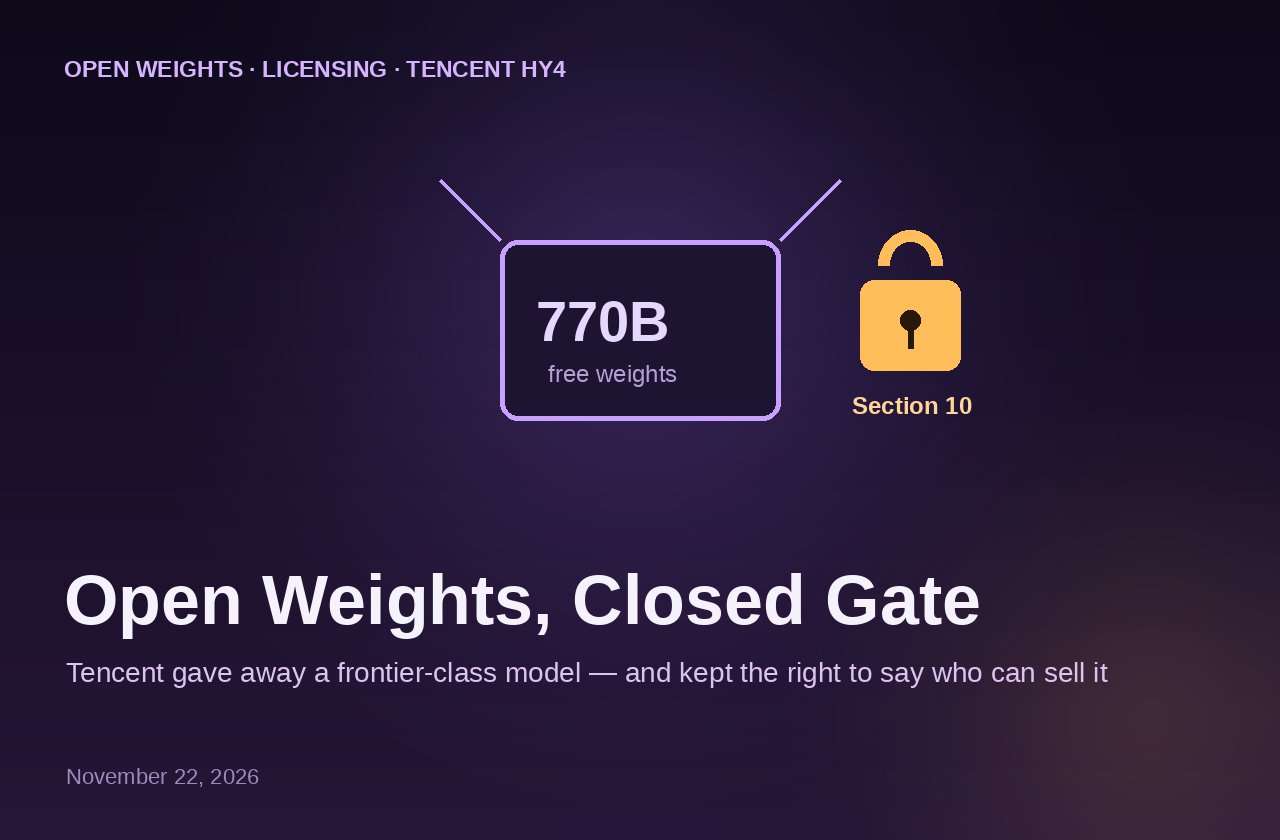
Tencent just gave away one of the largest language models ever released with open weights. The catch is nine paragraphs into the license.
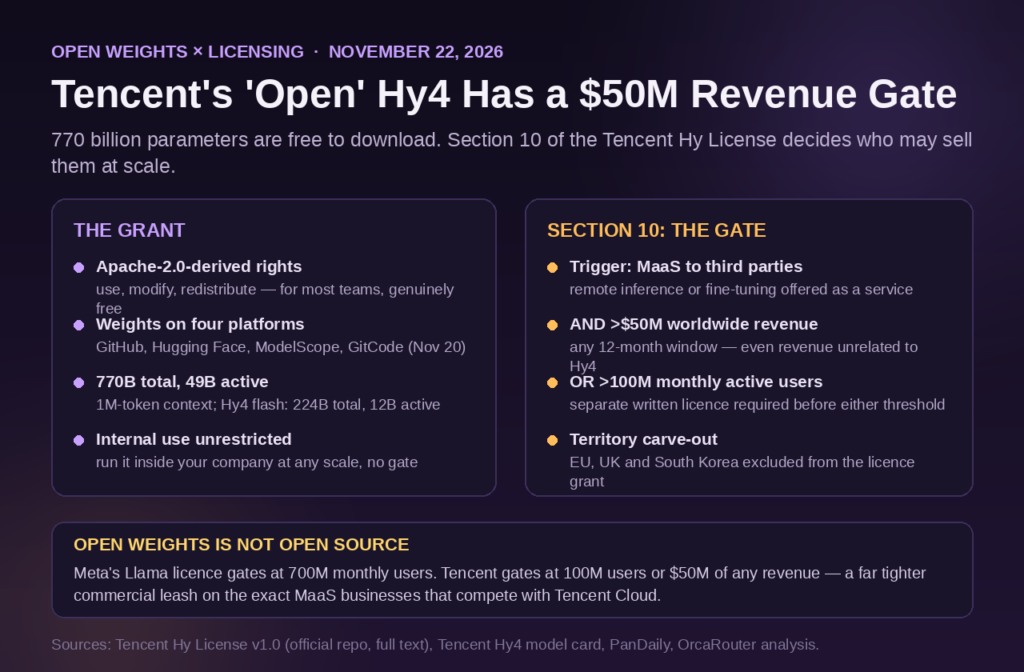
Hy4 landed on GitHub, Hugging Face, ModelScope and GitCode on November 20 — 770 billion total parameters with 49 billion active, a one-million-token context window, and a lighter “flash” variant at 224B total / 12B active. Coverage rightly focused on the capability claims. But for anyone planning to build a business on these weights, the more important document is the Tencent Hy License v1.0 sitting next to them.
What the license gives you
The grant is derived from Apache 2.0: use, modify, redistribute. For the overwhelming majority of teams — researchers, startups, enterprises running Hy4 internally — it is genuinely free. Internal deployment is unrestricted at any scale. You can fine-tune it, ship products built on it, and publish derivatives. On paper this looks like standard open-weight generosity.
What Section 10 takes back
Section 10 is a commercial gate with two triggers. If you offer the model to third parties as a service — remote inference or fine-tuning, the model-as-a-service business — and your worldwide revenue exceeds $50 million in any 12-month period, you need a separate written license from Tencent. Note the wording: the revenue test applies to your business overall, not just revenue derived from Hy4. A large company that runs a modest Hy4 endpoint alongside unrelated businesses trips the gate on its total revenue.
The second trigger is independent: more than 100 million monthly active users requires that separate license regardless of revenue. There is also a territory carve-out — the European Union, United Kingdom and South Korea are excluded from the license grant, a reminder that “open” releases are increasingly jurisdiction-aware.
Why the thresholds matter
Compare Meta’s Llama community license, which gates at 700 million monthly active users — a number only a handful of companies on earth will ever reach. Tencent’s gate sits at 100 million users or $50 million of any revenue. That is not a fence around hyperscalers; it is a fence around the entire successful MaaS middle class — exactly the inference providers and API resellers who compete with Tencent Cloud’s own model business.
Read strategically, the design is coherent: give the weights away to win mindshare, benchmarks and ecosystem gravity, while reserving the right to tax or block anyone who turns those weights into a competing cloud service at scale. The model is free as in speech for developers and free as in beer for enterprises — but not for competitors.
None of this makes Hy4 a bad deal. For most readers of this newsletter, the gate will never bind, and a frontier-class 770B model with a million-token context is a remarkable gift. But “open weights” and “open source” are not synonyms, and the distance between them is where business models go to die. Before you architect a product on any open release, read the license to the end — especially the section nobody quotes in the launch tweet.