Your team probably has a strategy deck. It has a dashboard, maybe several. It has an experiment backlog, a budget spreadsheet, and a Slack channel where screenshots of charts get posted with the caption “thoughts?” What it almost certainly doesn’t have is a rhythm — a fixed schedule that decides which numbers get read when, by whom, and what that person is allowed to change as a result.
So reviews happen when someone panics. Experiments finish and nobody reads the result. The budget you set in January quietly drifts until December, when it gets copied forward with a 3% bump. None of that is a strategy failure. It’s a cadence failure.
This playbook installs the missing layer: a daily pulse, a weekly review, a monthly business review, and a quarterly re-arbitration — with agendas, artifacts, decision rights, and a 90-day rollout you can start on Monday.
Why Cadence Is the Missing Layer
Here’s the principle the whole system rests on: every artifact needs a recurring consumer. A dashboard without a scheduled reader is decoration. An experiment without a readout meeting is a coin flip you paid for. A budget without a re-grading date is a suggestion.
Most marketing teams don’t suffer from a shortage of tools or data. They suffer from unconnected pipes. The pace report exists, but no ritual consumes it. The test result lands, but no meeting reads it. The cadence is the plumbing between everything else you’ve built — and it’s the cheapest layer to install, because it’s mostly calendar entries and one-page templates.
The Measurable Cost of a Rhythm-Free Week
Let’s put numbers on the chaos, because “we’re busy” doesn’t survive contact with data.
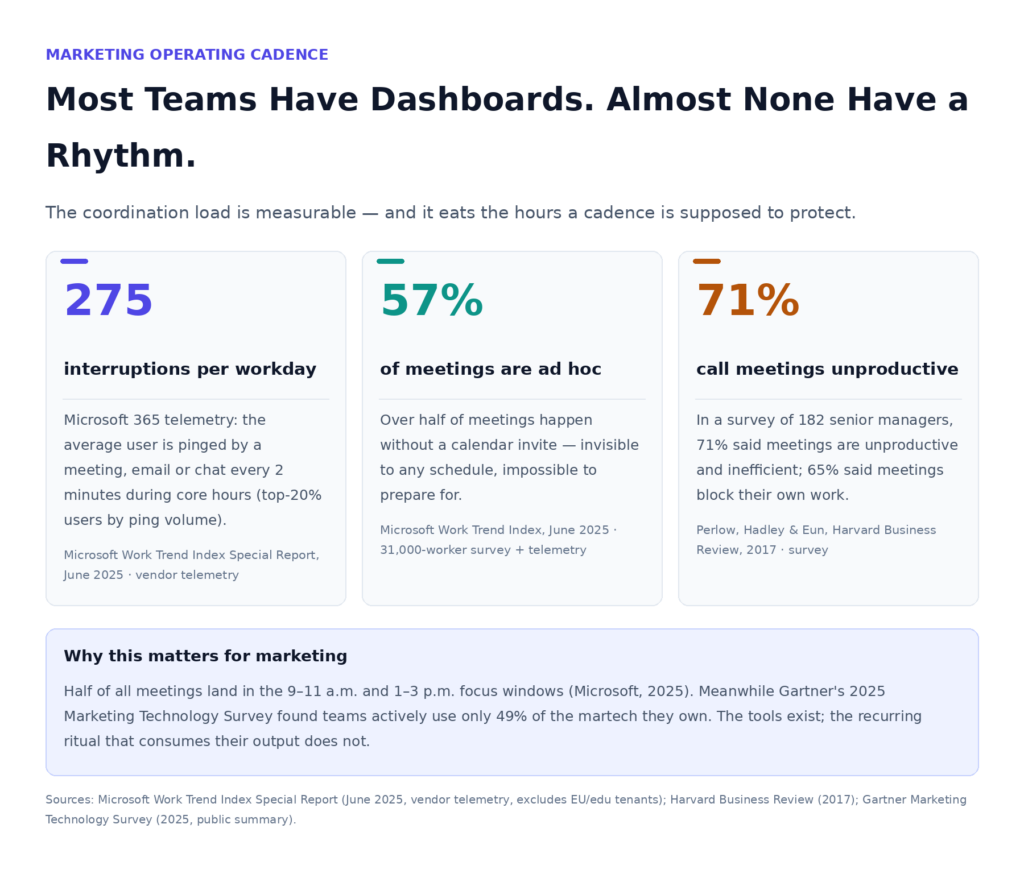
Executives now spend nearly 23 hours a week in meetings, up from less than 10 hours in the 1960s, according to research summarized by Leslie Perlow, Constance Hadley and Eunice Eun in Harvard Business Review. In their survey of 182 senior managers, 71% said meetings are unproductive and inefficient, 65% said meetings keep them from completing their own work, and 64% said meetings come at the expense of deep thinking.
The interruption load is worse than the meeting load. Microsoft’s 2025 Work Trend Index special report — telemetry from Microsoft 365, so treat it as vendor data, though the scale is hard to dismiss — found the average user gets pinged by a meeting, email or chat every two minutes during core hours, roughly 275 interruptions a day. Some 57% of meetings are ad hoc calls with no calendar invite at all, and half of all meetings land squarely in the 9–11 a.m. and 1–3 p.m. windows when most people focus best. Nearly half of employees (48%) and more than half of leaders (52%) describe their work as chaotic and fragmented in the accompanying 31,000-person survey.
Marketing feels this acutely because it bought the tools to escape it — and then didn’t build the ritual that uses them. Gartner’s 2025 Marketing Technology Survey found that teams actively use only 49% of the martech they own, and just 15% of organizations qualify as high performers that hit strategic goals with positive ROI. The dashboard isn’t the problem. The missing consumer is.
The Four-Beat Stack at a Glance
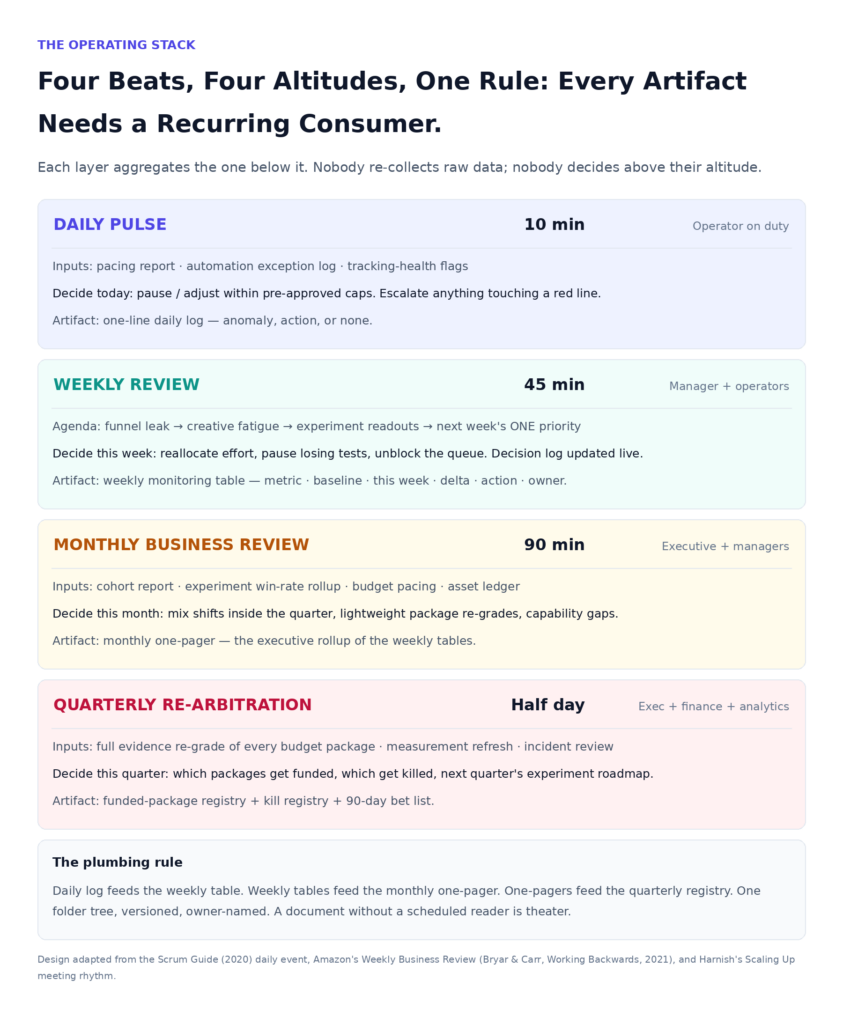
The system has four beats, each at a different altitude. The daily pulse protects execution. The weekly review steers tactics. The monthly business review checks the business. The quarterly re-arbitration re-decides the money. Two rules keep them honest: each layer aggregates the one below it — nobody re-collects raw data — and nobody makes decisions above their altitude.
Daily Pulse: Ten Minutes, One Operator
The daily pulse is short, defensive, and owned by whoever is on operator duty. Three inputs: the spend-pacing report, the automation exception log, and a tracking-health flag. That’s it. If nothing tripped, there’s nothing to review — write “none” in the log and go back to work.
What can be decided today? Pauses and adjustments inside pre-approved caps: kill the ad set that blew its CPA ceiling, nudge the bid, restart the broken automation. Anything touching a red line — brand safety, legal claims, a pricing change, a key relationship — gets escalated, not decided. The artifact is one line: anomaly, action, or none.
This design borrows directly from the 2020 Scrum Guide, whose 15-minute daily event exists at the same time and place every working day and, in the guide’s own words, should “eliminate the need for other meetings.” A daily pulse that spawns three follow-up meetings has failed its one job.
Weekly Review: Forty-Five Minutes, One Priority Out
The weekly review is where marketing actually gets managed. Manager plus operators, 45 minutes, fixed agenda: funnel leak, creative fatigue, experiment readouts, then next week’s single priority. One priority out — not five. The decision log gets updated live, in the room.
The working document is a monitoring table: metric, baseline, this week, delta, action, owner. If a metric sits inside its normal range, nobody talks about it. This is Amazon’s Weekly Business Review trick, described by former Amazon executives Colin Bryar and Bill Carr in Working Backwards: the same metrics, in the same order, in the same chart format every week, so the eye catches only what moved. Amazon reviews hundreds of metrics in about an hour this way, using a “6-12” chart that pairs six trailing weeks with twelve trailing months. You don’t need hundreds of metrics. You need the discipline.
Bryar and Carr’s second lesson matters even more: watch controllable inputs, not just outputs. Amazon’s selection metric started as “new detail pages created” — teams responded by adding items nobody wanted. The weekly review caught it, and the metric evolved into the share of detail-page views where the product was in stock with two-day shipping. A wrong input caught weekly costs you weeks. Caught annually, it costs you the year.
And read those experiments. Ron Kohavi and Stefan Thomke reported in Harvard Business Review that only about a third of ideas tested at Microsoft improved the metric they targeted; on well-optimized Bing, the hit rate runs 10–20%. A $100-million-a-year headline change sat deprioritized for six months before someone tested it. If most of your ideas fail, the readout meeting is where the surviving winners get found.
Monthly Business Review: Ninety Minutes at Executive Altitude
Once a month, the executive joins the managers for 90 minutes. Inputs: the cohort report, the experiment win-rate rollup, budget pacing, and the asset ledger. Decisions allowed: mix shifts inside the quarter, lightweight re-grades of budget packages, and naming capability gaps that need hiring or tooling.
The artifact is a one-pager — an executive rollup assembled from the weekly tables, not a fresh research project. If your monthly review requires someone to spend two days rebuilding numbers that already exist in the weekly logs, your artifact chain is broken. Fix the chain, not the meeting.
Quarterly Re-Arbitration: The Half-Day That Pays for the Year
Once a quarter, executive plus finance plus analytics block half a day. This is not a QBR where someone reads slides about last quarter. It’s a re-arbitration: every budget package re-defends its evidence from a near-zero base. What did we bet, what did the bet return, and would we fund it again today?
Three outputs: next quarter’s funded packages, a kill registry with execution dates, and the experiment roadmap. The kill registry is the sleeper hit. Zombies — the retainer nobody remembers signing, the channel that survived three reorgs — die only when a scheduled ritual forces the question. Skip one quarterly re-grade and they resurrect.
The Money Case for Re-Deciding Budgets
If the quarterly beat feels expensive, look at what the research says about the alternative. McKinsey’s analysis of large US companies over 1990–2010 found that active reallocators — companies that genuinely shift capital toward winners — delivered roughly 10% annual returns to shareholders versus about 6% for sluggish reallocators. Over twenty years, that gap compounds to roughly double the company value. Yet in McKinsey’s executive survey, 83% named reallocation the top management lever for growth while a third of companies shifted barely 1% of capital year over year. Everyone agrees; almost nobody schedules it.
The current environment makes the quarterly beat non-optional. Gartner’s 2026 CMO Spend Survey of 401 marketing leaders found budgets essentially flat at 7.8% of company revenue, with 56% of CMOs saying they lack the budget to execute their strategy. Inside that flat pie, paid media keeps swelling — 31.4% of spend, a five-year high. When the pie doesn’t grow, the only lever left is moving slices. That’s what the half-day is for.
The decision-side evidence points the same way. In McKinsey’s global survey of 1,259 executives, only 20% of organizations consistently made fast, high-quality decisions — and respondents who said decisions were made at the right level, usually by delegating down, were 6.8 times more likely to be at winning companies. Bain’s research, published in Harvard Business Review, found decision effectiveness correlated with financial results at 95% confidence or higher across every country, industry and company size studied, with top-quintile decision makers generating shareholder returns nearly six percentage points higher. (Bain sells decision consulting, so note the affiliation — but the direction matches McKinsey’s independent survey.)
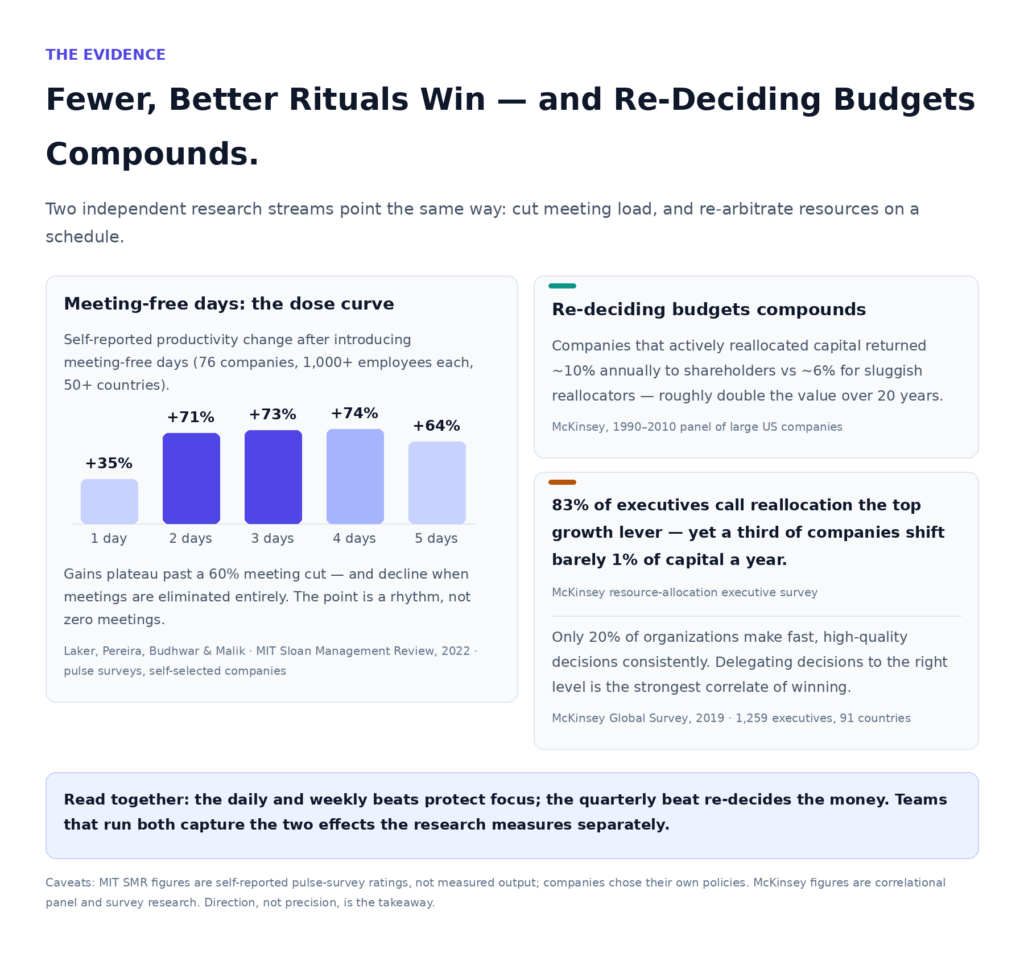
One more finding worth framing on the wall: professors Benjamin Laker, Vijay Pereira, Pawan Budhwar and Ashish Malik surveyed 76 companies for MIT Sloan Management Review and found that two meeting-free days a week coincided with 71% higher self-reported productivity and 52% higher satisfaction. But the gains plateau past a 60% meeting cut and reverse when meetings vanish entirely. The lesson isn’t “fewer meetings, always.” It’s that meetings are a dose — and the cadence is the prescription.
Decision Rights: Who Decides What, at Which Beat
A cadence without decision rights is theater with better attendance. Borrow Bain’s RAPID framework — recommend, agree, perform, input, decide — and pin one accountable “D” to every decision type. Then map each decision to its beat:
| Decision type | Who decides | Cadence | Escalation path |
|---|---|---|---|
| Pause / adjust within caps | Operator on duty | Daily | Manager, same day |
| Red-line breach (legal, brand, pricing) | Executive | Escalated immediately | Executive + finance |
| Effort reallocation, test pauses | Manager | Weekly | Monthly review |
| Mix shift inside the quarter | Executive + managers | Monthly | Quarterly re-arbitration |
| Package funding / kills | Executive, finance agrees | Quarterly | CEO / board |
Two warnings from the RAPID literature: too many people with veto power (“A” roles) paralyzes everything, and consensus is not a decision standard. One person decides; the rest commit.
The Artifact Chain: Documents That Feed Each Other
The daily log feeds the weekly table. Weekly tables feed the monthly one-pager. One-pagers feed the quarterly package registry. Each layer aggregates; no layer re-collects. Store everything in one folder tree, versioned, with an owner’s name on every document — not “marketing final v3 FINAL.xlsx” floating in someone’s downloads.
The test of a healthy chain: the monthly one-pager should assemble in under two hours from existing artifacts. If it takes two days, you’re paying a duplication tax every month, and the quarterly half-day will collapse under its own prep weight.
The 90-Day Rollout
Don’t install all four beats at once. Sequence matters: operators before executives, artifacts before attendance.
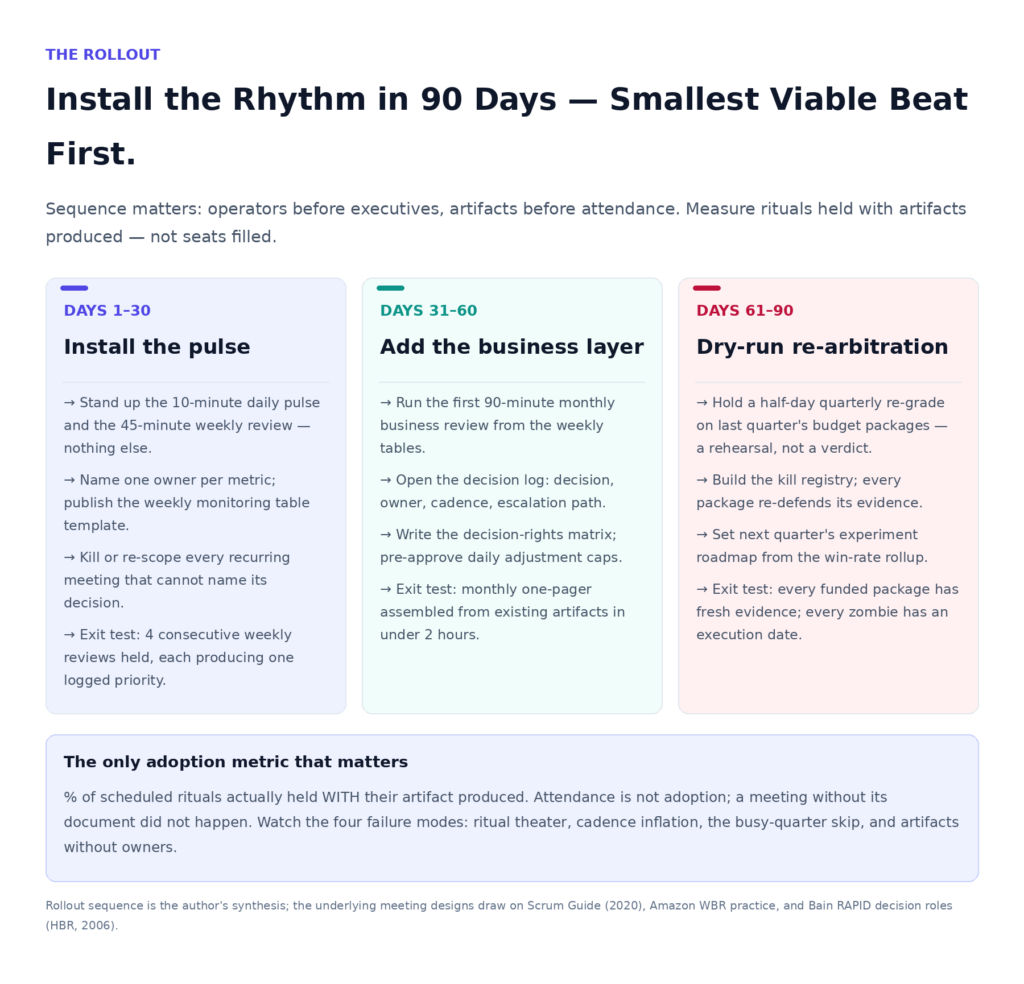
Days 1–30: Install the Smallest Viable Rhythm
Stand up the 10-minute daily pulse and the 45-minute weekly review. Nothing else. Name one owner per metric, publish the monitoring-table template, and kill or re-scope every recurring meeting that can’t name the decision it serves. Exit test: four consecutive weekly reviews held, each producing one logged priority.
Days 31–60: Add the Business Layer
Run the first 90-minute monthly review from the weekly tables. Open the decision log — decision, owner, cadence, escalation path — and write the decision-rights matrix. Pre-approve the daily adjustment caps so operators stop asking permission to do their jobs. Exit test: the monthly one-pager assembles from existing artifacts in under two hours.
Days 61–90: Dry-Run the Re-Arbitration
Hold the half-day quarterly re-grade on last quarter’s packages as a rehearsal, not a verdict. Build the kill registry. Set next quarter’s experiment roadmap from the win-rate rollup. Exit test: every funded package has fresh evidence, and every zombie has an execution date.
The Only Adoption Metric That Matters
Track the percentage of scheduled rituals actually held with their artifact produced. Not attendance. A meeting without its document didn’t happen — it evaporated into everyone’s memory, which is where decisions go to die. In the first quarter, aim for 80% or better; below that, you’re installing habits, not a system.
Four Failure Modes to Watch
Ritual theater. Meetings held, no decisions logged. The fix is the artifact-required rule: no document, no credit.
Cadence inflation. Someone proposes a daily version of everything. Remember the dose curve — beyond a point, more coordination destroys the focus it was meant to protect. Every new ritual must name the decision it serves and the old ritual it replaces or feeds.
The busy-quarter skip. “We’re slammed, let’s push the re-arbitration.” That’s precisely the quarter the zombies need killing. The quarterly beat is the one appointment that survives launches, audits and offsites — put it on the calendar a year out.
Artifacts without owners. A document nobody owns rots within two cycles. One name per artifact, written on the artifact.
The Bottom Line
Strategy doesn’t fail in the deck. It fails in the gap between the deck and the calendar. You don’t need a transformation program to close that gap — you need ten minutes a day, forty-five a week, ninety a month, half a day a quarter, and the discipline to make every ritual produce a document that the next ritual consumes. Install the rhythm in 90 days. Then let it compound, the way the reallocators’ returns do.