Here is an uncomfortable thought: most campaign waste is decided before a single asset goes live. Not in the media buy. Not in the algorithm. In a document — the brief — that everyone treats as paperwork and nobody treats as strategy.
You have seen the pattern. A campaign launches, underperforms, and the post-mortem blames the creative, the channel, the budget. But rewind far enough and you find a brief that said “increase awareness,” targeted “millennials,” and defined success as “strong engagement.” Three phrases, zero decisions. Everything after that was improvisation wearing a lanyard.
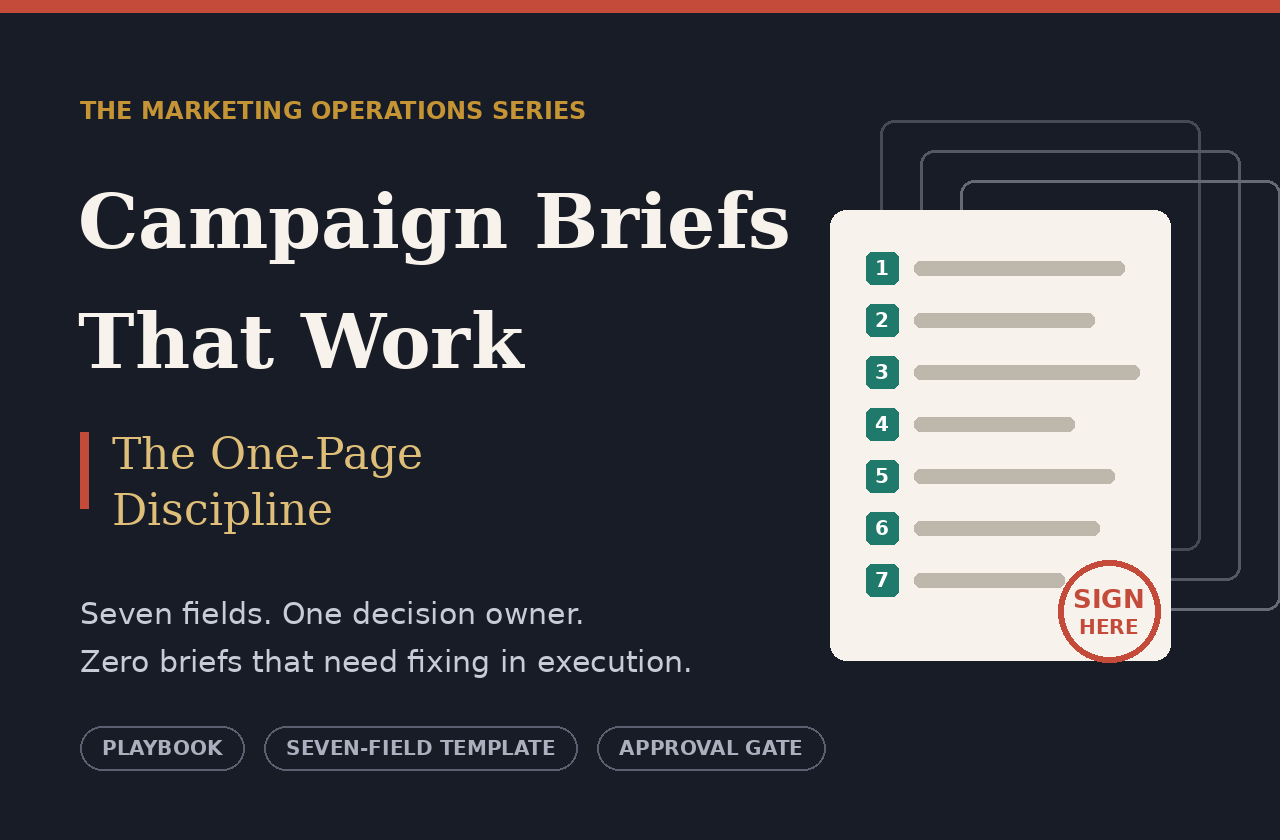
This playbook makes one argument: the brief is the strategy, compressed into a page that a stranger could audit. We will walk through the evidence that briefs are broken, a seven-field template that fixes them, the question-mapping method that fills the hardest field, and the approval gate that stops bad briefs from becoming bad campaigns. Let’s get into it.
Two planets, one document
How bad is it? The BetterBriefs Project — the first global study of marketing briefs, run with research firm Flood + Partners and presented at the IPA’s EffWorks Global in 2021 — surveyed more than 1,700 marketers and agency staff across over 70 countries. The headline finding reads like a marriage counseling transcript.
Some 78% of marketers believed their briefs gave clear strategic direction. Only 5% of agencies agreed. On clear, concise language: 83% of marketers said yes, 7% of agencies concurred. And while 80% of marketers rated themselves good at writing briefs, just 10% of agencies agreed with that self-assessment.
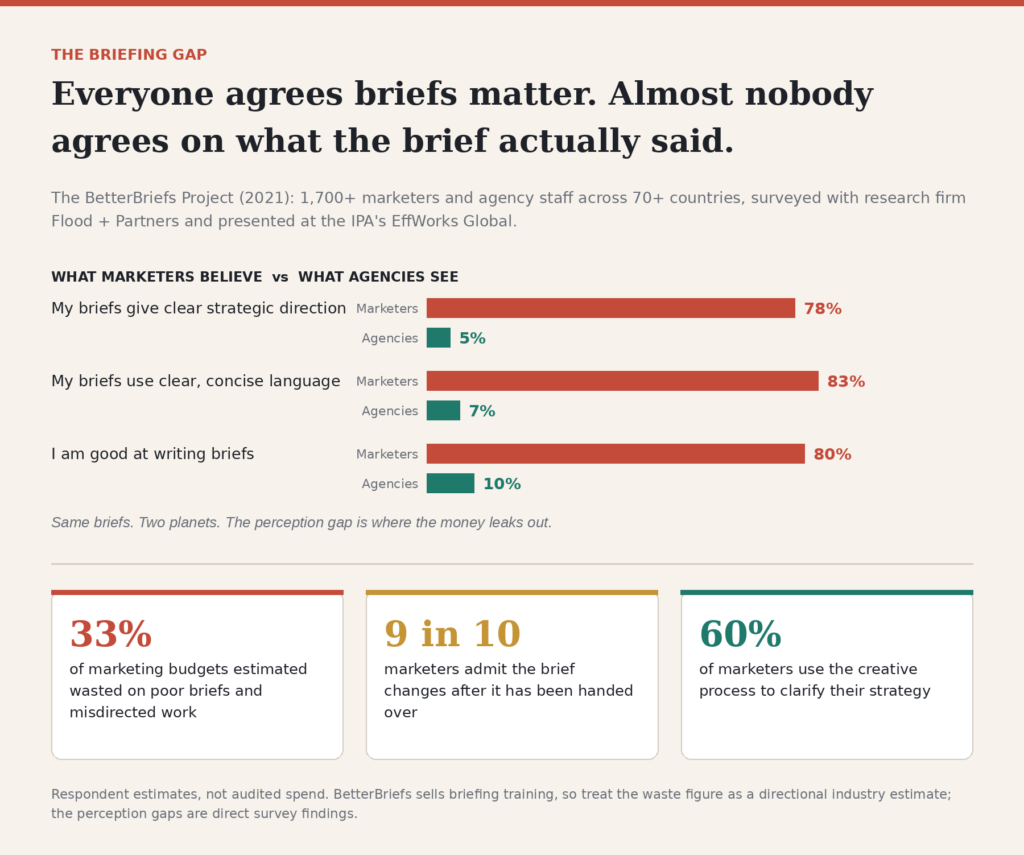
The money follows the misalignment. Respondents estimated that around 33% of marketing budgets goes to waste through poor briefs and misdirected work. Nine in ten marketers admitted the brief changes after it has been handed over, and 60% confessed to using the creative process itself to figure out what the strategy was. Read that again: the agency is hired to execute a strategy that the client is still inventing, live, on the agency’s clock.
A caveat worth keeping: these are perception surveys, and BetterBriefs sells briefing training, so it has a commercial interest in the diagnosis. But the study was executed by an independent research firm, co-published with the IPA, and the UK follow-up in 2022 (508 respondents) found the same pattern — including among the people you would expect to know better. Among marketers who write briefs, 72% had more than a decade of experience and 64% held senior or director titles. Seniority does not fix this. Structure does.
The rework spiral
The downstream cost has a number. The BetterIdeas Project — BetterBriefs’ 2025 follow-up with Flood + Partners, produced in partnership with the IPA and the World Federation of Advertisers, covering 1,034 respondents in 54 countries — found it now takes an average of five rounds of creative development to get an idea signed off. IPA research in the UK recorded three rounds back in 2007. Two extra rounds, despite two decades of better tools, more data and faster software. (The 2007 baseline comes from a separate study, so treat the trend as indicative rather than a controlled comparison.)
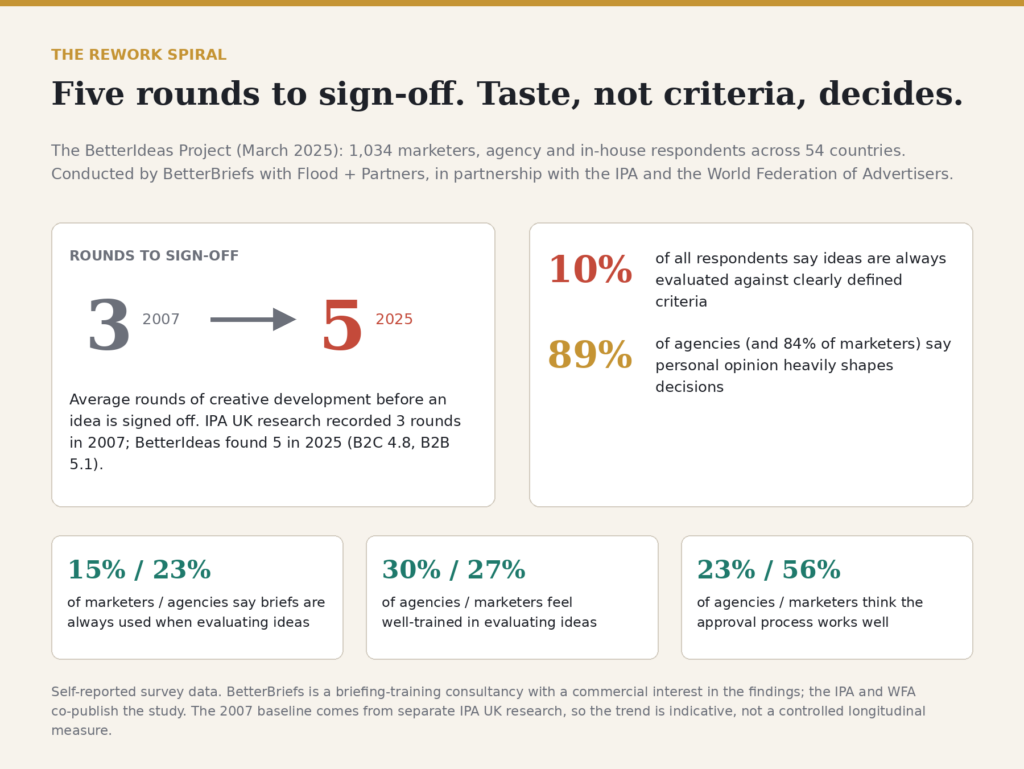
Why so many rounds? Because nothing anchors the feedback. Only 10% of all respondents said ideas are always evaluated against clearly defined criteria. Briefs are always used when evaluating ideas at just 15% of marketers’ organizations and 23% of agencies’. Meanwhile, 89% of agencies and 84% of marketers admitted that personal opinion heavily shapes decisions. When the brief is absent from the review room, taste becomes the tiebreaker — and taste is infinite. Every new stakeholder is a new round.
That is the spiral: vague brief, subjective review, revision by opinion, re-brief, repeat. The fix is not “better feedback.” The fix is writing a brief that makes subjective feedback impossible to justify.
Why briefs fail: a quick pathology
Bad briefs fail in predictable ways. Run your last one against this list:
- Objective that isn’t a business goal. “Increase awareness” is a mood. “200 qualified demos at or below a target cost per acquisition” is a decision.
- Audience that isn’t a person. A persona PDF describes a demographic. A brief needs a human in a moment, holding an unresolved question.
- Success defined as a metrics buffet. Twelve KPIs means no KPI. You need one primary number and a couple of guardrails.
- No kill criterion. If nothing can end the campaign early, everything runs until the budget dies of natural causes.
- No decision owner. “The marketing team” cannot approve anything. Teams diffuse; humans decide.
Notice what these failures have in common: each one postpones a decision from the cheap phase (writing) to the expensive phase (production and review). A brief is a device for making decisions while they are still cheap.
The seven-field brief
Here is the template. One page, seven fields, and every field must be checkable by someone who was not in the room. This structure follows the logic of the IPA’s best-practice guide “The best way for a client to brief an agency,” co-authored by Mark Ritson with BetterBriefs in 2022: strategy first, one brief for one problem, and objectives that link commercial outcomes to behavior change.
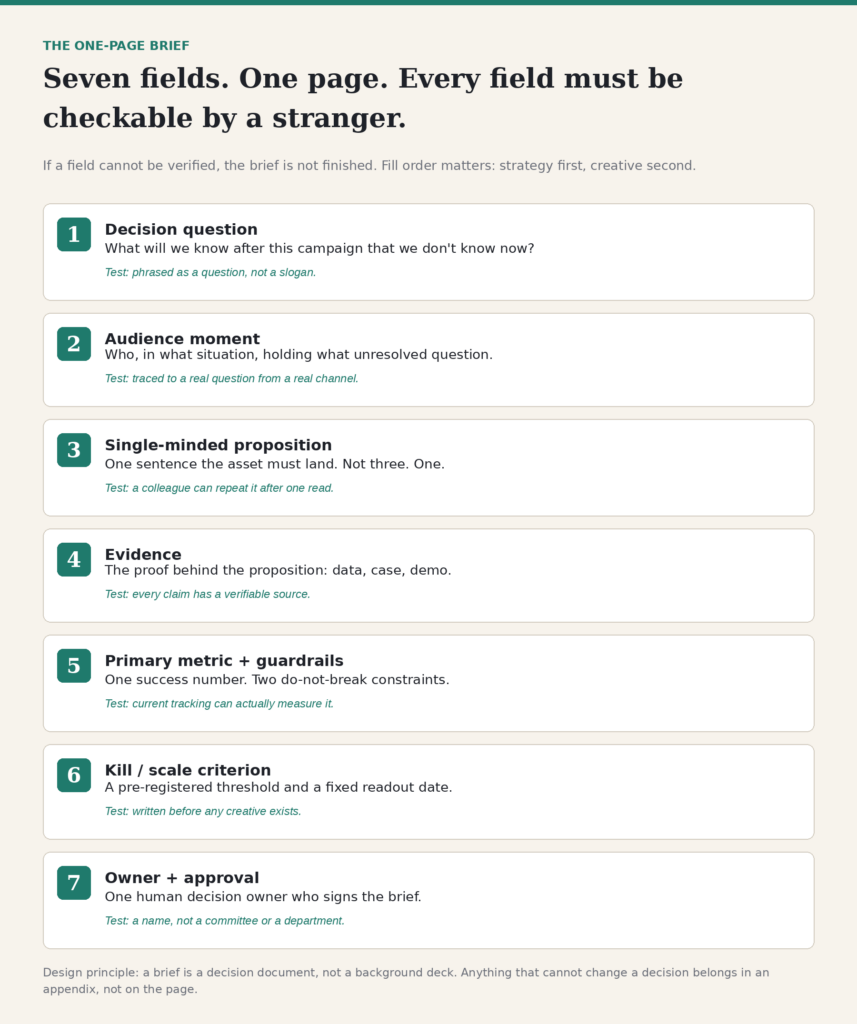
Fields 1–2: start with a question, not a slogan
Field one is the decision question: what will we know after this campaign that we don’t know now? “Can we acquire ops leaders at a sustainable cost through search?” is a decision question. “Build brand love” is a poster. If the campaign cannot change what you know, it is decoration.
Field two is the audience moment: who, in what situation, holding what unresolved question. Not “B2B decision-makers, 35–54.” More like: an operations manager who has already sat through three vendor demos and is quietly asking whether switching tools will make her look reckless. We will fill this field properly in a moment, because it is the one most briefs fake.
Fields 3–4: one sentence, backed by proof
Field three is the single-minded proposition — one sentence the asset must land. The test: can a colleague repeat it after one read? If your proposition needs a semicolon and a “while also,” you have three briefs wearing a trench coat.
Field four is the evidence: the data, case or demo the proposition rests on. BetterBriefs puts it well — a message is only as strong as the truth sitting behind it. Every claim in the brief needs a verifiable source, because every claim in the asset will inherit it. This field also becomes your claim library when AI enters production, which matters more than it used to.
Fields 5–6: decide the score before the game
Field five: one primary metric plus two guardrails. The metric comes from your reporting stack, not from whoever shouts loudest in the kickoff. And a nuance from the research worth honoring: when Les Binet and Peter Field analyzed the IPA’s databank of effectiveness cases — 880 campaigns for their 2007 “Marketing in the Era of Accountability” — they found campaigns with hard business objectives outperformed those chasing intermediate metrics, and that fewer than 20% of marketers even evaluated profit effects. Their warning was against treating a single intermediate metric as proof of success. So: one number decides, guardrails protect, and a small suite of secondary measures informs. Primary metric for the decision; the suite for the story.
Field six: the kill/scale criterion, pre-registered. Write the threshold and the readout date before any creative exists — “if cost per qualified demo exceeds target at day 21, kill; if below, scale.” This borrows directly from experiment pre-registration in research science, where committing to the analysis plan before seeing data is the standard defense against rationalizing whatever happened. Teams that choose the metric after seeing the creative are not measuring. They are decorating a verdict they already reached.
Field 7: one name on the line
The owner and approver is one human. Not a committee, not a department, not “stakeholders.” One person who signs the brief, owns the decision question, and answers for the readout. Committees can advise. Only a name can decide.
Filling field 2: the question-map method
The audience moment is where briefs go to die, so give it a method. Build a question map from four real channels: sales-call logs, customer-service tickets, search queries, and the prompts people type into AI assistants. Add community threads if your category has them. These are verbatim records of what your market actually asks — not what a workshop imagines it asks.
Grade every question on three axes: frequency (how often does it appear?), intent (does answering it move someone toward a decision?), and answerability (can your product truthfully answer it?). Multiply, rank, and pick the top question your campaign will answer. That question, in the customer’s own words, becomes field two.
And here is the rule that will save you the most money: no real question found, no campaign. If the map is empty, the campaign is a solution looking for a problem, and it goes back to strategy — not forward to creative. Remember, 60% of marketers in the BetterBriefs study were already using the creative process to clarify strategy. The question map is how you stop being one of them.
The approval gate
A great brief can still be killed by a bad process, so the template needs a gate. The approver checks four things: are all seven fields present and specific? Is the evidence verifiable? Can current tracking actually measure the primary metric? Is the kill criterion unambiguous? Incomplete briefs are returned, not “fixed in execution.” Review within 24 hours, so the gate never becomes the bottleneck it exists to prevent.
This is not a new idea. It is a recovered one. In 1963, Avis and its agency DDB signed a six-point contract, famously including the rule that Avis would “approve or disapprove, not try to improve” the ads — any change had to be grounded in a material operating defect. Conviction should prevail; compromise should be avoided. The campaign that contract protected was “We Try Harder,” and Avis swung from a $3.2 million loss to a $1.2 million profit within a year. The IPA’s effectiveness director cited that same contract in the BetterIdeas report, sixty years later, because the industry still has not learned it: feedback that rewrites strategy mid-flight is not collaboration. It is the rework spiral with better manners.
For agencies, one addition: the brief is the contract scope. A change request that touches the proposition, audience or metric re-opens the brief — with a new sign-off — not just the asset. Otherwise you are doing new strategy at old prices.
Handing the brief to production — and to AI
Now the part nobody planned for. AI production made brief quality urgent, because machines take you at your word. A human designer fills gaps with judgment and context; a generative system fills gaps with defaults. Whatever you leave undefined, it will confidently invent — at the speed of three hundred variants before lunch.
And agencies are already drowning in the opposite failure: AI-written briefs. At Digiday’s Media Buying Summit in late 2026, M&C Saatchi’s North American CEO Nadja Bellan-White estimated that 85% of the briefs her agency receives from clients were written using AI tools — documents running to hundreds of pages, dense with “frameworks” and “commercial objectives,” thin on actual decisions. Her verdict: “a little bit ridiculous.” That 85% is one agency’s estimate, not an industry census, but the direction is corroborated: ad-tech firm Basis Technologies surveyed 184 marketing and advertising professionals in August 2026 and found 51.1% of organizations now run AI agents, with 56.4% of those agent-users assigning them campaign brief drafting. (Basis sells AI advertising tools, so note the vendor’s interest — and the small sample.) There is also a trust cost: a GWI survey of 150 British marketers found 29% said inaccurate AI-generated insights had already cost their companies money. Small sample, UK only — but the failure mode travels.
So the rule for AI is the rule from the Avis contract, updated: AI informs, humans decide. Use it to crunch the question-map data, summarize research, stress-test the proposition, generate variants — but only inside the fence the brief builds. Field four becomes the claim library the model may draw from; the guardrails and brand red lines become hard constraints; variants are allowed only within the single-minded proposition. Never let the tool that writes fluently also decide strategically. Fluency was never the scarce input. Judgment is.
A worked example (illustrative)
To make it concrete — invented numbers, clearly labeled as illustrative — here is a filled brief for a B2B SaaS demo campaign:
- Decision question: can we acquire operations leaders via paid search at a cost that survives finance scrutiny?
- Audience moment: an ops manager, three demos deep, asking “will switching make me look reckless?” (top-graded question from call logs).
- Proposition: switching takes one afternoon, and your team keeps working while it happens.
- Evidence: migration benchmark from 40 customer onboardings; two named reference customers.
- Primary metric + guardrails: cost per qualified demo at or below target; guardrails — no churn spike among new cohorts, no claim outside the approved library.
- Kill/scale: readout at day 21 against pre-registered threshold; kill below it, scale above.
- Owner: one demand-gen lead, named, who signs.
Seven fields, roughly 250 words. Every line checkable. Compare that with the ten-page deck it replaces — and ask which one an agency could actually execute without guessing.
Audit the brief, not just the campaign
After the readout, score the brief itself. Was the question real — did the audience moment show up in the data? Did the metric decide, or did opinions overrule it? Was the kill rule honored, or quietly renegotiated at day 19? Three questions, five minutes, and the answers go into your SOP library so the next brief starts smarter. Teams that audit campaigns but never audit briefs keep paying tuition for the same course.
Failure modes to watch
Four ways this discipline decays, so you can catch them early:
- Field theater. All seven fields filled, all seven vague. The template is not a form; it is a set of decisions. “TBD” in field six means no brief.
- Metric after creative. Choosing the success number once the assets exist. That is not measurement planning; it is verdict shopping.
- “They’ll know it when they see it.” The client who cannot state criteria but promises recognition. That promise is five rounds of rework, prepaid.
- Brief inflation. The page grows an appendix, then a chapter, then a deck — often with AI help. When the brief passes one page, someone has stopped deciding and started hoarding.
The takeaway
The industry keeps buying faster production, smarter targeting and better measurement to fix a problem that lives upstream. The evidence — from 1,700 respondents in 2021 to 1,034 in 2025 — says the leak is in the document everyone skims. One page. Seven fields. A real question, a single proposition, verifiable proof, a pre-registered score, and one name on the line. Write the brief like a decision, review it like a contract, and let everything downstream finally be execution.
Your next campaign’s fate is decided in a document you can fix this afternoon. That is the cheapest leverage in marketing. Use it.