The most revealing thing about Amazon’s reported $7.5 billion pursuit of Decart is not the price. It is the guest list of buyers who wanted it first. According to the Financial Times, in a report carried by Reuters and flashed through Asian newswires early Saturday Beijing time, Amazon is in advanced talks to acquire the two-year-old Israeli startup, with an agreement possible as early as early next week — though the deal could still fall apart. Neither company has confirmed it. Amazon did not respond to requests for comment; Decart declined.
The courtship history, pieced together by Calcalist and Globes, reads like a stress test of the AI market’s power structure. Nvidia approached Decart first; the founders chose to pursue Anthropic instead. Anthropic negotiated a deal around $6 billion, completed due diligence — and walked away in September. Decart went back to Nvidia, itself an investor, asking to reopen talks; Nvidia declined. Then Amazon entered at roughly $5.5 billion in October, and the price climbed past $7 billion toward the reported $7.5 billion. A company valued at about $4 billion in May, when it raised $300 million from Radical Ventures with Nvidia, Sequoia and Benchmark participating, has nearly doubled in six months — while public AI stocks were having their worst week of the cycle.
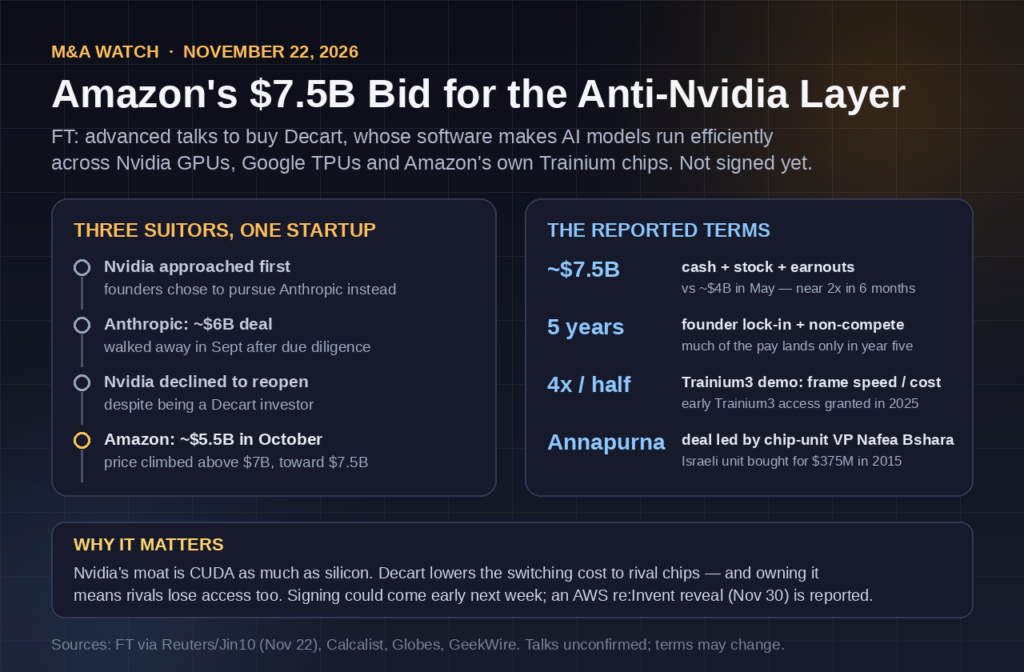
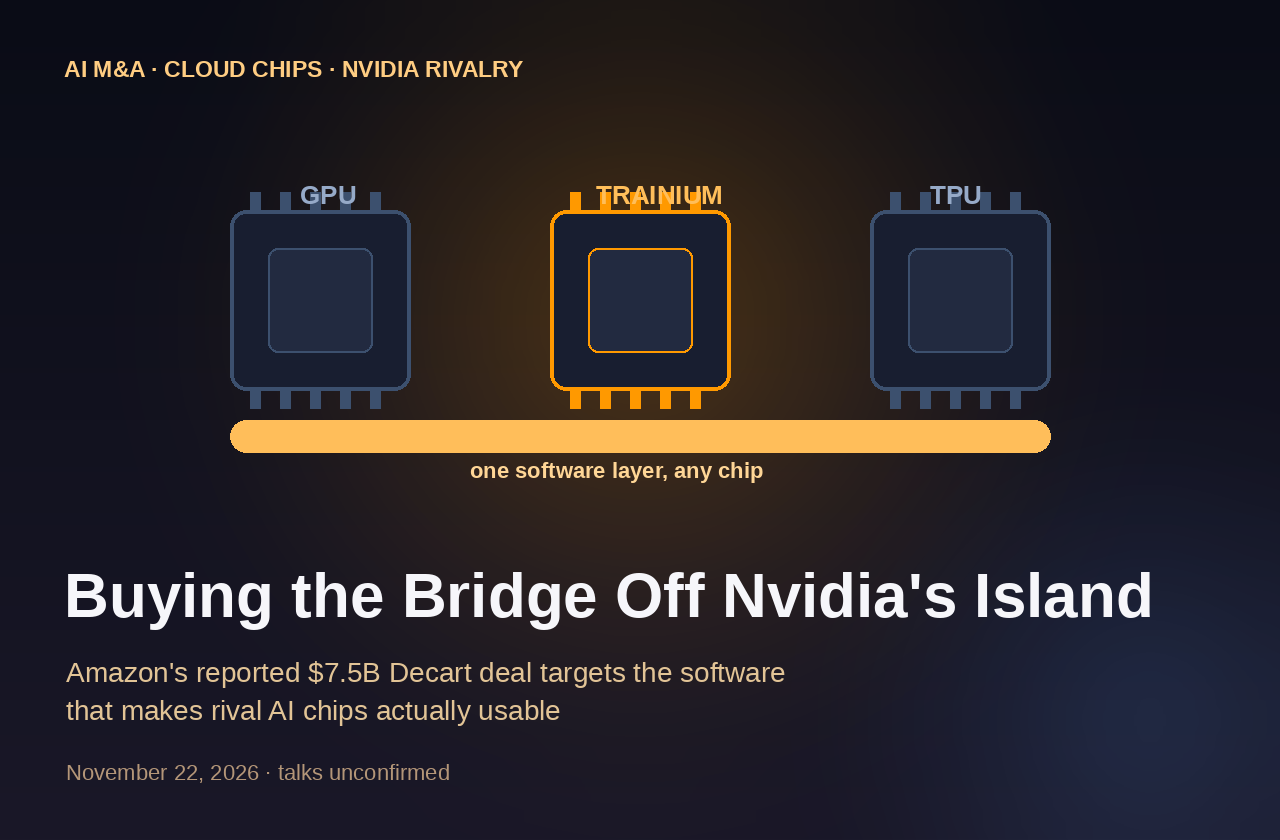
What Amazon is buying is a bridge. Nvidia’s dominance rests as much on CUDA — the software layer developers have built around for fifteen years — as on the silicon itself. Moving a model from Nvidia GPUs to a rival chip has traditionally meant weeks of engineering. Decart’s optimization software makes models run efficiently across Nvidia GPUs, Google TPUs and Amazon’s own Trainium processors, and makes switching between them dramatically easier. Amazon knows the technology works because it has been a customer: at last December’s Trainium3 launch, Amazon featured Decart achieving four times faster frame generation at half the cost of GPUs. Globes reports the optimization squeezes more tokens per kilowatt out of Amazon’s processors — efficiency measured in electricity, the industry’s scarcest input.
The deal’s internal logic is visible in who is leading it: Nafea Bshara, the Amazon vice president who runs Annapurna Labs, the Israeli chip unit Amazon bought for $375 million in 2015 and which now builds Trainium. This is not a corporate-development shopping trip; it is the chip division acquiring the software that makes its chips competitive. The structure reflects discipline too — cash, stock and performance-linked earnouts, with the three founders (the Leitersdorf brothers and Moshe Shalev) committed to five years and a non-compete, and a significant share of their payout landing only in year five. Amazon is buying the bridge and locking the builders on its side of the river.
For everyone else, the strategic read is uncomfortable and clear. Owning Decart does not just accelerate AWS’s escape from Nvidia dependence — it denies the same escape hatch to rivals, since an Amazon-owned optimization layer will not be marketed to help Google’s TPUs. The timing amplifies the signal: in the same week an SEC accounting probe was reported at Nvidia and chip stocks lost trillions, the largest cloud buyer on earth moved to acquire the software that loosens Nvidia’s grip. Whether it signs next week or is unveiled at re:Invent on November 30, as Globes reports is planned, the message is already delivered. The AI infrastructure war has moved from who owns the chips to who owns the exits.