Everybody in China’s performance-marketing world agrees on one thing this year: traffic got more expensive. Yet inside the same price wave, something strange is happening. Some advertisers spend more and perform better, while others watch conversions halve on a flat budget. Same platforms, same inflation, opposite outcomes.
The difference isn’t diligence. It’s that the rules changed, not just the prices. Three shifts rewrote the game: AI answers now eat informational queries before your ad ever loads; smart bidding stopped being an option and became a survival threshold; and privacy law ended the precision-targeting golden age. This playbook walks through each shift, then gives you the per-platform operating rules for Baidu, Tencent and Douyin — plus the ads-and-GEO coordination that actually lowers acquisition costs.
Rule Change 1: AI Answers Ate the Informational Query
Start with the demand side. CNNIC, the state-affiliated body that publishes China’s official internet statistics, reported in February 2026 that generative-AI users reached 602 million as of December 2025 — 42.8% of the population, up 141.7% in a single year. When nearly half the country asks a chatbot before it asks a search box, the top of your funnel moves.
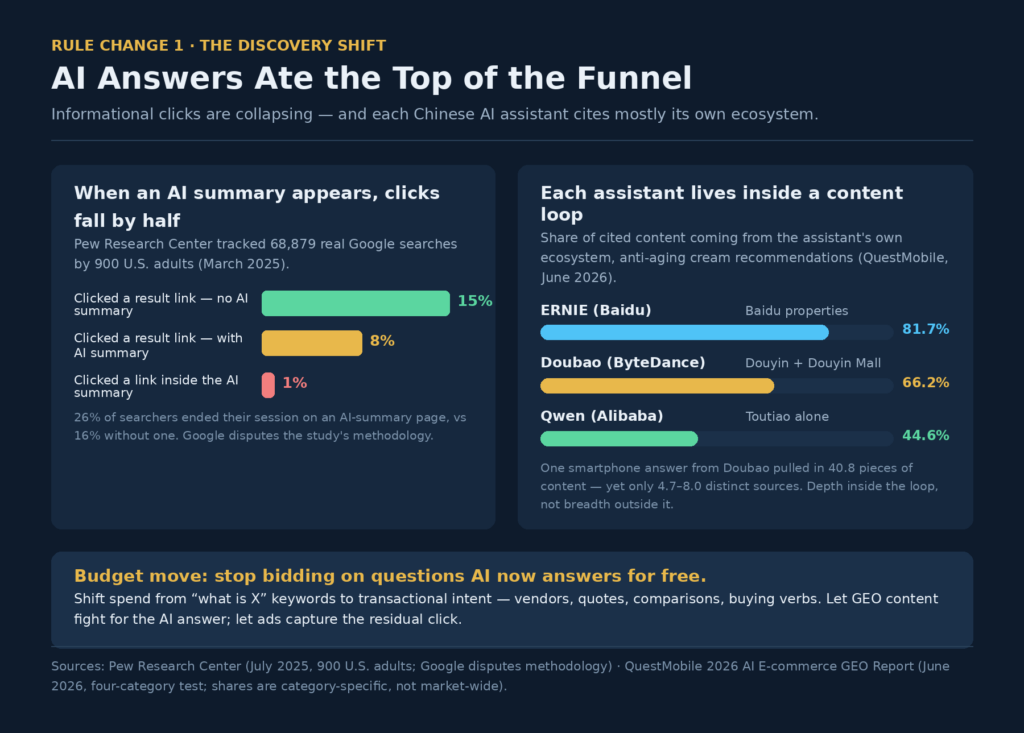
What does that do to clicks? The cleanest independent evidence comes from Pew Research Center, which tracked 68,879 real Google searches by 900 U.S. adults in March 2025. When an AI summary appeared, users clicked a traditional result link 8% of the time — versus 15% without one. Only 1% clicked a citation inside the AI summary itself, and 26% ended their browsing session entirely, versus 16% on classic results pages. Google publicly disputes the study’s methodology, so treat the exact ratios as directional rather than gospel. The direction, though, matches what every media buyer sees in their own search-term reports: question-shaped queries convert into clicks less and less.
The budget implication is blunt. Stop paying for questions the machines now answer for free. “What is X” and “how does X work” keywords are being hollowed out. Transactional intent — vendors, quotes, comparisons, buying verbs — is where the residual click still lives, and it’s where your bids belong.
The Ecosystem Loop: Why Content Outside It Turns Invisible
Here’s the part most PPC teams miss. In China, the AI answer isn’t a neutral librarian. QuestMobile’s June 2026 GEO study tested high-purchase-intent questions across four consumer categories and found that in anti-aging cream recommendations, 81.7% of the content ERNIE cited came from Baidu’s own properties. Doubao pulled 66.2% of cited content from Douyin and Douyin Mall. Even Alibaba’s Qwen leaned on Toutiao for 44.6%. One Doubao smartphone answer aggregated 40.8 pieces of content — but from only 4.7 to 8.0 distinct sources. Depth inside the loop, not breadth outside it.
These are third-party measurements from a four-category test, not market-wide constants; your category’s numbers will differ. But the structural finding travels: each assistant is an extension of its parent’s content ecosystem. If your content doesn’t live inside the loop, the AI recommendation never sees it — no matter how good your landing page is. Which means your Douyin ad creative and your GEO content strategy are no longer separate departments. They’re the same asset pool.
Rule Change 2: Smart Bidding Became the Survival Threshold
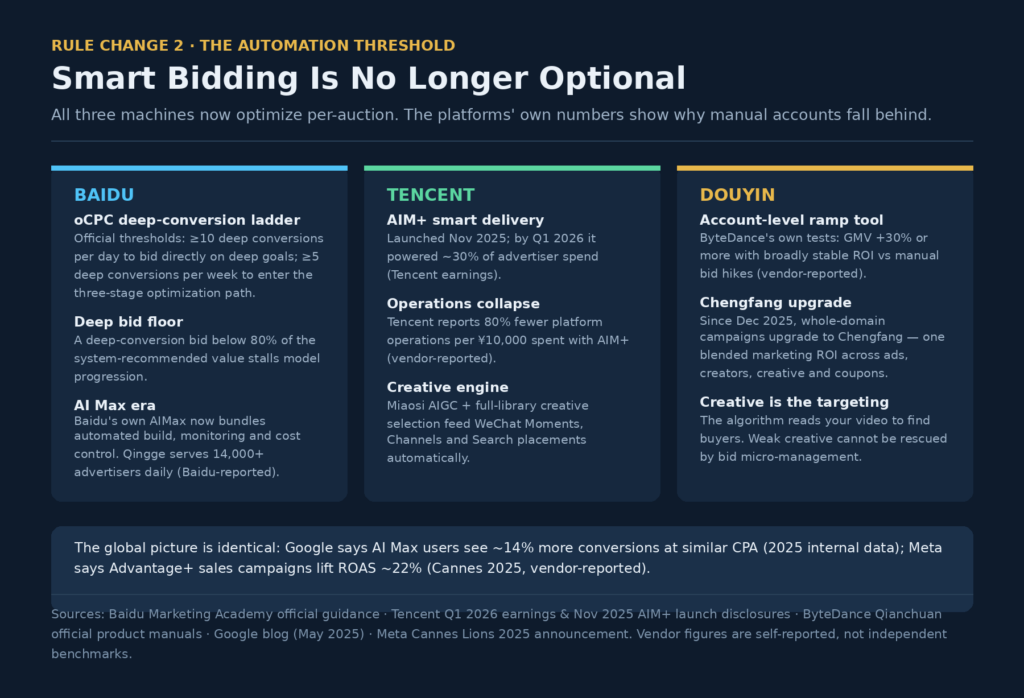
The second shift hides inside the auction. Every major platform now makes thousands of per-auction decisions no human team can match: this user, this moment, this creative, this bid. The platforms’ own numbers tell you where this is heading. Google says advertisers activating AI Max for Search typically see around 14% more conversions at similar CPA — internal 2025 data, non-retail, so vendor-reported rather than audited. Meta told advertisers at Cannes Lions in June 2025 that Advantage+ sales campaigns lift ROAS by an average of 22%, also self-reported. And Google’s April 2026 announcement moved AI Max out of beta, with automatic upgrades for legacy settings starting September 2026 and Dynamic Search Ads sunset pushed to February 2027. The train isn’t coming. It’s here.
China’s three machines moved in lockstep. Tencent’s Q1 2026 earnings showed marketing-services revenue of ¥38.17 billion, up 20% year over year, with its AIM+ smart-delivery matrix already powering roughly 30% of advertiser spend. ByteDance’s official product manual for Qianchuan’s account-level ramp tool reports test GMV gains of 30% or more with broadly stable ROI — again, the vendor’s own tests, not an independent benchmark. Reframe what the machine is doing: it isn’t choosing for you. It’s making the thousands of micro-choices you cannot make manually. Accounts that insist on hand-cranking every bid aren’t keeping control; they’re bringing a spreadsheet to a machine-gun fight.
Rule Change 3: The Precision-Targeting Golden Age Is Over
The third shift is legal, not technical. China’s Personal Information Protection Law, effective since November 2021, requires that automated-decision marketing offer users either a non-personalized option or a convenient opt-out — and courts have enforced it against platforms that quietly re-enabled personalized ads. Add the platform-side signal narrowing that followed, and the result is simple: the machine guesses intent from fuzzier inputs, and guessing costs more.
You can’t legislate your way back to 2019’s targeting granularity. What you can do is refill the signal gap with data you own: first-party audiences, compliant server-side conversion tracking, and deep conversion events wired honestly. Every platform below rewards the same thing — clean, deep, consented conversion data. That’s the new targeting.
Baidu: Buy Intent, Not Keywords
Baidu remains the acquisition backbone for B2B, industrial and enterprise services — the categories where buyers still type problems into a search box. And the ecosystem loop gives Baidu assets a second life: with ERNIE citing Baidu properties at 81.7% in QuestMobile’s test, your Baijiahao articles and encyclopedia presence now work double duty, feeding both classic search and AI answers.
The three intent tiers
Restructure your keyword book around intent, not vocabulary:
| Intent tier | Example queries | Bid posture |
|---|---|---|
| Cognition | “what is industrial lubricant” | Low or zero search bid; let feed and GEO content cover it |
| Comparison | “lubricant supplier A vs B”, “X pricing” | oCPC core battlefield |
| Decision | “X vendor quote”, “buy X bulk” | Highest priority, premium bids |
Feed oCPC the conversions that pay your bills
Baidu’s official guidance is more specific than the folk wisdom circulating in optimizer groups. To bid directly on deep conversion goals, a strategy needs roughly 10 deep conversions per day; the gentler three-stage optimization path starts at about 5 deep conversions per week; and a deep-conversion bid below 80% of the system-recommended value stalls model progression. Notice what those thresholds imply: consolidation. Twenty micro-campaigns each starving for data will never stabilize; a few pooled strategies will.
And define “conversion” honestly. A form fill is not a customer. Wire qualified consultations, store visits and signed contracts back as deep events, or the model will optimize you toward tire-kickers with great form-filling technique. Baidu itself has moved this direction — its September 2026 launch upgraded AIMax into an automated build-monitor-control system, and its Qingge AI-native platform, launched in 2023, now serves around 14,000 advertisers daily by Baidu’s own count. The direction of travel is not subtle.
Tencent: The WeChat Ecosystem Machine
Tencent sells a different animal: social-graph intent rather than search intent. Moments, Channels and WeChat Search inventory all run through oCPA-style optimization, and since November 2025 the AIM+ matrix automates targeting, bidding and placement together. Tencent’s launch disclosure claimed 80% fewer platform operations per ¥10,000 spent — vendor-reported, but consistent with what agencies describe.
The private-domain handoff is your deep conversion
The structural advantage here is the closed loop. An ad can hand the user to a Mini Program store, a WeCom contact or a Channels livestream without ever leaving WeChat. Make that handoff event — not the click — your optimization target. A WeCom add or a Mini Program purchase tells the machine far more about intent than an impression ever will, and it drops the user into a private-domain audience you can reach again without paying for another click.
Creative rules differ from search, too. The feed punishes repurposed TVC assets; native-format vertical video and nine-image Moments layouts earn their keep. Tencent’s own case materials show AI-derived creative carrying over half of some merchants’ orders — the creative pool, not the bid sheet, is where this channel is won.
Douyin: The Creative Is the Targeting
On Douyin, interest e-commerce inverts the old logic entirely. You don’t pick an audience and show it an ad; the algorithm reads your video and finds the audience the video implies. Content-as-targeting means your three-second hook is a targeting decision. A clickbait opening that pulls students to an anti-aging serum ad isn’t a creative win — it’s a targeting error the machine will faithfully scale.
So the operating cadence shifts from bid micro-management to creative iteration. Ship genuinely different angles — different hooks, scenes, proof structures — not twenty re-cuts of the same template, which the system increasingly treats as one asset. Qianchuan’s official materials reward original first-published creative with cold-start exploration boosts, and its account-level ramp tool exists precisely to test and rescue campaigns faster than manual price hikes.
From whole-domain to Chengfang
The biggest structural change: in December 2025 Qianchuan launched Chengfang, upgrading whole-domain campaigns into a blended marketing-ROI engine that optimizes ads, creator commissions, creative supply and coupon subsidies together. Existing campaigns upgrade with one click and inherit their models — no new cold start. Two operating details matter. First, with only basic delivery enabled, the blended ROI target uses the same net-transaction basis as whole-domain delivery; once creator commissions are included, the denominator grows and your old target will strangle volume if copied blindly. Second, official guidance says keep ROI-target adjustments under 5% per move and avoid frequent edits inside a seven-day window. The cost-guarantee rules deserve equal respect: compensation requires actual direct pay-ROI below 80% of target with at least 10 conversions in broad delivery (2 in search scenes), and more than two same-day edits to your ROI target or targeting void eligibility. Ramp-tool conversions don’t count toward the guarantee at all. Read the rules before you touch the buttons.
The Ads × GEO Coordination Play
Now connect the loops. If Doubao cites Douyin content at 66.2% and ERNIE cites Baidu properties at 81.7% in QuestMobile’s tested scenarios, then the content you produce for ads inside those ecosystems is simultaneously your GEO inventory. One asset pool, two distribution machines. AI-answer presence pre-sells the brand before the click; ads capture the residual transactional intent; shared creative lowers the effective cost of both.
Operate it with a simple split: product-demo and comparison content serves both ads and GEO; pure promotional mechanics serve ads only; deep explainer and structured Q&A content serves GEO first. Measure them separately — platform-reported ROI for the ad side, citation presence and assisted conversions for the GEO side — or you’ll credit one machine for the other’s work.
Guardrails: What Humans Still Decide
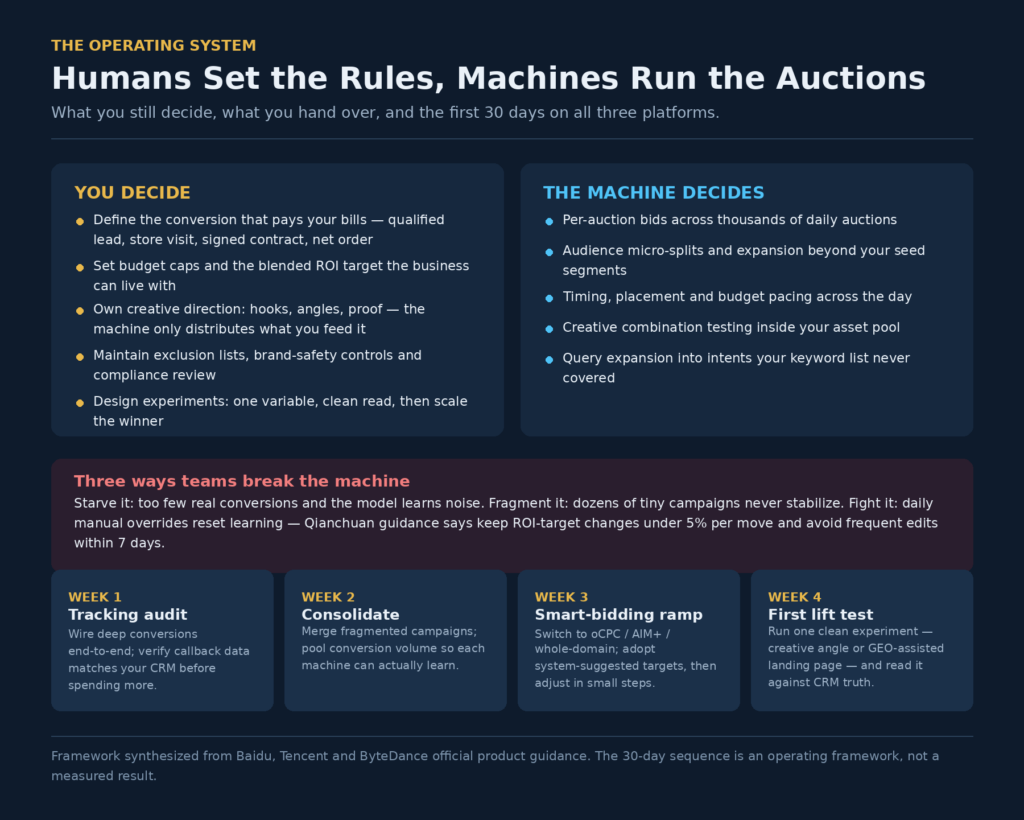
“Loss of control” is the objection every team raises, and it deserves a real answer. The machine decides per-auction bids, audience micro-splits, timing and creative combinations. You still decide the five things that matter: the conversion definition, budget caps and blended ROI targets, creative direction, exclusion and brand-safety lists, and experiment design. Three failure modes break the machine, and all three are human errors: starving it of real conversions so it learns noise; fragmenting campaigns until nothing stabilizes; and fighting it with daily overrides that reset learning. Set the rules, feed the data, then let it run.
Budget Allocation: One Table, Three Businesses
There is no universal split — only a framework you adjust with your own data. As a starting posture:
| Business type | Baidu | Tencent | Douyin |
|---|---|---|---|
| B2B lead-gen | Core (search intent + deep oCPC) | Secondary (WeCom handoff, retargeting) | Test only (awareness creative) |
| E-commerce | Secondary (brand + comparison queries) | Growing (Mini Program store loop) | Core (creative engine + Chengfang) |
| Local services | Core (decision-tier queries) | Core (Moments geo + private domain) | Supporting (short-video seeding) |
Within each platform, a 70/20/10 posture works as a discipline, not a law: 70% on proven smart-bidding structures, 20% on controlled experiments, 10% on GEO-content tests. This is an operating framework — not a measured result — and your CRM, not the platform dashboard, decides whether it’s working.
The 30-Day Launch Checklist
Week one: audit tracking end-to-end; verify deep-conversion callbacks match your CRM before spending another yuan. Week two: consolidate fragmented campaigns so each machine has enough pooled signal to learn. Week three: switch to the platform’s smart-bidding mode — oCPC, AIM+, whole-domain or Chengfang — adopting system-suggested targets first. Week four: run one clean experiment, a creative angle or a GEO-assisted landing page, and read it against CRM truth. Then repeat the loop monthly. Boring? Yes. That’s the point.
Summary
The 2026 PPC game is not won by working harder inside the old rules. AI answers stole the informational query, so buy transactional intent and fight for the AI citation with ecosystem-native content. Smart bidding became the threshold, so pool your conversion data and let the machine run the auctions. Privacy killed precision targeting, so refill the gap with first-party, deep, compliant conversion events. Baidu sells intent, Tencent sells the closed loop, Douyin sells creative-as-targeting — and the teams that coordinate ads with GEO across all three are the ones spending more while paying less per customer. One budget, three machines. Learn to drive all three.





