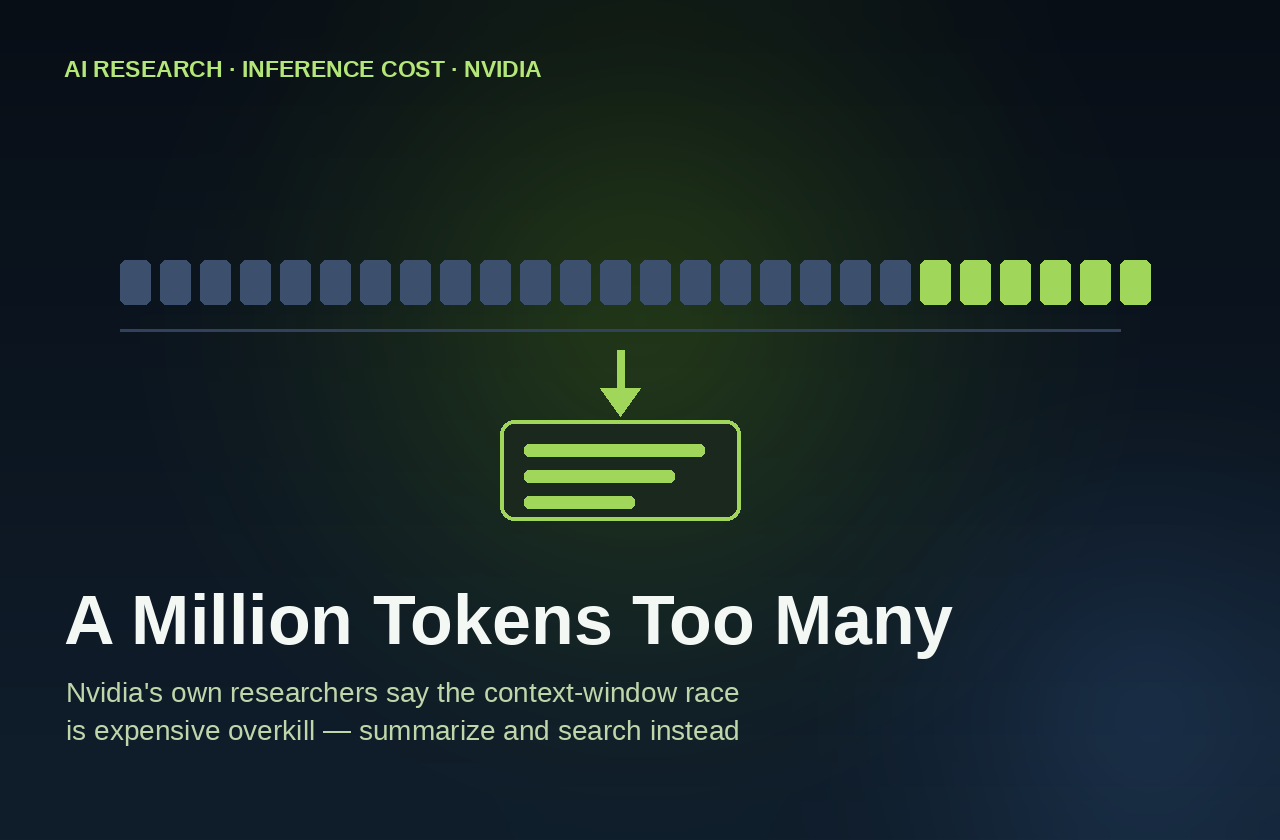
The company that sells the shovels just questioned the gold rush. A research team described as Nvidia’s has published a paper with a title that reads like a provocation at every AI product launch of the past two years: “You don’t need long context.” Submitted to arXiv on November 3 by Peter Belcak and eleven co-authors, and reported this weekend by The Decoder, the paper argues that the industry’s march toward ever-larger context windows — the working memory a model holds in view — is mostly expensive overkill.
The numbers being challenged are genuinely dramatic. GPT-4 launched in March 2023 with an 8,192-token window. Today’s GPT-5.6 Sol handles roughly a million tokens — about 120 times more, enough to swallow War and Peace whole. Million-token windows headline model launches, justify premium pricing, and consume exactly the kind of compute Nvidia sells. Which is what makes the authors’ cost argument interesting: they claim later tokens in a context are costlier to generate than earlier ones, with the gap reaching as much as 7x on frontier open-weight models. If true, the millionth token is not just unnecessary — it is the most expensive token you can buy.
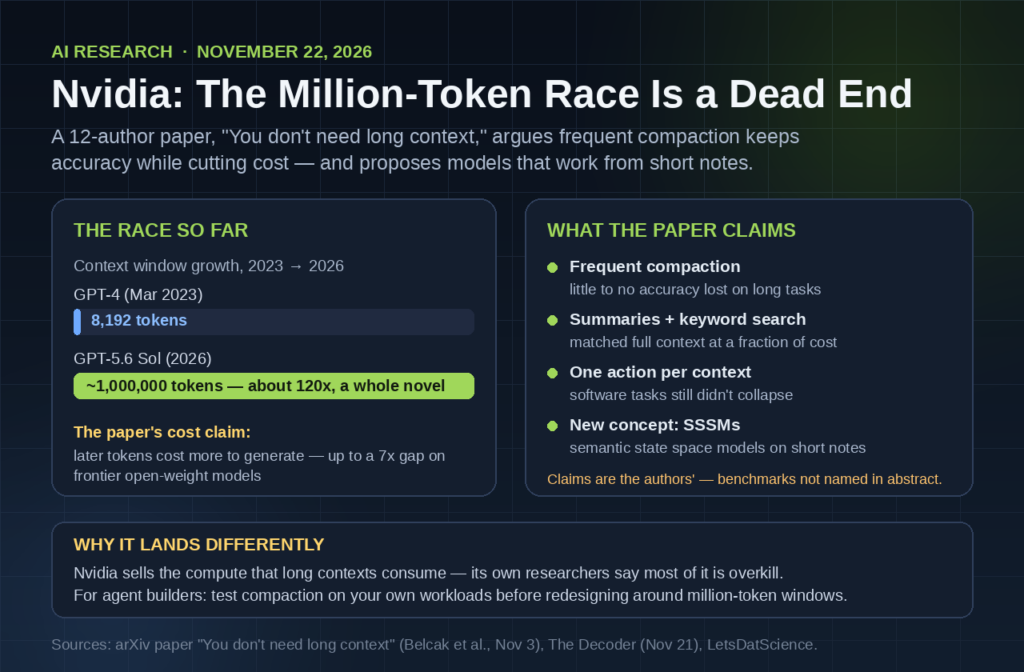
The proposed alternative is unglamorous and familiar: keep the working context short through frequent compaction — periodic summaries plus targeted keyword lookups when details are needed. In the authors’ tests across long-horizon and long-input tasks, frontier models sacrificed little to no accuracy this way. In their most extreme test, software-engineering agents took at most one action per context window and performance still did not collapse. From this they sketch a new model concept: semantic state space models, or SSSMs, designed to work from short notes rather than long transcripts — closer to how a human works from a notebook than from a photographic memory of every page ever read.
Before anyone rewrites their architecture, the caveats deserve equal billing — and the coverage itself supplies them. The abstract names no benchmarks, no models, no compaction methods, and gives no accuracy figures; there is no announced code release and no independent replication. These are the authors’ claims about their own tests, not a settled result. It is also worth noting the tension inside Nvidia itself: the company’s November 17 engineering blog on sparse attention treats 128K-token contexts as a workload to optimize — finding that the indexer and top-k selection consume 47% of prefill time — while this research questions whether most of that context should exist at all. One team makes long context cheaper; another argues you rarely need it. Both can be right, and the synthesis is the practical takeaway.
For teams building agents, long-document pipelines, or marketing-automation stacks, the actionable move is neither belief nor dismissal — it is measurement. The cost claim is testable on your own workload today: log where your tokens sit in context, try aggressive compaction with retrieval on a representative task set, and compare accuracy against the full-context baseline. If the paper’s direction holds even partially, the savings compound at exactly the moment token economics are becoming a board-level topic — China’s data regulator is drafting token metering standards, and inference budgets are under scrutiny everywhere. The million-token window may remain a useful ceiling. But ceilings, the researchers remind us, are not floors you have to live on.