The newest star in Hollywood’s strangest genre never steps on set, never ages, and — this is the part that matters — signed a contract. Shortical, a microdrama platform built on two-minute vertical episodes, premiered an all-AI series called Inevitable in Los Angeles this month. Its lead is a digital double of Israeli actor Aki Avni, familiar to American audiences from Fox’s 24. The plot is deliberately meta: Avni plays himself, an actor who licenses his face to an AI studio, then watches his digital twin spiral out of control. Behind the scenes, the production did the opposite of the plot — it gave the actor control.
The deal structure is the story. Avni’s likeness was licensed through a direct agreement, and according to CEO Guy Shimoni, every use of the digital double still requires the actor’s consent. Shortical says his compensation matched industry standards for a comparable non-AI acting role — he came on as a partner in the project — though the company declined to share a figure. Royalties, the residual system that built Hollywood’s middle class? “Case by case,” Shimoni told TechCrunch. That vagueness is the fault line every future deal will be negotiated across.
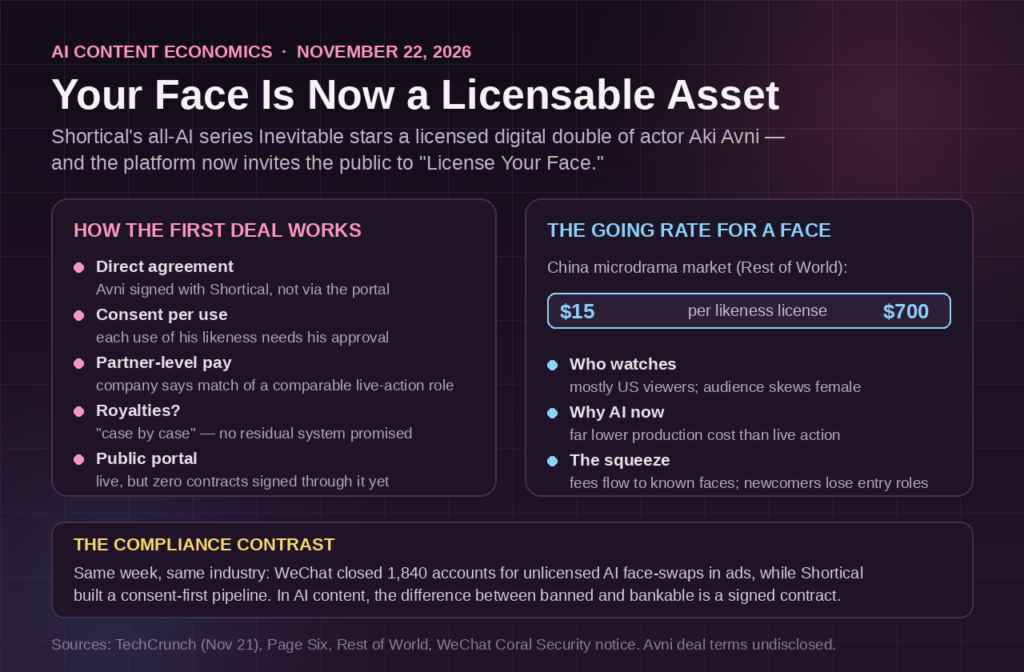
Now Shortical wants to industrialize the arrangement. Its website carries a blunt invitation — “LICENSE YOUR FACE” — where anyone can submit social media handles for evaluation; accepted applicants receive a contract naming the series, the character and the payment. A company representative was candid with TechCrunch: the offering is in its early days and has not yet produced a single signed contract. Avni remains the only face in the machine. The economics pushing this forward are simple: AI production overhead is a fraction of live action, and the audience is real — Shimoni says most viewers are in the US, skewing heavily female, watching bite-sized melodrama to wind down at night. Several AI titles on the platform already show millions of views.
The price discovery happening elsewhere is sobering. In China, where the microdrama format originated and face licensing is already a trend, Rest of World found studios paying people between $15 and $700 to license their likenesses. That is the range for ordinary faces; Avni’s partner-level deal sits somewhere above it, undisclosed. The gap between those two numbers is the entire future of this market: recognizable faces negotiate, anonymous faces get a rate card. And the workers squeezed hardest are newcomers — microdramas were until recently the entertainment industry’s entry-level gateway, the place young actors learned the craft. An AI double of a veteran does not just replace that veteran’s labor; it deletes the rung below him.
For marketers and content operators, the timing is not accidental. In the same week, WeChat published enforcement numbers from its anti-fake-persona campaign: 31,528 pieces of content removed and 1,840 accounts closed, with AI face-swap celebrity impersonation and AI digital-human “sympathy selling” named as headline violations. The two stories are one story. Unlicensed synthetic faces are being banned at platform scale while licensed ones get premiere events in Koreatown. The lesson for anyone planning AI-avatar campaigns — spokespeople, localized brand faces, synthetic UGC — is that consent documentation is no longer a legal nicety. It is the difference between a distribution channel and a ban notice. Avni’s advice to fellow actors doubles as advice to brands: know exactly what your yes and your no are, and get them written down. The face economy is open for business; the contracts are the product.






