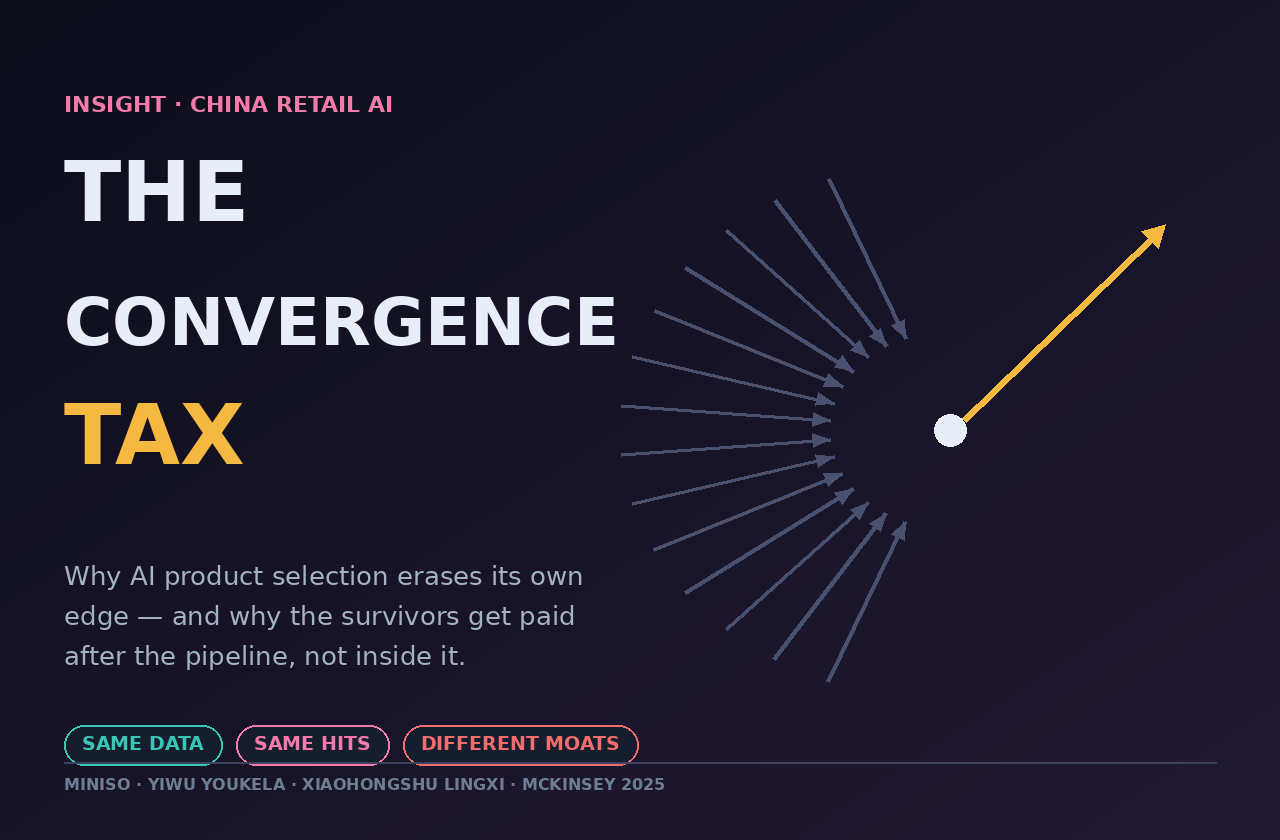
Everyone is celebrating the wrong number. The headlines about Chinese retail AI fixate on speed — selection cycles cut from ten days to two, five thousand reviews parsed over breakfast. But speed was never the scarce resource. Insight was. And the moment insight became rentable, it started dying as an advantage.
That is the mechanism worth understanding. Call it the convergence tax.
Step One: The Cost of Knowing Collapses
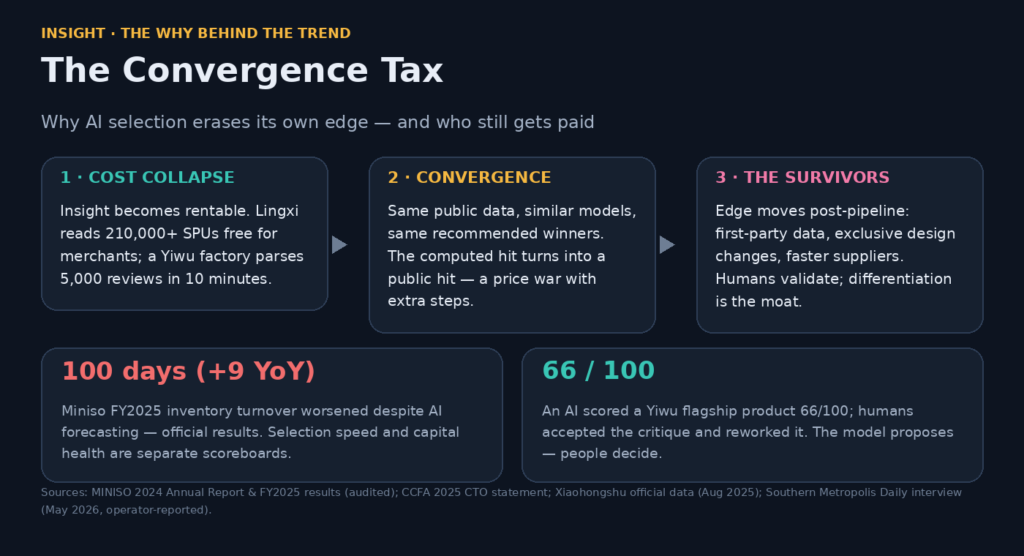
Until recently, knowing what customers actually wanted was expensive. A Yiwu lamp factory needed three staff and two days to scrape one category’s reviews by hand — messy data, no synthesis. Then the platforms productized knowing. Xiaohongshu’s Lingxi engine now reads demand signals across more than 210,000 SPUs, distilled from 1.3 billion attribute words, and since August 2025 it has been free to any business account. The same factory now parses 5,000 real reviews in ten minutes and gets a structured brief in its DingTalk group at 9 a.m.
When McKinsey’s 2025 survey (1,993 firms, all industries) finds 83% of mainland Chinese companies regularly using generative AI, the implication is not “everyone got smarter.” It is that the price of the same smartness fell to near zero.
Step Two: Cheap Insight Converges
Here is the part the vendor decks skip. An edge exists only when your information differs from your rival’s. But these engines feed on the same public substrate — the same marketplace listings, the same review corpora, the same trend curves. Similar inputs through similar models yield similar outputs. Every merchant’s AI discovers the same underserved 18–29 cohort, the same missing feature, the same argument for turning the blue lamp pink.
The computed hit becomes a public hit. And a public hit is a price war with extra steps. We should be honest about the evidence here: no rigorous study yet quantifies this compression, and the loudest warnings come from vendors selling differentiation tools. But the logic needs no study — it is arithmetic. Shared data plus shared models equals shared answers. The Yiwu founder who once piled up ten million RMB of dead inventory chasing trends by gut was slow; his AI-assisted successor would reach the same graveyard faster, with better dashboards.
Step Three: The Survivors Get Paid After the Pipeline
So who keeps the margin? Look at what the documented winners do after the recommendation. The Yiwu team treated the AI’s 66-out-of-100 product score as a brief for human rework, not a verdict to accept wholesale. Miniso pairs its 711 launch machine — 100 SKUs from 10,000 ideas weekly, per its annual report — with exclusive IP licensing that competitors literally cannot copy. The moat moved downstream: first-party data the public corpus lacks, design modifications rivals must reverse-engineer, supplier relationships that ship the differentiated variant before the copies tool up.
And one more discipline the tax imposes: separate scoreboards. Miniso’s FY2025 results show inventory turnover at 100 days — nine days worse year over year — even with AI forecasting running. Demand computation optimizes each bet; it does not repeal the working-capital cost of opening hundreds of overseas stores. Anyone who reads “AI selection” as “leaner balance sheet” will be surprised by the invoice.
The trend, then, is not that AI picks better products. It is that picking stopped being where the money is. The pipeline is rented, the insight is public, and the tax is paid by everyone who stops at the recommendation. What survives is what you do next — and that part, for now, cannot be subscribed to.