For decades, picking the next hit product in Chinese retail worked like this: a buyer scrolled through marketplaces late at night, felt something in their gut, and placed a bet. Sometimes the bet paid. Sometimes it became a warehouse full of last season’s regrets.
That gut is now being replaced — or at least audited — by a computation pipeline. A listed global retailer runs AI sales forecasting across tens of thousands of new SKUs a year. A small lamp factory in Yiwu lets an AI agent read five thousand customer reviews before breakfast and blocks any product listing whose main image cannot clear a click-through threshold. And the platforms themselves — JD.com, Xiaohongshu, livestream operators — are packaging this capability into tools anyone can rent.
This article walks through the published record: what these companies actually said, what their audited numbers confirm, and what the whole shift means for your brand. Along the way, we will flag exactly which figures are company claims and which are verified facts — because in this story, that distinction is the difference between a playbook and a press release.
The Ground Is Already Moving
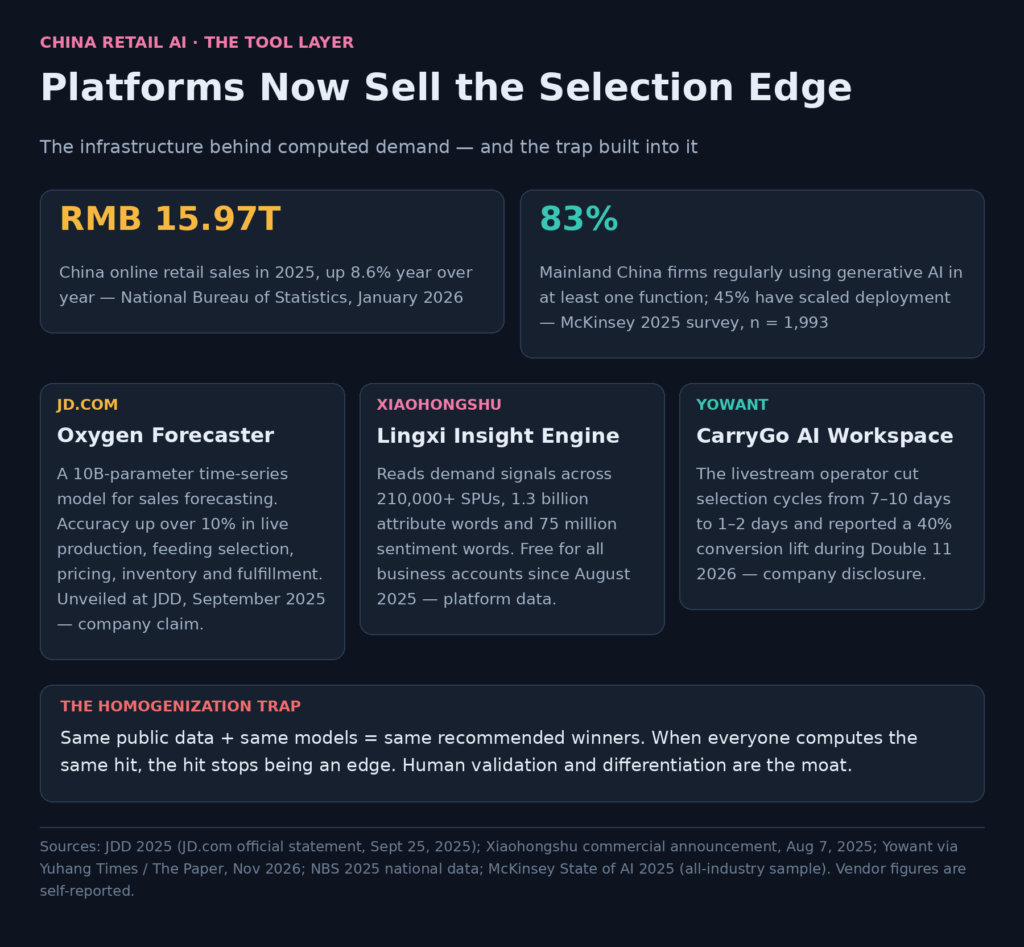
Two numbers set the stage. China’s National Bureau of Statistics reported that online retail sales reached RMB 15.97 trillion in 2025, up 8.6% year over year, with physical-goods e-commerce alone accounting for 26.1% of total retail sales. This is not a niche channel anymore; it is the main arena.
The second number comes from McKinsey’s State of AI 2025 survey — 1,993 respondents across 105 countries, fielded between June and July 2025. Globally, 88% of organizations now use AI regularly in at least one business function, up from 78% a year earlier. In mainland China, 83% of firms regularly use generative AI, and 45% report scaled or full deployment, ahead of the 38% global average.
One caveat worth keeping: that survey covers all industries, not retail specifically. And it carries a sobering footnote — only about 39% of firms report any measurable earnings impact from AI. Adoption is nearly universal. Value capture is not. Product selection happens to be one of the few retail workflows where the value chain from data to decision to inventory is short enough to close that gap. Let’s look at who is closing it.
Case One: Miniso’s 711 Machine
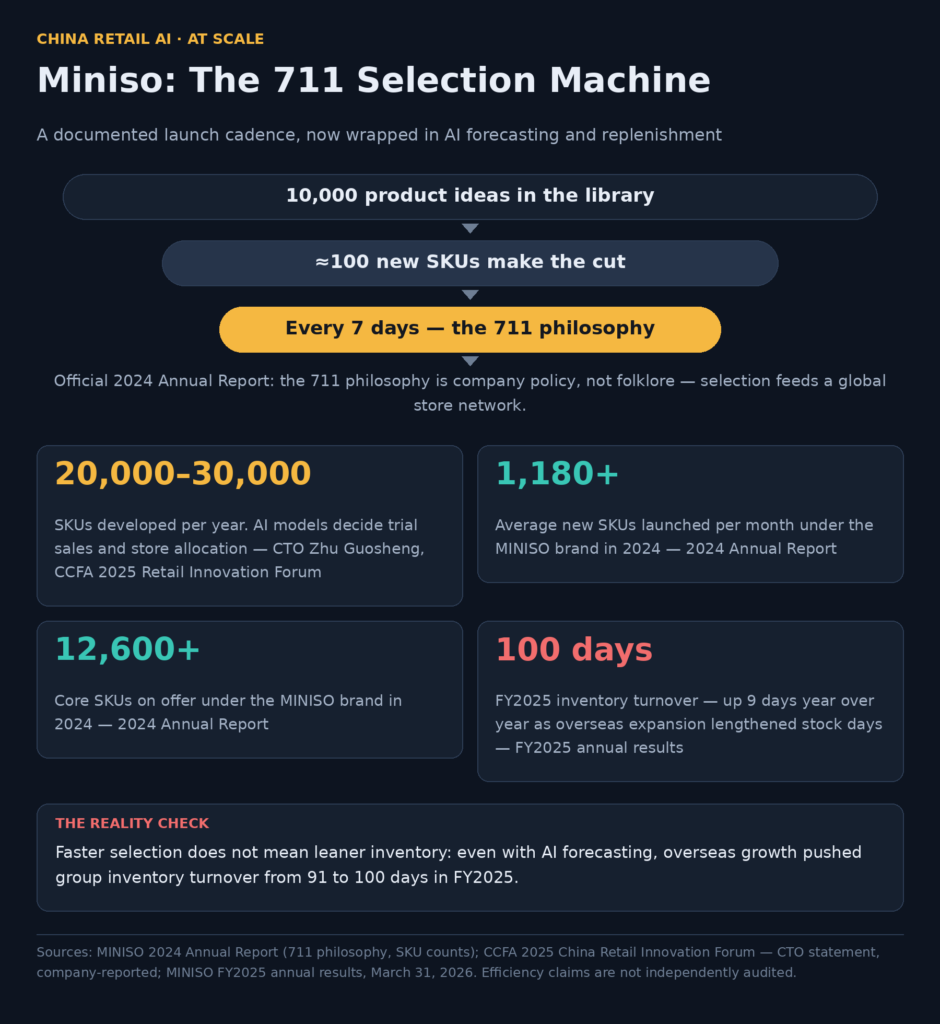
Here is the surprise: Miniso’s famous selection cadence predates the AI wave entirely. The company’s 2024 Annual Report spells out the “711 philosophy” in plain corporate prose: every seven days, launch roughly 100 new MINISO SKUs, carefully selected from a library of 10,000 product ideas. In 2024, the brand launched an average of more than 1,180 new SKUs per month and kept over 12,600 core SKUs on offer.
Read that again. Ten thousand ideas in, one hundred products out, every single week. Before any large model touched the process, Miniso had already industrialized what most retailers still treat as artisanal guesswork. The AI story is not about inventing this machine. It is about what happens when you bolt prediction engines onto a machine that already runs at speed.
What the CTO Actually Said
At the CCFA 2025 China Retail Innovation Forum — the industry conference run by China’s chain-store association — Miniso’s vice president and chief technology officer Zhu Guosheng described the AI layer in a panel transcript published in December 2025. Three points stand out.
First, scale: the company develops roughly 20,000 to 30,000 SKUs a year, and AI algorithms now inform which new products get trial sales and how they are distributed across stores. Second, the AI started in the supply chain — sales forecasting and intelligent replenishment — before generative models opened up content production. Third, Miniso is building a content platform for tens of thousands of KOCs (key opinion consumers), and Zhu volunteered a cost estimate: at full maturity, monthly compute consumption could reach several million RMB. He also confirmed the company does not train its own foundation models; it partners with public cloud providers instead.
These are company statements from an executive on a conference stage, not audited disclosures. Treat the mechanism as credible and the numbers as self-reported.
The Reality Check Nobody Quotes
Now the part the AI-enthusiasm articles skip. Miniso’s FY2025 annual results, released on March 31, 2026, show revenue of RMB 21.44 billion, up 26.2%, across 8,485 stores worldwide. Strong. But inventory turnover came in at 100 days — nine days slower than the prior year, with the company attributing the drag to overseas expansion.
So the retailer with the most celebrated selection machine on earth, running AI forecasting and replenishment, watched its inventory get heavier, not lighter. Does that mean the AI failed? No — it means selection speed and inventory health are different variables. AI can sharpen the forecast for each SKU, but opening hundreds of overseas stores adds stock days that no forecast can wish away. Efficiency at the item level does not automatically compound into efficiency at the balance-sheet level. Keep that lesson; we will return to it.
Case Two: The Lamp Factory That Stopped Guessing
If Miniso shows the pipeline at corporate scale, Zhejiang Youkela shows it at the other end of the food chain. This is a Yiwu company — the city that functions as the world’s wholesale vending machine — making star-projector lamps since 2009, a classic front-shop, back-factory operation with fewer than eighty staff.
Founder and CEO Wei Jun told Southern Metropolis Daily, in an interview published May 25, 2026, exactly why he switched. His products sold at RMB 150–200. Then a competitor’s RMB 58 lamp went globally viral, and his instinct was panic: should we abandon our price band and chase the cheap hit? He knew where that road ended, because he had driven it before — years of copying whatever trended on Douyin had left him with, in his own words, over ten million RMB of dead inventory. This time, instead of guessing faster, he changed how decisions got made.
Step 1: Aggregate Everything, by Price Band
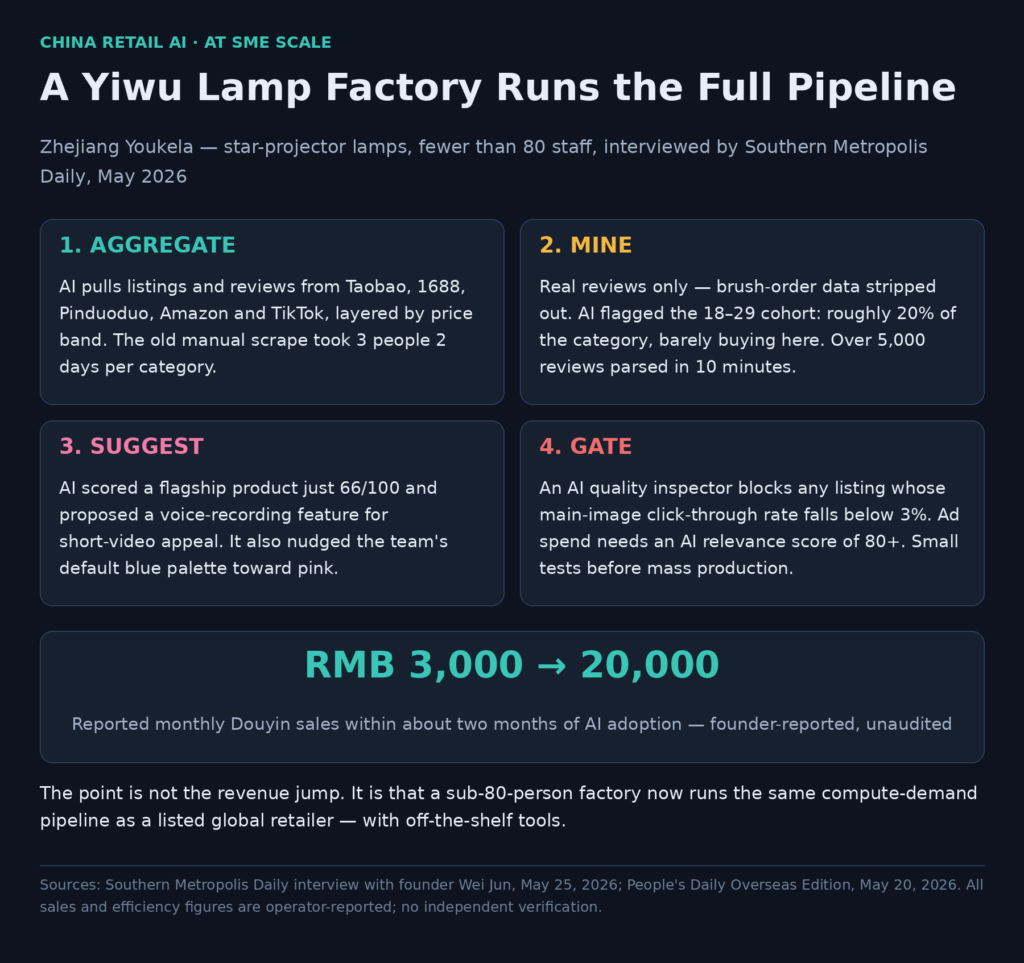
The old research routine: three staff, two days per category, manually copying competitor listings and reviews from Taobao, Xiaohongshu and Douyin into spreadsheets. The new routine: AI aggregates data across Taobao, 1688, Pinduoduo, Amazon and TikTok — domestic and cross-border at once — and layers the comparison by price band. The unit of analysis shifted from “what’s trending” to “what sells, to whom, at which price.”
Step 2: Mine the Real Reviews
The aggregation is plumbing. The review mining is where the insight lives. Youkela’s pipeline strips out brush-order data — the fake purchases that pollute Chinese e-commerce metrics — and extracts pain points, itch points and core selling points from genuine customer reviews. That filter surfaced a blind spot: buyers aged 18–29 made up roughly 20% of the overall category yet barely bought from Youkela. The company’s experience-built products skewed to buyers aged 35–50. The response was a new sub-RMB-100 line aimed at the younger cohort.
People’s Daily Overseas Edition, profiling the same company on May 20, 2026, added a concrete detail: its AI agent, running on an enterprise agent platform, parses more than 5,000 user reviews in about ten minutes and pushes a structured report to the team’s DingTalk group at 9 a.m. Complaints like glare and missing Bluetooth control come back as a specification list, not vague sentiment.
Step 3: Let the Model Insult Your Product
The most human moment in the whole story: the AI scored one of Youkela’s proudest products at 66 out of 100 and suggested adding an emotional feature — a voice-recording function — to make it shareable on short video. It also flagged that the team, dominated by male engineers, kept designing everything in blue, and recommended pink. Wei Jun’s team reviewed the suggestions, agreed, and reworked the product. Note the sequence: the model proposes, humans validate, then the change ships. Nobody handed the design keys to the algorithm.
Step 4: Gate Before You Spend
Here is the mechanism worth stealing. Before a listing goes live, an “AI quality inspector” checks the main image’s click-through rate. Below 3%? The system blocks the listing. Before ad budget is committed, AI estimates keyword–image–audience relevance, and anything scoring under 80 does not get spend. A live heatmap then shifts budget toward high-converting regions and away from weak ones.
The reported outcome: monthly Douyin store sales rose from roughly RMB 3,000 to roughly RMB 20,000 within about two months of adoption. Two honesty flags. These are founder-reported figures with no platform verification. And the newspaper’s own headline says “daily sales” while its body text says “monthly sales” — we follow the body text and label the caliber accordingly. The absolute numbers are small; that is precisely the point. The pipeline works at a scale where a data team of one is the whole data team.
The Tool Layer You Can Rent
Neither case required building a foundation model. That is the third storyline: the infrastructure is now a product.
JD.com: A Ten-Billion-Parameter Forecaster
At its global tech conference on September 25, 2025, JD.com senior vice president Hu Xi unveiled Oxygen Forecaster, a self-developed 10B-parameter time-series model for sales forecasting. The company claims accuracy improved by more than 10% in live production, feeding selection, pricing, inventory placement and fulfillment. It is a launch-stage claim — no independent re-test exists — but the architectural point matters: forecasting is becoming a specialized model category, not a spreadsheet feature.
Xiaohongshu: Demand Signals as a Service
Xiaohongshu’s Lingxi platform turns the site’s lifestyle content into structured demand data: insights across more than 210,000 SPUs, built from over 1.3 billion attribute words and 75 million sentiment words. Since August 7, 2025, it has been free to any registered business account. When the platform where Chinese consumers describe what they want starts handing merchants the parsed version of those desires, the research advantage of scale shrinks dramatically. These are platform-published figures describing the platform’s own tool.
Yowant: Selection at Livestream Speed
Livestream operator Yowant disclosed its first AI-run Double 11 in November 2026, covered by The Paper and a district government newspaper: running on the CarryGo AI workspace, selection cycles fell from 7–10 days to 1–2 days, conversion rose 40%, and first-half GMV grew 39% year over year. A company vice president told Yicai that overall livestream preparation time compressed by roughly 70%. Again: company disclosure, not audited results — but the direction is consistent across all three tool providers.
The Pipeline Behind All Three Stories
Strip away the brand names and the same architecture appears: aggregate cross-platform data by price band; mine de-brushed reviews for unmet demand; let AI suggest design and feature changes; gate listings and spend behind explicit thresholds; test small before producing at volume; and keep a human validation step between suggestion and shipment.
Miniso runs it with proprietary systems and a global store network. Youkela runs it with off-the-shelf agents and a DingTalk group. The pipeline is scale-invariant. That is genuinely new — five years ago, this capability stack belonged exclusively to companies with nine-figure tech budgets.
Four Assumptions That Break on Contact
“AI picks the winners.” No — AI ranks candidates and flags anomalies. In every documented case, humans made the final call, including accepting a humiliating 66/100 design score.
“This is a big-company game.” The Yiwu case disproves it. The marginal cost of the pipeline collapsed when platforms productized it.
“Efficiency equals profit.” Miniso’s 100-day inventory turnover, nine days worse year over year, disproves the automatic version of that claim. Selection efficiency and working-capital health are separate scoreboards.
“The data is clean.” The single most valuable line in the Yiwu workflow is the brush-order filter. Mine polluted reviews and you will confidently compute demand that does not exist.
The Same-Hit Trap
Now the strategic risk, and a labeling note first: what follows is analysis, not a measured finding. We found no rigorous quantitative study establishing that AI selection shortens product lifecycles, and we refuse to dress up vendor commentary as evidence.
The logic, however, is hard to escape. If thousands of merchants query the same public platform data through similar models, the recommendations converge. Everyone’s AI finds the same underserved cohort, the same trending attribute, the same pink lamp. The “computed hit” becomes a public hit — and a public hit is just a price war with extra steps. Wei Jun’s ten-million-RMB inventory graveyard was built by human trend-chasing; the AI version of that failure mode would simply arrive faster and look smarter on the dashboard.
The moat, therefore, is not the pipeline itself — that is rented. It is what you do after the pipeline: proprietary first-party data, exclusive design modifications, supplier relationships that can execute a differentiated variant before the copycats tool up. AI tells you where demand is. Whether you serve it distinctively is still a human business decision.
What the Evidence Can and Cannot Say
A quick ledger. Audited facts: Miniso’s revenue, store count, inventory days, and the 711 policy as written in its annual report; national retail statistics. Company statements: the CTO’s SKU volumes and compute estimates; JD’s accuracy gain; Yowant’s cycle compression. Operator-reported: every Youkela sales figure. Survey data: McKinsey’s adoption rates, all-industry. What we cut from the original brief: an unverifiable 1688 “negative-review millionaire” anecdote that existed only in content-farm compilations, and a broker-report inventory figure whose caliber could not be reconciled. If a number cannot survive that ledger, it does not belong in your strategy deck either.
The Playbook for Your Brand
Five moves, in order. First, build the pipeline, not the prompt — a one-off chat query is research theater; aggregation, mining, gating and testing must connect. Second, mine the negative reviews after de-brushing; complaints are the cheapest specification document you will ever read. Third, set explicit gates before spending — a CTR floor, a relevance threshold, a small-batch rule — and let the system enforce them when humans are tempted. Fourth, budget a differentiation step after every AI recommendation; if you cannot make the suggested product meaningfully yours, expect margin to decay on schedule. Fifth, track inventory days next to hit rate, because Miniso just demonstrated why the two can move in opposite directions.
The Bottom Line
The published record shows Chinese retail moving from buyer intuition to computed demand — a documented 711 cadence with AI forecasting at the top of the market, a review-mining, CTR-gated pipeline at the bottom, and a rented tool layer in between. The figures deserve their source labels, the inventory data deserves your attention, and the homogenization logic deserves a plan. AI will tell everyone where the demand is. The winners will be the ones who answer a harder question: what will we do about it that nobody else can copy?