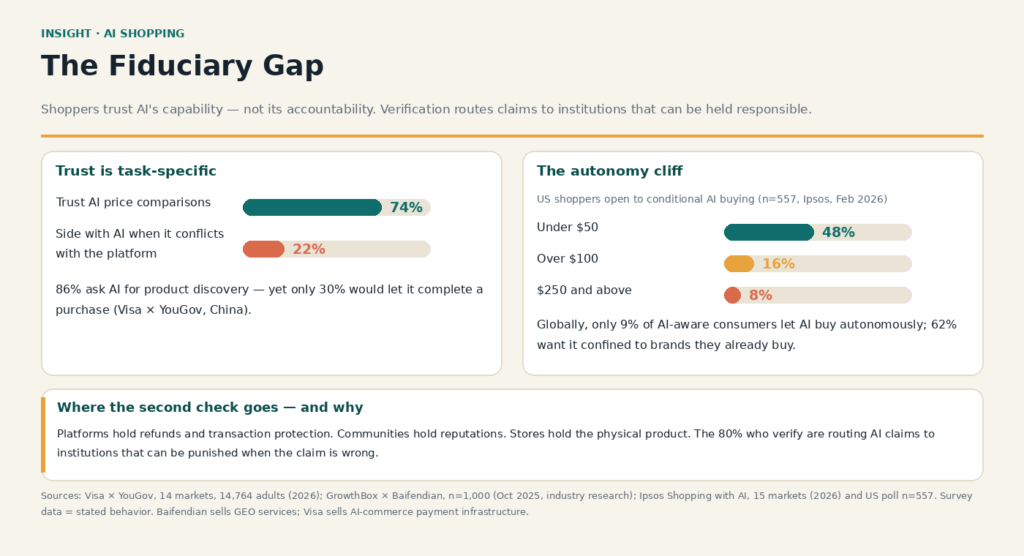
Here is a paradox worth sitting with. Chinese consumers rate AI more reliable than social media (53%, GrowthBox × Baifendian, n=1,000), happily delegate the tedious work of comparison to it — 71% generate spec tables with AI — and 86% use it for product discovery (Visa × YouGov). Yet when AI’s advice collides with the platform’s, only 22% side with AI. And just 30% would let it complete a purchase.
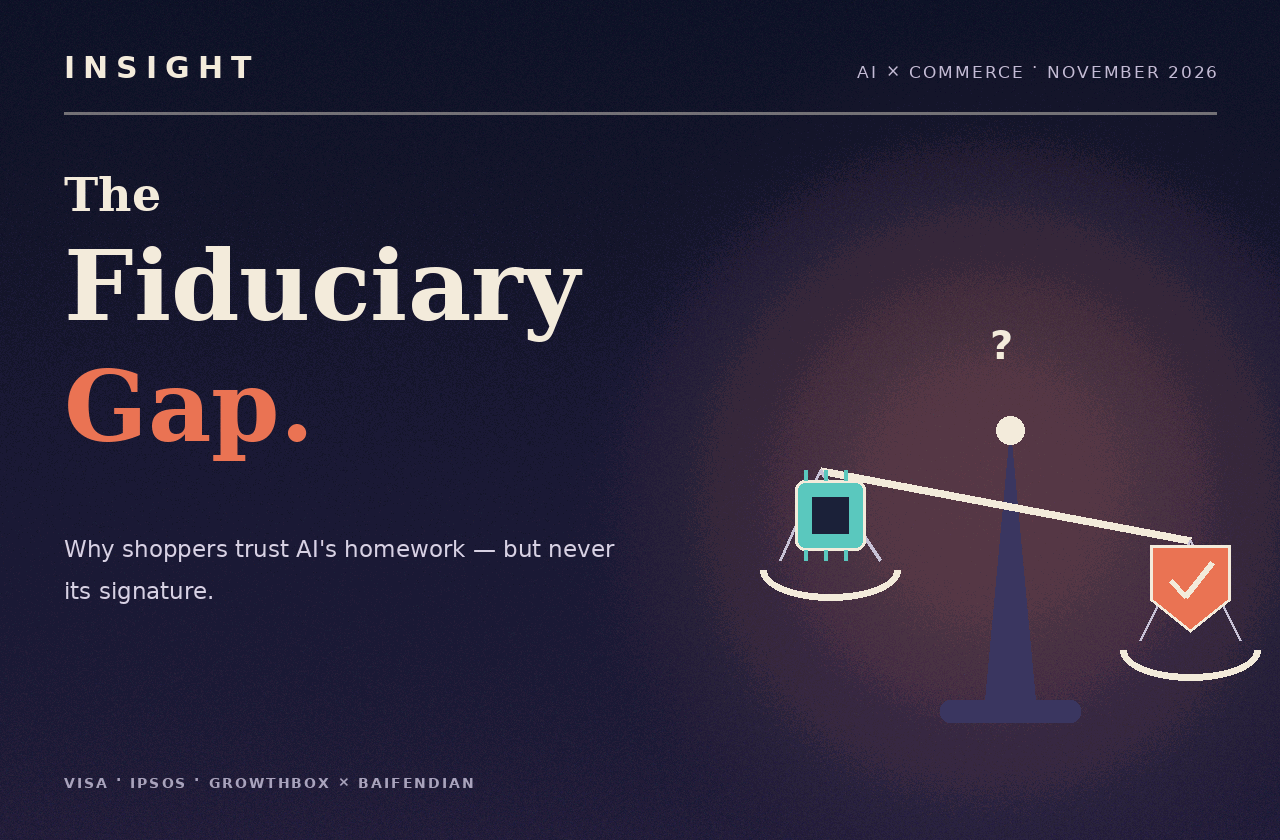
The usual explanation is that shoppers don’t trust AI yet. The data says something stranger: they trust its capability plenty. What they don’t trust is its accountability. Call it the fiduciary gap — the distance between an advisor who is smart and an advisor who can be held responsible.
Capability trust is cheap; fiduciary trust is institutional
A fiduciary is someone obliged to act in your interest and punishable when they don’t. Your bank, your doctor, the platform holding your escrow — each has skin in the game. An AI assistant has none. It cannot be fined, refunded against, or sued. It does not lose a license when it recommends a lemon.
So consumers do the rational thing: they accept the analysis and route the risk elsewhere. That is exactly what the 80% second-verification habit is. It is not skepticism about intelligence; it is the transfer of a claim to an institution that can be punished if the claim is wrong. Platforms hold refunds and transaction protection. Communities hold reputations — a blogger who shills a bad product loses followers. Stores hold the physical object you can touch. Each verification route is, underneath, an accountability route.
The price cliff proves it
If the gap were about accuracy, better models would close it uniformly. Instead, permission collapses with stakes. In Ipsos’s US poll of conditional adopters (n=557, February 2026), 48% would let AI spend under $50 without approval — but only 16% above $100 and 8% at $250-plus. Globally, a mere 9% of AI-aware consumers allow autonomous buying, and 62% want AI confined to brands they already buy.
Read that pattern as insurance pricing. Shoppers self-insure small mistakes; large ones require an underwriter. The model’s IQ is irrelevant at that boundary. What matters is who absorbs the loss — and today, the answer is always the human.
Why this gap won’t close with smarter models
The named blockers in Visa’s China data — hidden fees (38%), recommendation accuracy (37%), data security (34%) — are mostly governance problems, not intelligence problems. A model that explains its reasoning beautifully still cannot promise a refund. This is why even heavy users keep the leash: verification is the consumer’s homemade liability system.
For brands, the implication flips the usual GEO advice. Being cited by AI earns you a claim. Winning means being the institution that can back the claim: consistent official specs, enforceable warranties, authentic reviews, plain fee disclosure. The shortlist is written by the machine. The signature — the part that costs something when it’s wrong — is still human. Build for the signature.