Everyone repeats the same line about Pinduoduo: traffic there is cheap. Merchants say it, agencies say it, brand managers whisper it over budget spreadsheets like it’s a discovered loophole. And it’s true — in the narrow sense that clicks cost less and shoppers arrive pre-sold on low prices. But cheap for whom? Here’s the uncomfortable answer this piece will defend: Pinduoduo’s traffic is cheap because its merchants are thin. The platform didn’t find a cheaper way to buy attention. It found a way to make hundreds of thousands of sellers prepay for it — out of margins they barely have. Once you see the machinery, you can’t unsee it.
Start With the Ledger, Not the Legend
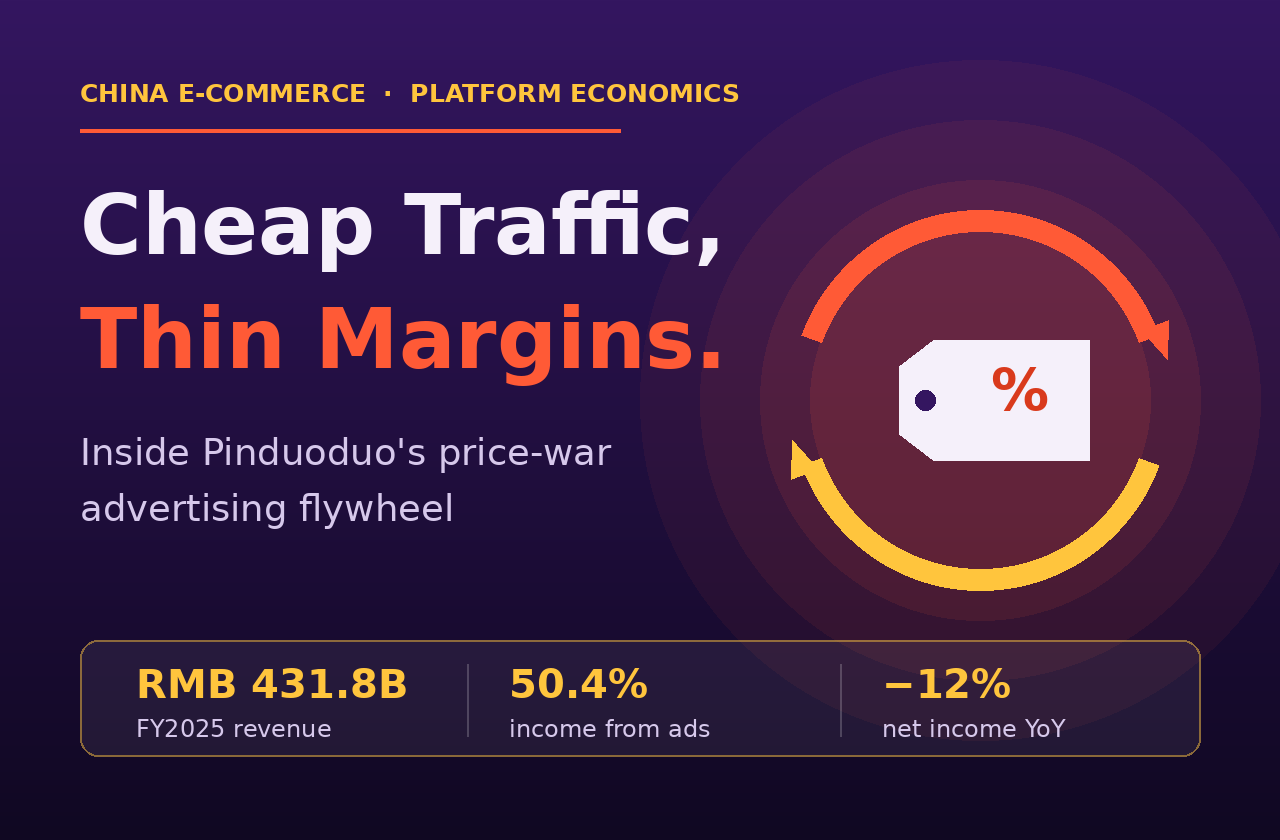
PDD Holdings, Pinduoduo’s parent, closed fiscal 2025 with RMB 431.85 billion in revenue, up 10% year over year, according to its own unaudited results released on March 25, 2026. Two lines matter for our story. Online marketing services and others — the ad business — brought in RMB 217.78 billion, or 50.4% of everything the group earned. Transaction services added RMB 214.06 billion, the other 49.6%. Read that split again: half of one of China’s largest commerce groups’ revenue is advertising. Pinduoduo is not a retailer that happens to sell ads. It is an ad platform that happens to move parcels.
The costs tell the second half. Sales and marketing expenses hit RMB 125.29 billion — 29% of revenue, up 13% — as the company kept buying users with promotions and subsidies. Net income fell 12% to RMB 99.36 billion, and operating profit dropped 13%. Even the machine that monetizes everyone else’s desperation is feeling margin pressure. And note the quarterly wrinkle: in Q4 2025, ad revenue grew just 5% while transaction services grew 19%. The ad engine that once compounded at 50%-plus per quarter is decelerating hard. Hold that thought; it becomes important later.
The Price-War Flywheel, Stroke by Stroke
The model runs as a loop with four strokes, and each stroke feeds the next.
Stroke one: ultra-low prices pull the crowd. Rock-bottom listings are the acquisition channel. No brand storytelling required — the price is the creative. Stroke two: that crowd pulls the merchants. A vast, price-sensitive audience attracts waves of sellers, most of them white-label factories and small traders with no brand equity to lean on. Stroke three: the merchants’ competition becomes ad revenue. When everyone sells roughly the same thing at roughly the same price, visibility is the only differentiator left — and visibility is for sale. Stroke four: ad money funds the subsidies. Marketing income helps bankroll programs like the Ten-Billion Subsidy, launched June 1, 2019, which cuts prices further and restarts the loop.
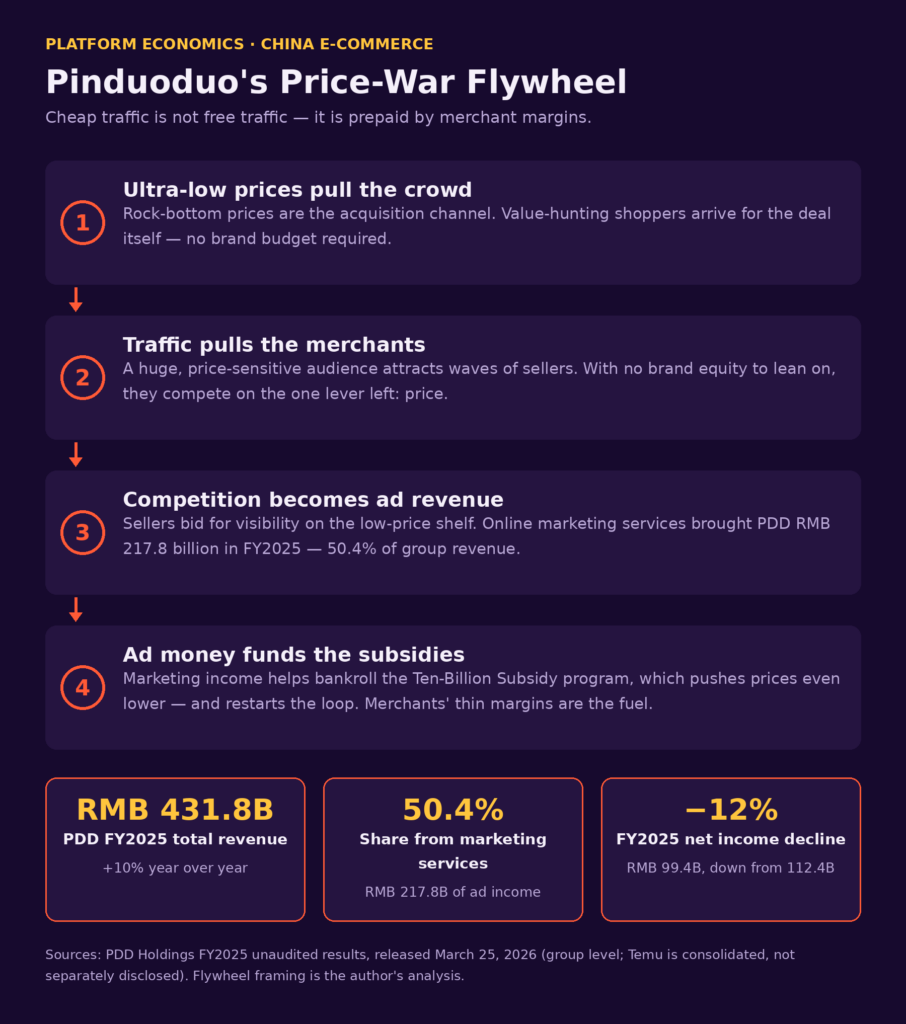
Where’s the fuel? Merchant margins. Every rotation of this wheel is paid for by sellers shaving their prices one notch thinner and spending one notch more on ads. The platform collects on both sides of the squeeze — ads on the way in, transaction fees on the way out. It’s elegant, if you’re the platform. It’s a treadmill, if you’re the merchant. And treadmills, as we’ll see, eventually attract the attention of people who regulate treadmills.
Three Generations of Ad Machinery
Pinduoduo’s ad tools evolved in three generations, and the progression is a masterclass in reducing merchant effort while increasing platform take.
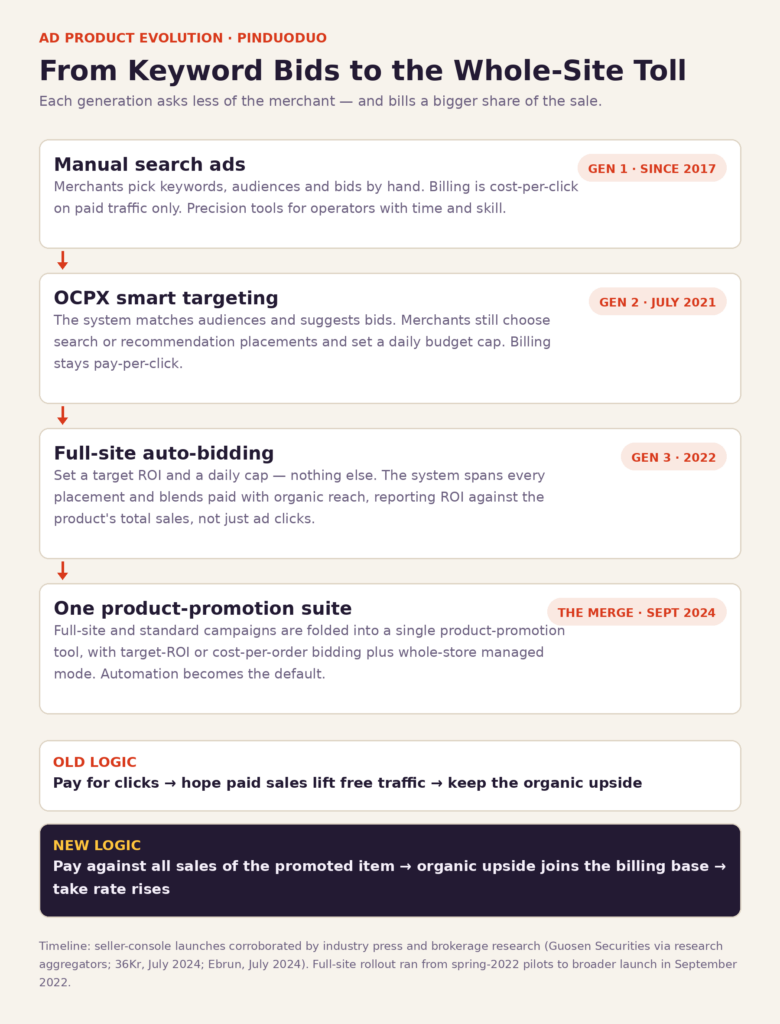
Generation one, running since roughly 2017, was manual search advertising: pick keywords, set audiences, manage bids, pay per click. Skilled operators could arbitrage it. Generation two arrived in July 2021 as OCPX smart targeting — the system matched audiences and suggested bids, but merchants still chose placements and paid only for paid clicks. Generation three is the one that changed everything: full-site promotion, piloted in spring 2022 and rolled out broadly that September. The merchant sets two numbers — a target ROI and a daily budget cap — and the system does the rest, spanning every search and recommendation slot on the platform. In September 2024, Pinduoduo folded full-site and standard campaigns into a single product-promotion suite, making automation the default rather than an option.
The Quiet Revolution: Billing the Traffic You Used to Get Free
Here’s the mechanism most outsiders miss, and it’s the heart of the whole model. In the old pay-per-click world, merchants bought paid traffic and hoped it would lift their organic ranking — the free traffic was the prize. Full-site promotion dissolved that boundary. The system optimizes against the promoted product’s total sales, paid and organic blended, and industry research describes the effective fee as a share of everything that product sells in a day. Analysts at Chinese brokerages put it bluntly: after full-site, there is no free traffic — there is only traffic you haven’t been billed for yet.
Think of it like a landlord who used to charge rent on the storefront, then switched to a percentage of everything sold in the building — including walk-ins who found you on their own. The ad load ceiling vanished. The platform’s monetization was no longer capped by how many ad slots it could cram into a feed; it was capped only by total merchant GMV and how thin a margin sellers would tolerate before exiting. That is why ad revenue could grow at multiples of GMV growth for eight straight quarters after the 2022 launch. It wasn’t more ads. It was a bigger bill.
What Everyone Misunderstands
Let’s clear the fog, because four errors dominate the conversation.
First: “cheap traffic is good traffic.” Cheap is a platform-and-shopper adjective. For the median merchant, low price plus ad spend plus after-sales costs can leave a margin that rounds to zero. There is no authoritative, sample-based statistic on average Pinduoduo merchant profitability — the percentages circulating in self-media contradict each other and none survives scrutiny — but the structural logic doesn’t need a survey: when visibility is auctioned among near-identical sellers, the auction price converges toward the sellers’ entire surplus. That’s not cynicism; that’s how auctions work.
Second: “Pinduoduo is just a low-price platform.” The ledger says otherwise. Low prices are the traffic engine; advertising — 50.4% of group revenue — is the business. Third: “Temu is a separate story.” It isn’t; more below. Fourth: “the model is static.” It’s being actively rewritten by regulators right now, which brings us to the most underpriced part of this analysis.
The State Steps In: The Anti-Involution Reset
On July 30, 2024, China’s Politburo used a phrase that would reshape platform economics: prevent “involution-style” cut-throat competition. What followed was a policy cascade. In September 2024, the market regulator’s interim anti-unfair-competition rules took effect, barring platforms from unreasonably restricting merchants’ pricing or squeezing them through deposits, subsidy cuts and traffic throttling. In March 2025, “comprehensive rectification of involution-style competition” entered the government work report, and the regulator’s chief publicly targeted refund-only abuse — the practice Pinduoduo pioneered around 2021, where shoppers keep the goods and get their money back.
The platforms moved. After the 618 festival in mid-2024, Taobao de-emphasized its five-star price-power weighting and returned to GMV-led ranking, and Pinduoduo reportedly made GMV growth its first priority too — both moves known through media reporting with internal sources rather than company announcements, so treat the specifics accordingly. In August 2024, Pinduoduo began rebating ad-service fees on orders fully refunded before shipment. On April 3, 2025, it pledged over RMB 100 billion in resources across three years for merchant support. Around April 22, 2025, the major platforms — Pinduoduo included — announced plans to scrap platform-forced refund-only after-sales. And on October 15, 2025, the amended Anti-Unfair Competition Law took effect with platform provisions aimed at forced below-cost selling.
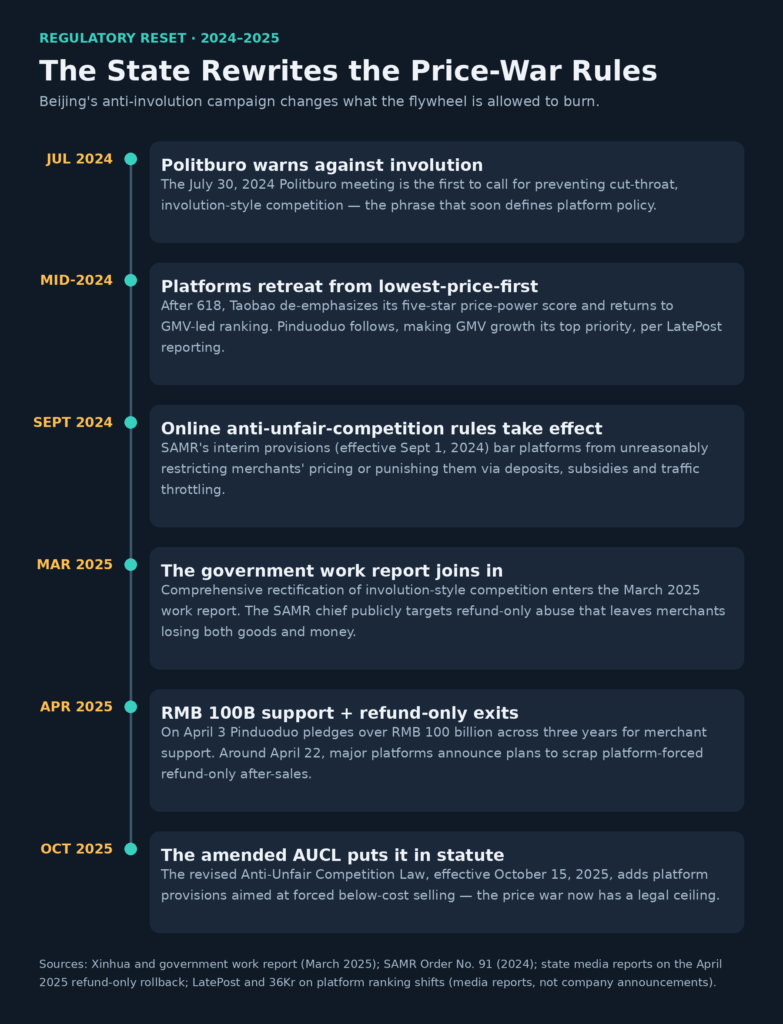
The flywheel isn’t banned. But its fuel supply — coerced low prices, punitive after-sales, margin destruction as policy — now has a legal ceiling. The Q4 2025 ad growth rate of 5% is what a monetization engine looks like when the state taps the brakes.
The Temu Connection: One Group, One Subsidy Pool
PDD has never disclosed Temu’s financials separately; the overseas app’s revenue sits inside transaction services, and every Temu loss figure you’ve seen is an external estimate — with analyst estimates diverging by a factor of three, none deserves to be quoted as fact. What is verified is the structure: domestic profits fund overseas expansion, and the group, not the app, is the unit of analysis.
The stress test came in 2025. Washington ended de minimis duty-free entry for Chinese parcels on May 2, 2025, and extended the suspension to all countries on August 29. Temu slashed US ad spending and pivoted to local-warehouse fulfillment. Sensor Tower, a commercial data firm, measured a 58% drop in Temu’s US daily active users that May, as reported by Reuters. HSBC analysts estimated that non-US users reached 90% of Temu’s roughly 405 million global monthly actives by Q2 — a bank estimate, not a company figure. The cross-subsidy now runs in an interesting direction: the domestic ad machine, growing at 5%, must fund an overseas rebuild. The flywheel’s output has a second mouth to feed.
What This Means for Your Brand
Do the merchant math before the platform math
Before anyone on your team calls Pinduoduo traffic “cheap,” build the full unit economic: landed cost, platform fees, the effective full-site ad take, after-sales losses, returns. If the target ROI your media buyer sets doesn’t clear that stack with margin left over, you’re not buying growth — you’re donating inventory to someone else’s flywheel. The honest number, not the dashboard ROI, decides.
Use it for volume, not margin
The channel genuinely works for what it’s built for: factory-direct supply chains with structural cost advantages, clearance of seasonal stock, high-velocity commodity SKUs. It does not work as a premium brand’s profit center, because the auction punishes exactly the thing premium brands sell — differentiation. Pick your SKUs the way you’d pick items for an outlet mall, not a flagship.
Trade with the regulator’s clock
The 2024–2025 reset is a tailwind for merchants who were being squeezed: fee rebates, the refund-only rollback, the RMB 100 billion support pledge. Claim what’s on the table, and watch whether the amended law’s enforcement actually loosens the price coercion in your category. Policy, not platform generosity, is doing this work — and policy can tighten again.
The Counterargument — and Its Limits
Fair objections exist. Some merchants absolutely profit on Pinduoduo — the ones whose supply chains are genuinely cheaper, not merely cheaper-listed. But that’s survivorship with a cost moat; it describes the winners of the auction, not the auction’s average participant. The platform itself is profitable, true — RMB 99.4 billion of net income is nobody’s distress signal. Yet that profit fell 12%, ad growth collapsed to 5% in Q4, and the group still ended 2025 sitting on RMB 422.3 billion in cash and short-term investments while choosing to spend down its margin on ecosystem support. Even management is telling you, in the language of accounting, that pure extraction had hit its limit. And yes, cheap traffic is a moat — for the platform. A moat built on merchant margins holds only as long as merchants survive to refill it. That’s the limit of every objection: each is true at the top of the pyramid and false at its base.
The Bottom Line
Pinduoduo built the most efficient price-war monetization machine in commerce history: half of a RMB 431.85 billion revenue base comes from advertising, and the full-site auto-bidding system bills merchants against sales they used to get for free. The traffic is cheap the way a company-town store is convenient — the price is baked into your wages. For the platform, that’s a moat. For merchants, it’s a trap with an exit price. And since mid-2024, the state has been rewriting the terms of the trap: refund-only is being dismantled, below-cost coercion now carries legal risk, and the ad engine’s growth has slowed to a crawl. If you’re a brand, the playbook is three lines long: compute your real unit economics, use the channel for volume rather than margin, and let the regulator’s clock — not the platform’s pitch deck — set your expectations. Cheap traffic is never free. Someone is always paying. Make sure you know who.