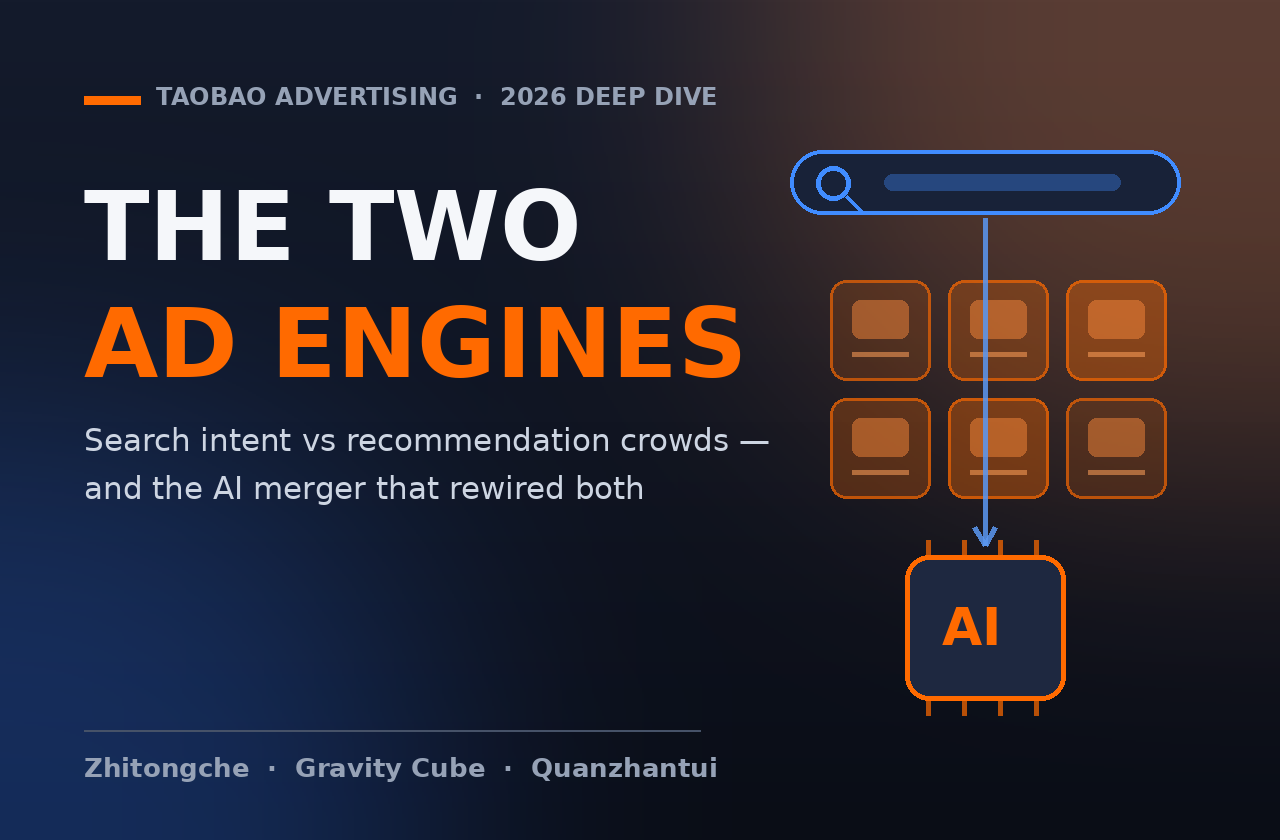
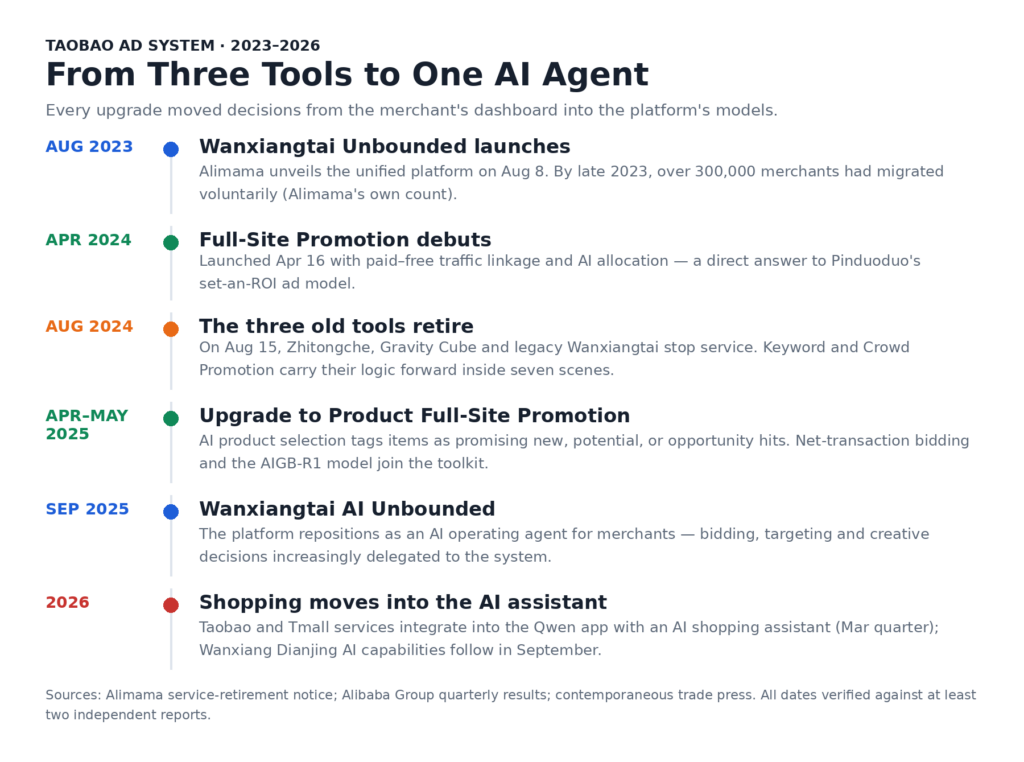
If you learned Taobao advertising from an English guide written before 2024, you learned a system that no longer exists. The two tools every guide dutifully explains — Zhitongche, the keyword-bidding workhorse, and Yinli Mofang, the recommendation-feed crowd targeter — were officially switched off on August 15, 2024. Not renamed. Switched off: product websites closed, leftover balances handled through customer service, per Alimama’s own retirement notice.
And yet almost nothing about the underlying strategy died with them. That is the paradox worth understanding. The tools merged; the two traffic logics they represented — capturing demand that already exists versus creating demand that doesn’t — survived intact inside a unified, increasingly AI-run platform. If you run ads on Taobao or Tmall in 2026, or you advise brands that do, the dashboard looks nothing like the 2019 screenshots still circulating in Western blog posts. The strategic choices, though, are older than the software. Let’s untangle what changed, what didn’t, and where sellers still burn money.
The Short Version
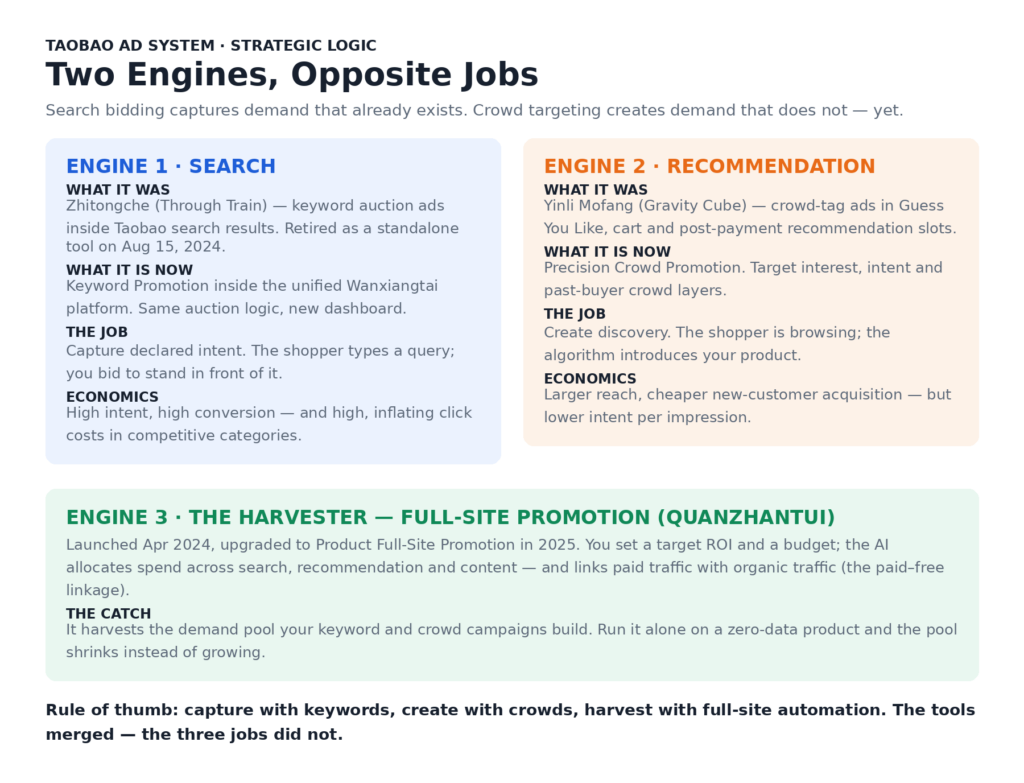
Taobao’s ad system ran on two engines with opposite jobs. Zhitongche (“Through Train”) sold search-keyword auctions: a shopper types a query, you bid to appear. Yinli Mofang (“Gravity Cube”) sold crowd-tag targeting in recommendation slots: a shopper browses, the algorithm introduces you. In August 2024 both were folded into Alimama’s unified Wanxiangtai Unbounded platform as Keyword Promotion and Precision Crowd Promotion. A third mechanism — Full-Site Promotion, launched in April 2024 — now automates allocation across both. Through 2025 and 2026 the platform kept absorbing decisions into AI, culminating in an agent-branded relaunch and Taobao’s integration into Alibaba’s Qwen assistant. The tools became one. The strategy is still three jobs: capture, create, harvest.
Two Engines, Opposite Jobs
The Capture Engine: Search Keyword Bidding
Zhitongche was, at heart, Google Ads inside a marketplace. You chose keywords, set bids, and competed for placement in Taobao’s search results. The traffic was gold because the intent was declared: someone typing “summer dress” into a shopping app is not browsing for entertainment. Conversion rates rewarded that intent, and so did costs. In hot categories, keyword auctions became brutal — Chinese seller communities spent years complaining that search traffic was both scarce and expensive, a complaint echoed across contemporaneous trade coverage of the merger.
The engine’s job was capture. Existing demand flows through search every day; keyword bidding decides who stands in front of it. Nothing creates new demand here. You are paying for position in a queue that forms whether you advertise or not.
The Create Engine: Recommendation Crowd Targeting
Yinli Mofang worked the other side of the app. Its ads lived in Guess You Like feeds, cart pages, and post-payment recommendation slots — placements shoppers reach while browsing, not searching. Instead of keywords, you targeted crowd tags: interest segments, high-intent segments, past buyers. The recommendation algorithm matched your product to people whose behavior suggested they might want it, even though they never asked.
That is creation, or at least discovery. The pool of reachable shoppers is far larger than search, and acquisition costs per new customer are typically lower — a pattern practitioner guides consistently reported around the merger. The trade-off is intent per impression. A feed impression is a maybe; a search click is a want. Two engines, two economics, two jobs.
The 2024 Merger Most English Guides Miss
Here is the update that most English-language content still hasn’t absorbed. Alimama launched Wanxiangtai Unbounded on August 8, 2023, then spent a year migrating merchants onto it. By late 2023 the company said more than 300,000 merchants had migrated voluntarily, with over 70% citing unified accounts and budgets as the main draw — Alimama’s own numbers, worth remembering when you weigh them. On August 15, 2024, the migration became an eviction: Zhitongche, Yinli Mofang, and the legacy Wanxiangtai scenario tool stopped service entirely.
Seven Scenes, One Wallet
The merged platform reorganized everything into seven scenes, confirmed by Alimama’s official learning materials: Keyword Promotion (the old Zhitongche), Precision Crowd Promotion (the old Yinli Mofang), Product Operations, Consumer Operations, Campaign Scenarios, Store Operations, and Content Marketing. One account, one balance — top up once, spend anywhere across search, recommendation, livestream, and short-video inventory.
Notice what the structure admits. The two precision tools kept their manual, controllable character; the other five scenes lean on automation. Alimama effectively sorted advertising into “you drive” and “the system drives,” then put both behind one login. The strategic question stopped being which tool to open and became how much control to surrender.
Enter the Harvester: Full-Site Promotion
The third mechanism matters more than its billing suggests. Full-Site Promotion — Quanzhantui in Alibaba’s earnings language — launched on April 16, 2024 and opened to all sellers that August. You set a target ROI and a daily budget. The system decides keywords, crowds, placements, and bids across the entire app. Trade press at the time read it, correctly, as Alibaba’s answer to Pinduoduo, whose set-an-ROI ad product had already trained a generation of Chinese sellers to expect ads without dashboards.
The Paid–Free Linkage Is the Real Story
The genuinely novel piece is what Alimama calls paid–free linkage: paid spend is optimized to lift the product’s organic search and recommendation traffic too, and reporting blends both. That is a profound change in what an ad dollar buys. In the Zhitongche era, you bought clicks. In the Quanzhantui era, you buy the algorithm’s overall favor toward your product. It also complicates measurement — when paid and organic move together by design, channel-level attribution becomes partly theatrical.
The catch is arithmetic. A harvester harvests. Full-Site Promotion amplifies whatever demand pool your product already has; it does not manufacture one from zero. Sellers who switched everything to automation and killed their keyword and crowd campaigns discovered their pools quietly shrinking. The healthy pattern practitioners converged on is three-pronged: full-site as the base, keyword campaigns to keep expanding search demand, crowd campaigns to keep expanding recommendation reach.
2025–2026: The Dashboard Became an Agent
The story didn’t stop at the merger, and this is where even recent English guides go stale. In April–May 2025, Full-Site Promotion was upgraded into Product Full-Site Promotion, with AI selection tagging products as promising new items, potential growers, or opportunity hits, each with its own bidding playbook. A net-transaction bidding mode began filtering out likely refunders — Alimama claimed roughly 20% lower return rates, and its AIGB-R1 model supposedly lifted hit-product ROI attainment by 16%. Both figures are platform-reported, with no published methodology or third-party audit. Treat them as vendor claims, not benchmarks.
In September 2025 the whole platform relaunched as Wanxiangtai AI Unbounded, explicitly positioned as an operating agent rather than a toolkit. By the March 2026 quarter, Alibaba was integrating Taobao and Tmall services into its Qwen app and shipping a Qwen Shopping Assistant, per its earnings announcements; in September 2026 it introduced Wanxiang Dianjing, an AI layer that reads intent behind queries and finds audiences beyond conventional tags. The direction is unmistakable: first the tools merged, then the decisions migrated, and now the shopper’s interface itself is becoming an assistant. Bidding on keywords is starting to mean convincing a model, not just outranking rivals.
What Alibaba’s Own Earnings Reveal
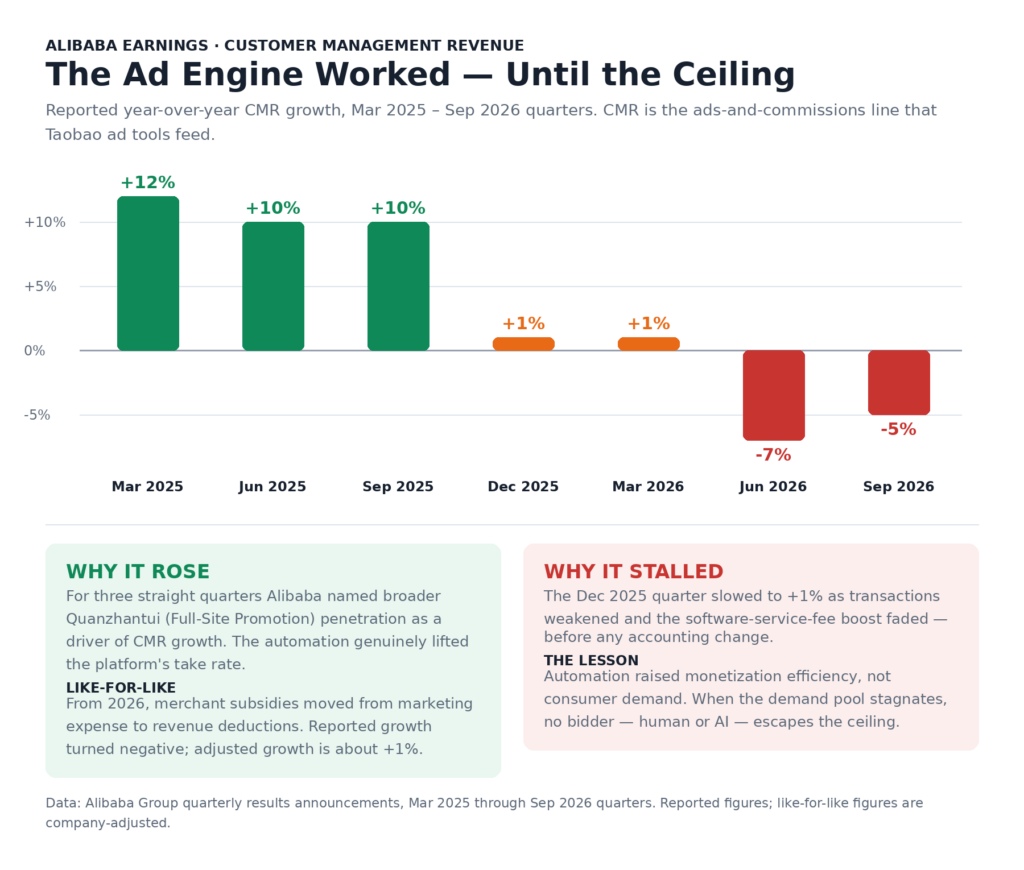
Did any of this work? The honest answer is: yes, then it hit a ceiling. Customer management revenue — the ads-and-commissions line these tools feed — grew 12% year over year in the March 2025 quarter to RMB 71.1 billion, and Alibaba explicitly credited the software service fee plus “broader penetration of AI-powered marketing tool Quanzhantui.” Growth held at 10% through the June and September 2025 quarters. That is about as close to official confirmation as you get: the automation genuinely raised the platform’s take rate.
When the Growth Story Stalled
Then the curve bent. The December 2025 quarter slowed to 1% as transactions weakened and the fee effect faded. From 2026, an accounting change — merchant subsidies reclassified from marketing expense into revenue deductions — pushed reported growth negative: minus 7% in the June 2026 quarter and minus 5% in the September 2026 quarter, with like-for-like growth around 1% in both, according to the company’s results announcements. Note what disappeared from the earnings narrative along the way: Quanzhantui as a named growth driver.
The lesson is bigger than one platform. Automation improved monetization efficiency; it did not create consumer demand. When the demand pool stagnates, no bidder — human or AI — escapes the ceiling. For sellers, that means the efficiency war is now table stakes, and differentiation has to come from product, creative, and crowd expansion. For analysts, it means reading “AI-powered growth” claims against the actual revenue line.
The Practitioner Playbook
New Products: Label Before You Harvest
A new listing has no behavioral history, so recommendation models don’t know whom to show it to. The established move is a labeling phase: run Keyword Promotion on tight, relevant queries (practitioners commonly describe roughly a week of this) so the system learns which searches convert, or use the Product Operations scene’s new-launch automation. Only once baseline sales and conversion data exist does Full-Site Promotion have a pool to amplify. Specific order-count thresholds circulating in seller communities are folklore, not official rules — the principle is data first, automation second.
Proven Products: Harvest plus Expand
For a product with traction, run Full-Site Promotion in target-ROI mode as your profit base, switching to maximize-volume mode with a daily cap during campaign peaks. Keep a keyword campaign defending your core search terms and a crowd campaign prospecting. On crowd budgets, practitioners commonly weight intent and past-buyer segments early (cheap conversions that fund learning), then shift toward broad interest segments as the product matures and needs fresh demand. Treat those splits as heuristics to test, not laws — category economics vary wildly.
Creative and Measurement
Recommendation slots punish white-background catalog shots; scene imagery and short video earn the click, and the platform’s own guidance pushes merchants to upload plenty of variants so the system can test. On measurement, watch net-of-refund ROI where available, watch whether organic traffic grows alongside paid (the linkage promise), and distrust any dashboard that grades the algorithm’s homework with the algorithm’s own answers — including platform-published case studies, which are marketing material by definition.
Four Ways to Burn Money in the Merged System
One: running 2019 logic — micromanaging manual bids inside a system designed to optimize around you. Two: going full-site-only and letting the demand pool shrink while the harvester congratulates itself. Three: fighting keyword inflation in saturated categories when crowd inventory offers cheaper discovery. Four: taking vendor ROI claims at face value; every impressive case number in Alimama’s promotional material is self-reported. The merged system rewards operators who set strategy and guardrails, then let the machine execute — and who keep enough manual campaigns alive to feed it new demand.
What Marketers Outside China Should Steal
You don’t need a Taobao store to use this framework. Amazon’s Sponsored Products versus Sponsored Display is the same capture-versus-create split. Google’s Performance Max is the same harvester, with the same opacity complaints and the same pool-shrinkage risk when brands kill their manual campaigns. And every major platform is walking the same path Alimama walked: tools merge, decisions automate, the interface becomes an agent. China simply ran the tape two years ahead. Watch what breaks there first — attribution, creative differentiation, the economics of advice when the ad platform also owns the shopping assistant — because it is coming to your channel next.
The Bottom Line
Taobao’s two ad engines never really died; they were absorbed. Zhitongche became Keyword Promotion, Yinli Mofang became Precision Crowd Promotion, and Full-Site Promotion became the AI harvester sitting on top of both — now itself absorbed into an agent-branded platform feeding an AI shopping assistant. The verified earnings arc shows automation lifting monetization for three quarters before macro reality capped it. The strategy that survives every rewrite of the software is the one this article opened with: capture declared intent, create discovery, harvest the pool — and never let the harvester become the whole farm.