Somewhere in China right now, a woman in her fifties is watching a shampoo ad. Nobody interrupted her. She asked for it. Thirty seconds of attention, traded voluntarily for an extra life in a puzzle game she plays while the kettle boils. Multiply that small bargain by a few hundred million people a day, and you get something most Western media plans have no line item for: a casual-attention ad channel hiding inside a chat app.
That channel is the mini-game — an instant-play game that lives inside WeChat or Douyin, with no download, no install and no app-store friction. In 2026, it stopped being a curiosity. It became media.
A Game Channel That Behaves Like a Media Channel
We keep filing mini-games under “gaming,” which is a bit like filing television under “electronics.” Technically true, strategically useless. A media channel is anything that gathers predictable attention at scale and sells access to it. By that definition, China’s mini-game ecosystem qualifies on every axis: audience, habitual usage, ad inventory and a functioning marketplace.
The reframe matters because it changes what a marketer can do here. You are not sponsoring a game. You are buying attention inside a distribution system that happens to be fun — one where the ad can be opt-in, the distribution can be social, and the ad unit itself can be a playable game.
The Numbers: A RMB 53.5 Billion Channel
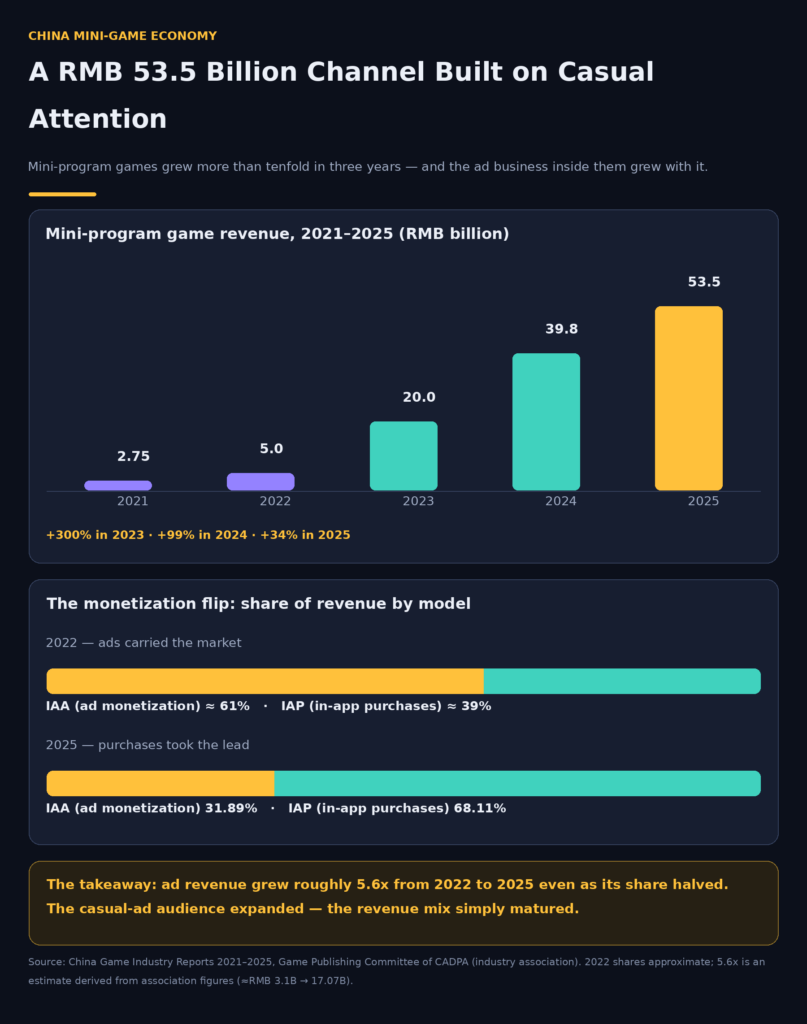
Start with the money, because the money is unusually well documented. The Game Publishing Committee of the China Audio-Video and Digital Publishing Association — the industry body whose annual report functions as the sector’s official ledger — put 2025 mini-program game revenue at RMB 53.535 billion, up 34.39% year on year. That is roughly 15% of China’s entire games market, which totaled RMB 350.8 billion.
The trajectory is the story. The same association’s reports trace the category from RMB 2.75 billion in 2021 to RMB 5 billion in 2022, RMB 20 billion in 2023, RMB 39.8 billion in 2024, and today’s figure. More than tenfold growth in three years, while the overall games market grew single digits. When one format compounds at 30–300% a year inside a mature industry, it is not a fad. It is a structural shift in where attention goes.
The Monetization Flip Everyone Misreads
Here is where casual observers get the story backwards. In 2022, ad monetization — the industry calls it IAA, in-app advertising — carried roughly 61% of mini-game revenue, with in-app purchases (IAP) at about 39%. By 2025, the split had inverted: purchases took 68.11%, ads 31.89%.
Read superficially, that looks like the death of the ad model. Read carefully, it is the opposite. Ad revenue grew from roughly RMB 3 billion to RMB 17.07 billion over the same stretch — a five-to-six-fold increase, derived from the association’s share and total figures. The pie grew faster than the ad slice shrank. Meanwhile the ad-funded audience kept expanding: Tencent reported IAA user growth of 25% year on year and commercial growth of 30% at its May 2026 developer conference.
What actually happened is maturation. Deep-paying genres — simulation, RPG, strategy — arrived and pulled the revenue mix toward purchases. The casual ad business underneath did not die. It got bigger and quieter, which is exactly what mature media businesses do.
Who Is Actually Playing: Not Who You Think
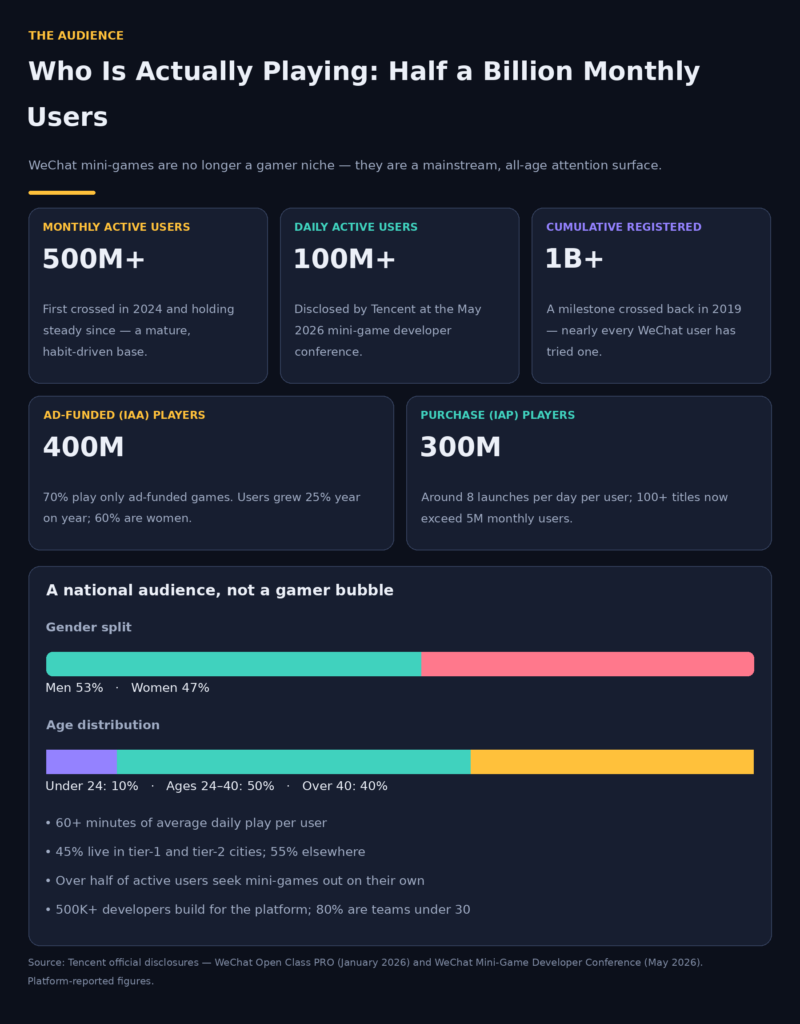
If your mental image of a Chinese mini-game player is a teenage boy, update it. Tencent’s platform disclosures — first at WeChat Open Class PRO in January 2026, then at the developer conference in May — describe an audience of more than 500 million monthly active users, a milestone first crossed in 2024, with daily actives above 100 million and cumulative registrations past one billion, a mark reached back in 2019. Note the layered timing: these are three different milestones, not one announcement.
The composition is the surprise. Users split 53% male and 47% female. Half are aged 24 to 40, and a full 40% are over 40. Only 45% live in tier-1 and tier-2 cities. Average daily play exceeds 60 minutes, and more than half of active users seek mini-games out on their own rather than stumbling in through a shared link. Among ad-funded games specifically, women are 60% of players.
One honest caveat: these are Tencent’s own figures, unaudited, disclosed at events designed to attract developers. They are directionally consistent with the association’s independent market data, but treat the decimals as marketing, not census. The headline — this is a mainstream, all-age, lower-tier-city-heavy audience with an hour a day to spare — survives any reasonable discount.
The Four Machines Behind the Format
Strip away the game skins and four mechanisms do the work. Each one maps to a marketing move.
Machine 1: Rewarded Video, the Ad Users Ask For
The native ad unit of the mini-game economy is the rewarded video: watch thirty seconds, get an extra life, a hint, a boost. The player initiates the transaction. That single design choice flips the psychology of advertising — the ad stops being an interruption and becomes a payment. You cannot buy that kind of consent with a pre-roll.
The inventory is deep. Tencent counts more than 1,400 ad-funded titles earning over RMB 1 million a year, with new million-yuan monthly earners appearing every month. For a brand, this is reachable performance inventory: reward placements bought through Tencent’s ad system, aimed at an audience that chose to watch.
Machine 2: Social Fission, the Distribution You Cannot Buy
The second machine is WeChat’s relationship graph. At the January 2026 Open Class, WeChat’s own instructors put numbers on it: for games with well-designed social mechanics, 30–50% of registered users arrive through shares and group chats. In board-and-card genres it reaches 70–80%. Users who enter socially retain about 20% better than average, and some ad-funded games earn more than 80% of their revenue from socially acquired players.
The platform even quotes an exchange rate: a typical ad-funded game buys two users and gets a third one free through sharing. Purchase games run closer to buy-three-get-one. Think about what that means for effective CPM — a third of your reach can arrive at zero media cost, carrying a friend’s implicit endorsement. No banner network on earth offers that.
Machine 3: Playable Ads — When the Game Is the Ad
The third machine reverses the direction of the money. A mini-game can be the ad: a thirty-second playable slice of gameplay used to acquire users for another app or game.
The performance evidence is strong, with the usual vendor caveat. Liftoff, a mobile growth platform that sells ad optimization, reported in its 2025 Mobile Ad Creative Index — built on 4.7 trillion impressions from its own network — that playable ads converted impressions to installs at 8 times the rate of non-playable formats for top-spending game advertisers, and 16 times for the rest. Earlier research from Magna and IPG Media Lab, run with brands including Amazon and MillerCoors, found interactive video ads lifted viewing time 47% and ad recall 32%, with a ninefold lift in purchase intent among people who interacted. That study measured interactive video, not pure playables, and it dates to 2017 — but the direction has held across every serious dataset since.
China’s twist: the playable does not need to fake the product. Because the real game runs instantly in WeChat, the ad and the destination can be the same thing. The funnel collapses to a tap.
Machine 4: Branded Mini-Games, Media You Own
The fourth machine is building your own. The precedent cases are old enough to have battle-tested numbers. KFC’s 2019 retro arcade — Battle City, Pac-Man and Galaxian rebuilt under Bandai Namco license, with hidden KFC levels and score-linked coupons — drew 1.85 million registrations in about five weeks, peaked at 840,000 daily users, and pushed players straight into its ordering mini-program. Buying a chicken bucket bought unlimited game lives; playing earned discounts. A closed loop between play and purchase.
McDonald’s ran the volume version: after becoming Jump Jump’s first commercial partner in 2018, its 2019 New Year campaign placed custom content across seven top mini-games, logging 320 million impressions and 35 million people reached, with gift-card sales at several times normal levels — figures from its award-submitted case study, so brand-reported, but concrete. And Sheep a Sheep, the 2022 viral puzzle, proved the ceiling and the trap at once: servers buckled under the traffic, its founder later said revenue crossed RMB 100 million, and the infamous screenshot claiming RMB 4.68 million in a single day was confirmed fake — publicly debunked by Tencent’s Pony Ma himself. Plan for the format, not for the lottery.
What Western Marketers Get Wrong
The common error is equivalence: “We have playable ads too.” Not like this. In the West, a playable is a user-acquisition tactic — a creative format inside someone else’s ad network. In China, the mini-game is an ecosystem: its own audience of half a billion, its own social distribution, its own ad marketplace, its own payment rails, and more than 500,000 developers, 80% of them teams under thirty people, feeding it content. The playable is one export of that system, not the system itself.
The second error is dismissing the audience as low-value because the games are casual. Casual is the point. This is the attention of the bus stop, the queue, the kettle — attention that never shows up in a gamer demographic and rarely converts through a hard-sell funnel, but responds beautifully to a small, honest exchange.
The Counterarguments, and Where They Break
“Aren’t these just annoying interstitial ads?”
Some are, and those deserve the annoyance. But the format that carries the economy is the rewarded video, which is opt-in by construction. The distinction is not cosmetic: consent changes recall, completion and brand affect. Buy the rewarded placement, not the forced one.
“The IAA share collapsed — the format is dying”
Share fell; absolute revenue roughly quintupled and the ad-funded audience grew to 400 million monthly players, larger than the purchase audience. A format does not die while adding users and revenue. It just stops being the only story.
“This only works inside WeChat”
WeChat is the largest venue, not the only one. Douyin’s mini-game ecosystem reported 120% year-on-year DAU growth and doubling revenue at its December 2025 ecosystem conference, and DataEye estimates roughly a third of China’s mini-game players now play on Douyin, skewing younger. Alipay runs them too. The logic — instant play, rewarded attention, native sharing — travels across every super-app that hosts it.
The Playbook: What to Do Monday Morning
Four moves, in ascending order of commitment. First, audit where your audience’s casual attention already lives; if you sell to Chinese consumers over 30, outside tier-1 cities, or to women — this audience is probably your audience. Second, buy rewarded-video inventory through Tencent’s ad system and judge it on completed views and downstream action, not CPM alone. Third, design for the share: asynchronous challenges, group leaderboards, a reason to pull a friend in — then track social registration share and the retention delta, because that is where the free third of your reach comes from. Fourth, if the budget allows, build a branded mini-game with a KFC-style loop: play earns real commercial value, purchase enhances play. Keep it small, keep it honest, ship it in weeks.
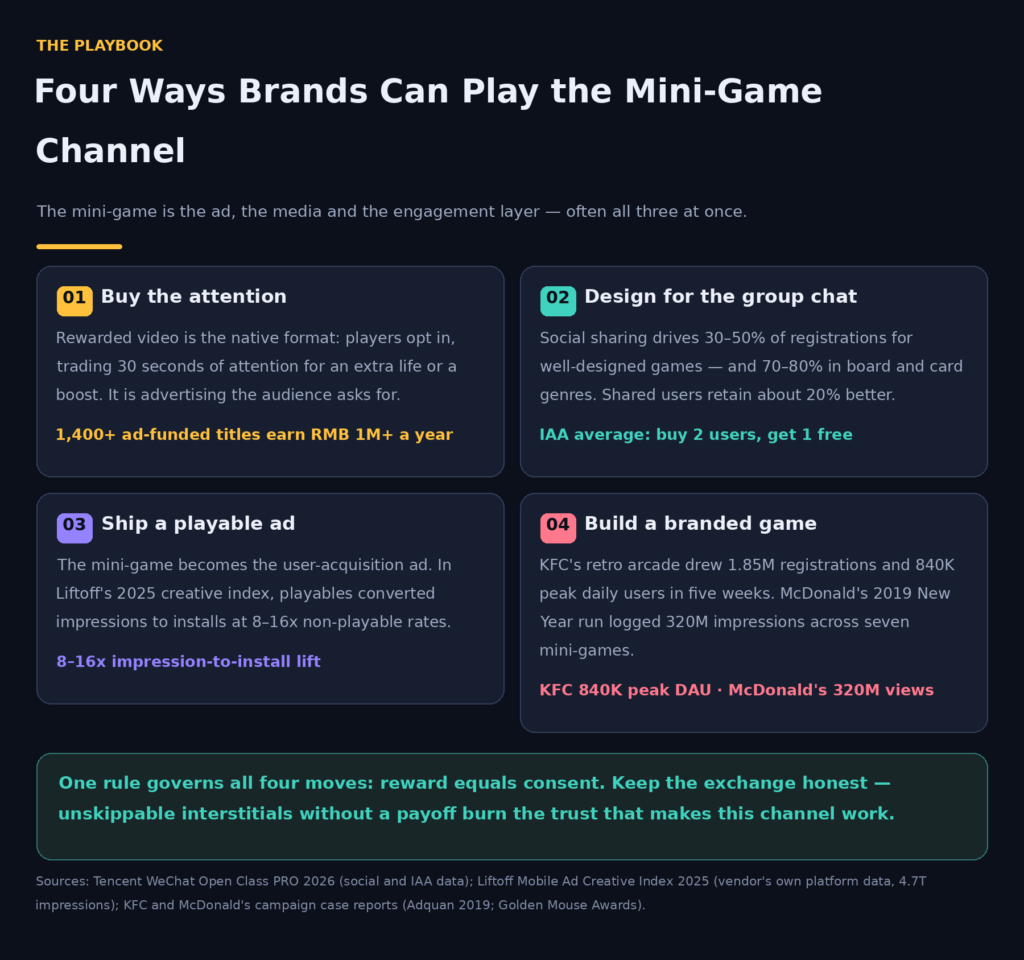
One governance note: the reward must be real. An unskippable ad with no payoff burns the trust that makes this channel outperform. The entire economics rest on a voluntary exchange; break the exchange and you are back to buying resentment at banner prices.
The Takeaway
The mini-game is the new banner ad — except it is interactive, social and opt-in, sitting on 500 million monthly players and a market that grew tenfold in three years. The brands that treat it as media, not as gaming, get three things a banner never gave them: attention the user chose, distribution a friend carried, and an ad the audience actually played. The casual hour was always there. China just built the machine that sells it honestly.