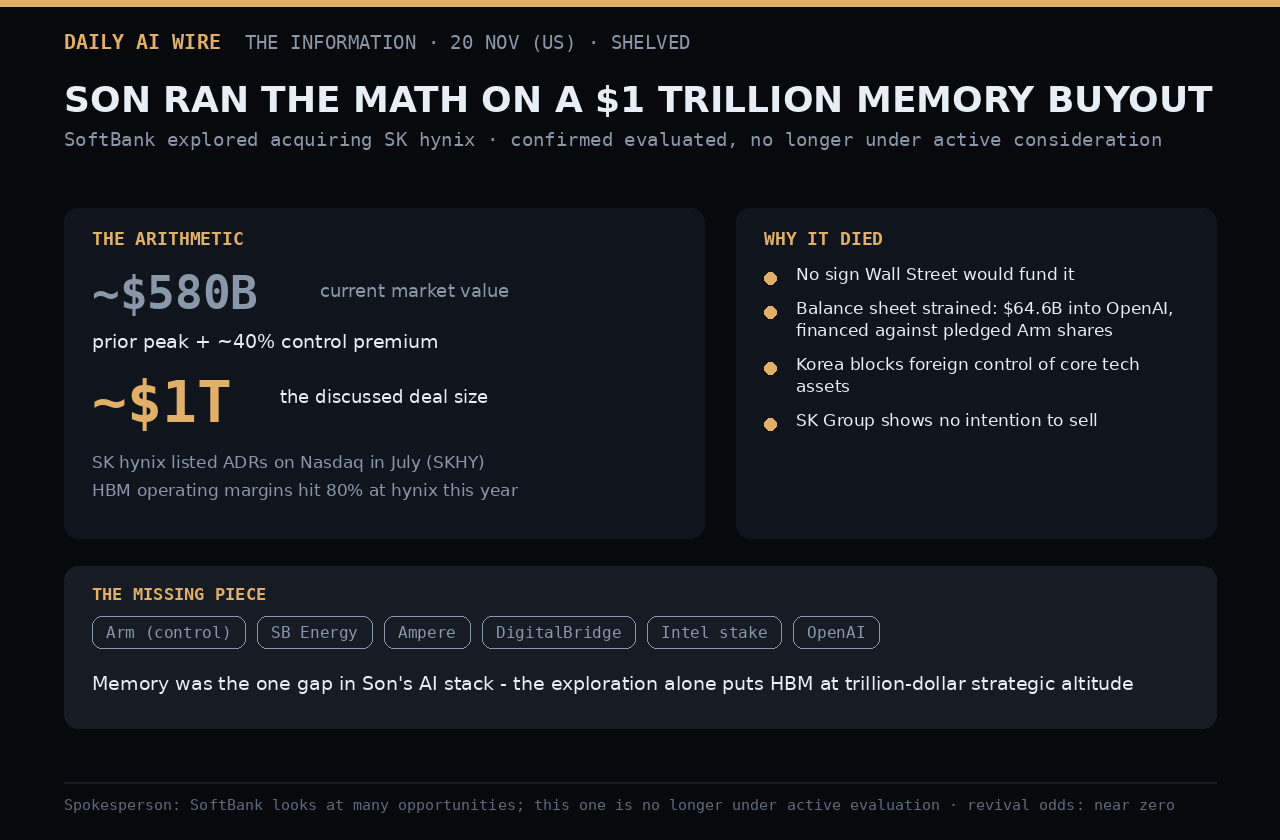
The Information reported on November 20 (US time, with Reuters and Yonhap following on the 21st) that SoftBank’s Masayoshi Son recently approached Wall Street institutions to explore financing an acquisition of SK hynix at a scale approaching $1 trillion — a figure derived from the memory maker’s higher market value a month ago plus a customary ~40% control premium, against today’s roughly $580 billion (the company listed Nasdaq ADRs under SKHY in July). A SoftBank spokesperson confirmed the evaluation and killed it in one sentence: “SoftBank looks at a large number of opportunities, and this deal is no longer under active evaluation.” The obstacles were structural: no sign Wall Street would fund it, a balance sheet already strained by $64.6 billion committed to OpenAI and financed against pledged Arm shares, Korea’s near-certain refusal to let a Japanese buyer control a core national tech asset, and no indication SK Group wants to sell. The strategic logic nonetheless reads clearly — Son controls Arm and SB Energy, holds Ampere, DigitalBridge, Intel and OpenAI stakes, and memory was the one missing piece of his AI stack, in a market where SK hynix’s operating margins touched 80% this year. Revival odds are near zero; but the exploration alone elevates HBM to trillion-dollar M&A altitude — memory is no longer a commodity line item, it is the asset empires are imagined around.