Picture the last thing you bought online because of something you read. Maybe it was a camera comparison, a skincare breakdown, an “is this worth it” thread. Now ask yourself an awkward question: when you clicked buy, had you ever left the article?
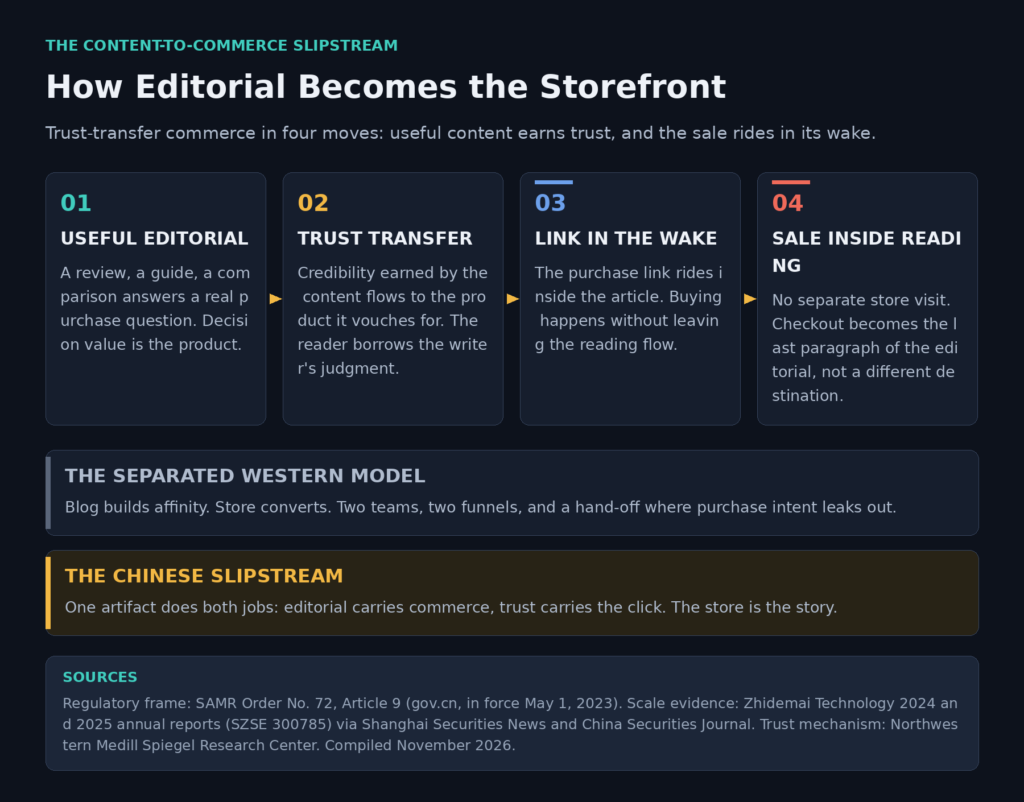
In most Western marketing stacks, you had. The blog lives over here, the store lives over there, and a funnel — with all its leaks — stretched between them. In China, that gap has quietly collapsed. On Xiaohongshu (RedNote), Zhihu and SMZDM — the deal-review platform whose name literally translates as “what is worth buying” — the review, the guide and the comparison are not preludes to the store. They are the store. The purchase link rides inside the reading, trust flows from the writer to the product, and the sale happens without the reader ever changing mental gears.
Call it the content-to-commerce slipstream. In cycling, the rider tucked behind a leader spends dramatically less energy, carried along in the low-pressure wake. Chinese editorial does that for commerce: useful content cuts the resistance, and the sale drafts behind it, nearly invisible. This piece unpacks how that wake forms, why regulators decided to label it rather than ban it, and why — of all things — AI answer engines are now the slipstream’s biggest amplifier.
The Storefront That Looks Like an Article
Start with what a shopper actually does. She wants a robot vacuum. Instead of opening a mall app, she opens RedNote and searches for a hands-on comparison written by someone who owns three of them. The note ranks suction, noise, mop-washing quirks — and carries a product card. Two taps later she has ordered, without ever visiting what a Western marketer would recognize as a storefront.
This is not a fringe behavior. By June 2024, RedNote reported roughly 320 million monthly active users, and its COO Conan disclosed at the company’s 2023 IF conference that about 70 percent of those users search inside the app; a third open it and go straight to the search bar. Media reports in December 2024, tracing platform data, put daily search volume near 600 million queries — roughly double the mid-2023 level. RedNote’s own 2024 search-marketing whitepaper adds that 88 percent of searches are user-initiated. Treat that last figure as platform self-reporting — the company sells search ads, so the number flatters its pitch — but the direction matches every third-party account: in China, a huge share of purchase research begins inside content platforms, not on a search engine results page.
The Western separation — content builds affinity, commerce converts it — is not a law of nature. It is an artifact of how our tools got built. China’s platforms skipped the separation entirely.
Trust Transfer: The Engine Under the Hood
Why does an article sell better than an ad that says the same things? Because trust is not attached to claims — it is attached to sources. When a writer spends 2,000 words honestly explaining where a product fails, the reader extends credit to the writer, and that credit quietly extends to whatever the writer recommends. The commerce borrows the editorial’s credibility. That is the transfer.
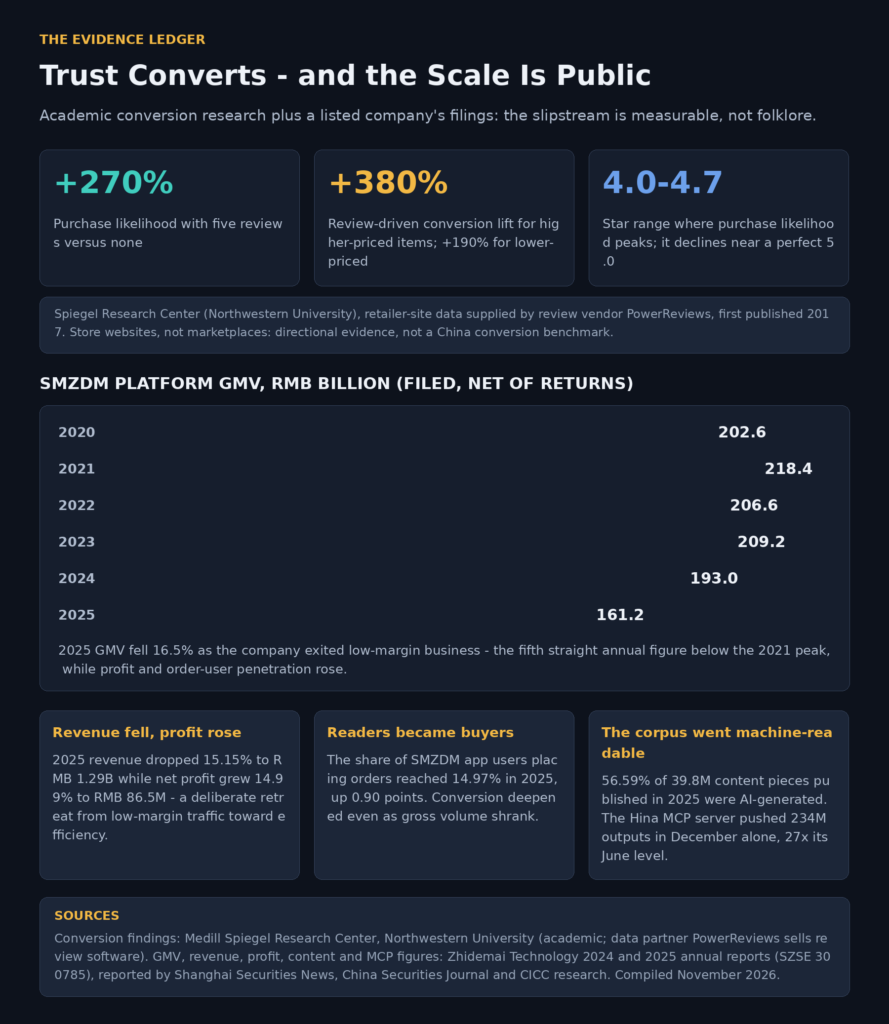
The best quantified evidence comes from academia, not from platforms. Northwestern University’s Medill Spiegel Research Center, analyzing retailer-site data supplied by review vendor PowerReviews (first published in 2017), found that a product displaying five reviews enjoys purchase likelihood 270 percent higher than the same product with none. Displaying reviews lifted conversion about 190 percent for lower-priced items and 380 percent for higher-priced ones — uncertainty is expensive, and evidence is the discount. Most tellingly, purchase likelihood peaked around 4.0 to 4.7 stars and fell as ratings approached a perfect 5.0. Shoppers instinctively distrust perfection.
Two honest caveats: the data covers retailer websites, not Chinese marketplaces, and PowerReviews sells review software, so the partnership deserves a footnote of skepticism. But the mechanism — usefulness earns trust, trust converts, perfection erodes it — is exactly what the slipstream industrializes.
The Receipts: A Listed Company That Runs on Editorial
SMZDM’s operator, Zhidemai Technology, trades in Shenzhen (300785), which means the slipstream’s economics are audited and public. Its 2024 annual report showed revenue of RMB 1.52 billion (up 4.55 percent), net profit of RMB 75.2 million, and platform GMV of RMB 19.3 billion on roughly 195 million orders. Read that ratio again: RMB 1.5 billion of revenue steering RMB 19.3 billion of transactions. The editorial layer captures roughly eight percent of the commerce it conducts — a tollbooth on the slipstream.
The 2025 report, released in April 2026, is even more instructive. Revenue fell 15.15 percent to RMB 1.29 billion as the company deliberately exited low-margin traffic businesses; GMV slid 16.5 percent to RMB 16.1 billion. Yet net profit rose 14.99 percent to RMB 86.5 million, gross margin crossed 50 percent, and the share of app users who actually placed orders climbed to 14.97 percent. Fewer readers, deeper conversion. The company is betting that the future of editorial commerce is not more pageviews but more decision value per page — and it is rebuilding the whole stack around AI to get there. We will come back to that bet, because it is the most interesting number in this story.
The Label Floor: Order 72 and the Honest Fusion
Here is where the story turns from clever to durable. Fused content-commerce could easily have become a deception machine — ads disguised as advice. China’s regulator chose a different path: label the fusion, don’t ban it.
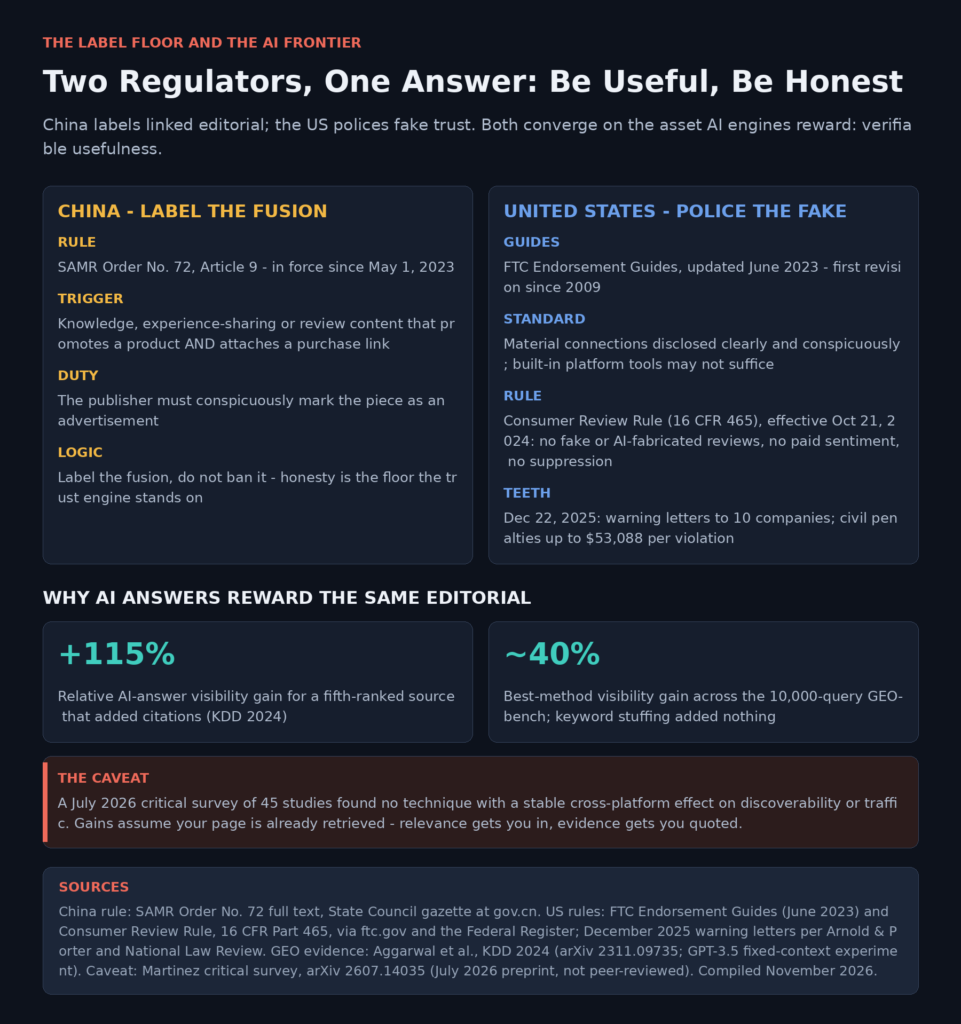
The Internet Advertising Administrative Measures — SAMR Order No. 72, in force since May 1, 2023 — state in Article 9 that when content promotes goods or services through knowledge introductions, experience sharing or consumer reviews, and attaches purchase links or other buying methods, the publisher must conspicuously mark it as an advertisement. Note the trigger: it is the link, not the praise. A genuinely independent review with no purchase path stays editorial. Attach the commerce, and the honesty obligation switches on.
The United States converged on the same floor from the opposite direction. The FTC’s Endorsement Guides, revised in June 2023 for the first time since 2009, require material connections to be disclosed clearly and conspicuously — and warn that a platform’s built-in “sponsored” toggle may not be enough. Then the Consumer Review Rule (16 CFR Part 465), effective October 21, 2024, made fake or AI-fabricated reviews, sentiment-conditioned paid reviews and review suppression formally punishable. On December 22, 2025, the FTC sent warning letters to ten companies, with civil penalties of up to $53,088 per violation on the table.
Two regulators, two legal traditions, one shared conclusion: useful editorial that sells is legitimate; hidden or fabricated trust is not. The label is the floor the whole engine stands on.
Why AI Answers Draft Behind the Same Editorial
Now the plot twist. The content format that regulators just finished labeling is the exact format generative engines prefer to cite.
The founding study — Aggarwal and colleagues, presented at KDD 2024 — built GEO-bench, a benchmark of about 10,000 queries, and tested nine content-optimization methods inside a simulated answer engine. The winners were not SEO tricks. Adding citations to credible sources, adding verifiable statistics, and adding expert quotations lifted a source’s visibility in AI answers by up to roughly 40 percent. Keyword stuffing did nothing. And the equalizer effect was striking: a source ranked fifth in retrieval gained up to 115 percent relative visibility just by citing its sources — evidence lets the underdog out-quote the incumbent.
Pause on what “citations, statistics, quotations” describes. It describes a good review. A serious comparison guide already carries specs, test numbers, sourced claims and expert judgment — it is GEO-native without trying. The slipstream corpus and the AI-citation corpus are the same corpus.
A necessary cold shower: the KDD experiments ran GPT-3.5 inside a fixed, already-retrieved context, and a July 2026 critical survey of 45 GEO studies by Olivier Martinez (an arXiv preprint, not peer-reviewed) concluded that no reviewed technique shows a stable, cross-platform causal effect on organic discoverability or downstream traffic. Translation: optimization improves your odds of being quoted once you are retrieved; it does not summon you into the answer from nowhere. Topical relevance gets you in. Evidence gets you quoted. Usefulness — the oldest asset in editorial — turns out to be both.
The Machine Is Already Reading: SMZDM’s AI Pivot
Remember Zhidemai’s bet? Here is what it looks like in the filings. In 2025, the platform published 39.8 million pieces of content, and 56.59 percent of them were AI-generated — the corpus itself is becoming machine-written. More striking is distribution: the company’s Hina MCP server, which feeds structured consumption content directly to AI agents and terminals, pushed 234 million content outputs in December 2025 alone, more than 27 times its June level, across forty-plus AI ecosystem partners. AI-related revenue reached RMB 87.2 million for the year.
Sit with that architecture. The review platform no longer waits for humans to open the app; it pipes its verdicts into the assistants where questions are already being asked. The storefront is migrating from the feed into the answer. A company that spent fifteen years perfecting editorial-that-sells is now selling the editorial to the machines that answer shoppers directly — and charging for the pipe. If you want to know where the slipstream goes next, follow that server’s output curve.
Four Misreadings Worth Retiring
“Soft articles are just deception.” Some are — scripted, undisclosed, farmed. But the model itself is labeled, useful editorial, and both Chinese and US rules now draw the line at exactly the right place: hidden commerce and fabricated experience. The abuse is not the architecture.
“Content and commerce are separate businesses.” That is a description of Western tooling, not of buyer psychology. The reader never experienced the seam; our org charts did.
“The slipstream means influencer posts.” It spans formats: long-form Zhihu answers, SMZDM deal teardowns, RedNote guides. The mechanism is trust transfer, not any one content type — which is why a boring, thorough comparison often outsells a glamorous endorsement.
“AI will kill editorial commerce.” The evidence points the other way. AI engines cite editorial, and platforms are wiring their corpora straight into assistants. What AI kills is thin, unverifiable content — the kind that never earned trust in the first place.
The Counterarguments, Taken Seriously
Does the mandatory advertising label tax conversion? Probably, at the margin — disclosure research generally finds labels reduce persuasion somewhat. But Spiegel’s perfection finding suggests the offsetting force: readers discount unlabeled enthusiasm too, and a labeled, genuinely useful review can out-convert a suspiciously glowing one. Honesty is not just compliance; it is positioning.
Is the space astroturfed? Parts of it, yes — China’s KOC seeding economy industrialized word-of-mouth, and industrialization invites fraud. That is precisely why the FTC’s fake-review rule and SAMR’s label mandate matter: they raise the cost of the counterfeit so the genuine article can price its trust honestly.
And is GEO overhyped? The 2026 survey says the traffic promises are. Notice what survives the skepticism: verifiable, well-sourced, decision-useful content wins citations conditionally and wins human trust unconditionally. Even if every GEO tactic evaporated tomorrow, the slipstream’s core asset would still compound.
The Playbook: Five Moves for Brands
- Commission decision value, not sentiment. Brief creators and internal teams on comparisons, failure modes and use-case fit. The 4.0-to-4.7-star lesson applies to editorial tone: a review with honest negatives is more persuasive than a hymn.
- Fuse the link natively — then label it. Put the purchase path inside the content and mark it as advertising where the rule requires. In the US, disclose material connections conspicuously; never trust the platform toggle alone.
- Write quotable. Specific numbers, named sources, attributable expert judgment. The KDD findings are a style guide: evidence is what both humans and machines lift out of your page.
- Publish where questions live. Map the actual queries your buyers type into RedNote search and into AI assistants, and answer them at the depth the question deserves. Relevance gets you retrieved; nothing else does.
- Prepare the machine-readable edition. Structured data, clean feeds, and — if you operate at platform scale — an MCP-style pipe. Zhidemai just showed the endgame: your editorial corpus is an asset AI systems will pay to ingest.
The Takeaway
China did not invent content marketing, and it did not invent affiliate links. It fused them, labeled the fusion, and let trust do the carrying — editorial that earns credibility, commerce that drafts behind it, checkout as the final paragraph. Regulators on both sides of the Pacific have now drawn the same boundary around it: be useful, be honest, be labeled. And the AI era rewards exactly that shape of content, conditionally in citations and unconditionally in human trust. The review is the storefront. Build it like one.