Fifty-two days ago, OpenAI put a price tag on collaboration: ChatGPT Spaces debuted at September’s DevDay as a perk for Pro, Business and Enterprise customers — an entry point of $100 a month. On November 20, that price became $20. OpenAI’s release notes confirm Spaces is rolling out to Plus subscribers worldwide, staged to adults 18 and older, with mobile editing added along the way. An 80% price cut in under two months is not a tweak. It is a strategy statement about where OpenAI thinks the next hundred million work hours will happen.
A Space, for the uninitiated, is a project folder with ChatGPT living inside it. It takes the Library slot in the left sidebar; you start from a template or upload pages, slides, spreadsheets, images and website links, and the assistant works from that shared material instead of starting every chat cold. The signature element is Pages — documents built for agent-assisted writing, research, visualization and coding that can refresh themselves automatically from connected tools. Add Scheduled Tasks for recurring jobs and an invite button for collaborators, and you have something that looks less like a chatbot and more like a lightweight Notion with a brain attached.
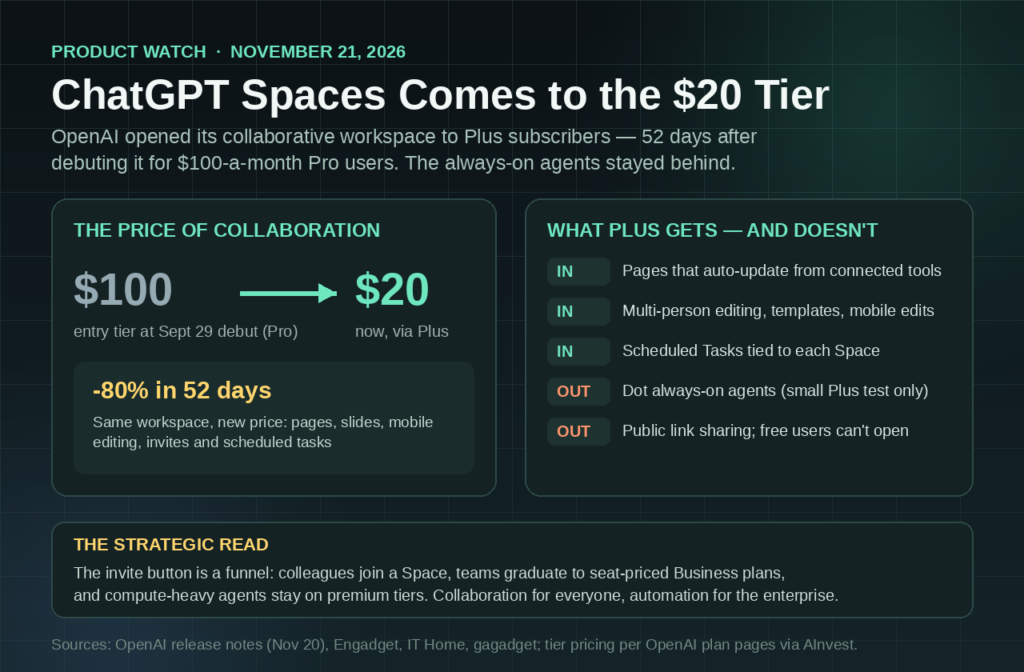
The asterisk matters as much as the headline. Dot — OpenAI’s always-on agent that keeps working on its own cloud computer after you close the tab — did not follow Spaces down the price ladder. Plus subscribers get the workspace without the automation; Engadget reports Dot access for Plus is limited to a small test group that began November 19, with no date for wider release. Sharing has edges too: collaborators need their own Space-enabled paid account, free users cannot open shared content, and there are no public links. This is a workspace for paid teams, not a publishing platform.
Read the two moves together and the architecture is legible: a collaboration layer priced for mass adoption, and a compute layer — the agents that burn tokens around the clock — reserved for tiers where usage economics work. The invite button doubles as a sales funnel. A Plus user pulls in a colleague; the colleague needs an account; a team that wants admin controls, single sign-on and spending limits graduates to Business, priced per seat with a two-seat minimum. OpenAI is seeding workspaces at consumer prices and harvesting organizations at enterprise ones.
For marketing teams specifically, the practical opening is real. A Space can hold a campaign’s brief, asset library, performance Pages that auto-update from connected analytics, and a scheduled task that rebuilds the weekly report — for the price of one existing subscription. The constraint is that every collaborator needs a paid seat, which quietly sets the floor for team adoption at $20 per head. Whether that beats your current stack is a spreadsheet question, not a hype question. But the direction of travel is unmistakable: the AI workspace war has moved from the enterprise suite down to the individual prosumer, and the vendors who win the $20 tier will own the habits that graduate into enterprise contracts.






