The clearest marketing ROI datapoint of the quarter did not come from an ad platform. It came from a shipment tracker. Counterpoint Research’s updated quarterly TV data, published this week and reported widely on November 21, shows Hisense reclaiming the world’s No. 2 TV brand position for the first time in a year — and the research firm names football sponsorships as a direct cause.
The numbers behind the swap are stark. Hisense’s share of global TV shipments rose from 11% in the second quarter to 13% in the third, while TCL slid from 13% to 10%. Samsung held the top spot at 14%, down a point; LG climbed to 10%, drawing level with TCL. Counterpoint’s attribution is unusually specific for a shipment report: Hisense’s comeback came from targeting Europe with football sponsorships, launching premium RGB MiniLED TVs, and backing competitive pricing with wider distribution. In a category where brands usually credit “product strength,” a research house crediting sponsorship is as close to third-party ROI validation as sports marketers ever get.
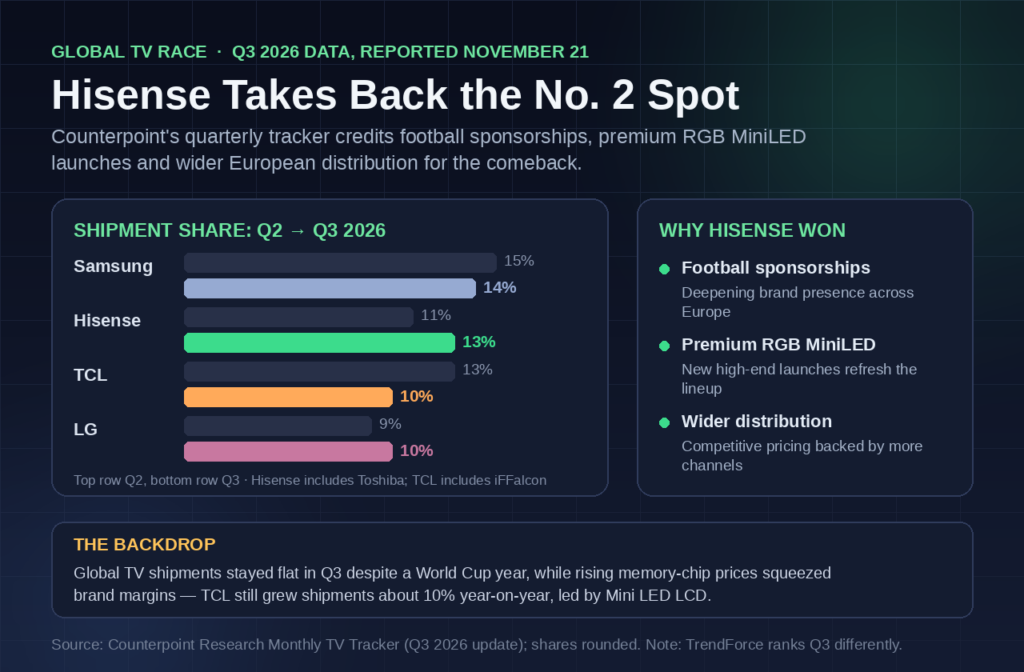
The context makes the gain harder-earned. Global TV shipments were essentially flat in the third quarter despite 2026 being a World Cup year — the sport’s biggest marketing tailwind failed to lift the overall market. Rising memory-chip prices are squeezing every brand’s margins. TCL, for its part, still grew shipments around 10% year-on-year, driven by Mini LED LCD, and remains formidable. One methodological note worth keeping: rival tracker TrendForce’s unit-based ranking still places TCL second by a margin of tens of thousands of sets. Different counting methods, different podiums — but Counterpoint’s share-based tracker is the one that explicitly credits the sponsorship strategy, and that is the finding marketers will cite.
For Hisense, the strategic read is that sports marketing worked as a system, not a logo. The football presence built European awareness; the RGB MiniLED launches gave that awareness something premium to buy; the distribution expansion made the purchase possible at a competitive price. Sponsorship without product and channel follow-through is expensive wallpaper. Hisense ran all three layers at once, and a year after losing the No. 2 spot, took it back.
The timing question now is durability. World Cup years end; the awareness they generate does not have to. Brands that treat tournament sponsorship as a one-season rental lose the asset the moment the final whistle blows, while those that convert it into ongoing league partnerships, retail momentum and product-line credibility keep compounding it. With TCL’s Mini LED momentum intact and the whole category fighting memory-cost inflation into 2027, the fight for second place is genuinely open again next quarter. But this quarter’s lesson stands on its own: in a flat market, the brand that owned the world’s biggest sport owned the growth.






