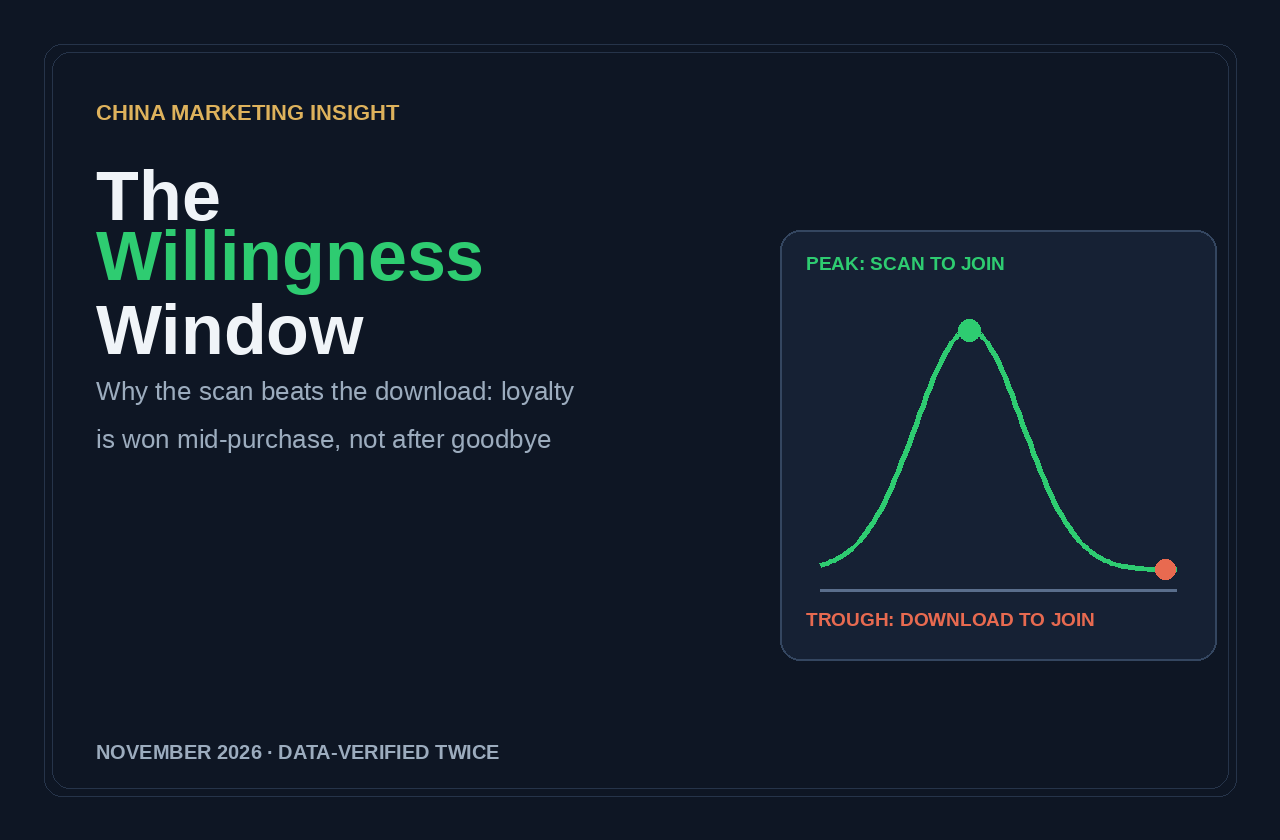
Watch two coffee counters, one in Seattle, one in Shenzhen. Both cashiers ask the same loyalty question. The difference isn’t the pitch, the discount, or the brand. It’s the clock. In Shenzhen, the question arrives while your wallet is still open — scan here to order, and membership rides along. In Seattle, it arrives as you turn to leave: download our app, create an account, verify your email. One asks at the peak of willingness. The other asks at the trough.
That timing gap is the real mechanism behind China’s scan-to-member machine, and it deserves a name: the willingness window. A customer’s readiness to start a relationship with a brand is not constant across a purchase. It spikes mid-transaction, when the value exchange is happening and joining is the fastest path to getting the thing they already want. It collapses the moment the transaction ends, because every additional step becomes pure homework. Loyalty enrollment, in other words, is a scheduling problem disguised as a persuasion problem.
China’s builders scheduled it correctly, mostly by accident of infrastructure. Luckin removed cash registers entirely: domestic stores are pickup points where the app or mini-program order is the purchase, so enrollment happens inside the peak by design. The November 2026 quarterly release reported a record 123 million average monthly transacting customers and over 520 million cumulative customers. Heytea’s queue-skipping mini-program turned waiting into ordering and ordering into membership — over 100 million members by the end of 2023, per its annual report. Mixue’s counter QR made a few-yuan lemonade purchase carry a signup, reaching about 315 million registered members in its listing prospectus. None of these brands persuaded harder. They asked earlier.
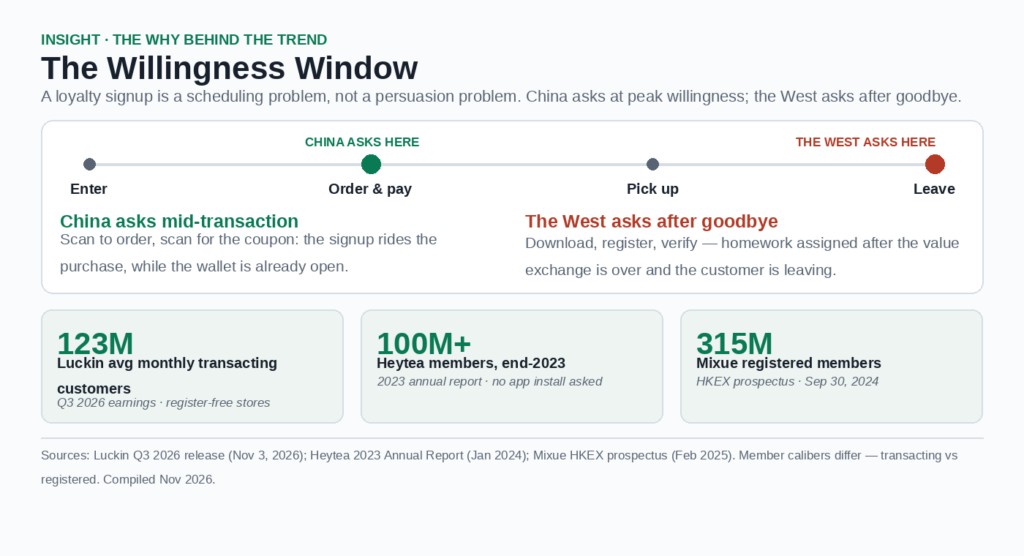
Why does the West keep asking late? Because app-first loyalty inherited its logic from email marketing: finish the sale, then start the relationship. That sequencing made sense when the relationship needed its own infrastructure — a mailing address, an account, an install. WeChat deleted that requirement. When identity, payment and a lightweight runtime already live in the customer’s pocket, there is no infrastructure left to build after goodbye, so there is no reason to wait.
The economics compound the timing. iResearch’s 2025 private-domain whitepaper estimates public acquisition at roughly RMB 1,088 per customer versus RMB 30–60 in private domain — directional averages from Alibaba’s and JD’s filings, not quoted prices. Enrolling at the peak means one near-free gesture replaces a paid re-acquisition campaign later. Miss the window, and you buy the customer back at auction rates.
One honest limit: peak willingness is not a consent loophole. China’s regulators drew that line explicitly — the June 2025 bulletin naming Heytea GO and other mini-programs punished missing withdrawal paths and encryption. The window justifies the ask; it never excuses coercion.
The transferable discovery is simple. You don’t need WeChat to move the question earlier. Any flow that fuses signup with payment — a wallet pass, an App Clip, a web form pre-filled at checkout — borrows the same window. Ask while the wallet is open. Everything after goodbye is a tax you chose to pay.