OpenAI’s advertising business crossed a quiet but consequential threshold this week. On Wednesday the company announced an exclusive reseller agreement with Aleph, a digital-advertising representation group, opening local purchase channels for ChatGPT Ads in 44 markets: 16 across Europe and Central Asia, 14 in Latin America, 10 in the Middle East and Africa, and 4 in Asia-Pacific. Brands and agencies in those countries can now contract through Aleph’s local entities, pay in local currency, access credit lines and get front-line support in-market — the unglamorous plumbing that decides whether an ad platform actually gets adopted outside its home country.
The distinction OpenAI is careful to make: this expands where ads can be bought, not where they can run. Campaigns through Aleph still target the 89 countries where ChatGPT advertising is already available, and OpenAI’s self-serve Ads Manager remains open to anyone who prefers to buy direct. In other words, the company is not opening 44 new audiences; it is removing 44 sets of friction — cross-border contracts, dollar invoicing, wire transfers, time-zone support — that kept smaller advertisers in emerging markets from testing the channel at all.
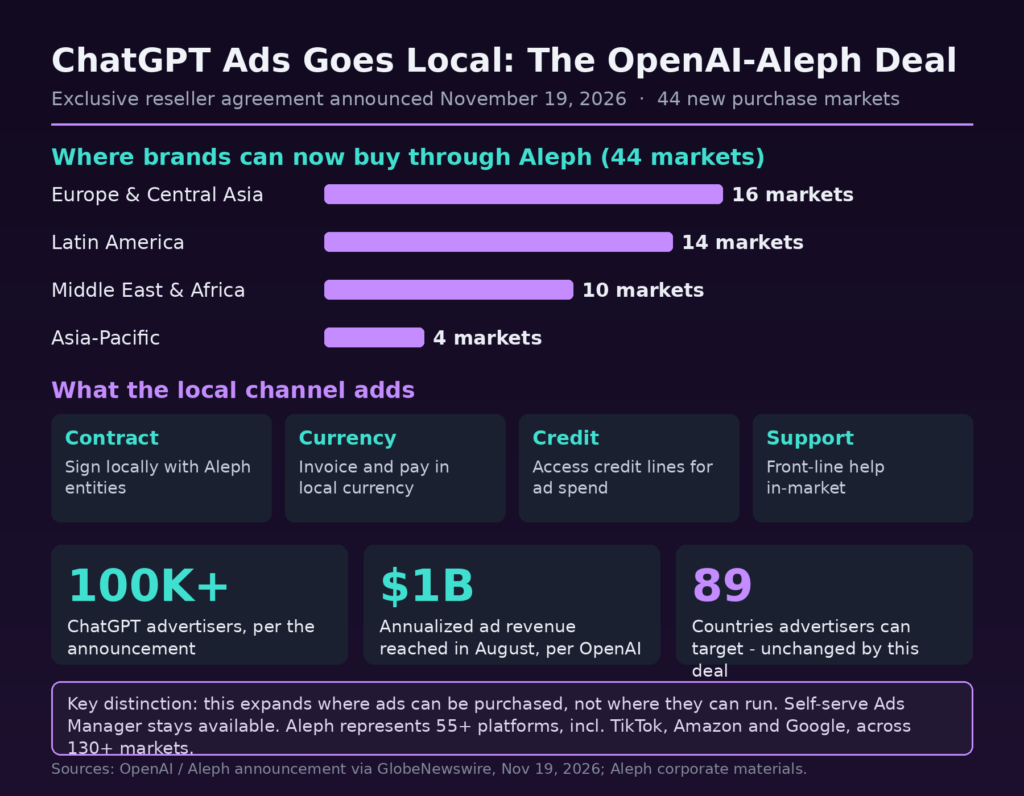
Aleph is an odd but logical choice. The group represents more than 55 platforms — including TikTok, Amazon and Google — across 130-plus markets, and its business is precisely the local scaffolding global platforms would rather not build themselves: local sales teams, local billing entities, local credit risk. Handing ChatGPT Ads distribution to a company that already sells its rivals’ inventory signals that OpenAI wants adoption speed over channel control. It is the same playbook Meta and Google used to scale into emerging markets a decade ago, arriving in AI advertising years earlier in the category’s life than most expected.
The scale numbers in the announcement explain the urgency. OpenAI says ChatGPT now has more than 100,000 advertisers and reached a $1 billion annualized ad-revenue run rate in August. Those are real figures for a product barely out of its experimental phase — and they sit against a cost structure, frontier-model training and inference, that subscription revenue alone has not covered. Advertising is no longer a side experiment at OpenAI; it is a load-bearing wall. Widening the buyer base through a reseller is the fastest way to feed it without building dozens of country organizations.
For global marketers, three practical implications follow. First, if you operate in São Paulo, Riyadh, Warsaw or Jakarta, the barrier to piloting ChatGPT placements just dropped from “set up a US-facing procurement path” to “call a local rep” — worth a small, measured test while competition for the inventory is thin. Second, the credit-line component matters more than it sounds: local financing turns AI advertising from a prepaid experiment into a plannable line item, which is how channels graduate from test budgets to annual commitments. Third, measurement discipline is on you. Conversational placements are still a young format with evolving reporting; run them against clear incrementality tests rather than folding them into last-click dashboards and hoping.
There is also a strategic read for the industry. An exclusive reseller arrangement means OpenAI’s emerging-market ad business will be shaped, priced and sold largely by a third party — a delegation of the customer relationship that platforms usually guard jealously. If the channel works, expect pressure on Anthropic, Perplexity and the rest of the assistant market to answer with distribution of their own, and expect Aleph’s rivals to court them. The AI ad race was supposed to be about models and formats. This week it became about invoices, credit and local sales teams — which is to say, it became a real advertising market.






