
Wall Street has financed railroads, airlines and shale booms. On Thursday it financed something new: a rocket company’s GPU fleet. SpaceX sold more than $30 billion of debt through a special-purpose vehicle called Project Saturn, part of a roughly $43 billion financing program, according to the Financial Times and Bloomberg. The largest tranche — $25 billion of investment-grade notes — is backed by five years of rental payments on Nvidia chips, including next-generation Vera Rubin parts. And somewhere in the negotiation, lenders reportedly asked for a covenant that has no precedent in corporate finance: a ban on launching the collateral into space.
Start with the terms, because they show what the bond market actually thinks of the AI buildout. The notes priced at 345 basis points over comparable Treasuries, an all-in yield of about 8.3% — against roughly 7.2% on SpaceX’s existing 2031 debt. They mature in 2032, but the structure repays principal in under four years, matching the cash flows to the short economic life of the hardware. Moody’s rated the tranche A3, one notch above SpaceX’s own corporate rating; KBRA assigned A-minus. The collateral, in other words, is considered better credit than the company. That is the financial signature of an asset boom: the machines get upgraded, the issuer gets marked down.
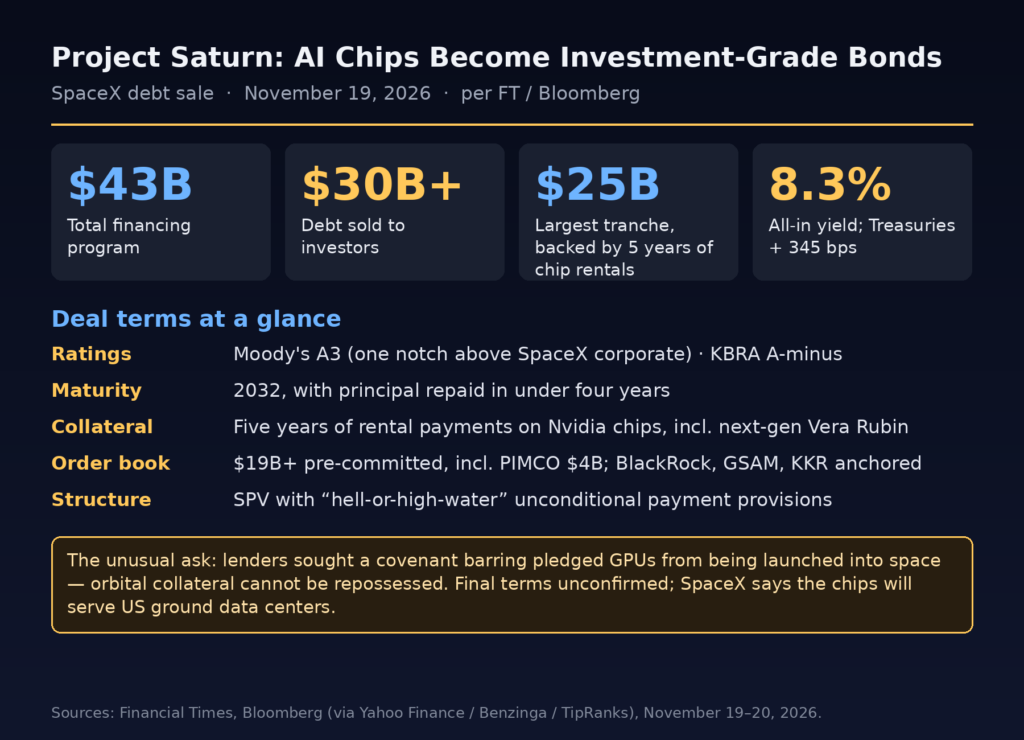
Demand was not the problem. More than $19 billion of commitments were locked before launch, including $4 billion from PIMCO, with BlackRock, Goldman Sachs Asset Management and KKR funds anchoring the book. Insurers and asset managers — the most conservative money in the system — are now underwriting GPU rental streams. The structure includes “hell-or-high-water” provisions, meaning payment obligations hold regardless of what happens to the underlying equipment or customers. Buyers demanded that belt-and-suspenders language for a reason: chips depreciate, tenants default, and the technology cycle does not wait for bondholders.
Then there is the clause that tells you everything about the counterparty. The FT reported that lenders sought to prohibit SpaceX from sending the pledged AI chips into orbit — because collateral circling the planet at 17,000 miles per hour cannot be repossessed. Whether the restriction made it into final documents is unconfirmed; SpaceX says the chips financed here will serve its US-based data centers, which it mostly owns and operates. But the request was rational. Elon Musk has publicly pitched orbital data centers — solar-powered computing with heat dumped through orbital radiators — and has said he expects to put Nvidia-powered computers in orbit as early as 2027. When your borrower’s roadmap includes escaping the jurisdiction of repo agents, the covenant writers earn their fees.
Zoom out and the deal is a milestone in a larger migration. AI infrastructure spending has outgrown equity markets and internal cash flow; it is now a credit story, structured through SPVs, rated by agencies, and sold to fixed-income portfolios that never bought a tech stock. Project Saturn offers the template: ring-fence the hardware, pledge the rental contracts, amortize fast, and pay whatever spread the market demands. Expect neoclouds and data-center developers to copy it. Expect investors, eventually, to ask what happens when several of these structures reference the same handful of chip tenants.
For now, the scoreboard reads: $30 billion placed, 8.3% coupon, investment-grade ratings, oversubscribed book. The AI trade that equity investors spent the week selling, bond investors bought — at a price, with lawyers attached, and with one eye on the launch pad.






