On February 3, 2013, the lights went out at the Superdome in the middle of the Super Bowl. For roughly 34 minutes, more than a hundred million viewers had nothing to watch — so they reached for their phones. Inside a Manhattan war room, the cookie brand Oreo and its agency 360i designed, captioned and approved an image of a cookie in shadow: you can still dunk in the dark. The tweet passed 10,000 retweets within the hour. A 30-second TV spot in that same game cost about $3.8 million. The free one won the night.
Western marketing has told that story for thirteen years as the birth of newsjacking — the occasional, opportunistic art of riding the news. But if you want to see what happens when that art becomes an industry, you have to look at China. There, riding the moment — practitioners call it borrowed momentum — is not a lucky strike once a year. It is an operating system: always-on teams watching the trending boards, pre-cleared approvals, content shipped in minutes. The hot search is the brief. Speed is the creative. And the fines, when teams get it wrong, arrive just as fast as the applause.
The Hot Search Is a Standing Brief
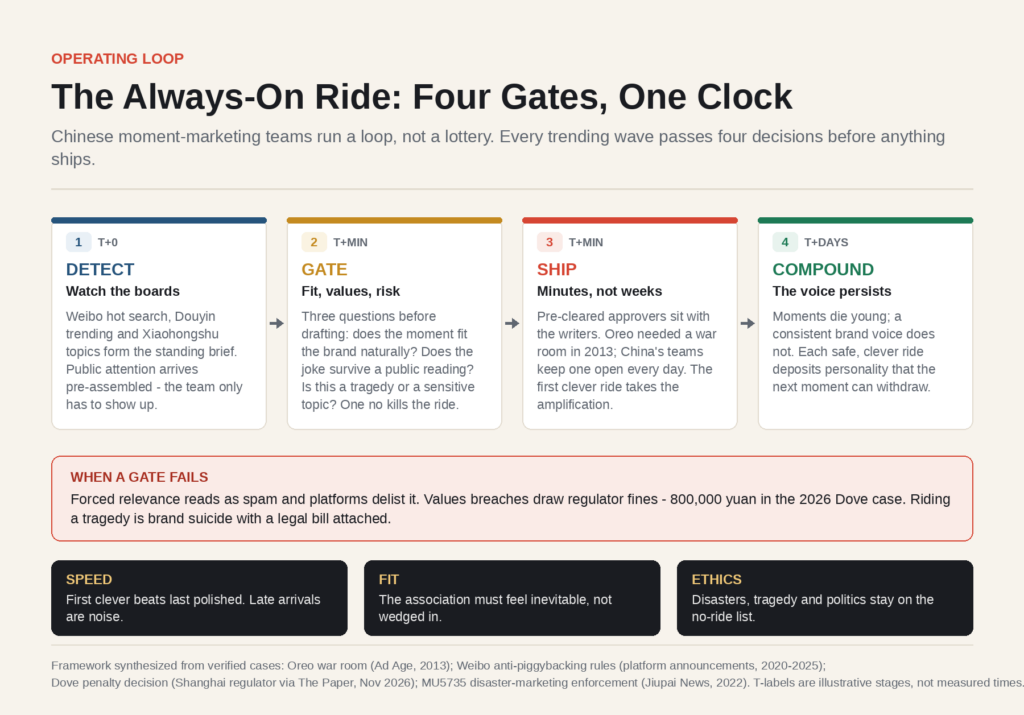
Start with the raw material. China’s internet now counts 1.125 billion users, 80.1% of the population, according to the China Internet Network Information Center’s 57th statistical report, released in February 2026 with data through December 2025. Of those, 1.074 billion — 95.4% — watch short video. When a story breaks, it does not travel through one channel; it detonates across Weibo’s hot-search list, Douyin’s trending feed and Xiaohongshu’s topic pages at once. A single afternoon can assemble an audience most global brands would need a year of media budget to reach.
That is the arbitrage. The public has already done the expensive part — gathering the attention, agreeing this is what everyone is talking about. The brand does not build an audience; it borrows one that is already standing there, and pays with wit instead of media money.
Weibo remains the marketplace where this attention gets priced. Its September 2026 numbers, released on November 17, show 551 million monthly active users and 254 million average daily actives. Here is the detail most coverage misses: management told investors that user numbers slipped partly because the quarter had fewer major trending topics and big hit stories. Read that again. The platform’s own growth depends on the news cycle being loud. When the moment economy goes quiet, even the attention landlord loses foot traffic.
From a Once-a-Year Stunt to an Always-On System
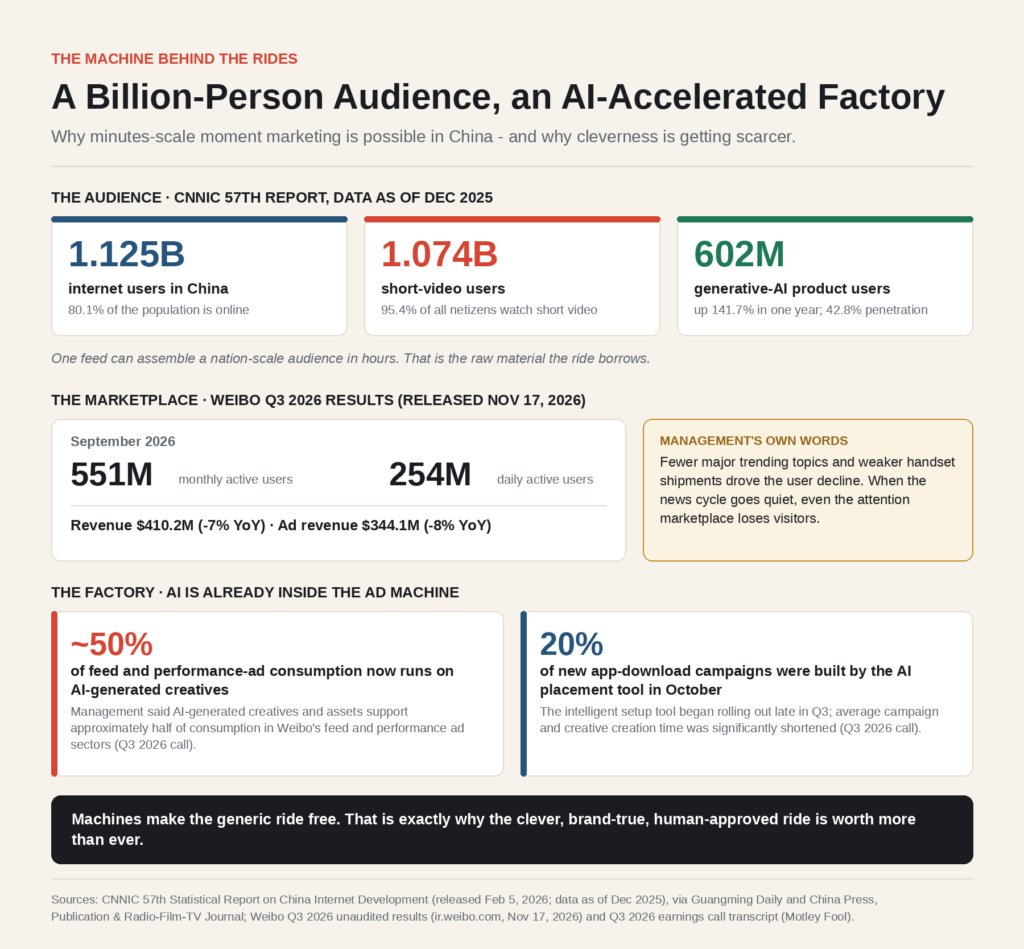
Oreo’s win looked spontaneous, but it was manufactured readiness: brand marketers, agency creatives and media staff sitting in one room with authority to approve on the spot. The tweet was the output; the war room was the product. China’s innovation was to stop treating that room as a Super Bowl exception. Consumer brands keep the room open every day — monitors on the trending boards, copy and design on standby, legal and brand guardians one message away.
The economics are blunt. An always-on team costs a few salaries. A single hot-search placement or a national TV spot costs multiples of that, and buys attention you must still earn a second time with creative. A ride that lands buys both at once: the placement is the topic itself, and the cleverness is what makes strangers share it. When the hit rate is decent, the math favors the team over the media buy. When it is not — well, we will get to the fines.
Speed Is the Creative
In this system, timing is not logistics. It is the idea. The first brand to say something genuinely clever about a moment gets treated as part of the story; the ninth brand saying the same joke is spam wearing a logo. Amplification compounds for early arrivals — fans screenshot, media pick it up, competitors quote it — while late arrivals pay an invisibility tax no amount of polish refunds.
This is why Chinese teams optimize for minutes rather than perfection. A poster at 95% craft shipped in twenty minutes beats the 100% version approved three days later, because the moment itself has a half-life measured in hours. The uncomfortable corollary: your approval chain is part of your creative. If legal needs two days, your best idea was stillborn. Oreo solved this in 2013 by putting the approvers in the room. The industrial version puts them in the group chat.
But speed alone is a trap, and the trap has a name.
Relevance Fit: The Difference Between Wit and Spam
Practitioners separate clever riding from forced riding — wedging your product into a topic it has nothing to do with. Audiences detect the seam instantly. Worse, the platform does too. Weibo’s community rules explicitly target posts that stuff unrelated hot-search keywords to steal traffic: penalties run from exclusion in search to muting to permanent bans. In a March 2025 enforcement notice, the platform said its anti-cheating system processes roughly 90,000 posts a day and keeps repeat offenders out of hot-search landing pages entirely. Later that year, batch announcements showed dozens of accounts muted or closed for malicious trend-riding.
So relevance fit is not just aesthetics; it is distribution policy. The ride has to feel inevitable — of course a cookie brand talks about dunking, of course a tea brand plays with luxury. When the association needs explaining, it has already failed. The cleverness people admire in the best Chinese social teams is mostly discipline: knowing which moments their brand has permission to touch, and letting the rest go by.
The Receipts: When Borrowed Momentum Prints Money
Three verified cases show the machine at full throttle.
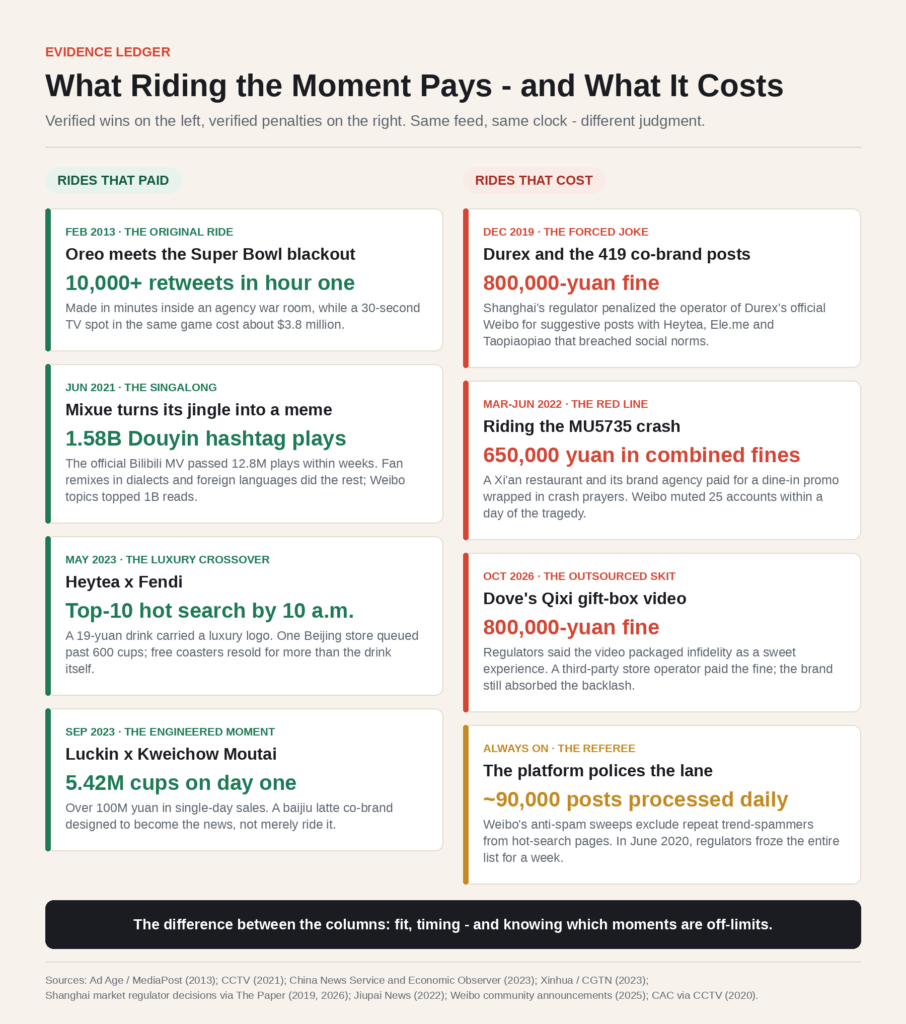
In May 2023, the tea chain Heytea put Fendi’s logo on a 19-yuan cup. By 10 a.m. on launch day the hashtag sat in Weibo’s hot-search top ten. One Beijing store’s queue passed 600 cups; free coasters flipped on secondhand apps for more than the drink cost. Nobody bought the tea for the tea. They bought a photographable slice of luxury — the moment was the product.
Four months later, Luckin Coffee went further and engineered the moment instead of waiting for one. Its latte laced with Kweichow Moutai — China’s most storied liquor — sold 5.42 million cups on day one, over 100 million yuan in a single day, a company record. The stunt echoed through the quarter: Luckin’s third-quarter 2023 revenue rose 85% year over year to 7.2 billion yuan, and average monthly transacting customers jumped almost 133% to 58.5 million. The general manager of Kantar Worldpanel in China called it the lipstick effect at work: a luxury everyone could suddenly afford a sip of.
And then there is the folk option. In June 2021, budget ice-cream chain Mixue uploaded a jingle video to Bilibili — thirteen characters of lyrics over an 1847 public-domain melody, Stephen Foster’s Oh! Susanna. Within weeks the official video passed 12.8 million plays, the Douyin hashtag reached 1.58 billion, and Weibo topics topped a billion reads as users remixed the song into dialects, foreign languages and absurdist sketches. The brand did not chase the wave; it released something so simple and so on-brand that the crowd chose to carry it. Fit, again, did the heavy lifting.
The Platform Owns the Wave You Are Riding
Here is the part borrowed-momentum romanticists skip: the wave is not yours, and it is not even neutral. Weibo sells commercial positions inside its own hot-search list — topics marked as promoted sit among organic ones. The attention you borrow is partly inventory the landlord rents out.
And the landlord answers to a regulator. In June 2020, the Cyberspace Administration of China ordered Weibo to freeze both its hot-search and hot-topics lists for a full week — 3 p.m. June 10 to 3 p.m. June 17 — for interfering with the order of online discourse around a public-opinion incident, plus a fine. For seven days, the brief simply did not exist. Any brand whose marketing calendar assumed a permanently open attention market discovered it was renting on contested land.
July 2025 showed the opposite condition: a manufactured news cycle at maximum volume. Three days after Taobao’s instant-commerce arm announced a 50-billion-yuan subsidy program, the delivery war peaked on a Saturday. Taobao Shangou and Ele.me logged over 80 million orders that day; Meituan’s instant retail broke 120 million by 10:54 p.m. Weibo’s hot search turned into, in one reporter’s phrase, a food-ordering guide; even the app’s splash screen was bought by the combatants. The delivery-war topic drew about 900 million plays on Douyin within a week. Tea chains rode the wave with free-coupon stunts, and on Monday their stocks jumped — ChaPanda up as much as 15% intraday — while the platforms burning the billions fell. Ride the war, not the wounds: the brands that profited sold tea, not commentary.
The Ethics Line Is Written in Fines
Every mature version of this system carries a no-ride list, and in China it is not merely cultural. The Advertising Law bans content that harms public order or good social customs, and regulators enforce it against moment-riders with paperwork.
The canonical creative case: Durex, long admired as the wittiest brand on Chinese social media, ran an April 2019 co-branded campaign with Heytea, Ele.me and Taopiaopiao built on suggestive one-night-stand innuendo. That December, Shanghai’s market regulator fined the company operating Durex’s official Weibo 800,000 yuan. A separate 810,000-yuan fine the following year, over a product-page ad, made headlines too — but the co-brand penalty is the one every social team should study. Wit had a license; that campaign exceeded it.
The hard line is tragedy. Within a day of the March 2022 China Eastern MU5735 crash, a Shanxi property developer circulated a memorial poster carrying its project’s phone number, and two Hefei firms did similar. Regulators investigated overnight. A Xi’an hotpot restaurant whose official account paired crash prayers with a dine-in promotion was fined 430,000 yuan that June; its brand agency paid another 220,000. Weibo, for its part, muted 25 accounts within a day of the crash for mocking the disaster. The message across cases is consistent: grief is not inventory.
The freshest receipt landed this month. In August 2026, the Kuaishou store flying Dove’s official-flagship banner ran a Qixi gift-box video whose storyline celebrated receiving chocolate from a flirtation while the boyfriend was away. Customer service dismissed the backlash — just a skit, swipe away if you dislike it. Dove apologized on August 25, blaming a third-party operator’s review lapse. In October, Shanghai’s Putuo district regulator fined that operator 800,000 yuan for packaging infidelity as a sweet experience; the case was published November 12 among twelve typical violations. One more number from that release deserves a pause: regulators in the Yangtze River Delta handled 10,463 advertising-violation cases in 2026 to date, with 57.7 million yuan in fines and confiscations. The ethics line is not a vibe. It is a docket.
AI Compresses the Clock and Floods the Feed
Now add the accelerant. The same CNNIC report counts 602 million users of generative-AI products in China — up 141.7% in a single year. And the machines are already inside the ad stack: on Weibo’s November earnings call, management said AI-generated creatives and assets now support approximately half of consumption in its feed and performance advertising. A new intelligent placement tool rolled out late in the quarter; by October, 20% of new app-download campaigns were built with it, and campaign creation time was significantly shortened.
For moment marketing, this is double-edged in the most literal way. Production time collapses toward zero — any team can ship a competent topical poster in minutes. Which means every team will. The feed fills with interchangeable borrowed-momentum content, and the half-life of a generic joke shortens again. Notice what Weibo’s management added: in brand and content marketing, clients still favor human social and creator assets. The market itself is pricing the difference. When machines make adequacy free, the scarce inputs — a genuinely surprising association, a brand voice people trust, the judgment to skip a toxic moment — get more valuable, not less. AI is the fastest intern you will ever hire. It still needs an editor with a spine.
What Everyone Gets Wrong
Four misconceptions travel with this topic, and each is expensive.
First: newsjacking is an occasional tactic. In China it is fixed infrastructure — headcount, monitoring, approval rails — closer to a newsroom than a campaign. Budgeting it as a stunt guarantees you show up late.
Second: speed is enough. Speed without fit is spam with a deadline; platforms delist it and audiences ridicule it. The gate comes before the clock.
Third: every moment is rideable. The docket above says otherwise. Disasters, tragedies and politically sensitive events are not creative opportunities; they are enforcement events with your logo attached.
Fourth: AI makes this easier, therefore better. AI makes the average ride cheaper, which makes the average ride worthless. The premium moved up the stack, to judgment.
The Playbook: Build the Room, Police the Gates
If you run a brand with any exposure to Chinese social — or you simply want the discipline this system enforces — the build list is short and unglamorous.
- Staff the room, not the campaign. A small standing team with monitoring duties beats a big agency mobilized per event. Readiness is the asset.
- Pre-clear the approvers. Brand, legal and social leads agree in advance what needs no meeting. Minutes-scale shipping is an org chart decision before it is a creative one.
- Write the fit test. One sentence: would a fan explain this association without our help? If not, pass — the platform’s spam filters and the audience’s eye roll await.
- Codify the no-ride list. Disasters, casualties, politics, and anything your customer-service team would have to apologize for. The Dove case adds a rider: outsourced operators inherit your logo but not your judgment — audit them like they are you, because regulators will.
- Use AI downstream of judgment. Let machines draft variants, resize, localize, schedule. Keep the decision to ride — and the final line of copy — human.
- Measure the voice, not the spike. One viral ride is weather. A year of consistent, safe, recognizably-yours rides is climate — that is what compounds into brand memory.
The Counterargument, and Its Limit
The honest objection: this is all ephemeral. Trends die in hours; a jingle wave crests and vanishes; surely brand equity built on borrowed attention is sand. Partly true. Any single ride is disposable, and teams that chase every wave without a voice become wallpaper. But the limitation cuts the other way too: Mixue’s jingle landed because a decade of cheap-and-cheerful positioning made it feel inevitable; Luckin’s Moutai coup worked because the brand had already trained its audience to expect audacious collabs. The moment is rented. The personality that makes each rental land is owned. Ephemeral tactics, compounding voice — that is the actual business model.
The second objection — it is too risky — mistakes the tail for the system. The fines in this article came from teams that skipped a gate: forced fit, tragedy, outsourced judgment. The system’s answer is not abstinence but engineering: the no-ride list, the one-sentence fit test, the pre-cleared approver who can say no in ninety seconds. Risk is a design parameter here, not a reason to leave the field.
The Takeaway
China did not invent newsjacking; it industrialized it. The hot search is a standing brief written by a billion people, and the brands that profit from it treat readiness as infrastructure, speed as creative, fit as distribution policy, and ethics as law — because it literally is. AI will make the mediocre ride free for everyone, which is precisely why the clever, brand-true, human-approved one keeps getting more expensive. The attention is already assembled. The only question is whether your room is open when it arrives.






