Your brand already has a sound — you just never designed it. The evidence stack is now hard to ignore: Ipsos’ meta-analysis of 2,015 US video ads found visual brand assets in 92% of creative but audio in only 8%, while ads carrying a sonic brand cue were 8.53 times more likely to land in the top third for branded attention. SoundOut’s 2025 index of 174 sonic logos adds the twist: recognition alone doesn’t pay — sounds that include the brand name drive nine times more actual attribution. With only 12% of US viewers giving TV their full attention and 233 million Americans listening to online audio monthly, the channel most brands treat as decoration is the one that still gets through. This piece unpacks the mechanism, the traps, and a practical playbook.
The Logo You Can Hear
Close your eyes. A five-note chime plays, and you know a computer has Intel inside. Two percussive knocks — ta-dum — and you’re on the couch, remote in hand, about to lose an evening to Netflix. Five whistled notes and you’re suddenly hungry for fries.
Nobody showed you a logo. Nobody said a brand name. Yet you retrieved three companies from memory in under ten seconds, using nothing but air pressure.
Now the uncomfortable question: what does your brand sound like? If the honest answer is “whatever stock track the editor picked for the last explainer video,” congratulations — you’re in the overwhelming majority. And that majority is leaving the most efficient memory-building channel in marketing on the table.
The 92% Problem: Marketing’s Visual Monoculture
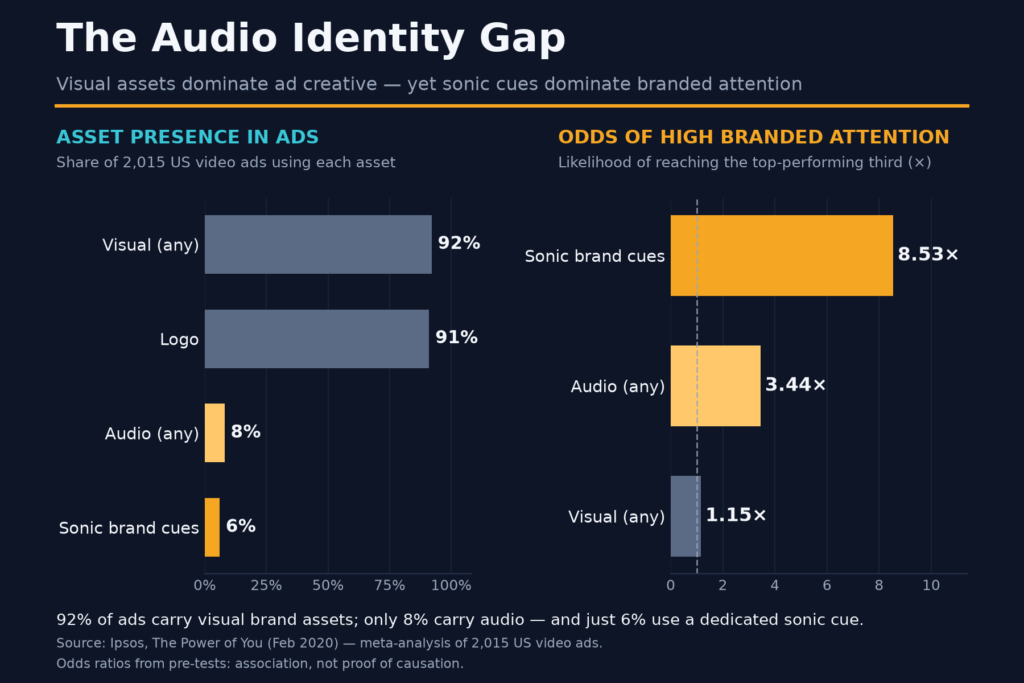
When Ipsos pulled apart its Creative Excellence database — 2,015 US video ads, pre-tested across roughly ten categories — it found a lopsided creative culture. Visual brand assets appeared in 92% of ads. Logos alone showed up in 91%. Audio assets of any kind? Eight percent. Dedicated sonic brand cues — the Intel-style stings, the branded jingles — just 6%.
Think about what that means. Nine out of ten ads compete on the same channel, using the same toolkit, shouting into the same overcrowded visual lane. Meanwhile the auditory lane sits nearly empty, like a highway with one car on it during rush hour.
This isn’t an accident. A decade of muted autoplay trained marketers to design for silence. If the feed plays without sound, why invest in sound? It’s a rational-sounding argument. It’s also, as the data shows, a strategically expensive one.
The 8.53x Finding — Read the Fine Print
Here’s the headline number, stated precisely: ads featuring sonic brand cues were 8.53 times more likely to appear in the top-performing third of the dataset on branded attention. Any audio asset scored 3.44x. Visual assets, on average, 1.15x — barely above baseline.
Two more details make the finding sharper. First, high-performing ads used 34% more brand assets on average than low performers — yet the frequency of simply showing or naming the brand was almost identical between the two groups. Saying your name louder isn’t the lever. Encoding your identity into the story is.
Second — and this is where most LinkedIn posts get it wrong — these are odds ratios from a pre-test meta-analysis. They describe a strong association, not a guaranteed causal uplift. Adding a jingle to a weak ad won’t multiply its performance by 8.53. What the data does say is that the brands investing in owned sound are disproportionately the ones winning attention. In a channel this empty, that’s already a compelling brief.
Why Sound Gets In: The Emotion and Memory Route
Why would a two-second sting outperform a carefully art-directed logo? Because sound takes a different road into the brain.
Stefan Koelsch’s review in Nature Reviews Neuroscience synthesizes the neuroimaging evidence: music modulates activity in the amygdala, the hippocampus, the nucleus accumbens — the core circuitry of emotion, memory and reward. Musical pleasure engages the same dopaminergic reward pathway that responds to food and other survival-relevant payoffs. The hippocampus, meanwhile, is central to forming the very memories brands need to exist inside.
Advertising researchers have seen the behavioral version of this for decades. Work cited in a 2026 Goldsmiths–Cambridge study recalls Yalch’s classic 1991 finding: brand names paired with musical jingles are remembered better than brand names delivered as spoken slogans. The melody isn’t decoration around the message. It’s the filing system the message gets stored in.
This is exactly the logic of distinctive brand assets in the Ehrenberg-Bass tradition: non-brand-name elements that trigger the brand in a category buyer’s memory. An asset’s value comes from fame — how many people link it to you — and uniqueness — how few competitors it could belong to. Colors and logos are managed this way religiously. Sound, almost never. Which is precisely why the lane is still open.
The Attention Loophole Nobody Is Guarding
Now add the media context, because it has quietly flipped the argument.
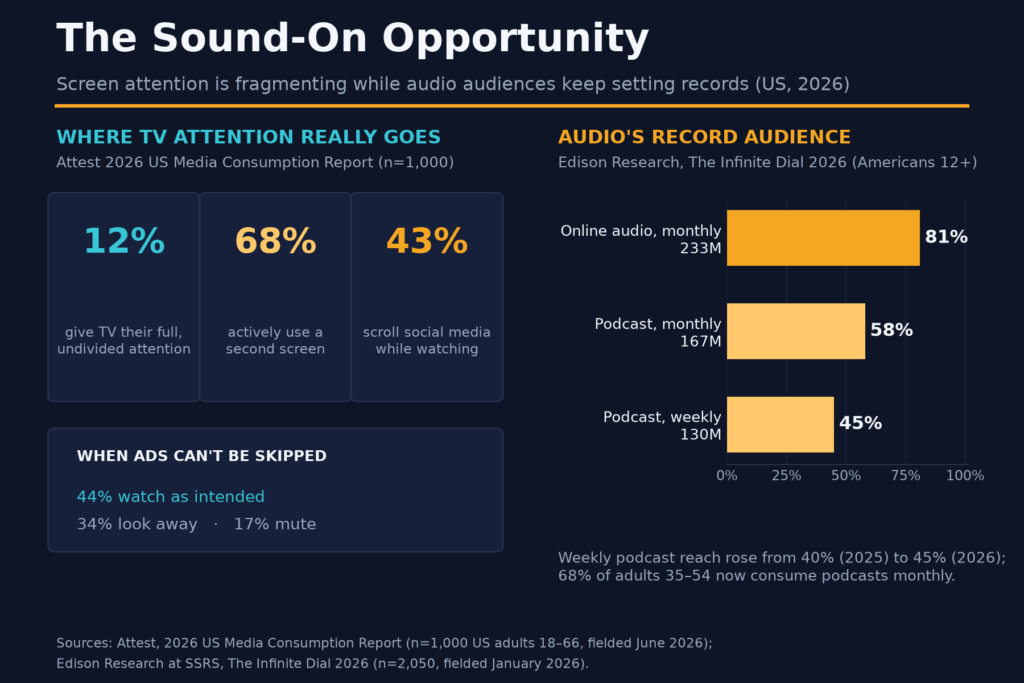
Attest’s 2026 US Media Consumption Report — a nationally representative survey of 1,000 American adults fielded in June 2026 — found that only 12% of people give television their full, undivided attention. Sixty-eight percent actively use a second screen while watching; 43% scroll social media with the TV on. Even when an ad can’t be skipped, only 44% watch it as intended. Thirty-four percent redirect their attention elsewhere, and 17% mute it.
Read that again: among viewers stuck with an unskippable ad, muting is a choice only 17% make — the rest are still exposed to the audio. The TV remains a remarkably reliable route to the ears. Your beautifully graded color palette cannot reach someone reading their phone. Your sonic logo can. Sound is the only brand asset that works when nobody is looking.
Audio’s Record Decade
And the sound-on world isn’t a niche — it’s most of America.
Edison Research’s Infinite Dial 2026, the longest-running digital media survey in the US, reports that 81% of Americans aged 12 and older — 233 million people — listened to online audio in the past month. Monthly podcast consumption hit an all-time high of 58%, or 167 million people, and weekly podcast reach climbed from 40% to 45% in a single year. Among 35–54-year-olds, the demographic advertisers pay the most to reach, 68% consume podcasts monthly. Even the 55-plus group jumped from 52% to 70% monthly online audio listening in just two years.
So the “everything is muted” worldview describes one environment — the social feed — and ignores the ones growing fastest: podcasts, streaming music, in-car systems, smart speakers, retail spaces, payment terminals. The audio identity gap persists partly because marketers extrapolate the mute button to the whole of media life.
Three Seconds, One Wedding Ring
Consider the most studied two seconds in streaming. In 2015, Netflix VP of Product Todd Yellin went hunting for a sound that would mean “a cinematic treat is about to begin” — without saying the brand’s name. He commissioned Oscar-winning sound designer Lon Bender, and the final shortlist was gloriously strange: a bubbling ocean sound, a goat bleat (Yellin’s pitch: their version of the MGM lion), and a deep double knock.
The knock won — reportedly clinched when Yellin played the finalists for his ten-year-old daughter. Its recipe, revealed on the Twenty Thousand Hertz podcast: Bender’s wedding ring knocking against a bedroom cabinet, sweetened with a slowed-down anvil, muted hits, and a reversed guitar phrase from the 1990s that the team called “the blossom.” Hans Zimmer later stretched it into an extended version for theatrical releases.
A wedding ring, an anvil, and a backwards guitar now trigger anticipation in hundreds of millions of living rooms. That’s the point: a sonic logo isn’t a tune. It’s compressed meaning — a whole brand promise folded into a sound short enough to fit inside a notification.
Recognition Is Not Attribution
But here’s where the story turns, and where most sonic-branding enthusiasm quietly dies.
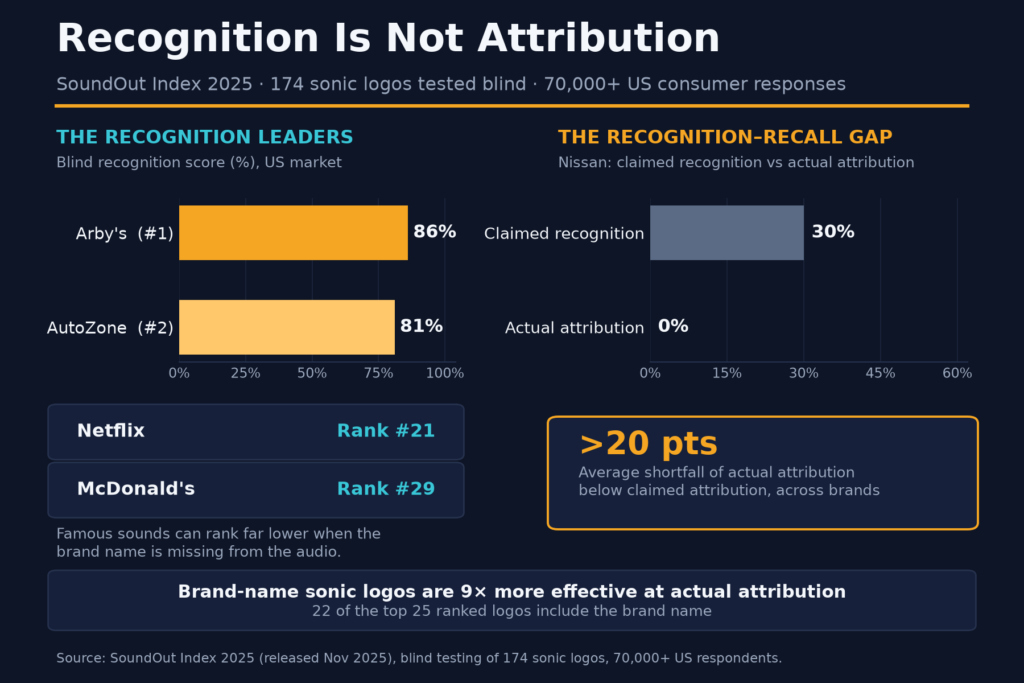
SoundOut’s Index 2025 — the largest blind test of its kind, covering 174 sonic logos with more than 70,000 consumer responses in the US — documented what it calls the recognition–recall gap. Plenty of sounds feel familiar. Far fewer get correctly pinned to a brand. On average, actual attribution ran more than 20 percentage points below claimed attribution.
The starkest example: 30% of respondents said they recognized Nissan’s sonic logo. The share who could actually attribute it to Nissan? Zero.
Familiarity, in other words, is not ownership. A sound everyone knows but nobody can name is a public good — you paid to build a memory structure, and any competitor with a similar vibe can squat in it. If your sonic dashboard celebrates recognition scores, you may be measuring the wrong thing entirely.
Say Your Name: The Arby’s Lesson
So who actually wins? A sandwich chain most branding decks never mention.
Arby’s “We have the meats” took the #1 spot at 86% recognition — up from third place in the previous biennial index — ahead of AutoZone at 81%. Netflix landed at #21. McDonald’s, owner of arguably the most famous five notes on earth, at #29.
The pattern is not subtle. Arby’s sings its own name. SoundOut’s analysis found that sonic logos containing the brand name are nine times more effective at driving actual attribution than purely musical cues, and 22 of the top 25 ranked logos include the name. SoundOut CEO David Courtier-Dutton’s summary is blunt: start by including your brand name until attribution is secured, then evolve toward a pure musical identity.
Netflix and McDonald’s earned their nameless stings through decades of relentless, consistent exposure. They graduated. Most brands haven’t put in the tuition — and skipping straight to abstract minimalism is how you end up as Nissan: familiar to everyone, owned by no one.
The index offers a bonus lesson for anyone with history: Maybelline dusted off a 25-year-old sonic logo, refreshed it, and vaulted to #20 out of 174. Pillsbury’s revival cracked the top 50. Dormant sound assets aren’t dead weight — they’re prepaid memory.
Build an Ecosystem, Not a Jingle
The second big mistake is scope. A sonic logo is not a sonic identity, any more than a favicon is a brand.
Mastercard’s 2019 launch remains the cleanest template. When the company dropped its name from its visual logo, it simultaneously built what it called a comprehensive sound architecture around one core melody: advertising scores, ringtones, hold music, and — the decisive move — point-of-sale acceptance sounds. By December 2019 the melody was live on 2,000 Android payment terminals across five Indian cities, with a second phase targeting 10,000 devices.
Notice what that does. The sound stops being an ad ornament and becomes functional feedback: your payment worked. Every transaction becomes a brand impression with genuine emotional stakes — reassurance — attached. That’s not a jingle. That’s infrastructure.
The practical shape of an ecosystem: a core mnemonic, a flexible musical theme derived from it, interface and product sounds built from the same melodic material, voice guidelines, and retail or event adaptations. One seed, many plants — all recognizably the same species.
Mixue: A One-Dollar Ice Cream With a Billion-View Song
If you suspect this is a wealthy-Western-brand phenomenon, meet Mixue.
The Chinese ice-cream-and-tea chain set its brand slogan — “I love you, you love me, Mixue ice cream and tea” — to the public-domain melody of Oh! Susanna, an 1847 American folk song. The track had circulated quietly since around 2019–2020. Then, on June 3, 2021, the official music video hit Bilibili and Douyin, and the internet detonated. Within three weeks the theme-song hashtag on Douyin passed 1.17 billion plays; the main brand hashtag reached 5.29 billion. User remixes — opera versions, Russian versions, heavy-metal suona versions — did the distribution work for free.
Two design choices made it compound. The brand name sits inside the lyric, so every earworm repetition is an attribution event — the Arby’s mechanism at national scale. And the song played on loop across the chain’s tens of thousands of franchise stores, turning physical retail into a media network.
The epilogue filed with regulators: Mixue’s HKEX listing documents record that the #Mixue hashtag had accumulated over 43.5 billion Douyin views by the end of 2024. In March 2025 the company listed in Hong Kong, raising roughly US$444 million — the world’s largest freshly-made drinks company by store count, propelled in no small part by a folk tune older than the American Civil War. Sound-first branding isn’t a luxury import. In China, it minted a giant.
Four Assumptions That Keep Brands Silent
Strip the debate down and four beliefs keep budgets visual-only:
- “Sonic branding means writing a jingle.” No — it means building a sound system: mnemonic, theme, UI sounds, voice, retail. The jingle era ended; the ecosystem era didn’t get the memo in most marketing departments.
- “Sound is the supporting act.” The Ipsos odds say the opposite: dedicated sonic cues carry the single strongest association with high branded attention of any asset type measured.
- “If people recognize it, we’ve won.” SoundOut’s gap says recognition without attribution is wasted spend. Design for the name-to-sound link, not just familiarity.
- “Feeds are muted, so sound is pointless.” The mute button governs one environment. It doesn’t govern podcasts, cars, stores, payment terminals — or the 83% who don’t mute unskippable ads.
The Honest Counterargument: The Muted Feed
Let’s steelman the skeptic, because the skeptical case has real teeth.
Autoplay-muted is genuinely the default in the feeds where many brands live. A sonic logo does nothing for a silent thumb-scroll, and no audio budget will fix a feed that never turns sound on. If your entire media plan is muted social video, sound is not your first lever — thumbnails, motion and on-screen branding are.
The 8.53x figure deserves caution too: it’s an association in pre-test data, and sonic cues often travel with bigger budgets and longer-running campaigns. Sound is not magic dust.
But here’s the limit of the argument: it treats media as static. The sound-on environments are the ones setting growth records, retail and payment moments are multiplying, and AI voice interfaces are quietly making brand-by-sound a product requirement, not a campaign choice. The right conclusion isn’t “sound doesn’t work.” It’s “deploy sound where sound is on — and stop pretending your brand only exists in a muted feed.”
The Playbook: Designing the Logo You Can’t See
Concretely, what should a brand do on Monday?
Audit the accidental identity. List every sound your brand already makes — hold music, app notifications, checkout beeps, event walk-on tracks. That’s your current sonic identity, whether you designed it or not.
Put your name in the sound — first. Until attribution is proven, follow the Arby’s rule, not the Netflix fantasy. Lyric or spoken name inside the mnemonic. Graduate to abstraction later, if the data lets you.
Compose for memory, not for the boardroom. The testing literature converges on a practical spec: one to three seconds, a handful of singable pitched events, a phrase that resolves, and one deliberate anomaly that makes it yours. A 2026 study by Silas and colleagues at Goldsmiths and Cambridge, testing 90 sonic logos with 1,860 participants, found that melodic complexity helps recognition but hurts singable recall — so decide which job your sound must do, and test both.
Test blind, with consumers. Measure recognition, recall and actual attribution separately — they are different muscles. The people who approved the sound have heard it forty times; they are the least representative audience on earth.
Ship a family, not a file. Full signature for end-frames, compressed cut for pre-roll, a two-note reduction for UI confirmations, a percussive version to sit under voiceover — plus key and tempo rules so local teams can adapt without eroding the asset.
Deploy where ears are guaranteed, and hold the line for years. Podcasts, retail, product sounds, payment moments, sound-on video. Then keep it consistent. Memory structures compound; every re-record resets the interest clock. Maybelline’s comeback came from reviving an asset, not chasing a new one.
The Bottom Line
The audio identity gap is the widest open lane in brand-building: 92% of ads crowd the visual channel while the asset with the strongest link to branded attention sits unused in 94% of them. Sound works because it routes through emotion and memory, travels without eyeballs, and compresses brand meaning into seconds. But recognition alone is a trap — attribution is the payout, and the brand name inside the sound is the cheapest insurance ever sold. Design an ecosystem, not a jingle; test like a researcher, deploy like a media planner, and stay consistent like a compound-interest investor. Your brand has a sound whether you designed it or not. The designed one wins.