Here’s the thing most Temu teardowns get backwards: the ultra-low price was never the product. It was the creative. The $3 blouse, the $1.50 garlic press — those numbers did the persuading that ad copy normally does. Around that hook, PDD Holdings built a four-layer machine: price as creative, gamification as retention, subsidy as acquisition, and a managed marketplace as supply control. It worked spectacularly. By Q2 2025, Temu had passed one billion cumulative app downloads and 416.5 million monthly active users, and an international postal survey found it tied with Amazon as the world’s most-used cross-border retailer by order share. Then the foundation cracked: Washington killed the duty-free parcel exemption in 2025, Brussels built its own wall in 2026, and this week — November 19, 2026 — PDD reported its first sharp marketing retreat. The machine bought a habit. Now the habit has to survive without the price that built it.
Background: From Launch to Legend in Eighteen Months
Temu launched in the US in September 2022 as PDD’s overseas arm, borrowing Pinduoduo’s factory-direct DNA and pointing it at American bargain hunters. Within months it was the most-downloaded app in the country. The pitch was almost insultingly simple: shop like a billionaire, pay like a pauper.
The economics underneath were less simple. Goods shipped straight from Chinese factories to individual American doorsteps, and — crucially — parcels under $800 entered the US duty-free under the de-minimis rule. That exemption wasn’t a footnote. It was the load-bearing wall of the entire price structure.
The Super Bowl Megaphone
Temu didn’t whisper. Its February 2023 Super Bowl debut ran one 30-second spot twice — roughly $14 million at prevailing rates — and it returned in February 2024 with three in-game spots plus two post-game airings, about $21 million of in-game airtime by media estimates, backed by more than $15 million in coupons and giveaways the company itself announced. Two years of America’s biggest stage, one message: everything is absurdly cheap, and the spinning wheel in your hand might make it cheaper still.
The Machine’s Four Layers
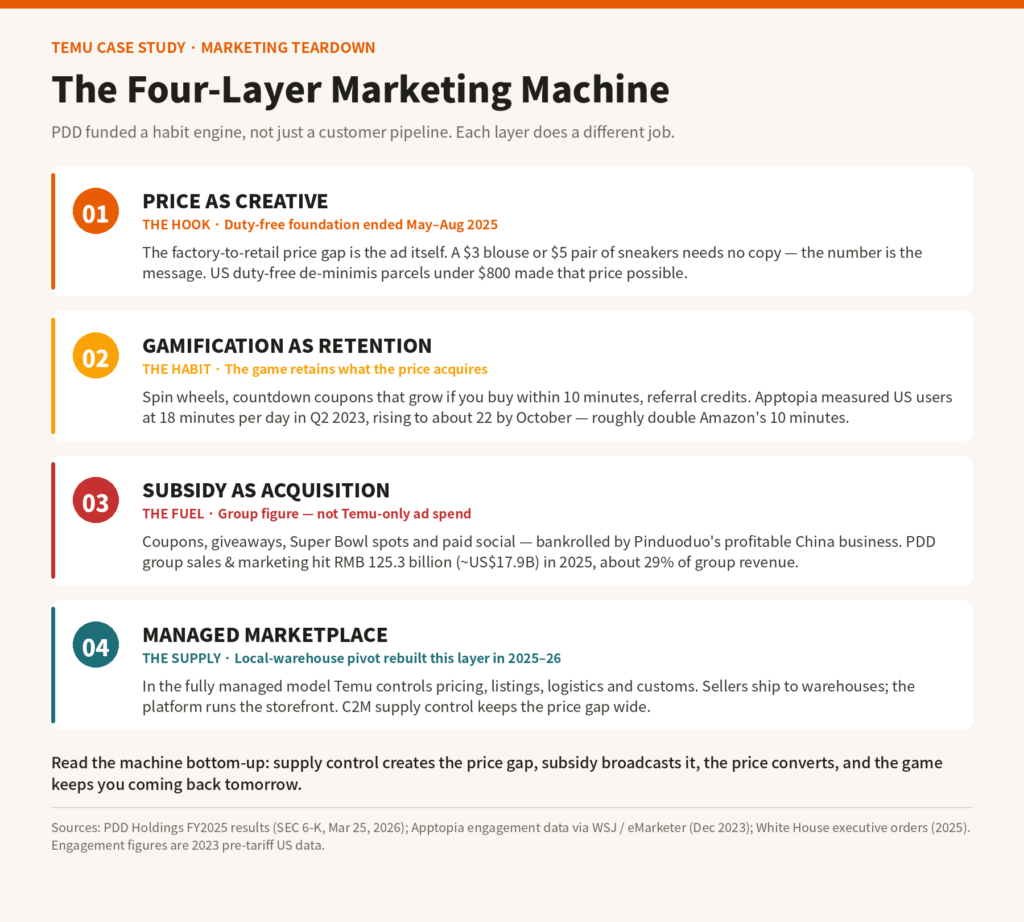
Strip away the noise and Temu’s marketing resolves into four layers, each doing a distinct job. Supply control creates the price gap; subsidy broadcasts it; the price converts; the game keeps you coming back tomorrow.
Layer One: Price as Creative
Why write a headline when the price tag is the headline? A blouse at $3 doesn’t need persuasion — the gap between factory cost and familiar retail price is the entire message. Every screenshot of a suspiciously cheap cart was unpaid advertising. De-minimis made those prices real; social sharing made them famous.
Layer Two: Gamification as Retention
The price gets you in. The game keeps you. Spin wheels, countdown coupons that grow in value if you buy within ten minutes, referral credits that turn your friends into your sales force. Apptopia measured the result: US users averaged 18 minutes a day inside Temu in Q2 2023 — nearly double Amazon’s 10 minutes — climbing to about 22 minutes by October. That’s not shopping behavior. That’s free-to-play mobile-game behavior, monetized in merchandise.
Layer Three: Subsidy as Acquisition
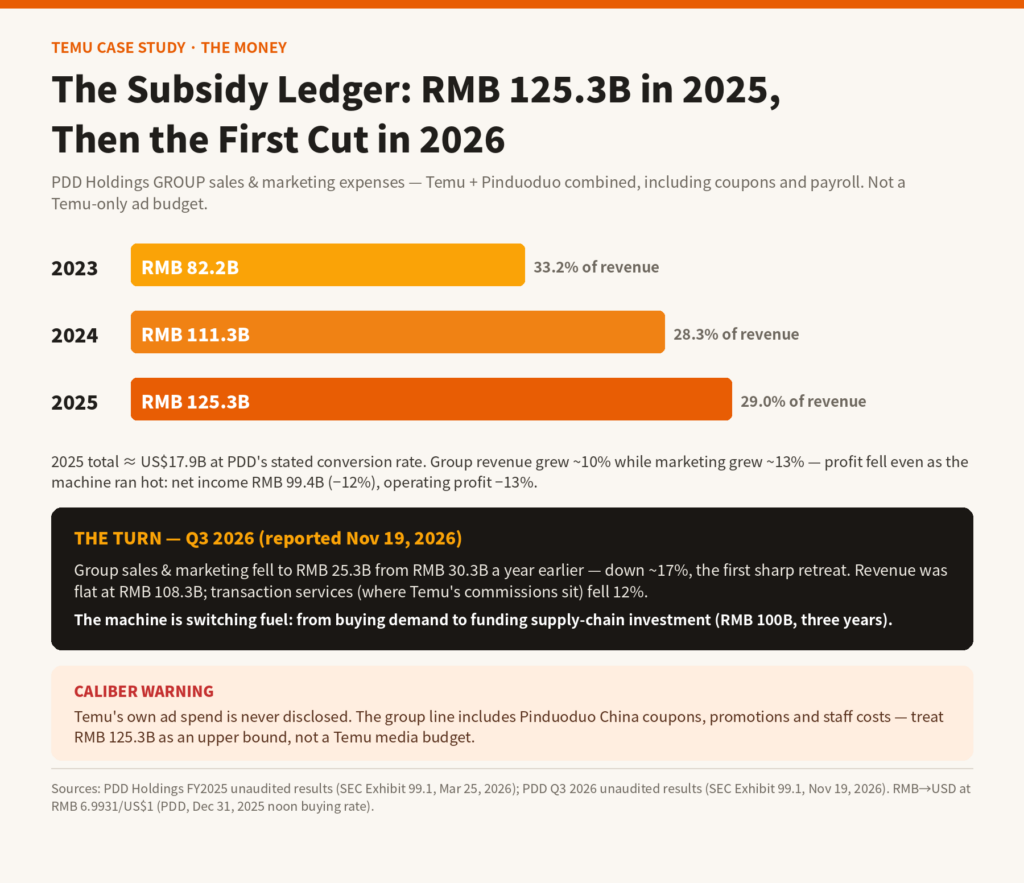
None of this is cheap. PDD’s group sales and marketing expenses ran RMB 82.2 billion in 2023, RMB 111.3 billion in 2024, and RMB 125.3 billion in 2025 — roughly US$17.9 billion at the company’s stated exchange rate, about 29% of group revenue. The fuel came from Pinduoduo’s profitable China business: a classic cross-subsidy, where the mature core funds the loss-making frontier. Below-cost customer acquisition is only irrational if nobody’s paying the difference. Somebody was.
Layer Four: The Managed Marketplace
In Temu’s fully managed model, sellers ship goods to warehouses and the platform takes over — pricing, listings, logistics, customs, marketing. It’s consumer-to-manufacturing supply control wearing a shopping-app costume. Sellers compete to supply; Temu decides what the shelf says. That control is what keeps the factory-to-retail gap wide enough to be an ad.
The Tariff Wall: The Arbitrage Had an Expiry Date
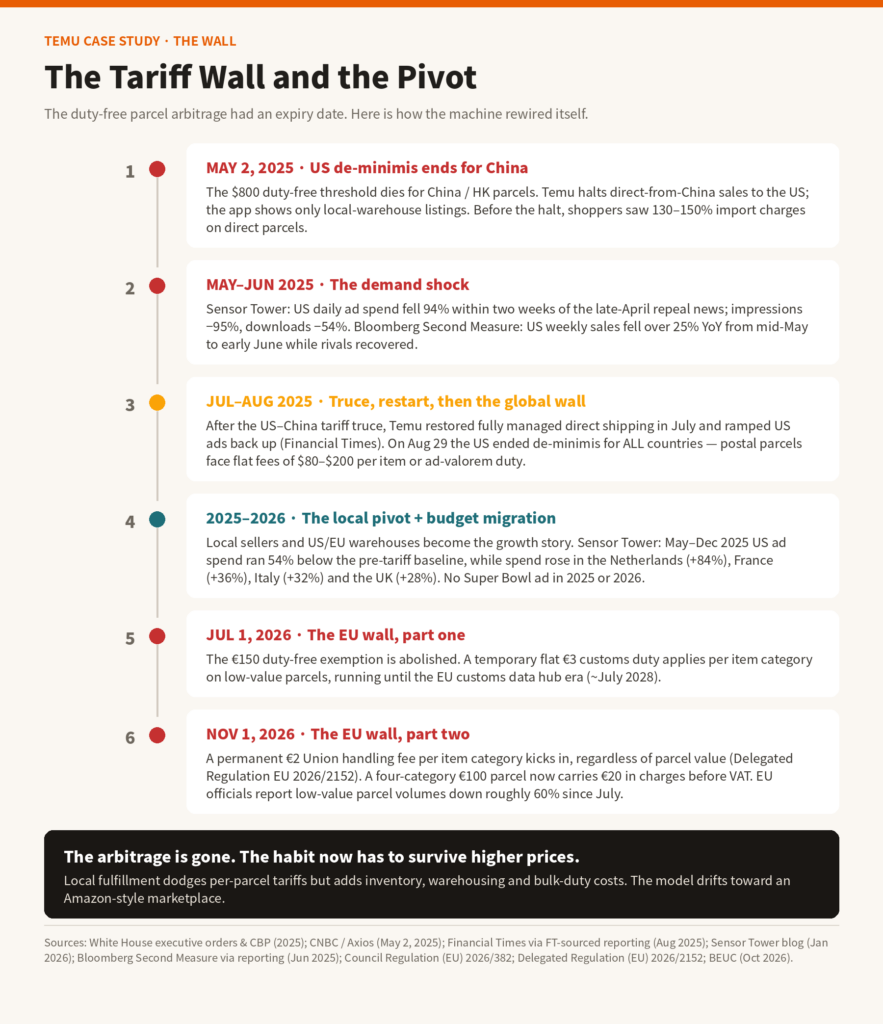
On May 2, 2025, the US eliminated de-minimis treatment for parcels from China and Hong Kong. Temu’s response was immediate and brutal: it stopped showing direct-from-China listings to American shoppers entirely. Before the switch, customers had been seeing import charges of 130–150% slapped onto direct parcels — fees that often cost more than the items themselves. After the switch, the US app showed only local-warehouse goods, with badges promising no import charges.
The demand shock was measurable. Sensor Tower recorded US daily ad spend dropping 94% within two weeks of the late-April repeal announcement, with ad impressions down 95% and downloads down 54%. Bloomberg Second Measure data showed US weekly sales falling more than 25% year-over-year from mid-May to early June, even as Shein, Walmart and Amazon recovered after the mid-May tariff truce.
Then the plot twisted again. After Washington and Beijing trimmed tariffs, Temu restored fully managed direct shipping in July 2025 and pushed US ad budgets back up, according to Financial Times reporting sourced from suppliers and analytics firm Smarter Ecommerce. But on August 29, 2025, the US ended de-minimis for every country — postal parcels now face flat fees of $80 to $200 per item or standard duties. The exemption wasn’t coming back.
Europe Builds Its Own Wall
Brussels moved in two steps. From July 1, 2026, the EU’s €150 duty-free threshold was abolished and replaced with a temporary flat €3 customs duty per item category on low-value parcels, intended to run until the EU customs data hub arrives around mid-2028. Then, on November 1, 2026, a permanent €2 Union handling fee per item category took effect under Delegated Regulation (EU) 2026/2152 — regardless of parcel value. Do the math on a typical Temu basket: a €100 parcel with four product categories now carries €20 in charges before VAT. EU officials report low-value parcel volumes down roughly 60% since July. When your average item costs less than the fee attached to it, the business model has a problem.
The Pivot: Local Sellers and a Redrawn Budget Map
Temu’s answer is to become less Temu. Local sellers, US and European warehouses, semi-managed fulfillment where merchants hold stock near the customer. Bulk imports pay duty once, spread across many units, instead of per parcel. It sidesteps the parcel tariff — but it adds inventory risk, warehousing costs and slower catalog refreshes. Structurally, it drifts toward the Amazon marketplace model Temu was built to undercut.
The ad budget followed the strategy. Sensor Tower’s full-year view: from May to December 2025, Temu’s US ad spend ran 54% below its pre-tariff baseline, while spending rose in the Netherlands (+84%), France (+36%), Italy (+32%) and the UK (+28%). The Super Bowl tells the same story in one frame: after headlining in 2023 and 2024, Temu bought no Super Bowl airtime in either 2025 or 2026.
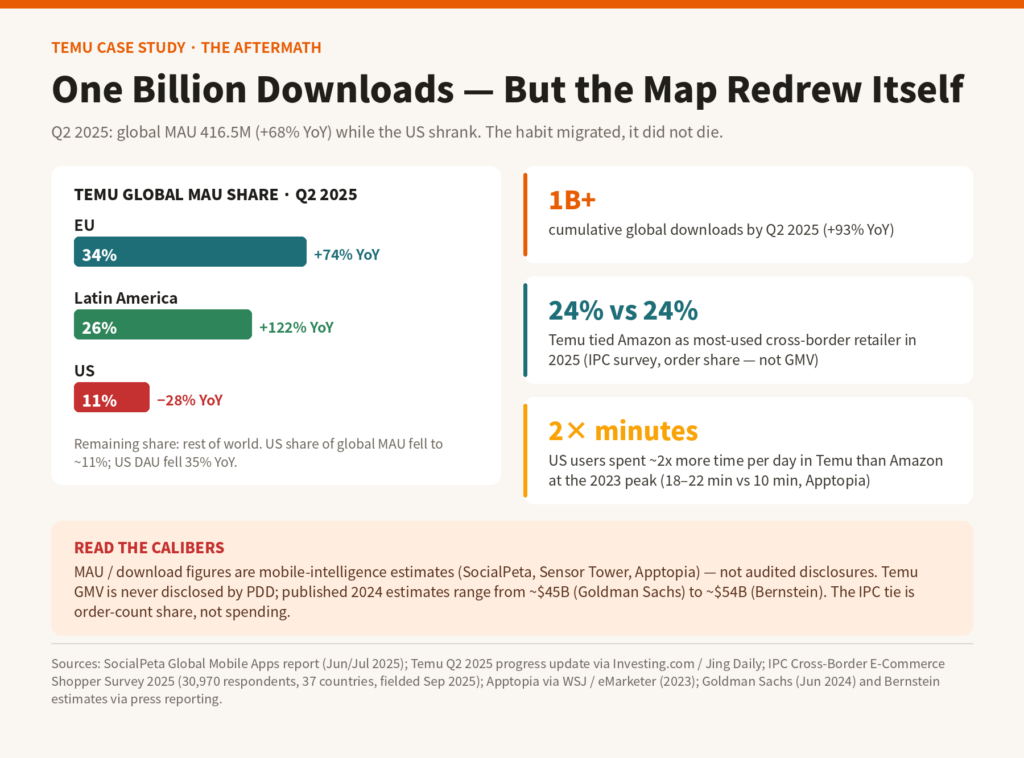
And the users? They migrated rather than vanished. SocialPeta’s mobile-intelligence estimates for Q2 2025 show global MAU up 68% year-over-year to 416.5 million, with Latin America up 122% (now 26% of users) and the EU up 74% (34%), while US MAU fell 28% to just 11% of the global base. Cumulative downloads crossed one billion. Meanwhile the International Post Corporation’s shopper survey — 30,970 respondents across 37 countries, fielded September 2025 — found Temu’s share of most-recent cross-border orders had risen from under 1% in 2022 to 24%, dead even with Amazon. Read the caliber carefully: that’s order count, not spending. Temu baskets are far smaller.
What Everyone Misunderstands
“Temu spent $17.9 billion on ads.” No. RMB 125.3 billion is PDD’s group sales-and-marketing line — Temu plus Pinduoduo China, including coupons, promotions and staff costs. It’s an upper bound on the machine’s fuel, not a Temu media budget. PDD has never disclosed Temu-only ad spend.
“The price is the product.” The price is the creative. The product is the habit — the daily browse loop — plus the supply control that sustains the gap. Confuse the hook for the business and you’ll misread everything that follows.
“Tariffs killed Temu.” They killed a loophole, not a company. Direct shipping resumed within months, group marketing kept rising through 2025, and the user base kept growing outside America. What died was US price leadership at the old magnitude.
“Temu did $70.8 billion in GMV in 2024.” You’ll see that number circulating. We couldn’t trace it to any named research firm’s published methodology, so we dropped it. What exists: Goldman Sachs projected roughly $45 billion for 2024; Bernstein’s estimate ran near $54 billion. PDD discloses no Temu GMV at all. Treat every figure as an estimate with a name attached.
The November 2026 Twist: The Machine Cuts Its Own Fuel
This week’s earnings changed the story’s final act. In Q3 2026, reported November 19, PDD’s group sales and marketing fell to RMB 25.3 billion from RMB 30.3 billion a year earlier — down about 17%, the first sharp retreat after years of escalation. Group revenue was flat at RMB 108.3 billion; transaction services, the line carrying Temu’s commissions, fell 12%. Profit beat expectations precisely because the marketing machine throttled down.
Where’s the money going instead? The “New Pinmu” initiative announced in March 2026: RMB 15 billion of initial capital and RMB 100 billion over three years to build proprietary brands and deepen supply-chain control across both Pinduoduo and Temu. Management said the quiet part on the call: consumer appreciation comes from price and service per purchase, not short-term marketing spend. The subsidy era is being rebranded as the supply-chain era. The same cross-subsidy engine, pointed at a different target.
The Reusable Methodology
Steal these four principles — they work beyond bargain e-commerce:
- Make the price gap the message. If your structural cost advantage is visible in the number itself, the number is your best creative. Stop writing copy that explains what the price already screams.
- Let the game retain what the price acquires. Acquisition and retention are different machines. Temu bought attention with subsidies and kept it with variable rewards and countdowns. Cheap traffic plus an engagement loop beats cheap traffic alone.
- Fund below-cost acquisition from a profitable core. Cross-subsidy isn’t cheating; it’s portfolio strategy. But name the donor business and know its limits — the frontier only survives while the core pays.
- Budget for the arbitrage’s death. Every regulatory loophole has an expiry date you don’t control. Temu’s local-warehouse buildout began over a year before de-minimis died — and it still wasn’t enough to save the old US economics. Start your pivot before the wall arrives.
Risks and Honest Caveats
The habit-versus-price test remains unproven: can a browse loop built on $3 blouses survive €5 of fees per parcel and local-warehouse markups? Nobody has published the answer yet. The compliance front keeps widening — European consumer group BEUC’s network found 69% of 162 tested Temu and Shein items non-compliant with EU safety standards, with separate Temu tests worse still — and every new fee, identifier mandate and safety check adds cost the old model never carried. Competitors smelled blood: Amazon launched its Haul storefront in November 2024 with most items under $20, and Shein and TikTok Shop keep pressing. Finally, mind every caliber in this article: group spend is not Temu spend, MAU and downloads are vendor estimates from firms that sell advertising intelligence, and the Amazon tie is orders, not money.
Conclusion: Does the Habit Outlive the Price?
Temu’s machine bought a habit with price-as-creative, gamification-as-retention, subsidy-as-acquisition and managed supply. The tariff walls erased the arbitrage that made the price possible, forced a local-fulfillment pivot, redrew the budget map toward Europe and Latin America — and now, with Q3 2026’s marketing cut and the RMB 100 billion supply-chain bet, PDD itself is betting that the next moat is built in warehouses and factories, not ad auctions. The reusable lesson stands: price acquires, the game retains, the core funds the frontier, and every arbitrage expires. Temu’s price was the ad. The open question — the one worth watching through 2027 — is whether the habit outlives the price.