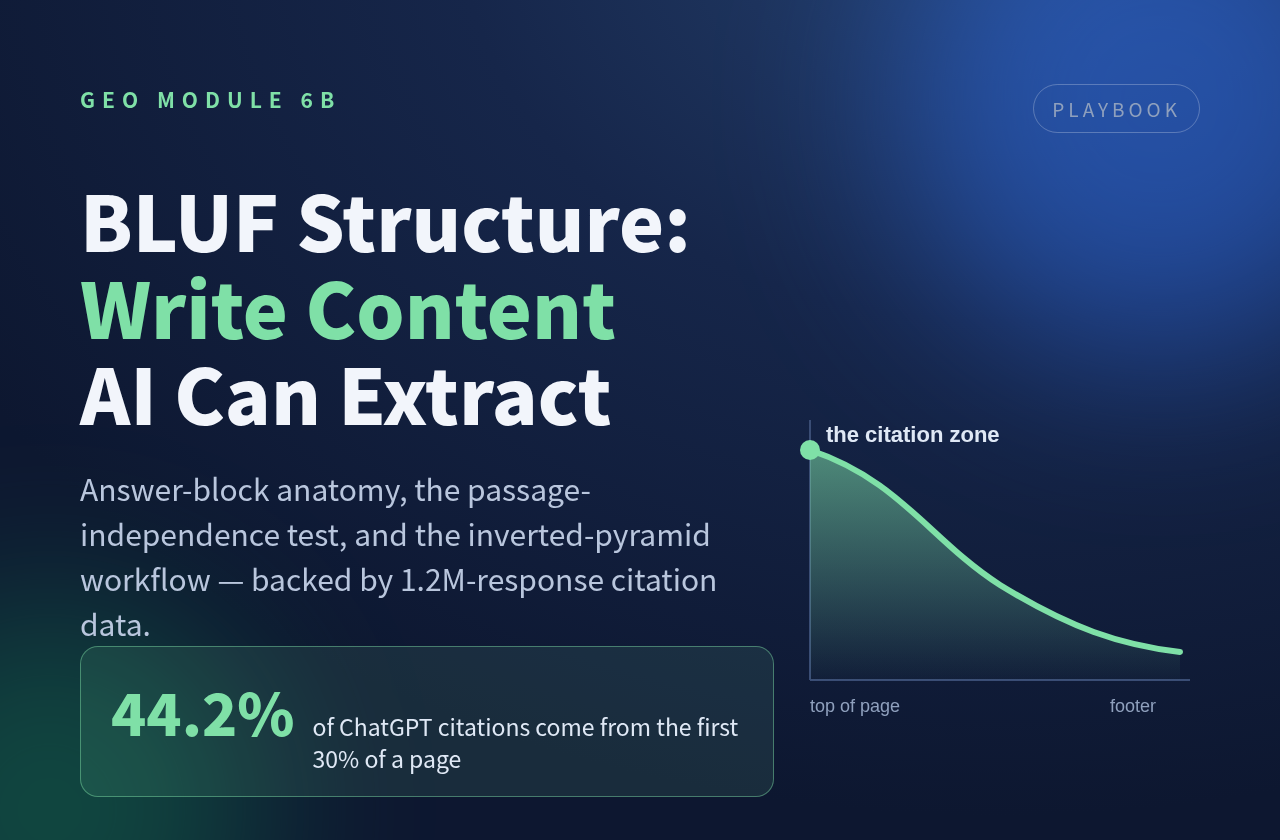
Almost half of everything ChatGPT quotes from your website comes from the top third of the page. Not the middle. Not your carefully crafted conclusion. The top.
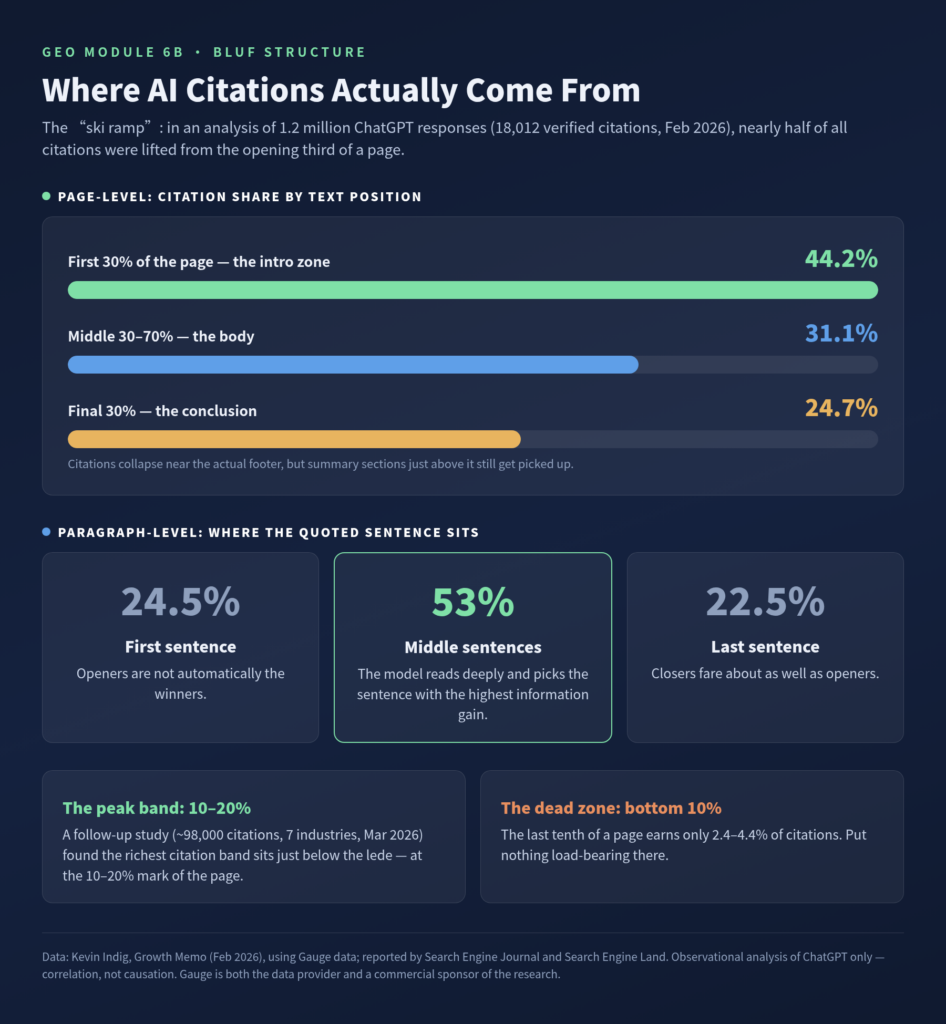
That single finding should change how you write. In February 2026, growth advisor Kevin Indig published an analysis of 1.2 million ChatGPT responses — drawing on a dataset of roughly 3 million answers and 30 million citations supplied by the analytics platform Gauge — and isolated 18,012 verified citations to map exactly where quoted text lives on a page. The result was a distribution he calls the “ski ramp”: 44.2% of citations came from the first 30% of the text, 31.1% from the middle, and 24.7% from the final third, with a sharp collapse near the footer.
The pattern has a name older than SEO. The U.S. Army calls it BLUF — Bottom Line Up Front. Journalists call it the inverted pyramid. AI engines, it turns out, read like editors on deadline: they grab the answer at the top and treat everything else as supporting material.
This playbook teaches you to write that way — without dumbing anything down.
Why the first 30% is the citation zone
Let’s be precise about what the data says, because this number gets passed around with sloppy attribution. The 44.2% figure comes from Indig’s Growth Memo analysis (widely misattributed to SparkToro in secondhand roundups — it isn’t theirs). His team matched AI answers to source sentences using semantic embeddings, kept only high-confidence matches, and measured where each quoted sentence sat in the page. The pattern held across randomized validation batches.
Two honest caveats before we build on it. First, this is an observational study of ChatGPT only, not a peer-reviewed experiment — correlation, not causation. Second, Gauge is both the data provider and a commercial sponsor of the research, which is worth knowing when you weigh the findings. The direction, though, lines up with independent evidence we’ll get to shortly.
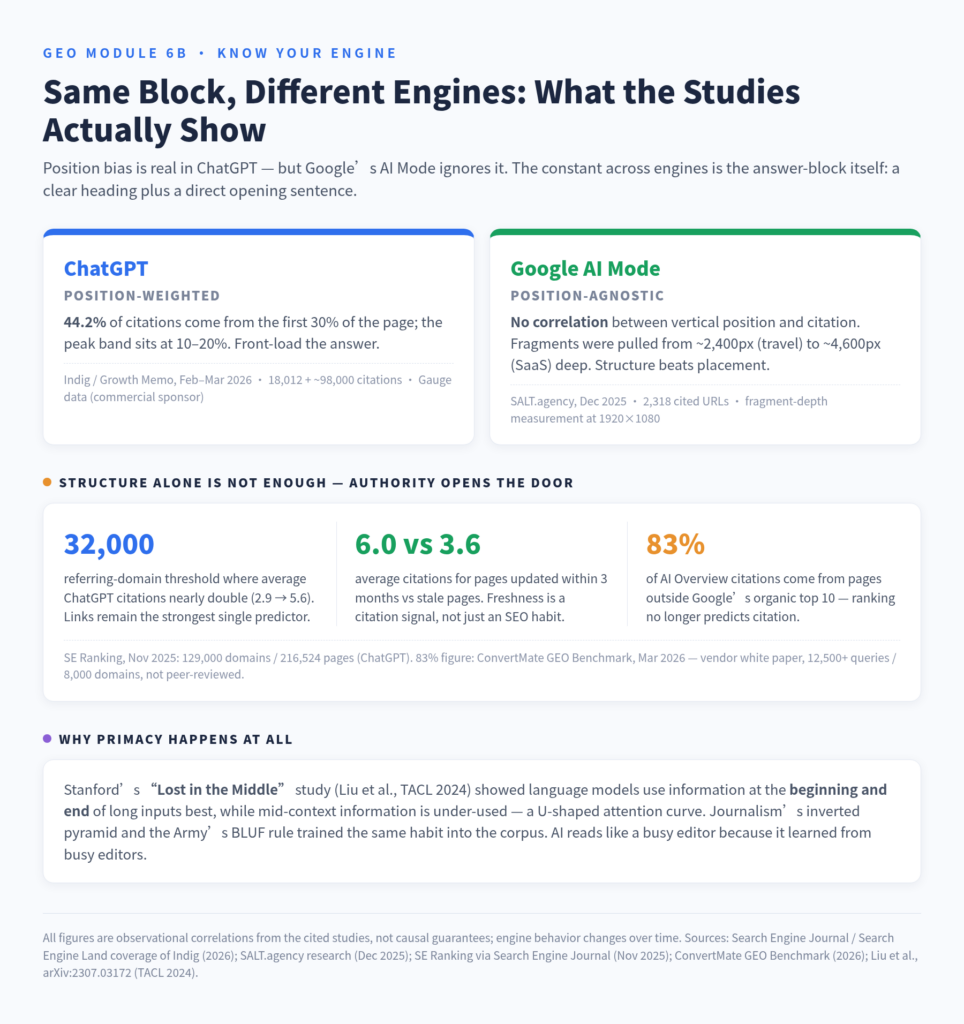
A follow-up study Indig published in March 2026 sharpened the picture: across roughly 98,000 citation records spanning seven industries, the richest citation band wasn’t the very first lines — it was the 10–20% mark of the page, just below the lede. The bottom 10% of a page earned only 2.4–4.4% of citations. Finance showed the steepest front-loading of any vertical, with 43.7% of its citations in the opening third.
Translation: your introduction isn’t a warm-up act. It’s the main event.
Why machines developed a primacy habit
This isn’t arbitrary. Stanford researchers showed in “Lost in the Middle” (Liu et al., published in Transactions of the Association for Computational Linguistics, 2024) that language models use information at the beginning and end of long inputs far better than information buried in the middle — a U-shaped attention curve that persists even in models built for long contexts.
Layer on the training corpus. Models learned from journalism and academic writing, both of which front-load conclusions. Indig’s hypothesis: the model establishes a frame from your opening, then interprets everything else through it. A slow narrative reveal doesn’t read as suspense. It reads as absence of an answer.
BLUF is doctrine, not a growth hack
Here’s the part that makes this feel less like chasing an algorithm. BLUF is codified U.S. Army writing doctrine. Army Regulation 25-50 requires correspondence to be understood in a single, rapid reading, written in active voice, with the bottom line up front. The Army’s Intelligence Center of Excellence goes further: its writing rubric awards the top grade — “Superior” — only when the main point lands within the top 2% of the document.
Journalism arrived at the same place from the reader’s side. Nielsen Norman Group’s classic eye-tracking work found 79% of web users scan pages while only 16% read word by word, and their rewrite experiments showed that combining concise, scannable, objective text improved usability by 124%. NN/g’s standing recommendation is the inverted pyramid: start with the conclusion, because readers can stop anywhere and still leave with the answer.
So when you front-load for AI, you’re not writing for robots at the expense of humans. You’re applying a discipline that busy humans demanded decades before ChatGPT existed.
The answer-block: anatomy of a liftable unit
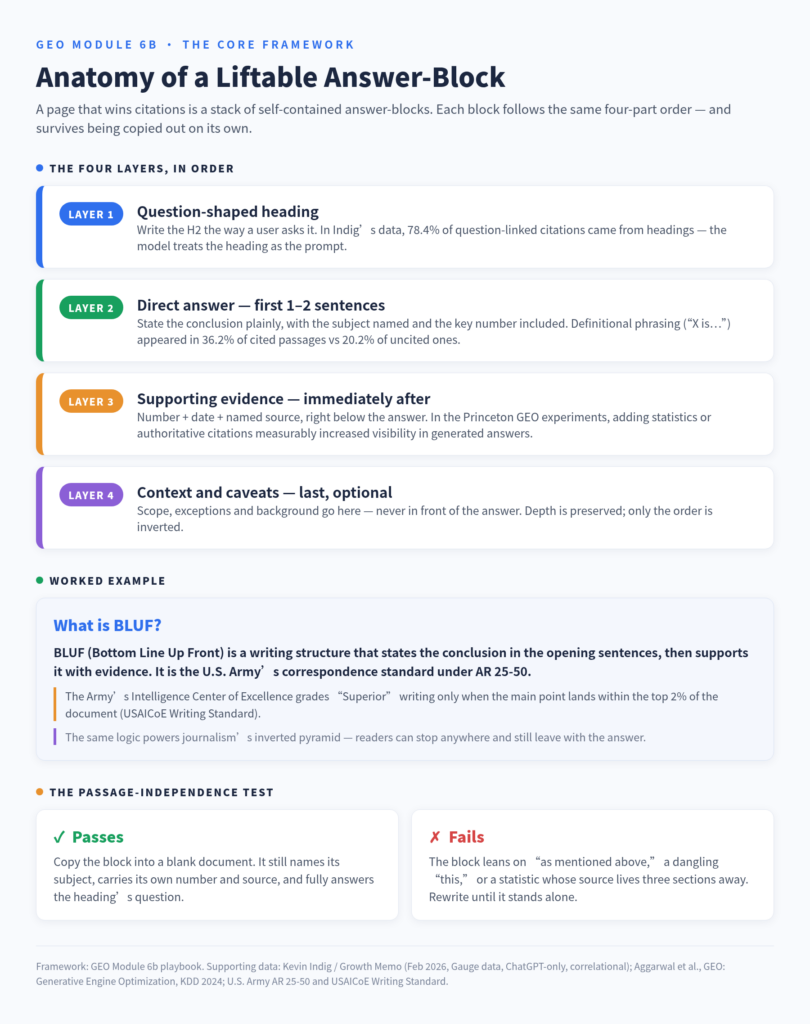
Here’s the core framework. A citable page is not an essay — it’s a stack of self-contained answer-blocks. Each block has four layers, in this order:
- A question-shaped heading. Write the H2 the way a user actually asks it. In Indig’s data, 78.4% of question-linked citations came from headings — the model treats your heading as the prompt and the paragraph beneath it as the answer.
- A direct answer in the first one or two sentences. State the conclusion plainly, name the subject, include the key number. Definitional phrasing (“X is…”, “X refers to…”) appeared in 36.2% of cited passages versus 20.2% of uncited ones.
- Supporting evidence immediately after. Number, date, named source — right below the answer, not three sections later. The Princeton-led GEO study (Aggarwal et al., KDD 2024) found that adding statistics lifted visibility by about 41% on its position-adjusted word-count metric, while adding quotations lifted its subjective-impression metric by about 28%. Different metrics, same direction: evidence makes text liftable. Note that these were laboratory results on a simulated engine, not a live-ranking guarantee.
- Context and caveats last. Scope, exceptions, background. Valuable — but never in front of the answer.
Notice what this preserves: all the depth. BLUF doesn’t delete your argument. It reorders it.
The passage-independence test
This is the quality gate most teams skip. Take one answer-block, copy it verbatim into a blank document, and ask: does it still resolve the question in its heading?
It passes if it names its own subject, carries its own number and source, and needs nothing from the surrounding page. It fails the moment it leans on “as mentioned above,” a dangling “this,” or a statistic whose attribution lives somewhere else. When the model lifts your passage — and it lifts passages, not pages — everything the reader needs must travel with it.
Run the reverse check too: ask an AI engine to summarize your page, then compare its summary to your intended answer. If the machine’s version misses your key point, your key point probably isn’t where the machine looks.
Don’t over-rotate: the paragraph-level surprise
Here’s where naive BLUF advice goes wrong. Indig zoomed into 1,000 heavily cited pieces and found that within a paragraph, 53% of citations came from middle sentences — only 24.5% from first sentences and 22.5% from last ones.
Read that again. The model is not skimming topic sentences like a tired human. It reads deeply and quotes the sentence with the highest information gain — the one with the clearest entities, the most complete fact — wherever it sits in the paragraph.
So the rule is: front-load at the page level, optimize for information density at the sentence level. Stuffing every paragraph’s first sentence with a keyword-stuffed pseudo-answer is optimizing for a behavior the data doesn’t show.
The engine caveat: Google doesn’t play the same game
Before you rebuild your entire site around the top third, know this: the ski ramp is a ChatGPT pattern. SALT.agency studied 2,318 URLs cited by Google’s AI Mode across travel, e-commerce, and SaaS (published December 2025) and found no correlation between how high text sits on a page and whether it gets cited. Cited fragments averaged around 2,400 pixels deep in travel and 4,600 in SaaS — far below any fold.
What did show up repeatedly in Google’s highlights? A descriptive subheading plus the sentence immediately after it. Google appears to retrieve fragments — sections, not pages — and judge each on its own merits.
Which means the answer-block survives both engines. Position gets you extra leverage in ChatGPT; structure is what travels everywhere. Build blocks, and you’re covered either way.
What BLUF can’t fix
Structure is a multiplier, not a ticket in. SE Ranking’s analysis of 129,000 domains and 216,524 pages (November 2025, reported by Search Engine Journal) found that referring domains were the strongest single predictor of ChatGPT citations — sites crossing roughly 32,000 referring domains saw average citations nearly double, from 2.9 to 5.6. The same study linked freshness to visibility: pages updated within three months averaged 6.0 citations against 3.6 for stale ones, and pages with expert quotes and dense statistics outperformed those without.
And ranking no longer guarantees citation: ConvertMate’s 2026 GEO benchmark — a vendor white paper covering 12,500-plus queries across 8,000 domains, not peer-reviewed — reports that 83% of AI Overview citations come from pages outside Google’s organic top 10. Treat that as directional, given the source sells GEO tooling, but it rhymes with everything above.
The honest summary: authority gets you retrieved, structure gets you quoted, freshness keeps you quoted. BLUF is the middle term — necessary, not sufficient.
The inverted-pyramid workflow
Five steps, in order, every time you draft an answer-page:
- Write the answer sentence first. Before the intro, before the outline. One sentence that resolves the query, with the subject named.
- Add the evidence. Number, date, source — attached directly beneath.
- Add context and caveats after. Everything a skeptic would ask goes below the answer, not above it.
- Shape the heading as the question. Mirror the query language your audience actually types or speaks.
- Run the independence test. Lift the block. If it fails, rewrite until it stands alone.
This inverts the academic build-up you were trained on. That structure earned credibility by showing the work before the conclusion. Extraction systems reward the opposite order — and, conveniently, so do scanning humans.
A worked transformation
Before: “In today’s fast-evolving digital landscape, many companies wonder about GEO. After extensive research, we found that…” — answer arrives in paragraph four.
After: “GEO (Generative Engine Optimization) is the practice of structuring content so AI engines can cite it. In ConvertMate’s 2026 benchmark of 12,500-plus queries, 83% of AI Overview citations came from pages outside Google’s organic top 10 — ranking no longer predicts citation.” — answer in sentence one, evidence in sentence two, context after.
Same information. Same depth. Different order. One version is a passage a model can lift; the other is a passage a model scrolls past.
Where BLUF doesn’t belong
Two honest boundaries. First, genre: narrative storytelling, brand films in text form, personal essays — these earn attention through tension, and flattening them into answer-blocks would destroy the product. Apply BLUF to answer-content: guides, definitions, comparisons, documentation, FAQ pages. Second, sameness: if every page on your site opens with the identical formula, readers (human ones) will feel the template. Vary the evidence, the examples, the voice. The structure is scaffolding, not a straitjacket.
The takeaway
Write the answer first. Back it with a number and a named source. Shape the heading as the question. Test whether the block survives being lifted. Keep the depth — just move it below the fold of the answer.
The first 30% of your page is where the citation is won. AI reads your introduction like an editor on deadline. Put the answer there.