Last updated: November 18, 2026. All figures verified against primary publications; vendor studies are labeled as such.
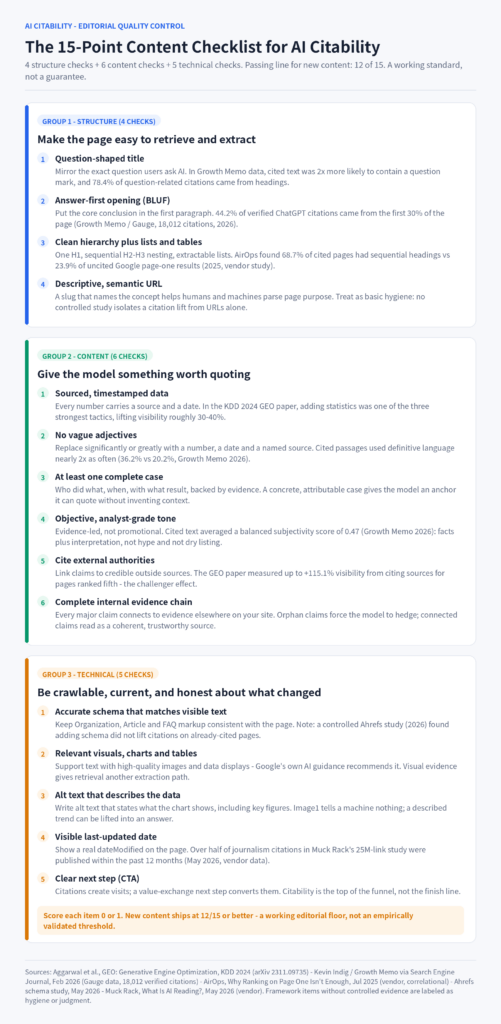
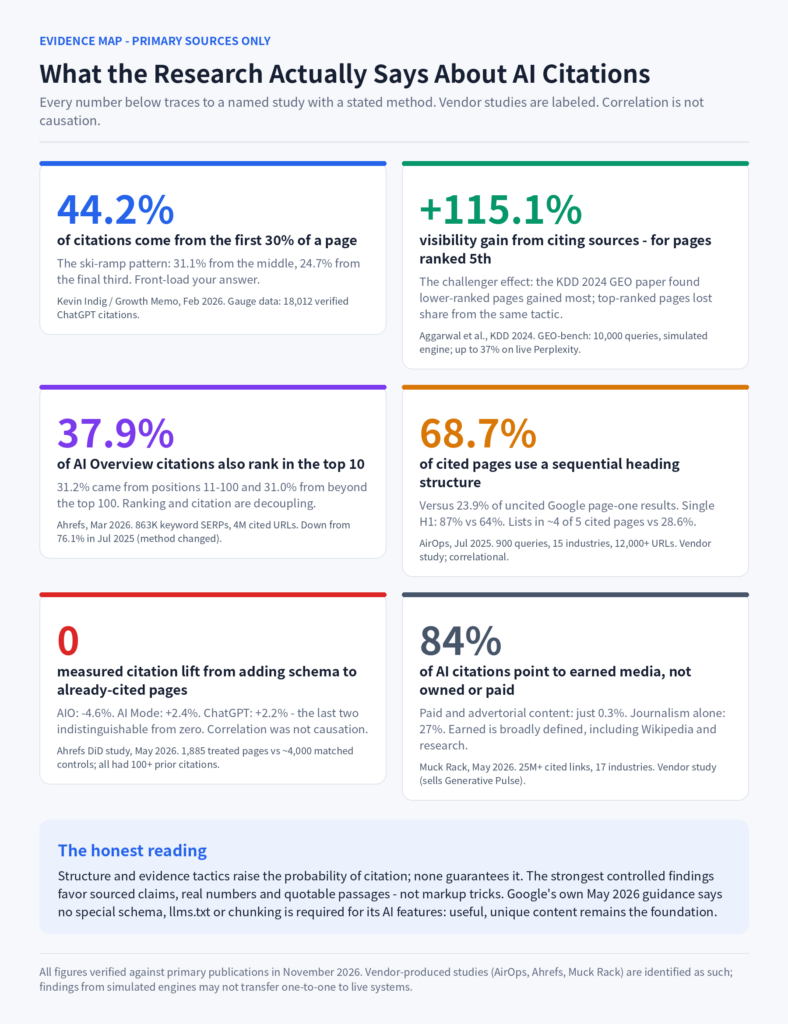
Good content and citable content are not the same thing. In Ahrefs’ March 2026 analysis of 863,000 keyword results pages and roughly 4 million AI Overview URLs, only 37.9% of cited pages also ranked in the top ten result blocks for the same query — and 31.0% came from beyond the top 100 entirely. AI engines apply their own selection criteria, and the strongest controlled evidence says those criteria reward sourced claims, specific numbers and cleanly extractable passages. This article turns that evidence into a 15-point editorial checklist: 4 structure checks, 6 content checks, 5 technical checks, with a working passing line of 12/15 for new content. Every item traces to a named study or is explicitly labeled as judgment. Passing raises your probability of citation. It never guarantees it — and any checklist that promises otherwise is selling you something.
Why Good Content Stops Being Enough
Here is the uncomfortable math. Your page can rank on page one and still be invisible inside the AI answer sitting above it. Ahrefs measured this twice: in July 2025, 76.1% of AI Overview citations came from top-ten pages; by March 2026 that share had fallen to 37.9%. One caveat before anyone panics — Ahrefs improved its citation parsing between studies, so part of that swing is better measurement, not purely changed behavior. The direction still holds. BrightEdge, using its own parser and an undisclosed methodology, put the overlap even lower, around 17% in February 2026. Two vendors, two instruments, one conclusion: ranking and citation have come apart.
Why? Google’s own documentation describes query fan-out: AI Overviews and AI Mode split your query into multiple related sub-searches and pull supporting pages from across that wider pool. A page that answers a sub-question beautifully can earn the citation even if it never ranked for the headline keyword. The unit of competition changed. You are no longer competing page against page for a blue link. You are competing passage against passage for a slot inside a generated answer.
That is why “write great content” stopped being actionable advice. Great for whom? A human reading top to bottom rewards narrative. A retrieval system scoring 200-word chunks rewards something else. The checklist below operationalizes that something else.
The Evidence Behind the Checklist
Before the items, the receipts. Four studies carry most of the weight, and each has limits you should know.
The founding academic study is “GEO: Generative Engine Optimization” by Aggarwal and colleagues from IIT Delhi and Princeton, published at KDD 2024. The team built GEO-bench — 10,000 queries across diverse domains — and tested nine content modifications on a simulated generative engine, then validated on live Perplexity.ai. Adding quotations, statistics and source citations lifted visibility roughly 30–40% on the paper’s position-adjusted word count metric, with an overall ceiling of “up to 40%” in the abstract and up to 37% on the live engine. Keyword stuffing did nothing or hurt. The catch: a simulated engine running GPT-3.5 with five retrieved sources is not today’s ChatGPT, so treat the numbers as directional evidence for a principle, not a forecast for your site.
The largest observational study of placement is Kevin Indig’s Growth Memo analysis, published in Search Engine Journal in February 2026. Working with data from Gauge — roughly 3 million ChatGPT answers and 30 million citations, narrowed to 18,012 verified citation matches — Indig found a “ski ramp”: 44.2% of citations came from the first 30% of a page, 31.1% from the middle, 24.7% from the final third. This is ChatGPT-only and observational; it shows where citations cluster, not what causes them. (You may see this 44.2% figure attributed to SparkToro in circulating summaries. That attribution is wrong; the primary analysis is Indig’s.)
The structure evidence comes from AirOps, a vendor that sells AI-search software — so read it as correlation, not causation. In July 2025 the company compared ChatGPT-cited URLs against uncited Google page-one results for 900 queries across 15 industries, reviewing more than 12,000 URLs. Cited pages were far more likely to have clean heading hierarchies and dense lists. We will use the specific numbers in the structure section.
And the most important corrective is Ahrefs’ May 2026 controlled study of schema markup, which we will get to in the technical section — because it overturns one of the most repeated claims in this entire field.
Structure Checks: Make the Page Easy to Retrieve and Extract
Check 1 — Does your title mirror the question users actually ask?
AI systems treat headings as prompts. In Indig’s data, cited text was twice as likely to contain a question mark (18% versus 8.9% in uncited text), and 78.4% of question-related citations came from headings rather than body copy. Write the H1 — and as many H2s as make sense — in the shape of the real query. “What is private-domain traffic?” beats “Understanding Traffic Ecosystems.” The engine reads your heading as the question and the paragraph beneath it as the candidate answer. Make that pairing explicit.
Check 2 — Does the opening state the answer before the warm-up?
This is the BLUF discipline: bottom line up front. With 44.2% of verified citations coming from the first 30% of a page, your opening paragraphs are the highest-leverage real estate you own. Put the core conclusion, one specific number and its source in the first 100–150 words. A useful nuance from the same study: at paragraph level, 53% of citations came from mid-paragraph sentences, not first sentences. So front-load the page, but do not strangle every paragraph into a topic-sentence formula. The engine hunts the sentence with the most information, wherever it sits.
Check 3 — Is the hierarchy clean, with real lists and tables?
AirOps found 68.7% of ChatGPT-cited pages used a sequential heading structure — H1 to H2 to H3 with no skipped levels — versus 23.9% of uncited page-one results. A single H1 appeared on 87% of cited pages versus 64%. Nearly four in five cited pages contained at least one list section, against 28.6% of the Google comparison group. Again: vendor correlation, not a controlled experiment. But the mechanism is plausible and the fix is cheap. Lists and tables give a retrieval system pre-packaged, self-contained units. One caution from Google’s own May 2026 guidance: you do not need to “chunk” content into artificial fragments — its systems handle multi-topic pages fine. Structure for clarity, not for a parser you imagine.
Check 4 — Does the URL name the concept?
A descriptive slug helps humans trust the link and helps machines classify the page. Be honest about the evidence here: no controlled study isolates a citation lift from URL structure alone. This item is hygiene, scored because broken hygiene correlates with broken everything else. If your CMS produces /post-1847-final-v2, fix it and move on.
Content Checks: Give the Model Something Worth Quoting
Check 5 — Does every number carry a source and a date?
The GEO paper’s statistics finding is the anchor: swapping qualitative claims for quantitative ones was among the three strongest tactics tested, lifting visibility roughly 30–40%. But an unsourced number is a liability, not an asset — it fails the verifiability test that made statistics work in the first place. Every figure gets a named source and a date. “Citations cluster at the top of pages (Growth Memo, February 2026)” is quotable. “Studies show most citations come from the top” is filler the model can get anywhere.
Check 6 — Have you purged the vague adjectives?
“Significantly.” “Greatly.” “A game-changer.” These words carry zero extractable information. Indig’s linguistic analysis found cited passages used definitive language — “X is,” “X refers to” — nearly twice as often as uncited ones (36.2% versus 20.2%). The edit is mechanical: find every vague intensifier and replace it with a number, a date and a source, or delete the sentence. If you cannot quantify the claim, ask whether you believe it.
Check 7 — Is there at least one complete, attributable case?
Who did what, when, with what result, backed by evidence a reader can check. A five-element case gives the model an anchor it can lift without inventing context — and it is the clearest expression of the first-hand experience Google keeps emphasizing. Its May 2026 guide contrasts commodity content (“7 tips for first-time homebuyers”) with non-commodity content (“why we waived the inspection and what the sewer line taught us”). One real case, told with specifics, does more for citability than ten generic best practices.
Check 8 — Does the tone read like an analyst, not a brochure?
Indig’s data puts the subjectivity score of cited text at 0.47 on a zero-to-one scale — balanced between bare facts and pure opinion. Not dry encyclopedia prose, not hype: facts plus interpretation. This matches the GEO paper’s finding that persuasive-but-grounded authoritative tone helped while empty promotion did not. Write the sentence that states the fact, then the sentence that says what it means. Promotional tone asks the model to launder your marketing; it declines.
Check 9 — Do your claims cite external authorities?
This is the challenger effect, and it is the most commercially interesting finding in the whole literature. In the GEO paper, adding source citations raised visibility by 115.1% for pages ranked fifth in the retrieved set — while top-ranked pages actually lost share from the same tactic. The engine rewards content that shows its receipts, and that reward flows disproportionately to challengers. If you are the underdog in your category, this is your lane. Cite the academic paper, the government dataset, the primary filing — not the blog post that cited the blog post.
Check 10 — Does every major claim connect to evidence elsewhere on your site?
An orphan claim forces a model to hedge. A claim that links to your methodology page, your dataset, your case library reads as part of a coherent source. No single study measures internal-link completeness as a citation factor — this item is labeled judgment — but it follows from how retrieval systems build trust in a domain, and it costs you nothing but editing discipline.
Technical Checks: Be Crawlable, Current and Honest
Check 11 — Is your schema accurate — and are your expectations realistic?
Here is where the checklist earns its keep by telling you what not to believe. The claim that stacking three or four schema types doubles your citation rate circulates everywhere. It has no controlled support, and the best available experiment contradicts it. In May 2026, Ahrefs tracked 1,885 pages that added JSON-LD between August 2025 and March 2026 against roughly 4,000 matched control pages, using difference-in-differences to strip out platform trends. Result: AI Overviews citations fell 4.6% relative to controls (small but statistically significant), AI Mode moved +2.4% and ChatGPT +2.2% — both indistinguishable from zero. The honest caveat: every treated page already had 100+ AI Overview citations, so the study cannot speak to undiscovered pages. And the correlation that started the myth is real — cited pages are about three times more likely to carry schema — it just reflects overall site quality, not markup magic. Keep Organization, Article and FAQ markup accurate and consistent with visible text, because Google requires that consistency and because it serves rich results and entity recognition. Do not budget it as a citation lever.
Check 12 — Do relevant visuals support the text?
Google’s own AI guidance recommends supporting textual content with high-quality, relevant images and video, and its systems handle multimodal queries. A chart that displays your data gives retrieval another surface to work with. This is official guidance, not a measured multiplier — score it as recommended practice.
Check 13 — Does alt text describe the data, not the filename?
“Image1” tells a machine nothing. “Bar chart: 44.2% of verified ChatGPT citations originate in the first 30% of a page, per Growth Memo’s February 2026 analysis” is an extractable fact that also serves screen-reader users. No controlled study isolates alt text as a standalone citation lever; it is accessibility hygiene with a plausible extraction benefit. Do it because it is right, and because it might help.
Check 14 — Is the last-updated date visible and real?
Freshness is where vendor data is strongest and primary data is thin, so here is what we can actually stand behind: in Muck Rack’s May 2026 study of more than 25 million cited links — the company sells AI-visibility monitoring, so note the interest — more than half of journalism citations came from articles published within the previous 12 months, with volume dropping sharply after six months. Recency demonstrably shapes what gets cited. Show a genuine dateModified on the page and in your markup, and update the substance when you touch the date. A refreshed timestamp on stale content is a lie the reader eventually catches.
Check 15 — Is there a clear next step?
Citations create visits; visits need somewhere to go. A value-exchange CTA — the template, the dataset, the calculator — converts the attention citability earns. This item is about your business model, not the algorithm. Score it anyway, because a page that wins citations and converts nothing is a trophy, not an asset.
The Passing Line: 12 of 15, and Why It Is a Heuristic
Score each item pass or fail. New content ships at 12/15 or better. Now the honest part: that threshold is an editorial heuristic, not an empirically validated cutoff. Nobody has run the experiment that proves 12 outperforms 11. The principle is what matters — meet most of the criteria, because the evidence supports the bundle, not any single trick. A floor keeps quality consistent across writers and quarters. Treat the number as a working standard your team owns, and revisit it as the research evolves.
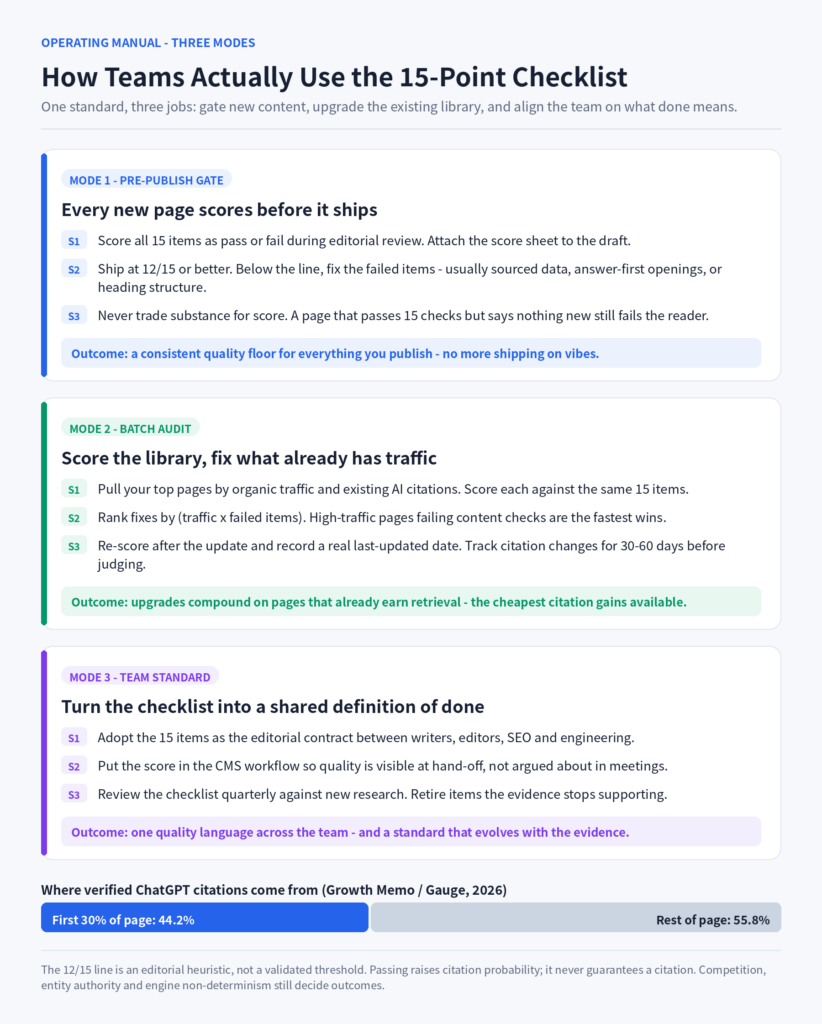
Three Ways Teams Actually Use the Checklist
As a pre-publish gate, the score sheet rides along with every draft, and editors fix failed items before shipping — usually sourced data, answer-first openings or heading structure. As a batch audit, you score the existing library and rank fixes by traffic multiplied by failed items; high-traffic pages failing content checks are the cheapest citation gains available, because they already earn retrieval. As a team standard, the 15 items become the shared definition of done between writers, editors, SEO and engineering — one quality language instead of meeting-room arguments. Review the checklist quarterly against new research and retire items the evidence stops supporting. That last instruction is not decoration: this field overturned its own schema consensus in under a year.
What the Checklist Cannot Do
Three limits, stated plainly. First, passing is not a guarantee. Citation outcomes depend on competition, entity authority and engine non-determinism — the same query can produce different sources across sessions, and no on-page checklist controls that. Second, the strongest experimental evidence comes from a simulated engine and from observational snapshots of live ones; effects vary by domain, engine and query type, and the GEO paper itself stresses domain-specific tuning. Google’s AI Overviews, ChatGPT and Perplexity are different information environments with different source diets. Third, writing to the checklist can produce formulaic content — the exact commodity content Google’s guidance warns against, and the scaled query-variation pages it classifies as spam. The checklist is a quality floor, not a substitute for having something to say. Keep the human value; let the checklist protect it.
Conclusion: Raise the Probability, Keep the Honesty
AI applies its own standard, and the measured components of that standard are surprisingly traditional: show your sources, quantify your claims, answer the question early, structure the page cleanly, stay current, and say something only you can say. The 15-point checklist turns those findings into an operating routine — gate, audit, align — with every item traceable to evidence or honestly labeled as judgment. Run it, meet the floor, and refuse the temptation to promise certainty. Good content is not enough; citable content is. And citable content, it turns out, is mostly just rigorous content that machines can read as well as humans can.