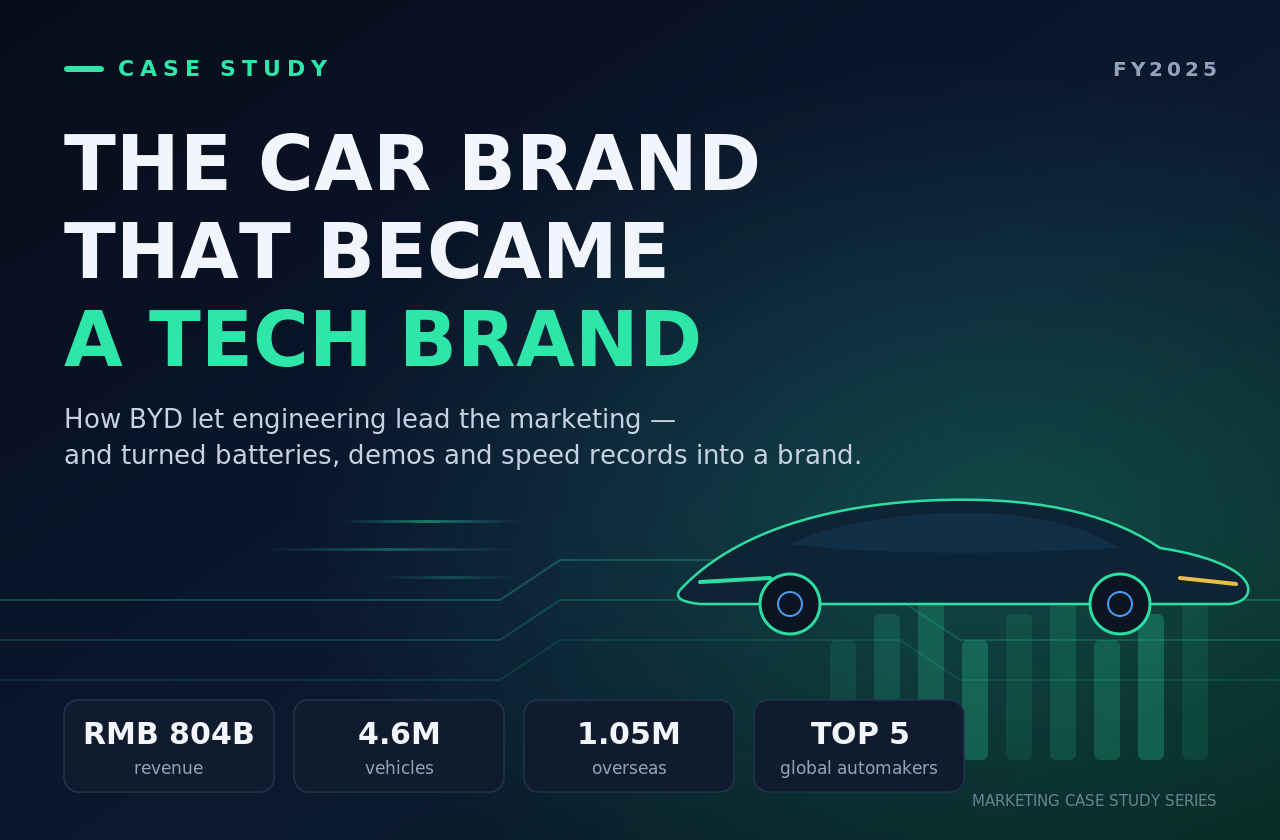
Here’s the strange thing about BYD: it never really ran a brand campaign to become a tech brand. It ran nail-penetration tests, charging demos, and a 496 km/h speed record — and let the engineering do the talking. Founded in 1995 as a battery maker, the company entered autos in 2003 and spent a decade being known as the cheap-car brand. Then the Blade Battery (2020), DM-i super hybrid (2021), and a wave of platform technologies rewrote the story. FY2025 proves the scale: revenue of RMB 804 billion (up 3.46%, first time above 800 billion), 4.6 million vehicles sold (up 7.73%), a first-ever seat among the world’s top-five automaker groups, and a fourth straight year as the global NEV sales champion. Overseas deliveries blew past one million (1.05 million, up 145%), and overseas gross margin hit 19.46% — higher than the 16.66% at home. The lesson for marketers: BYD’s brand transformation followed its engineering, not its ad budget. And the overseas margin premium is the receipts.
The Origin Story: A Battery Company That Wandered Into Cars
Wang Chuanfu started BYD in 1995 making rechargeable batteries, taking on Japanese incumbents with a scrappy, vertically integrated production style. The gene was set early: make the components yourself, don’t just assemble someone else’s.
The 2003 acquisition of Qinchuan Automobile looked bizarre at the time — a battery chemist buying a struggling carmaker. The 2005 F3 sedan cemented the wrong reputation: cheap, cheerful, copycat. For years, the brand stood for value, not technology.
But look closer and the tech brand was latent all along. In 2008, BYD launched the F3DM, the world’s first mass-produced plug-in hybrid — years before the industry took the format seriously. The battery DNA was always the moat. The marketing just hadn’t caught up.
Engine One: Technology as the Brand Story
When people ask how BYD rebranded itself, they expect a campaign case study. There isn’t one. The campaigns were the technology demos.
March 2020: the Blade Battery launch, built around the nail-penetration test — a brutal safety demonstration where the cell doesn’t catch fire even when punctured. That single visual did more for brand trust than any slogan could. In 2021, DM-i super hybrid reframed efficiency, and e-platform 3.0 reframed the architecture. February 2025 brought God’s Eye, an advanced driver-assistance system rolled out across the lineup — including a Seagull hatchback priced under RMB 70,000. A month later, the Super e-Platform delivered megawatt flash charging: 1,000 kW peak power, roughly 400 km of range added in five minutes, by the company’s official figures.
Then came the halo. In September 2025, the Yangwang U9 Xtreme — a 1,200-volt, four-motor hypercar with over 3,000 PS, limited to 30 units — clocked a certified 496.22 km/h at Germany’s ATP Papenburg track, the fastest production car on Earth. Its Nürburgring Nordschleife lap of 6:59.157 made it the first electric super sports car under seven minutes. In March 2026, the second-generation Blade Battery claimed a 10-to-70% charge in about five minutes.
Notice the pattern: every brand message is a verifiable engineering event. You can’t fake a lap time. That’s the whole trick.
Engine Two: Vertical Integration as the Moat
Why can BYD ship a megawatt charging platform and a 3,000 PS hypercar within weeks of each other? Because it owns the stack. Batteries (FinDreams), power semiconductors, motors, electronic controls — the full chain sits in-house.
This is the DJI logic at automotive scale: when you control the components, you control both cost and cadence. During supply crunches, integration is resilience. During price wars, it’s the margin cushion that lets you cut prices and still fund R&D. FY2025 R&D spending hit RMB 63.4 billion, up 17% — nearly twice the year’s net profit, with cumulative R&D past RMB 240 billion. Only a company with structurally lower component costs can spend like that while fighting a price war.
The integration isn’t the brand story. It’s what makes the brand story affordable.
Engine Three: The Premium Ladder — With One Wobble
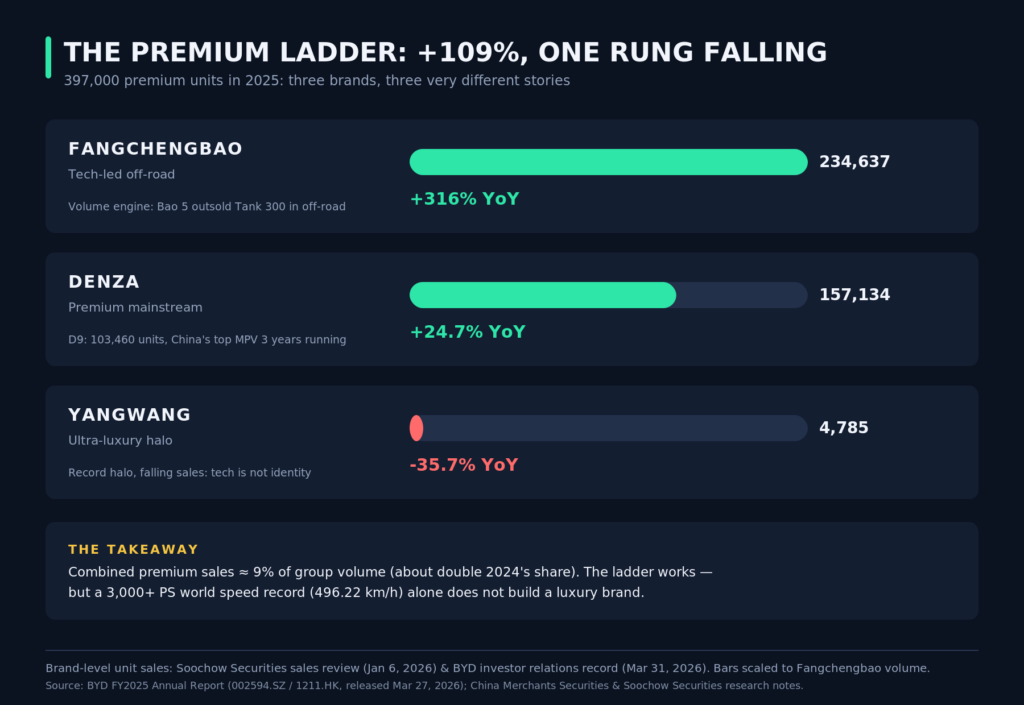
Tech trust is supposed to fund premium pricing. BYD built three rungs: Yangwang (ultra-luxury), Denza (premium mainstream), Fangchengbao (tech-led off-road). Combined 2025 sales reached roughly 397,000 units, up 109%, taking premium share to about 9% of group volume — roughly double the prior year.
But here’s the honest part most summaries skip. The ladder didn’t rise evenly:
- Fangchengbao: 234,637 units, +316%. The Bao 5 outsold the Tank 300 in hardcore off-road. The catch: much of the growth came from cheaper Titanium-series models, pulling the brand’s average transaction price down from around RMB 330K to RMB 240K. Volume up, positioning drifting.
- Denza: 157,134 units, +24.7%. The D9 MPV sold 103,460 units — China’s MPV sales champion for a third straight year — with brand transaction prices around RMB 360K. Solid, but over 60% of volume leans on one model.
- Yangwang: 4,785 units, −35.7%. Yes, the halo brand fell. The U9 Xtreme holds the production-car speed record, yet ultra-luxury buyers didn’t flock. Engineering credibility, it turns out, is necessary but not sufficient for luxury identity.
That’s not a failure of the strategy — it’s the strategy’s boundary condition. Tech trust converts to premium pricing in performance categories. In status categories, you also need heritage, narrative coherence, and scarcity discipline. BYD is still learning that half.
Engine Four: Globalization as Proof — and as Hedge
A tech brand that only works at home isn’t a tech brand; it’s a local price fighter. So the export numbers are the real branding audit.
Overseas deliveries passed one million for the first time in 2025: about 1.05 million units, up 145%. The footprint now spans 119 countries and regions. BYD runs its own fleet of eight ro-ro car carriers. Plants are operational in Thailand (July 2024), Uzbekistan (2024), and Brazil — where the first vehicle rolled off the line at the former Ford site in Camaçari in July 2025. The Hungarian plant in Szeged began trial production in early 2026, with full series production pushed to late 2026 per Reuters — a reminder that the localization hedge is capital-heavy and slower than the slide decks suggest.
And the pricing? In the second half of 2025, overseas passenger-car average selling prices ran around RMB 186K versus roughly RMB 127K at home — about 1.5x, per China Merchants Securities. The annual report itself describes a high-positioning pricing strategy overseas. Nobody pays a 50% premium for a cheap Chinese car. They pay it for technology they believe in. Management has set a 2026 overseas target of 1.5 million units.
The Numbers Behind the Pivot
Let’s put the full scoreboard on the table, because scale is what makes this case study matter:
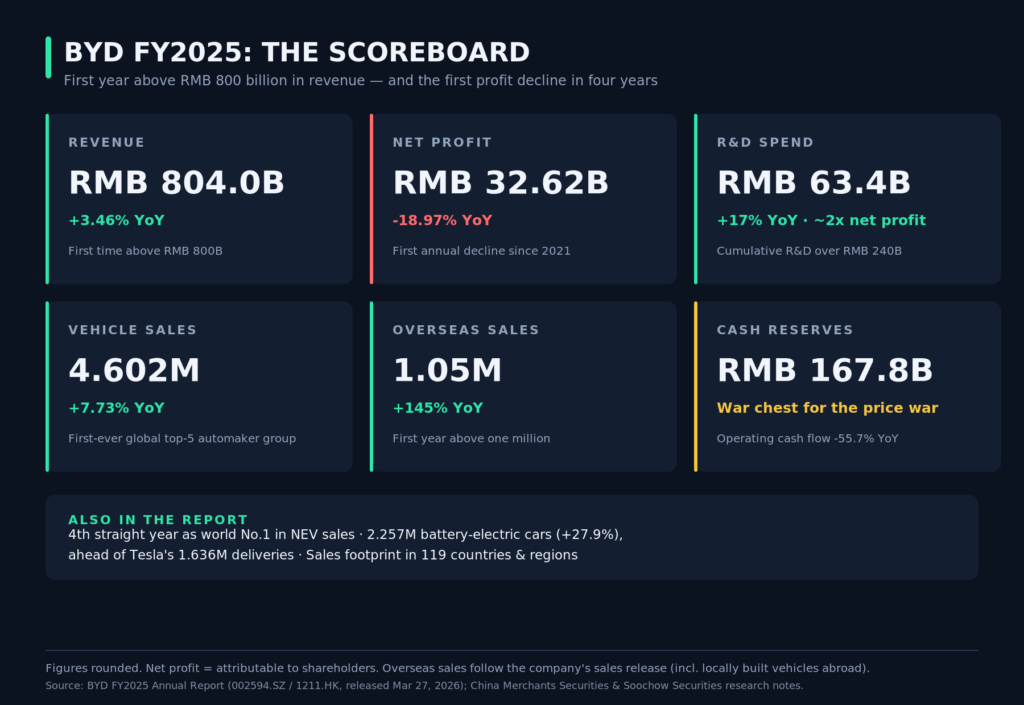
- Revenue: RMB 804 billion, +3.46%, first crossing of the 800-billion line. Autos and related products contributed RMB 648.6 billion (+5.06%, 80.68% of the total); handset components and assembly added RMB 155.2 billion.
- Net profit attributable to shareholders: RMB 32.62 billion, down 18.97% — the first annual decline since 2021.
- Battery-electric passenger cars: 2,256,714 units, +27.9%, ahead of Tesla’s 1,636,129 deliveries for the year.
- Cash reserves: RMB 167.8 billion — though operating cash flow fell 55.7% to RMB 59.1 billion.
Read those lines together and you get the real story: this is a company buying the future while the present gets harder.
The Margin Split: Two Economies Inside One Company
The most important chart in BYD’s annual report isn’t sales. It’s the regional margin divergence.
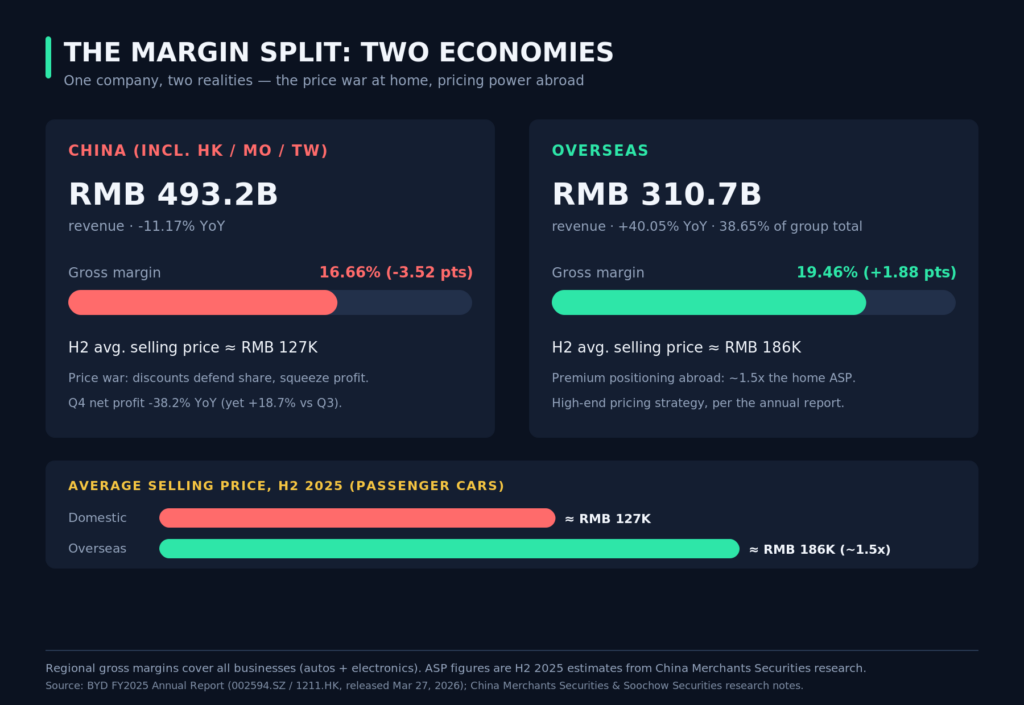
Domestic revenue (including Hong Kong, Macao, and Taiwan) fell 11.17% to RMB 493.2 billion, with regional gross margin sliding 3.52 points to 16.66%. Overseas revenue grew 40.05% to RMB 310.7 billion — now 38.65% of the group — with gross margin rising 1.88 points to 19.46%. (These regional margins cover all businesses, not just cars; brokerage estimates put the auto-only overseas gap even wider.)
The fourth quarter tells the pressure story in miniature: revenue down 13.5% year-on-year, net profit down 38.2% — yet profit up 18.7% versus Q3, as product-mix optimization and cost control started to bite. The domestic price war compresses; the overseas premium cushions. Globalization isn’t a vanity project. It’s the margin escape route.
What Everyone Gets Wrong About BYD
“It’s still a cheap-car brand”
The Seagull exists, yes. But so does a 1.5x overseas price premium, a 397K-unit premium portfolio, and the world’s fastest production car. The value tier is now the base of a ladder, not the whole building.
“Marketing drove the transformation”
Backwards. The Blade nail test, DM-i efficiency, the megawatt charger, the Papenburg record — engineering events came first, and brand perception followed. The marketing department’s job was amplification, not invention.
“4.6 million units means everything is fine”
Volume without margin is a treadmill. Net profit fell nearly 19% on record revenue. The quality story lives in the overseas and premium mix, not the headline unit count.
“It’s a China story”
With 38.65% of revenue from overseas, 119 markets, local plants on three continents and its own shipping fleet, the growth-and-margin engine is now explicitly global. The China-only framing is years out of date.
The Reusable Playbook for Marketers
Strip away the cars and four transferable lessons remain:
- Make the demo the campaign. A verifiable engineering event (nail test, lap record, five-minute charge) earns trust that slogans can’t buy. If your product has a provable superlative, stage it publicly.
- Own the stack that funds the story. Vertical integration gave BYD the cost headroom to out-spend rivals on R&D during a price war. Your equivalent might be proprietary data, manufacturing, or distribution — whatever lets you invest counter-cyclically.
- Climb the premium ladder rung by rung — and expect wobbles. Tech trust converts readily in performance categories (Fangchengbao) and slowly in status categories (Yangwang). Budget for narrative work, not just spec sheets, at the top rung.
- Use foreign markets as the brand audit. If customers abroad pay more than customers at home, your tech brand is real. Localize production early; tariffs don’t wait for your roadmap (ask Szeged).
Risks and Honest Caveats
No case study is complete without the bear case:
- Domestic margin compression is structural, not seasonal. Eight consecutive months of year-on-year domestic passenger-vehicle declines into December suggest the price war has staying power.
- Trade barriers are real and rising. EU tariffs on China-built EVs make the Hungary and Turkey plants strategic necessities — and both have run behind schedule. The hedge is capital-heavy.
- The premium ladder is still small. Nine percent of volume, with the halo rung shrinking and Denza dependent on a single MPV. One strong model refresh from a rival could sting.
- Perception lags reality in mature markets. In Europe and Japan, the tech story is landing; in North America, policy walls keep the brand largely off the field entirely. The transformation is globally uneven.
Conclusion
BYD didn’t market itself as a car company that does technology. It marketed technology that happens to ship as cars. The Blade Battery, DM-i, God’s Eye, megawatt charging, and a 496.22 km/h halo record were the brand campaign — and FY2025’s RMB 804 billion in revenue, 4.6 million vehicles, and top-five global ranking were the campaign results. The 19.46% overseas gross margin against 16.66% at home is the proof that the tech brand travels. The falling domestic profit is the proof that it had to.