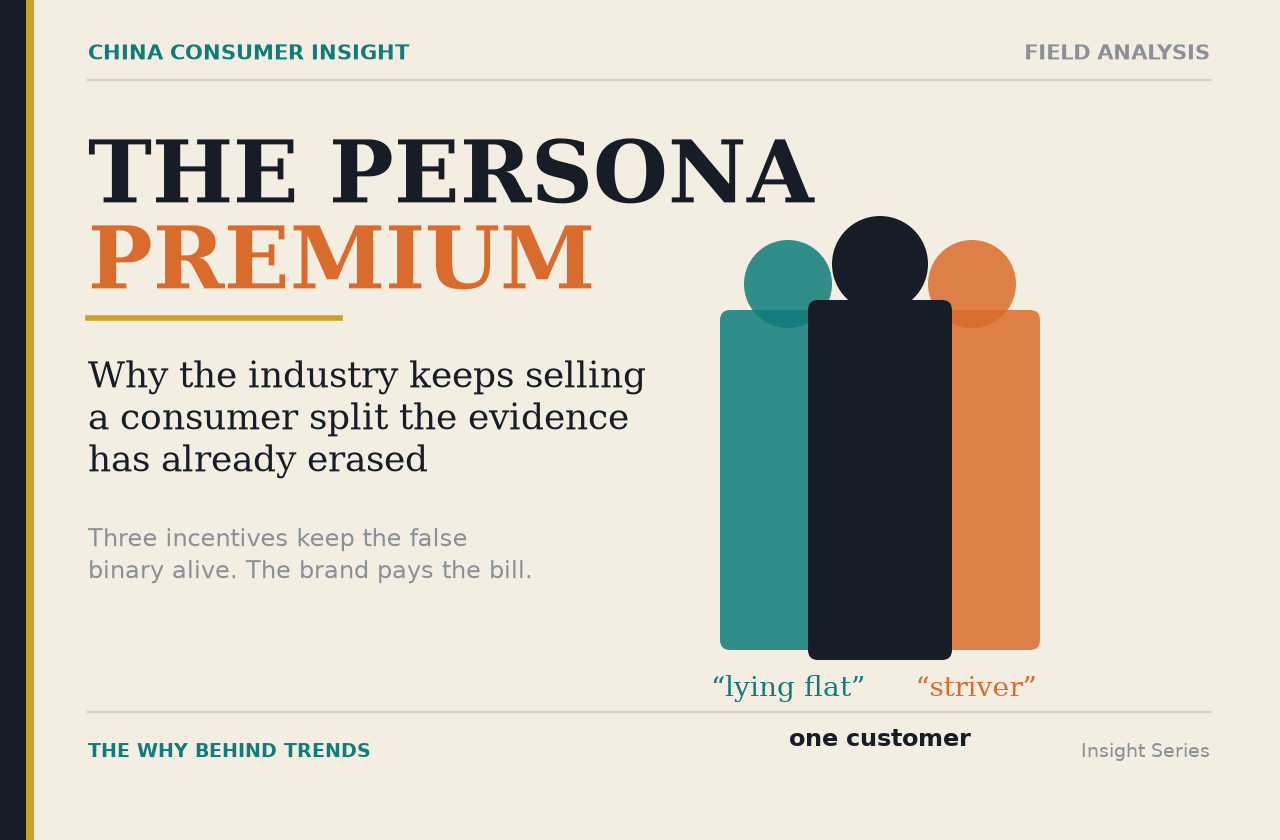
Every few months, a deck lands on a CMO’s desk with the same two cartoon consumers: the burned-out flat-lier in pajamas, the red-eyed striver at a standing desk. The evidence against this split has been public for years. The deck survives anyway. Why?
Because the binary isn’t an analytical mistake that persists by accident. It persists because three separate incentives pay for its survival — and none of those incentives belongs to the consumer.
Incentive One: The Pitch Rewards Legibility
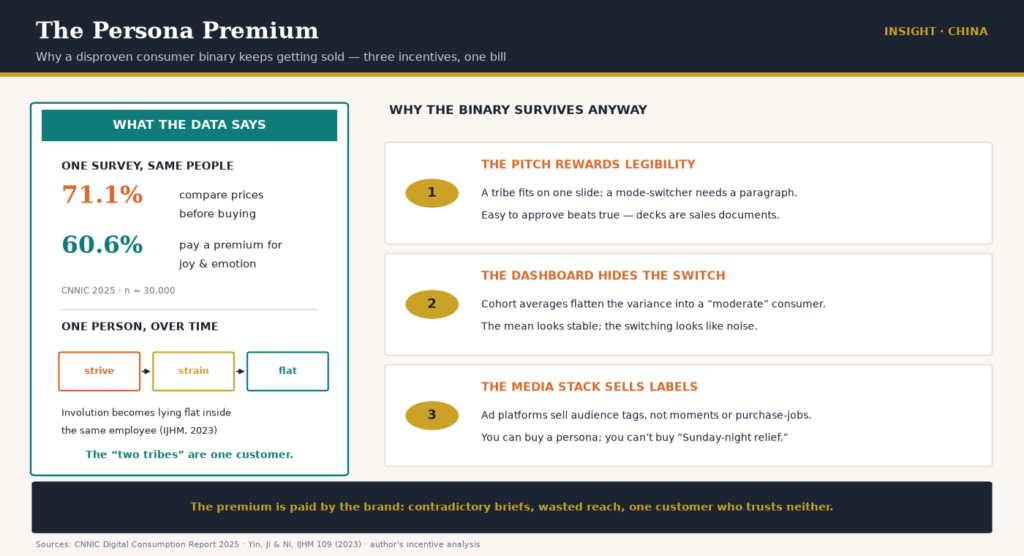
A tribe fits on one slide. You can name it, photograph it, give it a media budget. A mode-switcher — the analyst who buys certification courses on Monday and plush toys on Saturday — needs a paragraph, and paragraphs lose pitch meetings. Strategy decks are sales documents before they are analysis, and the format tax falls on nuance. The lying-flat/involution binary wins not because it’s true but because it’s approvable. Whoever presents the messier truth is asking the room to work harder, and rooms don’t buy that.
Incentive Two: The Dashboard Hides the Switch
Even teams that suspect the binary rarely see it refuted, because their measurement stack averages the evidence away. Cohort-level reporting computes a mean consumer per label — and the mean of a person who strives on weekdays and flattens on weekends looks… moderate. Stable. The switching, which is the actual behavior, registers as variance, and variance gets smoothed out of dashboards by design. CNNIC’s Digital Consumption Report 2025 caught what cohort dashboards miss precisely because it asked the same 30,000 respondents about both behaviors: 71.1% compare prices before buying, and 60.6% will pay a premium for emotional value. One population, both motives, same checkout. The instrument that could reveal the switch is the one most teams never build.
Incentive Three: The Media Stack Sells Labels, Not Moments
Here’s the least discussed mechanism: you can buy a persona. Ad platforms merchandise audience tags — age brackets, interest clusters, lookalike cohorts — because tags are inventory, and inventory needs stable names. You cannot buy “Sunday-night restorative purchase intent” as a standing audience. So even a marketer who intellectually accepts mode segmentation faces a procurement reality that pushes back toward labels. The binary survives at the media-planning layer not as a belief but as a purchase order.
Who Pays the Premium
Add the three up and you get a structural answer to the “why.” The pitch economy rewards the legible fiction; the measurement stack conceals the disconfirming variance; the ad market only sells the fiction’s components. Each layer is individually rational. Collectively they manufacture a premium — paid in contradictory briefs, wasted reach, and a customer who receives an ambition ad and a relief ad from the same brand in the same week and quietly downgrades her trust in both.
The peer-reviewed mechanism makes the cost concrete: a 2023 International Journal of Hospitality Management study traced involution converting into lying-flat withdrawal inside the same employees, mediated by exhaustion. The people your two personas describe are one person moving along a stress curve. Advertising to the curve’s endpoints as if they were zip codes isn’t segmentation. It’s billing.
The fix starts where the incentives can actually be changed: brief by purchase-job, instrument for switching, and buy contexts wherever the platform allows. The binary will keep selling itself. Your budget doesn’t have to keep buying.



