Every report about Chinese students abroad answers how many. Almost none answers why the audience keeps getting more valuable even when the headcount shrinks. That’s the question this insight exists to answer — because the mechanism, not the number, is what should change your budget.
Here’s the puzzle. Outbound flow is down about 19% from its 2019 peak. US enrollment has fallen for six straight years. By any naive reading, this is a declining market. Yet returnee influence on Chinese consumption keeps expanding, brands keep discovering the cohort’s taste-setting power, and the families behind these students keep getting richer and more bicultural. Something is compounding underneath the decline. Three mechanisms explain it.
Mechanism 1: Return Became the Default, Not the Fallback
For two decades, staying abroad was the assumed success case and returning was the consolation prize. That hierarchy has inverted — and an inverted default changes everything downstream.
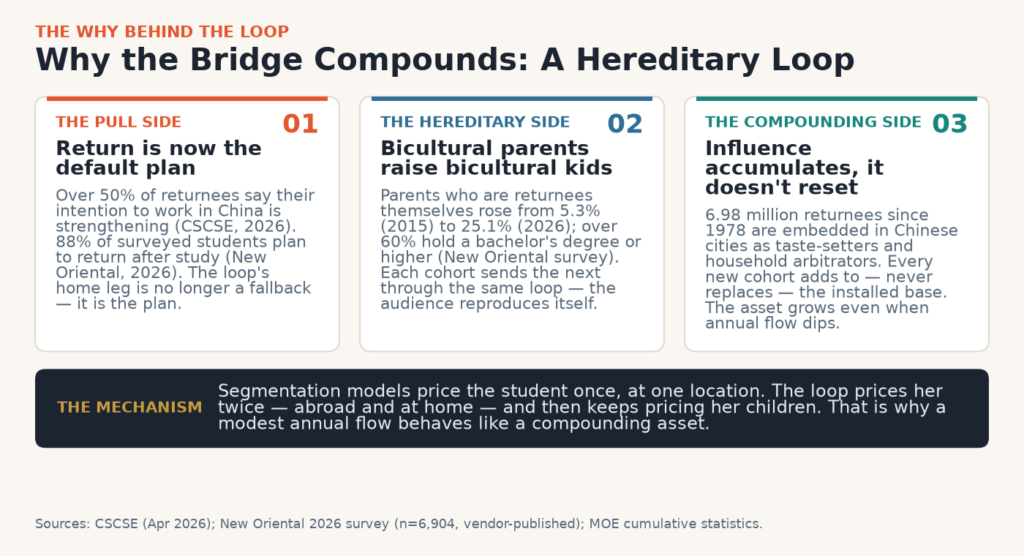
The CSCSE’s returnee employment trend report, released in April 2026, found that more than half of returnees explicitly describe their intention to work in China as strengthening. New Oriental’s 2026 survey goes further: 88% of surveyed students plan to return after their studies, with the master’s degree acting as the concentrated return window. Read those together and the implication is structural: the home leg of the loop is no longer where students end up when things go wrong abroad. It’s where they intended to go from the start.
Why does that matter commercially? Because a planned return is a marketable return. Students who know they’re coming home curate their abroad purchases with Chinese social audiences in mind, maintain their Chinese platform habits, and arrive with preferences already formatted for domestic seeding. The taste-transfer pipeline runs at full efficiency precisely because return is the plan.
Mechanism 2: The Loop Became Hereditary
This is the mechanism most analysts miss entirely. The student-abroad audience is now reproducing itself.
New Oriental’s longitudinal survey data shows parents who are returnees themselves rose from 5.3% in 2015 to 25.1% in 2026 — nearly a fivefold increase in eleven years. Over 60% of parents hold at least a bachelor’s degree. These households already live biculturally; sending a child abroad isn’t a leap into the unknown, it’s a family tradition executing its next cycle.
The consequence is a self-reinforcing funnel: bicultural parents raise bicultural children, who become bicultural parents. Each generation enters the loop with lower friction, higher budgets, and deeper two-market consumption habits than the last. You’re not acquiring a transient traveler. You’re acquiring a household lineage — and lineages don’t churn the way individuals do.
Mechanism 3: Influence Stacks, It Never Resets
The third mechanism is pure accumulation. Since 1978, 6.98 million returnees have come home and embedded themselves in Chinese cities — concentrated in Beijing, Shanghai, and the Greater Bay Area, now diffusing into Hangzhou, Chengdu, Chongqing, and Suzhou. Every year’s returning cohort adds to this installed base; it never replaces it.
So even when annual outbound flow dips, the stock of transnational taste-setters and household arbitrators keeps growing. A brand seeding one returnee today is tapping a network that six million prior returnees already normalized. The marginal cost of influencing Chinese consumption through this channel falls every year — because the channel itself keeps thickening.
What the Mechanism Means for You
Put the three together and the strategic read flips. Segmentation models price the student once, at one location, in one year. The loop prices her twice — abroad and at home — and then keeps pricing her children. A modest annual flow behaving like a compounding asset is not a paradox; it’s what happens when default plans, family lineage, and network accumulation all point the same direction.
The brands that understand this stop asking “is the student market shrinking?” and start asking “how do I get embedded in a loop that reproduces itself?” The first question measures a flow. The second buys an annuity.