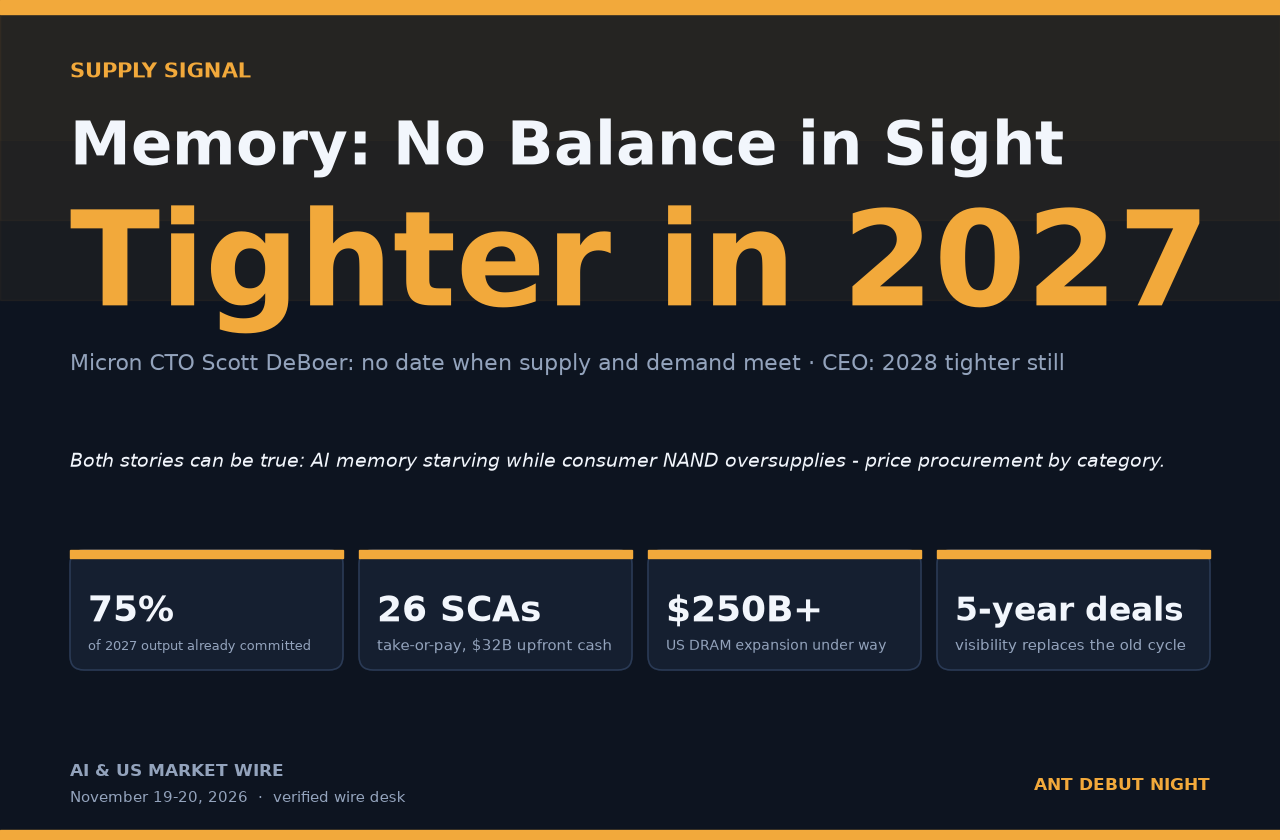
Micron president and CTO Scott DeBoer told Yahoo Finance’s Deirdre Bosa (interview aired Wednesday, November 18) that memory supply and demand will not rebalance “any time we can actually pick in the future right now,” reiterating that 2027 will be tighter than 2026, with AI agents driving a significant share of the compute-and-memory demand and no downward change visible in recent weeks; the supply response is real but slow — over $250 billion of US DRAM expansion plus global fab additions, with Idaho wafers from mid-2027, Japan late 2028 and New York by 2030. CEO Sanjay Mehrotra extended the horizon the same day at Austin’s TomorrowX Summit: 2027 and 2028 both “even tighter,” ~75% of 2027 output already committed, 2028 volumes in negotiation, and 26 strategic customer agreements — many five-year take-or-pay deals carrying $32 billion of upfront cash — replacing the old one-year cycle with multi-year visibility. This does not falsify TrendForce’s order-cut reporting; both can be true in a bifurcated market: HBM and server DRAM starving for AI while consumer NAND stays oversupplied and China demand stays weak — Kress’s margin warning on Tuesday’s Nvidia call and Apple’s June Mac/iPad price hikes are the same shortage showing up downstream. The procurement implication stands: split your cost forecasts by category and region, not by “memory” as one line — and note the equity market’s dissent, with MU still ~42% below its June record even as management describes a shortage with no visible end.