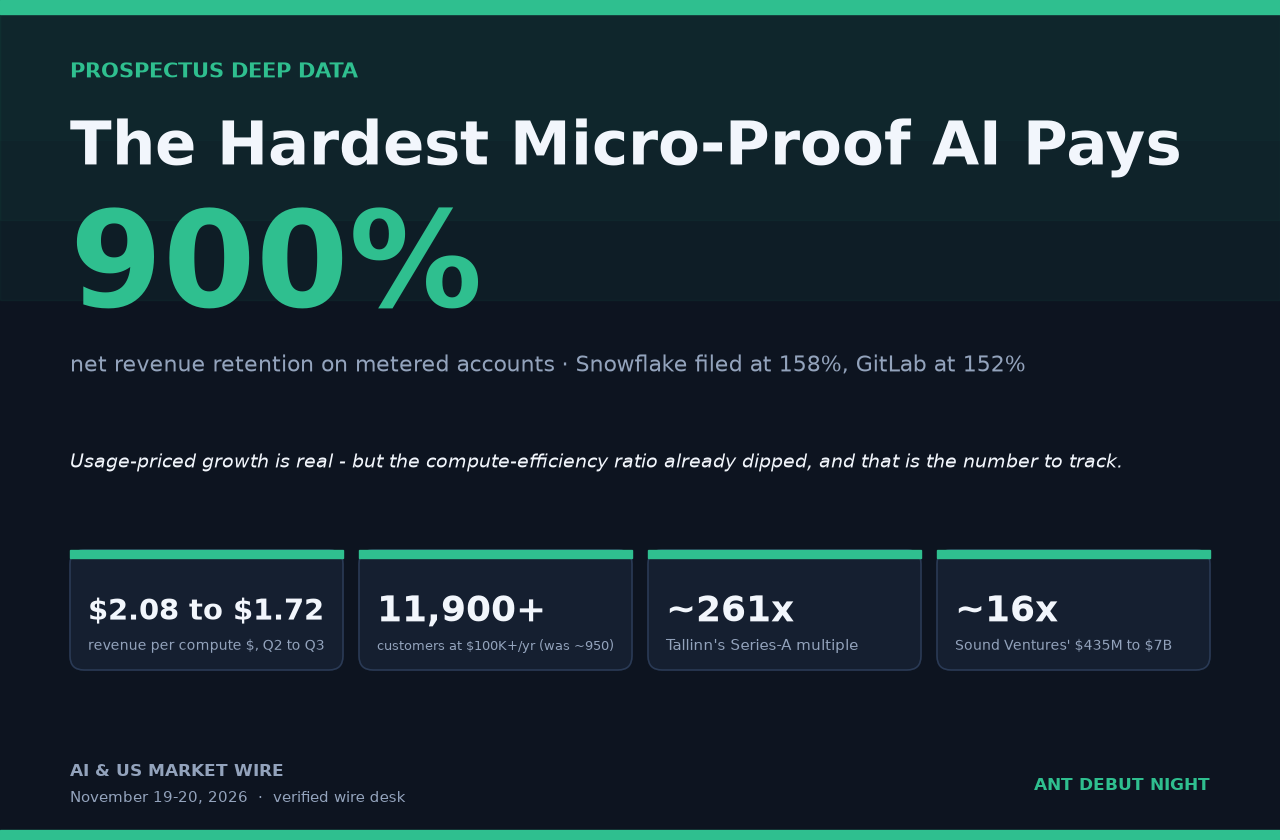
The strongest rebuttal to the token-deflation bear case sits in Anthropic’s S-1: net revenue retention of roughly 900% — the same customer cohort spent about nine times more in the September quarter than a year earlier — against Snowflake’s 158% and GitLab’s 152% at their IPOs, with the crucial definition that the figure covers metered accounts only (Pro/Max flat-fee subscriptions excluded), which is exactly what usage-priced AI revenue can do that seat-priced SaaS cannot; the customer pyramid broadens the proof, with $100K-plus accounts up ~12x in a year to 11,900+, 1,900+ at $1 million and ~250 at $10 million, and top-five concentration falling from ~36% to ~21% of quarterly revenue. But the outline’s $2.08-per-compute-dollar figure needs its second half: that was the Q2 peak — Q3 fell to $1.72 (vs $0.40 in early 2025), pulled down by $5 billion of pricier spot compute, and the ratio counts compute costs only, with a $567 million Q3 operating loss underneath; the efficiency curve, not the growth curve, is the metric to track each quarter. The wealth side-checks: Jaan Tallinn’s Series-A money is worth ~261x per Forbes (~$60M in, ~$15.6B stake, net worth ~$17B — the “300x” figure was computed at the earlier $74 midpoint), Sound Ventures’ ~$435M is ~$7B (~16x, a fund asset not Kutcher’s personal fortune — he left the firm this year), and the seven founders hold ~$19.9B each at $83; the “rejected by 21 VCs” and “3/4 of the first 100 employees still here” details could not be independently verified and are omitted. For AI SaaS, 900% NRR is now the gold benchmark — and the dollar-add, not the percentage, is what survives the base effect.