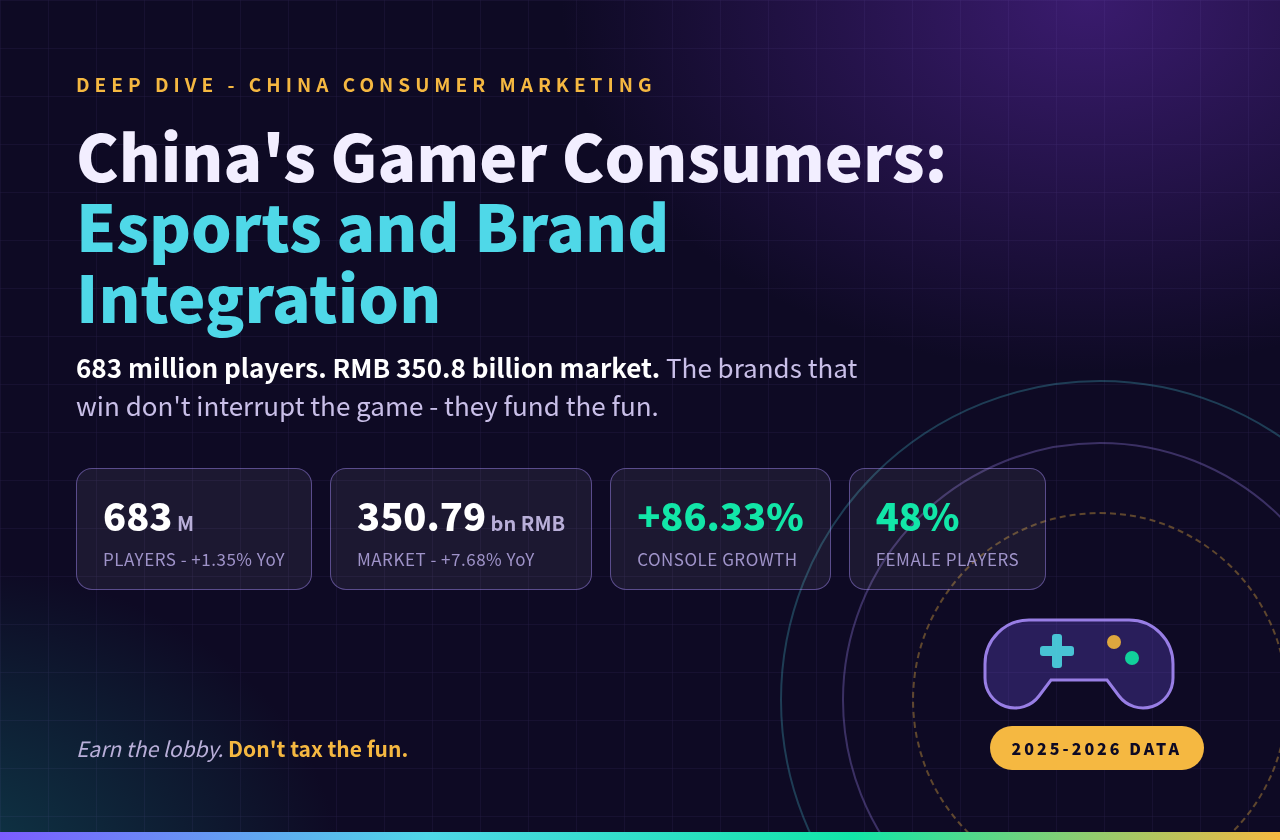
China’s gamers are not a niche youth segment. They are 683 million people — roughly half the population — spending inside a RMB 350.79 billion market that grew 7.68% in 2025 to an all-time high, according to the annual industry report released by the CADPA Game Publishing Committee (GPC) with data partner CNG. Esports titles alone pulled in RMB 170.05 billion, up 18.96%. Console revenue jumped 86.33%; mini-program games grew 34.39%. Yet most brand integrations still fail, because they interrupt a meritocratic, anti-extraction culture instead of funding it. The playbook that works has four moves: patronize the esports scene, give in-game value, speak the culture through creators, and build the rails players run on. Fund the fun, earn the lobby.
1. Gaming Is the Mainstream Now
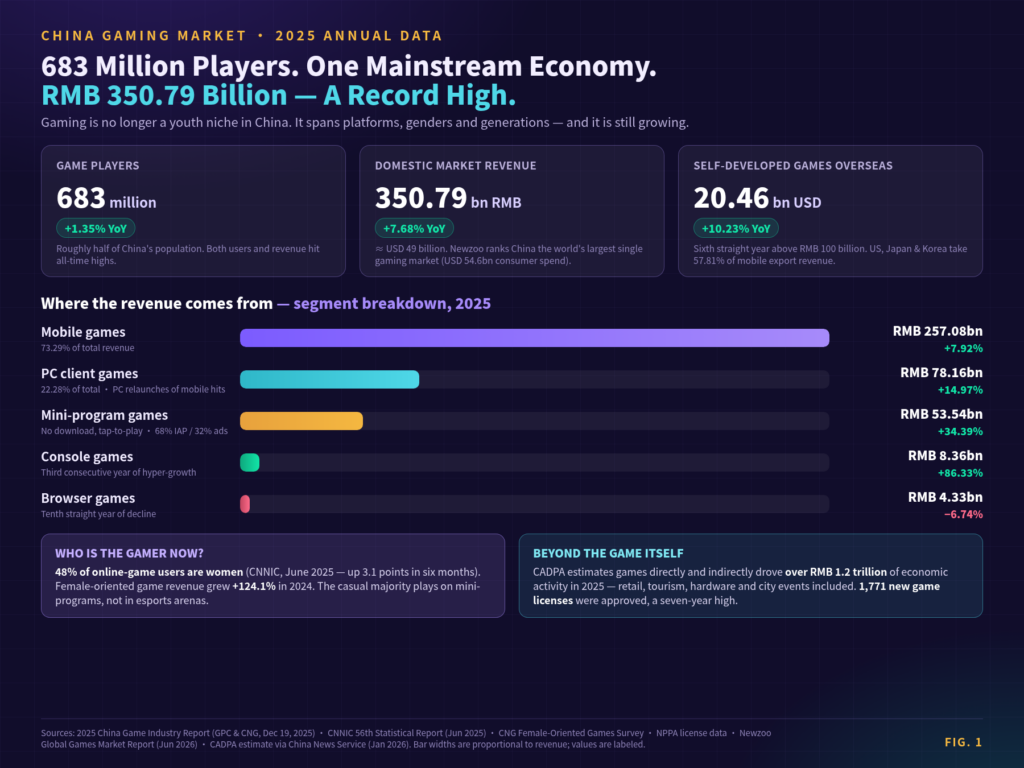
Let’s retire the stereotype first. The image of the Chinese gamer as a teenage boy in a dormitory misses almost everything that matters. When 683 million people play — a base that grew another 1.35% in 2025 — you are not looking at a subculture. You are looking at a cross-section of the country: commuters, parents, retirees, office workers on lunch breaks.
The money tells the same story. Domestic game revenue hit RMB 350.79 billion in 2025, a record, growing faster than most consumer categories. Mobile still dominates at RMB 257.08 billion (73.29% of the total, +7.92%), but the interesting motion is elsewhere. PC client games rebounded 14.97% to RMB 78.16 billion as hit mobile titles relaunched on PC. Console — long a rounding error — nearly doubled, up 86.33% to RMB 8.36 billion, its third consecutive year of hyper-growth. And mini-program games, the tap-to-play titles that live inside super-apps with no download at all, exploded 34.39% to RMB 53.54 billion.
This is a multi-platform, multi-demographic economy. Newzoo’s finalized 2025 data ranks China the world’s largest single gaming market at USD 54.6 billion in consumer spending, ahead of the United States at USD 50.8 billion. CADPA estimates games directly and indirectly drove more than RMB 1.2 trillion of economic activity in 2025 once you count hardware, tourism, retail and events. If your media plan still treats gaming as a youth-vertical line item, the plan is wrong before the first impression serves.
2. The Caliber Trap: RMB 170 Billion Is Not the Sponsorship Pool
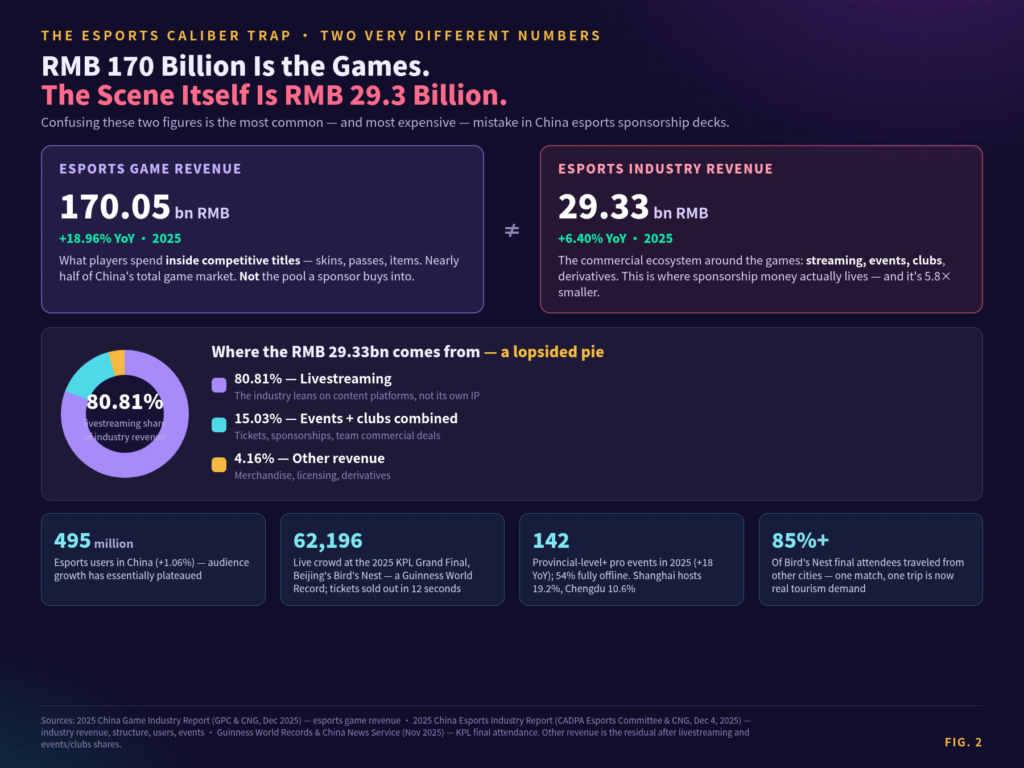
Here is the single most expensive mistake in China esports pitch decks, and it deserves its own section. Two numbers circulate, and they are not interchangeable.
The first: RMB 170.05 billion (+18.96%). That is esports GAME revenue — what players spend inside competitive titles on skins, battle passes and items. It is nearly half the total game market, and it belongs to the game publishers. The second: RMB 29.33 billion (+6.40%). That is the esports INDUSTRY — the commercial ecosystem of streaming, events, clubs and derivatives around the games, per the separate 2025 China Esports Industry Report released in December 2025. This is the pool sponsorship money actually lives in, and it is 5.8 times smaller.
The structure of that smaller pool is sobering. Livestreaming takes 80.81% of industry revenue. Events and clubs combined account for just 15.03%. The scene’s own IP — the part a brand sponsor touches — is still learning to pay for itself. CNG’s chief analyst Wang Xu has publicly warned that over-reliance on sponsorship leaves clubs and event operators fragile.
And yet the audience is enormous and the live demand is real: 495 million esports users, 142 provincial-level-or-higher professional events in 2025 (up 18 year on year), 54% of them fully offline. The 2025 KPL Grand Final filled Beijing’s Bird’s Nest with 62,196 spectators — a Guinness World Record for a single esports match — with tickets gone in 12 seconds and more than 85% of attendees traveling from other cities. Read those two facts together and the strategic picture snaps into focus: the money pool is modest, but the cultural stage is massive. You sponsor for legitimacy and reach, not for a slice of RMB 170 billion that was never on the table.
3. The Gamer’s Trust Economy: Meritocratic and Anti-Extraction
Why do so many integrations fail? Because gaming culture runs on earned status. Rank is earned. Skins signal commitment. Streamers are trusted because they are demonstrably good, not because a media agency polished them. It is a meritocracy, and it extends the same test to brands: what have you actually done for the scene?
An unskippable ad answers that question with nothing. It taxes the fun. Communities respond the way you would expect a meritocracy to respond to a toll booth — with mockery, boycott threads and memes that outlive the campaign. The backlash reflex is fast because the culture has practice: players spend years spotting pay-to-win mechanics and astroturfed hype.
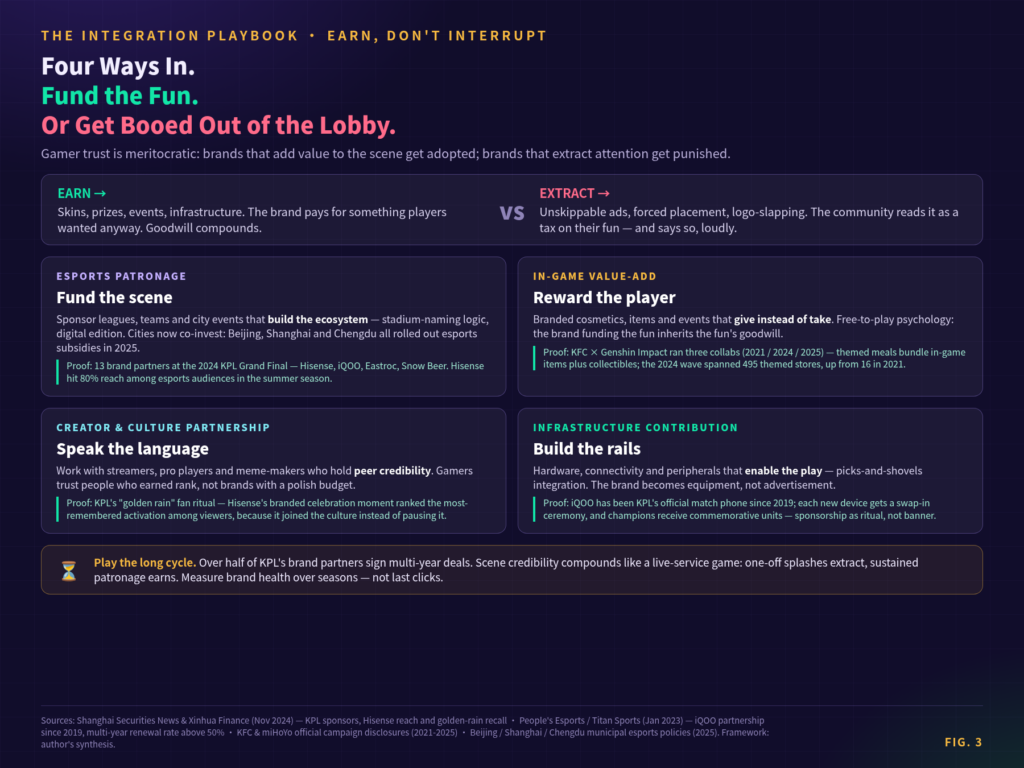
The flip side is unusually generous. Brands that fund something players wanted anyway — a prize pool, a tournament, a free cosmetic, better hardware — get adopted into the culture’s own rituals. The goodwill is not rented like ad inventory; it compounds like a live-service relationship. That asymmetry, punish extraction and reward contribution, is the entire game. Everything below is an application of it.
4. The Integration Playbook: Four Ways to Earn
4.1 Esports Patronage — Fund the Scene
Sponsor leagues, teams and city events that build the ecosystem, and you inherit stadium-naming logic in digital form. The 2024 KPL Grand Final gathered 13 brand partners across categories — Hisense, iQOO, energy-drink maker Eastroc, Snow Beer’s superX — and Hisense’s activation reached 80% of the esports audience during the summer season, per Shanghai Securities News. Cities are now co-investors in this stage: Beijing issued a 12-department support policy in June 2025, Shanghai announced its “Game Hu Ten Measures” with RMB 50 million a year in dedicated funding in December 2025, and Chengdu rolled out direct subsidies for venues and clubs. Patronage is no longer just a brand decision; it is industrial policy.
4.2 In-Game Value-Add — Reward the Player
Give, don’t take. Branded cosmetics, items and events that add to the game ride the free-to-play psychology: the brand funding the fun inherits the fun’s goodwill. The cleanest recurring example is KFC × Genshin Impact. Three collaborations — March 2021, July 2024, June 2025 — each bundled themed meals with in-game items and collectible merchandise. The 2024 wave spanned 495 themed stores, up from 16 at the first run in 2021. Players queued overnight and crashed ordering systems, then posted about it happily. The meal was not an ad for the game or the game an ad for the meal; both sides gave their audiences something they already wanted.
4.3 Creator and Culture Partnership — Speak the Language
Work with streamers, pro players and meme-makers who hold peer credibility. This is the KOC logic applied to gaming: trust flows through people who earned rank, not through corporate polish. Hisense’s “golden rain” celebration moment at KPL finals — a branded ritual layered onto an existing fan tradition — ranked as the most-remembered activation among viewers in 2024. It worked because it joined the culture instead of pausing it. Speak the memes, respect the merit, and let the community’s own voices carry the brand.
4.4 Infrastructure Contribution — Build the Rails
The picks-and-shovels move: hardware, connectivity and peripherals that enable play. iQOO has been KPL’s official match phone since 2019. Each new device gets a swap-in ceremony; champions receive commemorative units. The brand is not advertising next to the competition — it is equipment inside the competition, validated by the best players in the country every single match day. That is a credibility position no banner can buy.
5. What Everyone Misunderstands
Three errors keep repeating in briefs. First, the young-male stereotype: CNNIC’s 56th statistical report puts women at 48.0% of China’s online-game users as of June 2025, up 3.1 percentage points in six months. CNG’s survey found the female-oriented game segment grew 124.1% in 2024 to RMB 8 billion. The casual majority plays puzzle and simulation titles on mini-programs, not MOBAs in arenas — and mini-program revenue is already RMB 53.54 billion, with nearly a third of it monetized through ads, which tells you exactly how comfortable casual players are with brands when the exchange is fair.
Second, esports-equals-gaming. Esports is the visible tip; the volume lives in casual and mobile. An integration strategy that only buys jerseys misses most of the 683 million.
Third, the short-campaign error. Games run for years; scene credibility compounds over seasons. More than half of KPL’s brand partners sign multi-year deals, and the ones players remember — iQOO since 2019, KFC’s three-peat — are the ones that stayed. A one-off splash extracts. Sustained patronage earns.
6. The Long Game: Credibility Compounds Like a Live Service
Treat the gamer relationship as retention, not acquisition. The metrics follow: brand-lift studies across seasons, community sentiment, share of voice in creator content — not last-click attribution, which barely exists inside games anyway. In-game and esports measurement is genuinely immature; pretending otherwise produces confident dashboards and wrong conclusions. Measure long-cycle brand health, and budget like a publisher running a live service: continuous, seasonal, iterating. The brands that win the lobby are the ones still in it three years later.
7. Risks and Honest Caveats
Four gates deserve respect. The caliber trap, covered above: never pitch the RMB 170 billion game-revenue figure as the sponsorship market. Regulation: minors may play only Friday, Saturday, Sunday and holiday evenings from 8 to 9 p.m., and the 2025 minor-protection progress report found 71% of minors now play three hours a week or less — but 73.4% of over-time users borrow parents’ or grandparents’ accounts, so age-gating your campaign is a compliance duty, not a formality. Content approval is real too, even as the gate widened: 1,771 game licenses were issued in 2025, a seven-year high, up 25% year on year. Community volatility: the same meritocracy that adopts generous brands can turn on perceived extraction overnight — trust is earned continuously, never banked. And the measurement gap: if your CFO needs last-click ROI, this channel will disappoint you; if they need a decade of relevance with half the population, it is underpriced.
Conclusion
China’s 683 million gamers sit inside a RMB 350.8 billion market with the world’s largest national consumer spend, a female share approaching parity, and growth engines — console, mini-programs, PC relaunches — that most media plans have not caught up with. The culture is meritocratic and anti-extraction: it punishes brands that tax attention and adopts brands that fund the fun. The playbook is four moves — patronize the scene, reward the player, speak the culture, build the rails — executed across the casual majority and the hardcore tip, on a multi-year clock, inside the regulatory gates. The gamer does not hate brands. The gamer hates brands that take without giving. Fund the fun, earn the lobby.