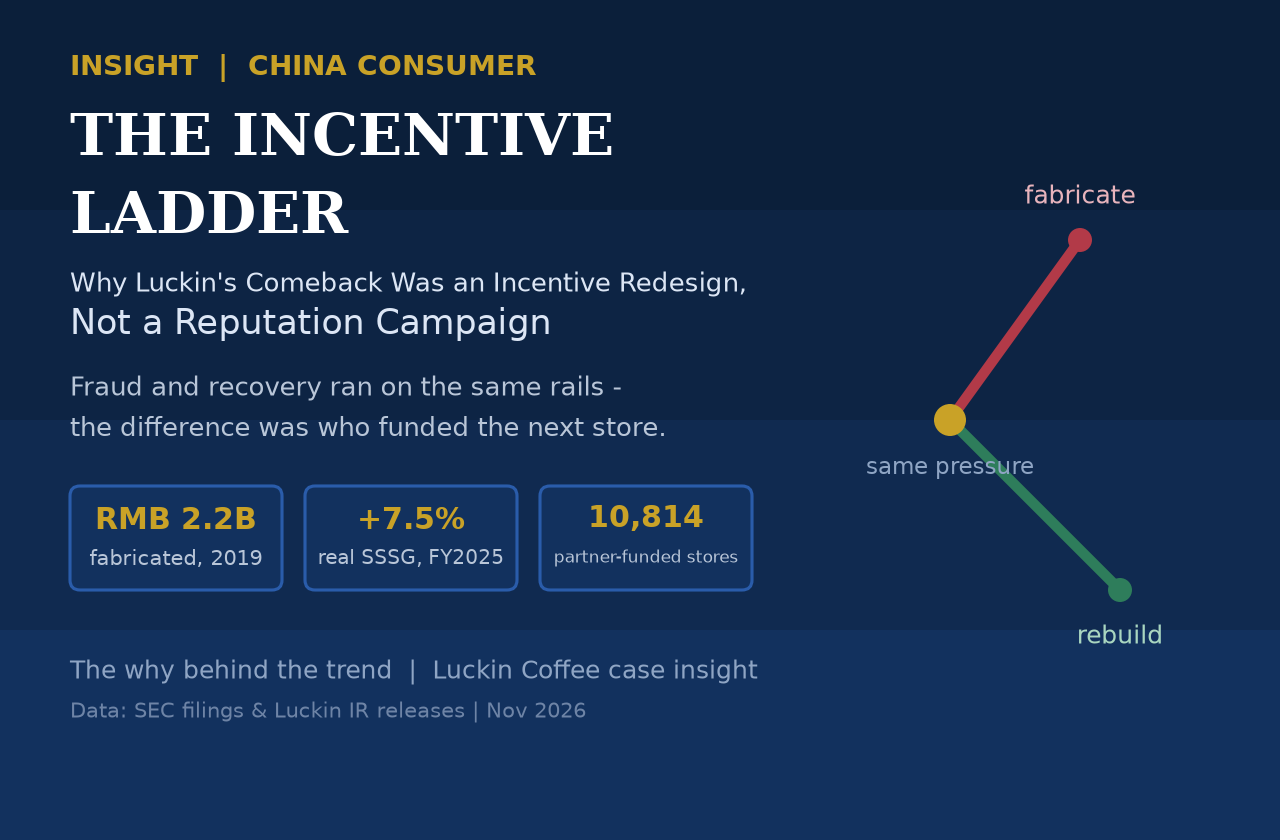
Everyone retells Luckin’s comeback as a story of redemption. Redemption is the symptom. The mechanism underneath is incentives — specifically, who pays for the next store and who demands the next decimal point of growth. Change those two questions and the same company produces fraud or compounding, with the same stores, the same app, the same cities.
The Old Machine Manufactured Pressure
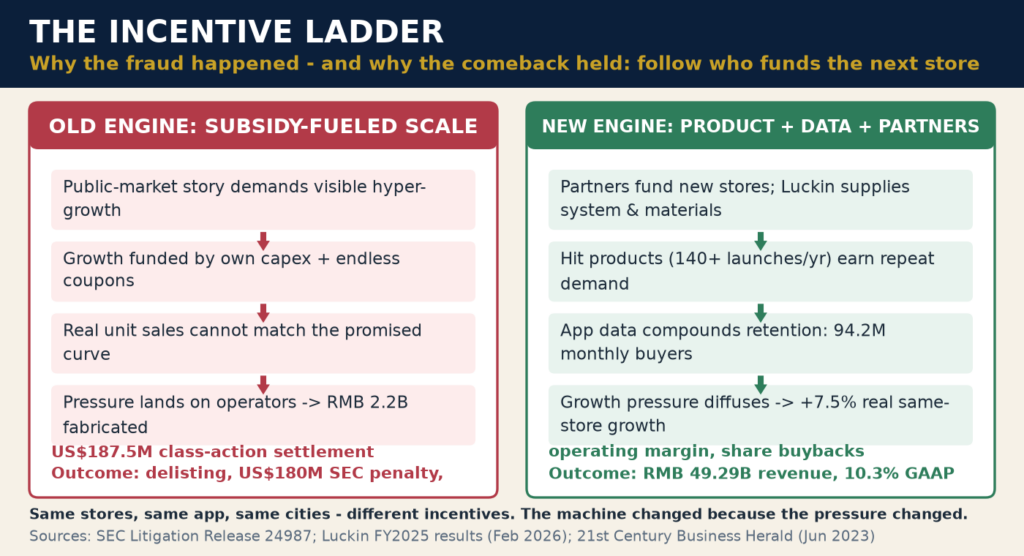
Follow the money in 2019. Luckin’s growth story was sold to public markets: an 18-month IPO, a US$12.5 billion peak valuation, a curve that had to keep bending upward. But the growth itself was funded by Luckin’s own capex and its own coupons. Every new store was a liability on its balance sheet; every discounted cup was a margin hole. When real demand could not match the promised curve, the gap did not disappear — it traveled down the org chart until it landed on operators, who filled it with RMB 2.2 billion of fabricated sales. The SEC’s complaint reads like an incentive diagram: employees built a fake operations database because the reporting structure rewarded the number, not the truth.
That is the uncomfortable insight: the fraud was not an alien event injected into a healthy company. It was the old incentive structure completing itself.
The New Machine Diffuses It
The rebuild is usually described as governance plus product. Look one layer deeper and both are incentive redesigns.
Partnership stores mean someone else’s capital funds expansion — 10,814 of them by end-2025. Luckin earns from materials, systems and profit-sharing, so its revenue grows when partners’ stores sell, not when Luckin burns cash to open. The pressure to fake store-level demand collapses because store-level demand is now somebody else’s investment thesis too.
The product engine (140+ launches in FY2025) and the app’s first-party data replace the coupon as the demand generator. A hit product earns a repeat purchase; a coupon only rents one. That is why same-store sales swung from −16.7% in 2024 to +7.5% in 2025 without a return to blanket subsidies. And governance — the quarterly-reviewed no-hire list, the independent board — is the enforcement layer that keeps the new incentives from quietly reverting.
The Test That Proves the Mechanism
If reputation drove the comeback, margins would be cosmetic. Instead, when the delivery subsidy war taxed Q4 2025 (operating margin 6.4%), the machine absorbed it and recovered: Q3 2026 store-level margin back to 23.3%, record non-GAAP profit of RMB 2.15 billion. A PR recovery cannot survive a cost shock. An incentive redesign can.
The transferable rule: before repairing a crisis narrative, redraw the incentive map. Ask who funds growth, who is measured on what, and where unmet pressure will land. Luckin answered all three — and the answers, not the apologies, produced RMB 49.29 billion of real revenue.