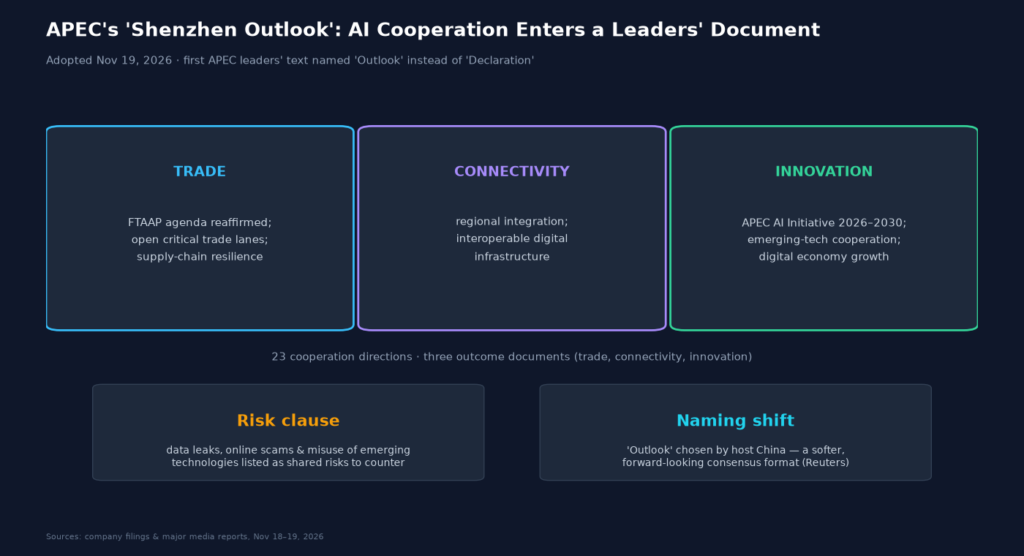
The communique that closed this year’s APEC summit is named differently from every one before it, and the difference is worth reading closely. When leaders of the 21 member economies adopted their joint text in Shenzhen on Thursday, they called it the “2026 APEC Leaders’ Shenzhen Outlook” — the first time the forum’s closing document has been styled an “Outlook” rather than a “Declaration.” Reuters, citing people familiar, reported the naming was the host’s choice: a softer, forward-looking format for consensus in a year when hard declarations are hard to write. Inside the softer wrapper sit 23 cooperation directions and three accompanying outcome documents on trade, connectivity, and innovation — including an APEC AI Initiative covering 2026–2030, commitments to supply-chain resilience and open trade lanes, and a clause that should interest every digital business: data leaks, online scams, and the malicious misuse of emerging technologies are formally listed as shared risks the member economies commit to countering together.
Why an AI initiative in a trade forum matters
APEC is not a standards body and its texts are not binding. But it is the widest table at which the US and China both sit in the Asia-Pacific, and the agenda it blesses tends to become the region’s default work program. Placing an AI cooperation initiative with a five-year horizon into a leaders-endorsed document — in the same week Washington tightened semiconductor access and Beijing threatened countermeasures — creates an official channel for engagement that exists independently of the chip fight. The initiative’s discussions span AI application in areas like clean energy and green finance, digital-economy growth, and capacity-building across economies at very different development stages. For businesses, the practical read is that regional AI interoperability — of standards, of governance expectations, of talent and data frameworks — now has political sponsorship at the highest level, even while the hardware layer decouples. Two tracks, moving in opposite directions, both officially sanctioned.
The naming shift reinforces the read. “Declaration” implies positions; “Outlook” implies direction. In a year of tariff shocks and technology controls, the host evidently judged that a document of shared direction could achieve unanimity where a document of shared positions could not. Cynics will call it lowering the bar. The alternative view: a forum that keeps producing unanimous texts, even rebranded ones, preserves the habit of agreement — and habits are what institutions run on when politics fail.
The scam-and-leak clause is the sleeper provision
Amid the trade language, the risk clause deserves commercial attention. Naming data breaches, online scams, and misuse of emerging technologies as shared regional risks commits 21 economies — spanning the majority of global e-commerce — to cooperative countermeasures. The context is not abstract: AI-generated fraud is scaling faster than defenses, verification vendors estimate up to a quarter of global ad spend may reach fraudsters, and the EU’s own commissioned study concluded this same week that its transparency regulations have failed to fix the problem. Asia-Pacific choosing to attack the fraud-and-leak layer cooperatively, while Europe litigates transparency and America argues export controls, creates a third regulatory vector — one aimed at the criminal misuse of the stack rather than the market structure around it.
For cross-border marketers, that vector points at operations: expect tightening expectations around merchant verification, payment-flow transparency, ad-fraud cooperation, and breach notification across APEC economies over the initiative’s horizon. Businesses already investing in verification and provenance are aligned with where regional policy is heading; those treating fraud as a media-quality nuisance are behind it.
Reading the document like a strategist
Three takeaways for companies with Asia-Pacific exposure. First, the digital-trade runway is politically maintained: supply-chain resilience and open lanes were reaffirmed unanimously in the same season as bilateral tech controls — the region’s official posture remains integration, and planning against it is planning against the declared direction of 21 governments. Second, AI governance will regionalize before it globalizes: with no worldwide framework in sight, the APEC initiative plus national regimes will define the operating envelope for AI products across the Pacific; compliance teams should track the initiative’s work program as a leading indicator, not a press release. Third, the host’s narrative win is real: Shenzhen — which spent the week showcasing robots, supercomputing and its tech industry to 5,000 journalists — converted a summit into a city-and-country brand campaign for “practical AI,” and the document’s innovation pillar gives that narrative an official annex.
Summit documents are usually read by diplomats and ignored by operators. This one is worth an hour from every strategy team selling across the Pacific: it tells you which way the region intends to bend, in the one voice all 21 economies were willing to sign.