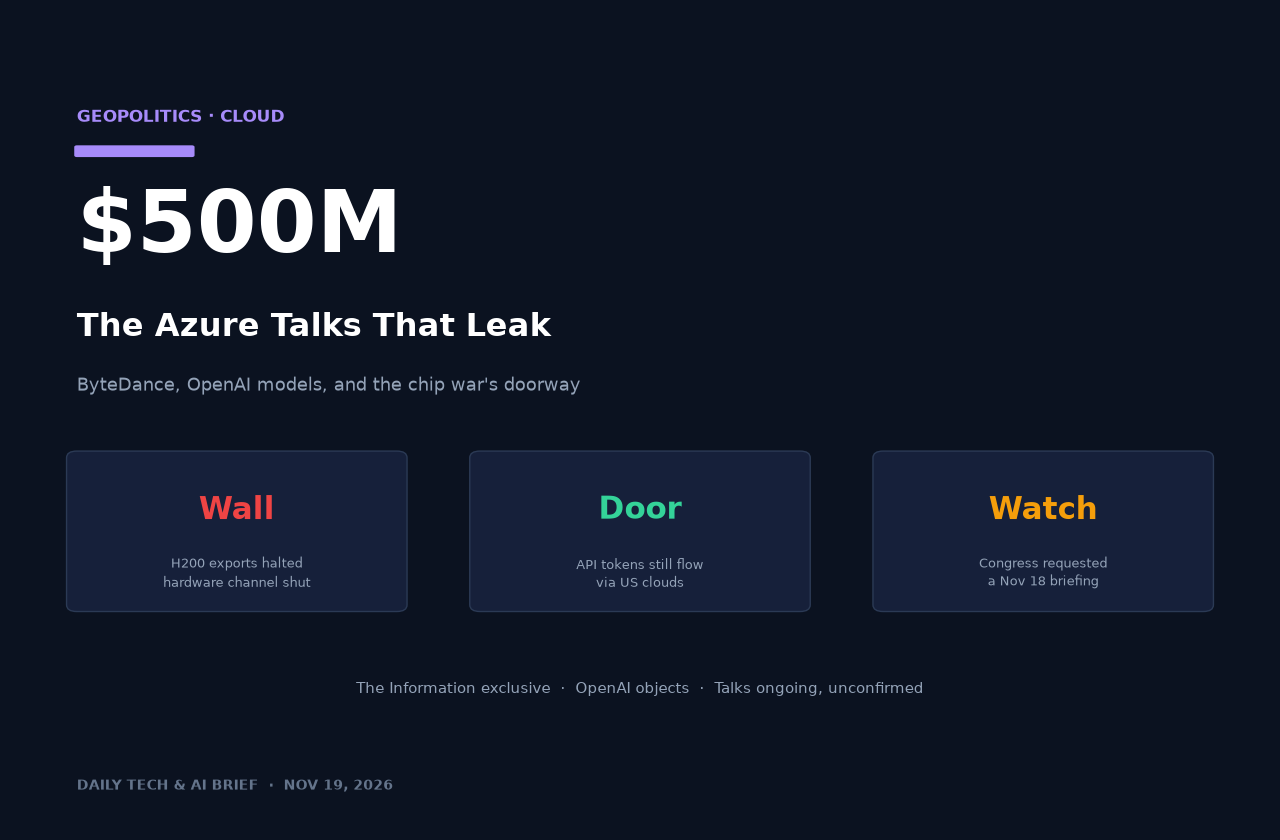
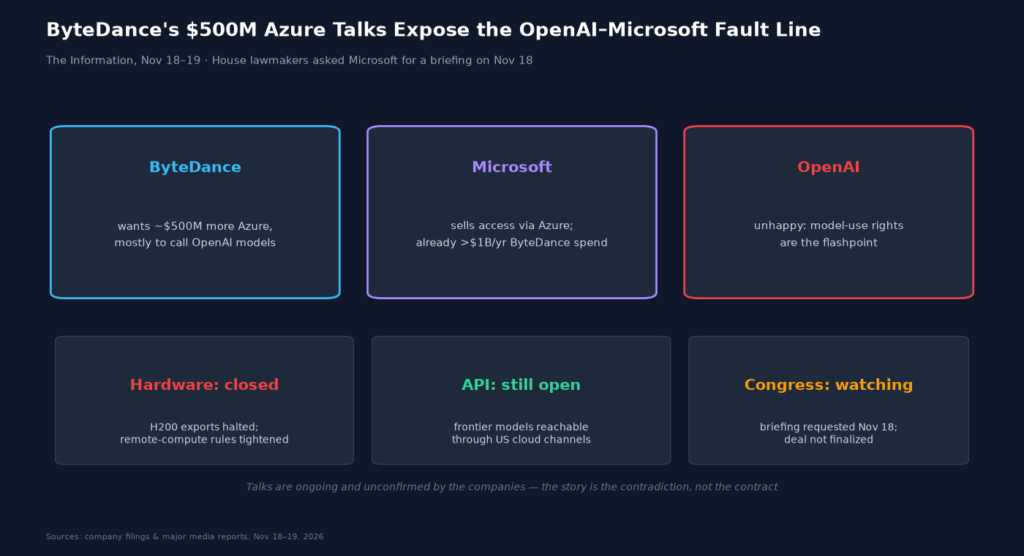
The United States has spent two years building a wall around China’s access to American AI. This week, a reported contract negotiation walked straight through it — legally. According to The Information, ByteDance is in advanced talks to add roughly $500 million in Microsoft Azure cloud spending, most of it to call OpenAI’s models. The report, echoed by outlets including Channel NewsAsia and Yahoo Finance, says the prospective deal has angered OpenAI, with the dispute centering on model-use rights. A small group of US House lawmakers asked Microsoft on Wednesday to brief them on the arrangement. No company has confirmed the deal, and talks are ongoing. But the story’s significance does not depend on the contract closing: it reveals that the chip war’s hardware wall and its software doorway are policy-inconsistent, and everyone — Beijing, Washington, Microsoft, OpenAI — is now negotiating in the gap.
The wall and the doorway
The hardware side is unambiguous. Nvidia’s interim CEO confirmed this week that H200 exports have stopped everywhere, including China; Washington has moved to restrict remote access to advanced semiconductors, closing the rent-a-datacenter workaround; and Beijing’s commerce ministry has threatened countermeasures. The intended effect is to starve Chinese AI development of frontier compute. Yet frontier capability is not only sold as chips — it is sold as tokens. An Azure subscription delivers OpenAI’s models as a service, with the compute staying on American soil, the profits staying with American companies, and the capability flowing to the customer wherever they sit. Bloomberg reported in June that ByteDance already expected to spend over $1 billion annually on Microsoft’s AI and cloud services. The reported $500 million increment is not an anomaly; it is the doorway operating at scale.
Whether this is a loophole or the design depends on whom you ask. Restriction hawks argue capability access is capability access — a Chinese consumer-app giant refining its products with GPT-class intelligence is the outcome export controls exist to prevent, laundered through a cloud invoice. The commerce argument, presumably Microsoft’s, is that API access keeps Chinese developers inside the American stack, dependent on American models, generating American revenue — the opposite of forcing them onto domestic alternatives. Both arguments are coherent. They cannot both be policy. The House briefing request is the first institutional attempt to force a choice.
The OpenAI–Microsoft fault line runs through it
The reported friction between OpenAI and its largest partner adds a second storyline. Microsoft’s Azure exclusivity has been renegotiated repeatedly, and OpenAI has grown from dependency to a company with its own IPO plans, its own government relationships, and its own views on who should consume its models. A deal in which Microsoft monetizes OpenAI intelligence to serve OpenAI’s competitor-state’s largest consumer platform — while OpenAI objects — dramatizes the misalignment: Microsoft optimizes for cloud revenue, OpenAI for strategic position. Every enterprise buyer building on either company should note that the alliance holding up half the industry’s AI stack contains this fault, and that model-use rights are where it surfaces. Contractual protections around model access, deprecation, and permitted use deserve fresh scrutiny in every renewal.
What marketers should do with a geopolitics story
It is tempting to file this under “not my department.” Three reasons it is. First, if you operate marketing in China for a global brand — or run global campaigns from Chinese teams — your AI toolchain’s legal geometry just became visible: the same model may be reachable through a US cloud channel, a domestic licensed deployment, or not at all, depending on rules that are actively being rewritten. Map which of your AI services ride which channel, because a single policy change can sever a workflow overnight. Second, the domestic alternatives are not a fallback anymore; they are the strategy Beijing is funding, as this week’s DeepSeek round and Alibaba’s full-stack quarter attest. Global teams serving China should be genuinely bilingual in model ecosystems, not grudgingly so. Third, expect the doorway to narrow: congressional attention plus an election-year Washington consensus means remote-access rules will likely tighten toward the hardware wall’s logic. Build the migration path to alternative models before you need it, and treat today’s convenient access as temporary.
The contract may or may not close. The contradiction it exposed is already policy’s problem — and, quietly, every global marketing organization’s contingency-planning problem too.






