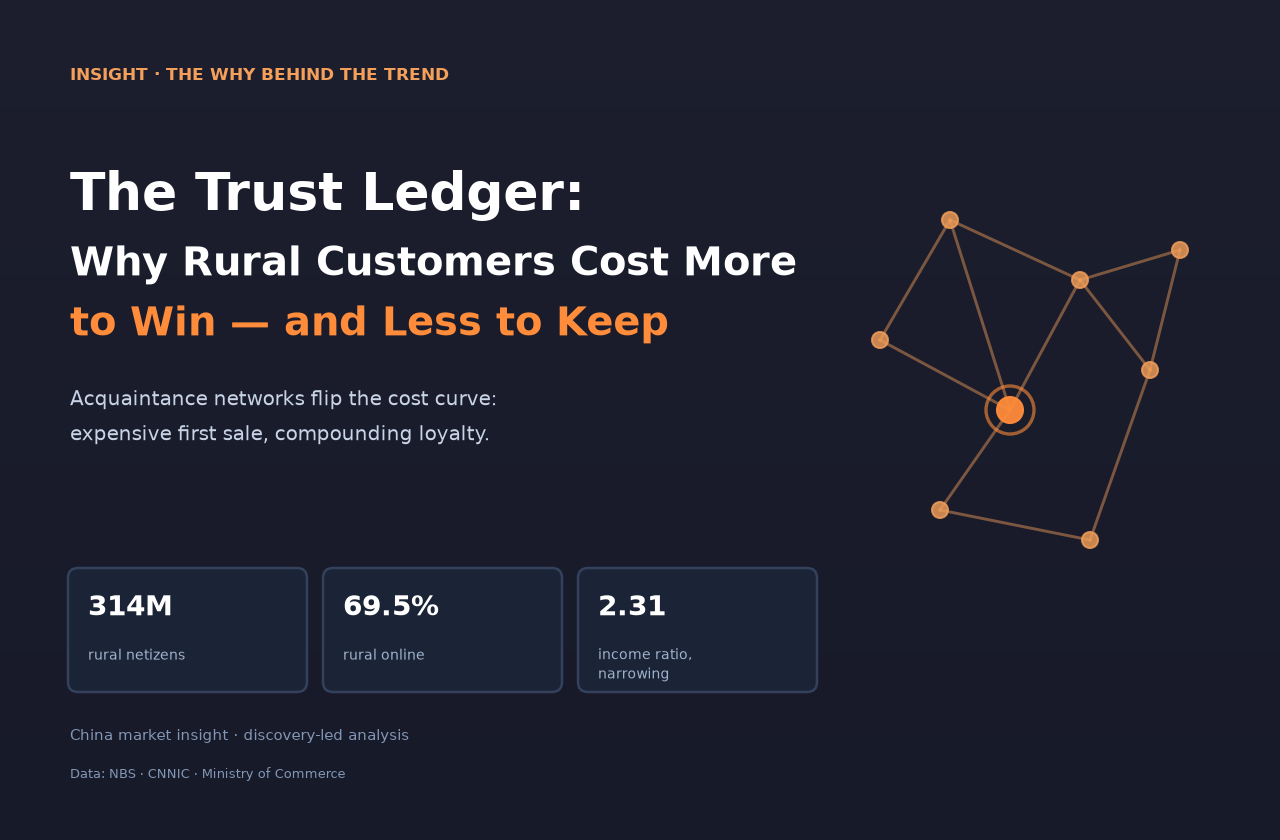
Ask a growth team why their China rural pilot underperformed and you will usually hear a demand-side answer: incomes too low, baskets too small. The numbers say otherwise — rural incomes grew 5.8% in 2025 against urban China’s 4.3%, and rural online retail crossed three trillion yuan. The pilot did not fail on demand. It failed on the ledger.
Here is the mechanism nobody puts in the deck. Urban e-commerce runs on anonymous-review trust: strangers rate strangers, and the platform rents that trust to you one impression at a time. Acquisition is cheap because the trust infrastructure already exists — you just buy access to it. But the rental never stops. Ratings decay, ads re-run, and every repeat purchase is re-acquired at nearly full price. Churn is cheap for the customer too: switching costs one click.
Rural commerce runs on the opposite system. In a village, trust is not rented from a platform; it is borrowed from a person. The shopkeeper who stocks your detergent, the neighbor whose washing machine has survived three winters, the local KOC with two hundred WeChat contacts who all know her real name. Before that person vouches for you, no ad budget can substitute. Earning the first endorsement is slow, human, and expensive — which is exactly why the first sale costs more in rural China than in Shanghai.
Then the curve flips. Once embedded in an acquaintance network, the network does your repeat selling for free. The endorsement persists because the endorser lives there; her reputation is collateral you did not have to pay for. And switching away carries a cost no urban marketplace can impose: it means publicly doubting the person who vouched. In a community where everyone trades favors, that is not a click — it is a small social rupture. Rural churn is expensive for the customer, so it is cheap for you.
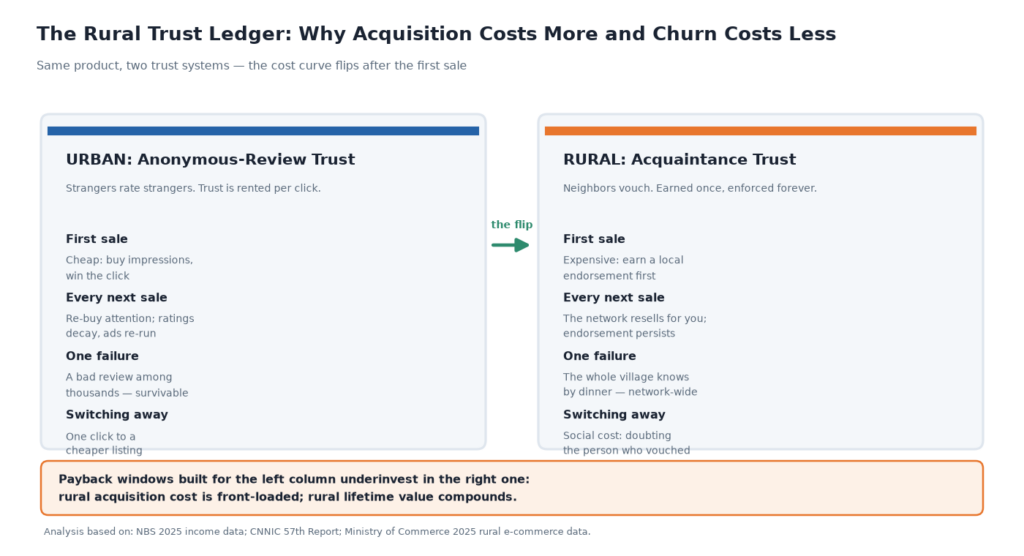
Notice what this does to the standard dashboard. A 30-day payback window is calibrated to the urban ledger, where cost sits in every period. Applied to the rural ledger — where cost is front-loaded and value compounds — it kills the pilot precisely at the moment the endorsement is about to start paying. The team reads “rural CAC is too high” and retreats, when the honest reading is “we measured a bond with a coupon ruler.”
There is a darker symmetry. The same network that resells for you also enforces against you. One failed delivery, one warranty dishonored, and the village knows by dinner — the endorsement reverses at the speed of gossip, network-wide. That is why rural trust cannot be growth-hacked: you are not buying an audience, you are joining a reputation system with permanent memory.
The strategic conclusion is uncomfortable for quarterly planning but simple: in rural China, spend like an underwriter, not a media buyer. Underwrite the first endorsement carefully, honor it obsessively, and let the network amortize it. The brands that win the next 300 million consumers will be the ones that understood they were borrowing trust from people — and paid it back.