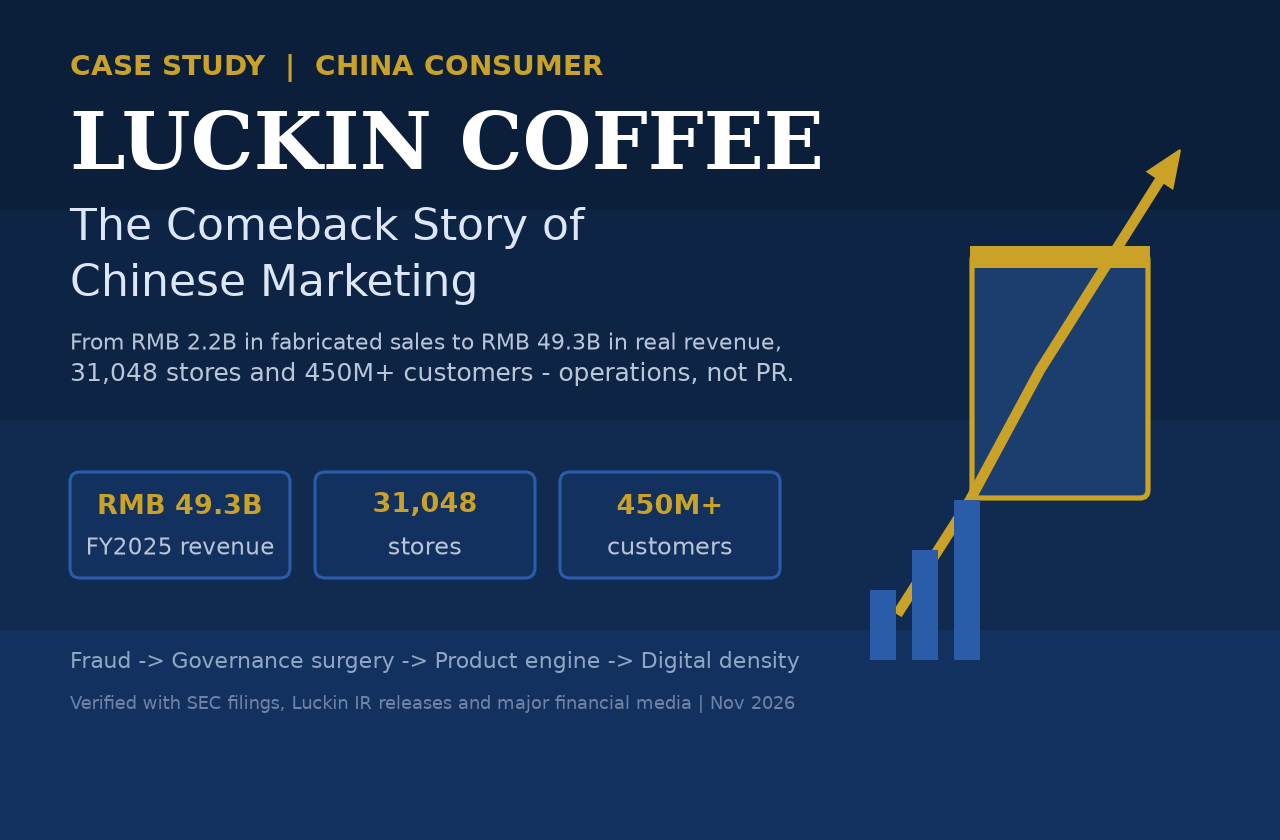
Luckin Coffee is the most instructive comeback in Chinese consumer history — because the comeback was not a reputation repair. It was a machine rebuild. In April 2020 the company admitted fabricating roughly RMB 2.2 billion in sales, was delisted from Nasdaq, and paid a US$180 million SEC penalty. By fiscal 2025 it reported RMB 49.29 billion in real revenue, RMB 3.6 billion in net profit, 31,048 stores and more than 450 million cumulative transacting customers. The bridge between those two numbers was governance surgery, a replaced growth engine, and capital-efficient density — not public relations. This case study walks through the fall, the rebuild, the proof, and the reusable lessons, with every core figure verified against filings, regulator documents and major financial media.
1. The Rocket: How Luckin Got Big Before It Got Honest
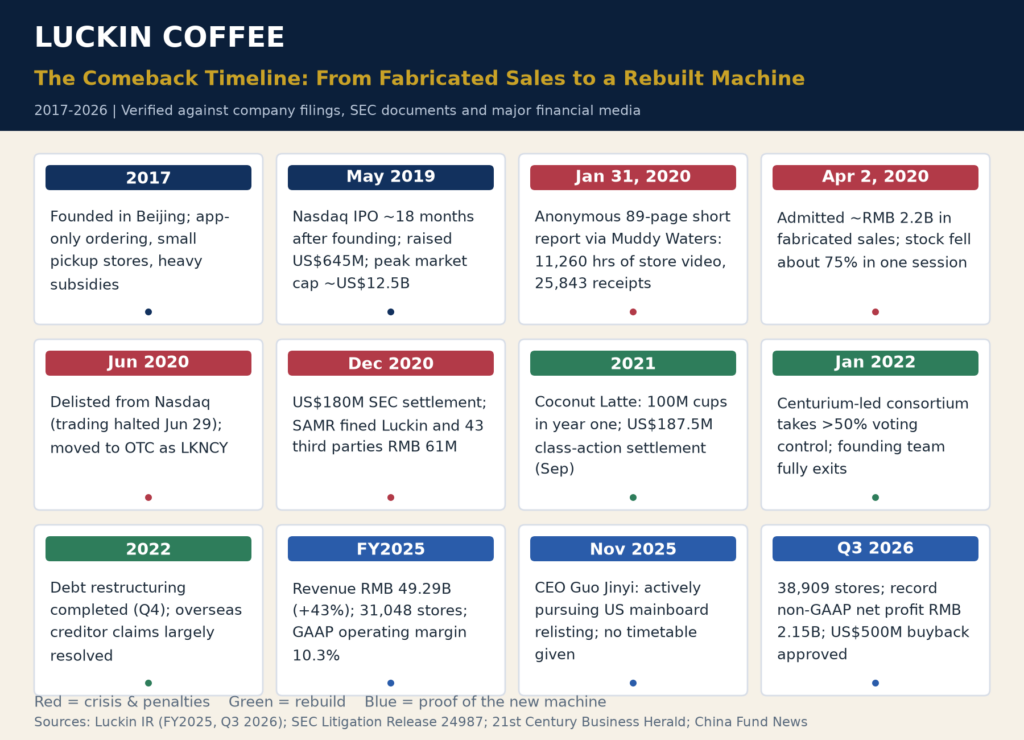
Founded in 2017 by Lu Zhengyao and Qian Zhiya — veterans of China’s car-rental wars — Luckin ran a playbook nobody in coffee had tried at scale: order only through the app, pick up from small stores embedded in office lobbies, and subsidize every cup until the habit stuck. The company called it “infinite scenarios.” Investors called it the future.
The numbers were spectacular. More than 400 stores within six months. Over 2,000 within a year. Roughly 4,500 by the end of 2019 — more than Starbucks had built in China in two decades. In May 2019, about 18 months after founding, Luckin IPO’d on Nasdaq and raised around US$645 million, the fastest listing ever for a Chinese consumer company. By January 2020 its market capitalization peaked near US$12.5 billion.
Here is the uncomfortable part: the model underneath the rocket was genuinely interesting. Small pickup stores kept rent low. App-only ordering captured first-party data on every transaction. Density made delivery cheap and pickup convenient. Remember that, because it explains everything that came later.
2. The Fall: An 89-Page Report and a RMB 2.2 Billion Confession
On January 31, 2020, short-seller Muddy Waters published an anonymous 89-page report it deemed credible. The research behind it was extraordinary: 92 full-time and 1,418 part-time investigators, 981 store-days of surveillance covering full business hours, 11,260 hours of store video, and 25,843 customer receipts. The conclusion: items sold per store per day were inflated by at least 69% in Q3 2019 and 88% in Q4 2019, and net selling prices were overstated by at least 12.3%.
Luckin initially denied everything. Then, on April 2, 2020, it admitted that its COO Liu Jian and other employees had fabricated roughly RMB 2.2 billion in sales between Q2 and Q4 of 2019. The stock lost about three-quarters of its value in a single session. The final internal investigation put the inflated revenue at RMB 2.12 billion and inflated costs at RMB 1.34 billion — the fraud had begun in April 2019, right around the IPO.
The consequences arrived fast. Nasdaq halted trading on June 29, 2020 and the ADSs left the exchange that July, relegated to the OTC market under the ticker LKNCY. In September 2020, China’s State Administration for Market Regulation fined Luckin’s two Chinese entities and 43 third-party accomplices a combined RMB 61 million for false publicity.
3. The Price of the Fraud: Three Settlements, One Clean Break
The SEC’s December 16, 2020 complaint is the most precise public record of what happened. From at least April 2019 through January 2020, Luckin intentionally fabricated more than US$300 million in retail sales through three purchasing schemes involving related parties. Employees inflated expenses by more than US$190 million, built a fake operations database, and altered accounting and bank records. Reported revenue was overstated by roughly 28% for the June 2019 quarter and 45% for the September 2019 quarter. During the fraud window, the company raised more than US$864 million from debt and equity investors.
Luckin settled for a US$180 million penalty — without admitting or denying the allegations — and the SEC explicitly acknowledged that the company self-reported, cooperated, terminated personnel, cut ties with fraudulent third parties, reorganized finance and added internal controls. That acknowledgment matters: it is the regulator certifying that remediation was real.
In September 2021, Luckin signed a binding term sheet for a US$187.5 million global settlement of the US securities class action, led by Swedish pension fund AP7, covering ADS purchasers from May 2019 to July 2020. Debt restructuring followed: a support agreement in March 2021, senior notes fully redeemed by August 2022, and completion in Q4 2022. The SEC confirmed in February 2022 that the penalty obligations were satisfied. The old liabilities were not deferred. They were closed.
4. Governance Surgery: Cutting Out the Fraud, Keeping the Machine
Most crisis playbooks start with communications. Luckin’s started with a scalpel.
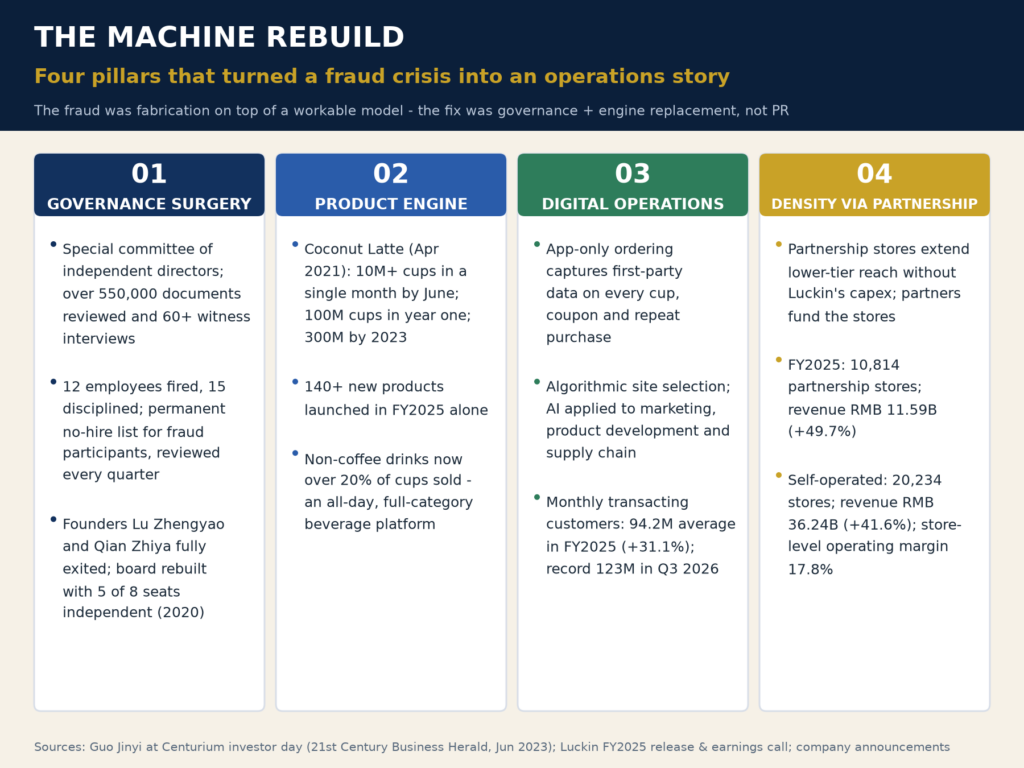
The board formed a special committee of independent directors on March 19, 2020 — before the public admission. The committee reviewed more than 550,000 documents and interviewed over 60 witnesses. Twelve employees were terminated and fifteen disciplined. Former CEO Qian Zhiya and COO Liu Jian were found to have participated; chairman Lu Zhengyao was pushed out. At the July 2020 shareholder and board meetings, the board was rebuilt: eight seats, five of them independent, with co-founder Guo Jinyi — cleared by the investigation — installed as chairman and CEO.
Then came the detail that separates theater from surgery. Guo has described a permanent no-hire list of everyone involved in the fraud, reviewed every quarter to make sure nobody slips back in. In his words at Centurium’s 2023 investor day: the old Luckin is dead. Just as importantly, the R&D and core operations teams untouched by the fraud were retained. You cannot rebuild a product engine if you fire the engineers.
The ownership reset completed in January 2022, when a consortium led by Centurium Capital — the early investor whose founder David Li (Li Hui) had called the fraud “an enormous betrayal” — bought the founders’ shares from the liquidators and took more than 50% of the voting power. In April 2025, Li himself became chairman while Guo stayed on as CEO. Control, management and accountability were now aligned in a way they never had been under the founding team.
5. The Product Engine: Coconut Latte and the End of Subsidy Dependence
The old Luckin bought volume with coupons. The new Luckin earned it with products.
On April 12, 2021 — a year after the confession, while the company was still in provisional liquidation — Luckin launched the Coconut Latte. It sold out instantly. By June 2021 the coconut series was moving more than 10 million cups in a single month, a company record. Within its first year the single product crossed 100 million cups; by April 2023, over 300 million. A milk-tea-adjacent coffee drink, engineered for Chinese palates, became the comeback’s emotional turning point: consumers who had written Luckin off as a fraud story started queueing for its product instead.
But one hit is luck. A pipeline is a machine. Luckin institutionalized the hit: internal R&D teams racing external product labs in a tournament-style selection process, consumer testing, regional gray launches, then national rollout backed by the store network. In FY2025 alone the company launched more than 140 new products. Non-coffee drinks — light milk teas, fruit teas — now account for over 20% of cups sold. The coffee company quietly became an all-day beverage platform, competing with tea chains as much as with Starbucks.
6. The Data Machine: Why App-Only Ordering Became the Moat
Here is the twist the short report missed. Muddy Waters argued the business model was fundamentally broken: Chinese consumers were price-sensitive, subsidies could never stop, and coffee demand was too small. The fraud claim was right. The model claim aged badly.
App-only ordering — dismissed in 2019 as a growth hack — turned out to be a data asset. Every cup, every coupon redemption, every repeat purchase flows into first-party data that feeds personalized offers, retention campaigns and demand forecasting. Site selection became algorithmic: the company opens stores where its own transaction data says demand exists, which is why it added 8,708 net new stores in 2025 without the unit economics collapsing. Management now describes AI working across marketing, product development and supply chain.
The customer numbers show the compounding. Average monthly transacting customers reached 94.2 million in FY2025, up 31.1%. From June to October 2025, more than 100 million customers transacted in five consecutive months. Cumulative transacting customers passed 450 million — roughly one in three people in China has bought from Luckin. A subsidy machine rents customers. A data machine keeps them.
7. Density Without the Burn: The Partnership Store Flywheel
The original Luckin scaled on its own balance sheet, and the pressure to show growth on that balance sheet is what incubated the fraud. The rebuilt Luckin fixed the capital structure of growth itself.
Self-operated stores anchor the high-tier cities and the data network. Partnership stores — Luckin’s franchise-like model, where partners fund the store and Luckin supplies materials, equipment, systems and profit-sharing — extend density into lower-tier markets without Luckin’s capex. By year-end 2025 the network stood at 31,048 stores: 20,234 self-operated and 10,814 partnership. Partnership revenue grew 49.7% to RMB 11.59 billion, outpacing self-operated revenue growth of 41.6% (RMB 36.24 billion). Self-operated stores still earned a 17.8% store-level operating margin for the full year.
That is the quiet lesson: the comeback did not just change how Luckin sells coffee. It changed who pays for the next store.
8. The Proof: FY2025 by the Numbers
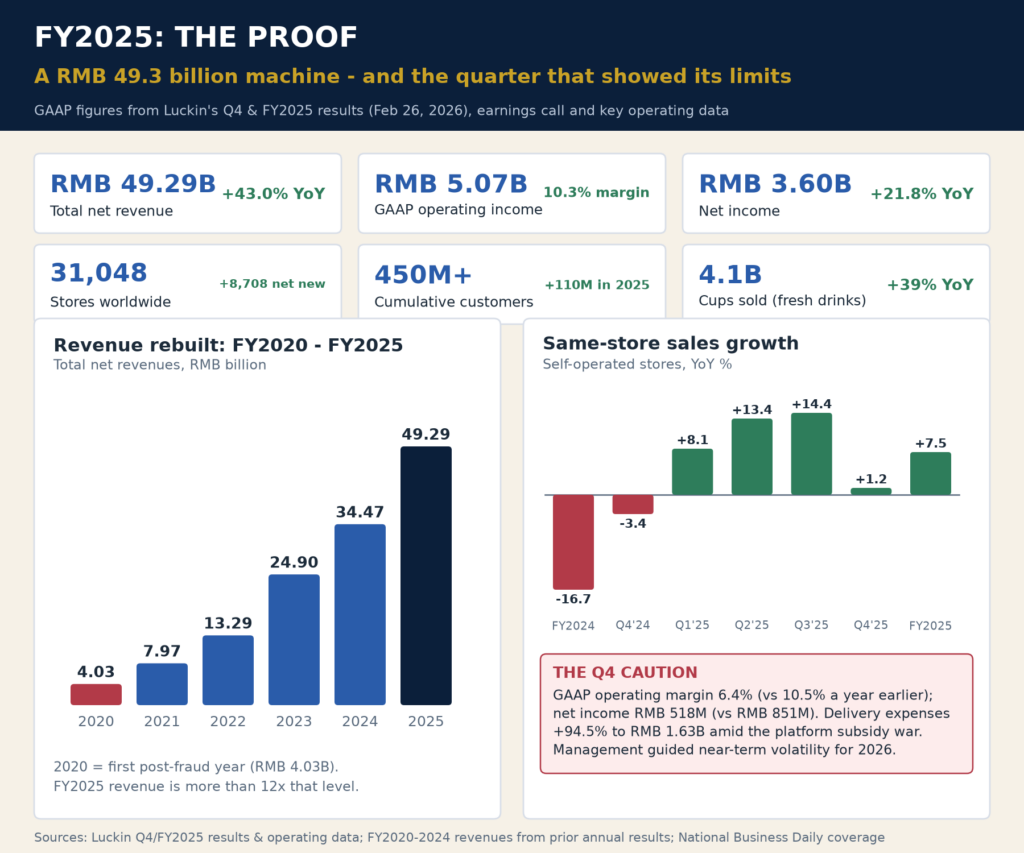
Sentiment is nice. Filings are better. Luckin’s Q4 and FY2025 results, released February 26, 2026, read like the closing argument of the comeback:
- Total net revenues of RMB 49.29 billion, up 43.0% year over year; GMV of RMB 56.65 billion, up 42.3%.
- GAAP operating income of RMB 5.07 billion, up 42.1%, at a 10.3% margin.
- Net income of RMB 3.60 billion, up 21.8%.
- 4.1 billion cups of freshly made drinks sold, up 39%.
- Same-store sales growth at self-operated stores of +7.5% for the year — against −16.7% in 2024.
- Year-end cash, deposits and short-term investments of roughly RMB 9 billion.
Read the same-store line twice. A −16.7% to +7.5% swing means existing stores started growing again — the growth was no longer just new-store arithmetic. For a company whose entire scandal was about faking exactly this kind of number, reporting it real and on the record is the whole point.
9. The Honest Caveat: Q4 and the Delivery War
No comeback story deserves your trust if it skips the ugly quarter. Q4 2025 was ugly.
GAAP operating margin fell to 6.4% from 10.5% a year earlier. Net income dropped to RMB 518 million from RMB 851 million. The culprit: delivery expenses jumped 94.5% to RMB 1.63 billion as China’s food-delivery platforms unleashed a subsidy war and Luckin’s cups rode along. For the full year, delivery expenses hit RMB 6.88 billion, up nearly 144%. Same-store growth slowed to 1.2% in Q4. Guo Jinyi told analysts the quarter reflected seasonality, shifting platform subsidies and cup-mix — and guided openly to near-term volatility in 2026.
Note what this pressure is and is not. It is the platforms’ subsidy war taxing Luckin’s logistics line. It is not a return to Luckin’s own pre-fraud coupon addiction. The distinction shows up in the very next data point.
10. Q3 2026: The Machine Passes Its Next Test
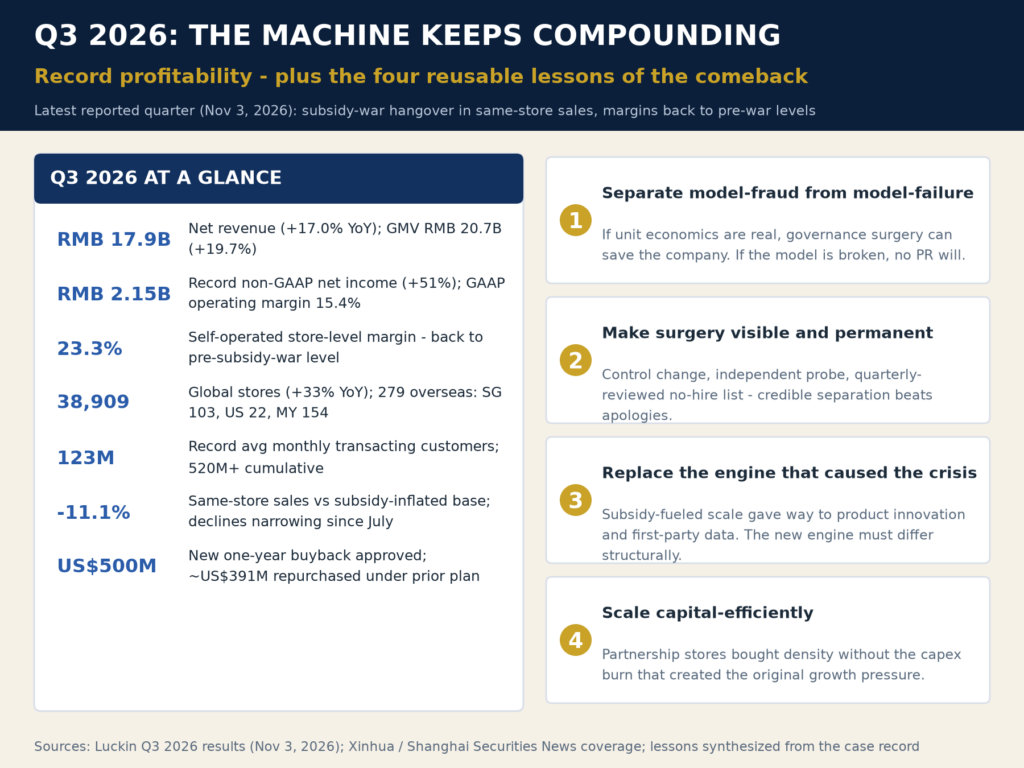
The freshest evidence arrived on November 3, 2026. Third-quarter revenue reached RMB 17.89 billion, up 17.0%. GAAP operating profit rose 55.1% to RMB 2.76 billion at a 15.4% margin, and non-GAAP net income hit a record RMB 2.15 billion. Store-level operating margin at self-operated stores recovered to 23.3% — essentially back to pre-subsidy-war levels — as delivery mix and costs normalized.
Yes, same-store sales fell 11.1% against the subsidy-inflated base of Q3 2025, and management said declines have narrowed month by month since July. But the network kept compounding: 38,909 stores globally, up 33% year over year, including 279 overseas (103 in Singapore, 22 in the US, 154 franchised in Malaysia). Average monthly transacting customers set another record at 123 million; the cumulative base passed 520 million. And the board approved a new one-year US$500 million share buyback, after repurchasing about US$391 million under the prior program.
A company that once fabricated profits is now returning capital to shareholders. Sit with that sentence for a moment.
11. What Everyone Gets Wrong About This Comeback
Four misconceptions keep circulating. Each one distorts the lesson.
The PR myth. People remember Coconut Latte’s viral moment and conclude marketing saved Luckin. The sequence says otherwise: governance surgery and settlements came first, the product engine second, and public sentiment followed the numbers. PR was the exhaust, not the engine.
The fraud-equals-death assumption. Enron-style fraud kills companies whose economics were fictional. Luckin’s fraud was fabrication layered on a workable model — small stores, app data, density. That distinction is why survival was possible at all. The short report was right about the numbers and wrong about the model.
The subsidy-still-drives-it error. FY2025’s +7.5% same-store growth and 140-product pipeline show repeat-and-innovation-driven demand. The Q4 margin squeeze came from platform delivery economics, not from Luckin buying its own volume back.
The Starbucks-killer simplification. Luckin won mass-market density, price and digital convenience; Starbucks retains premium third-place positioning. China’s coffee market grew into a two-engine market, not a zero-sum execution. And the real price-war antagonist was never Starbucks — it was Cotti Coffee, launched in October 2022 by none other than Lu Zhengyao and Qian Zhiya with a team reportedly half-staffed by ex-Luckin people. Cotti grew past 18,000 stores by December 2025 on blanket RMB 9.9 promotions, then narrowed that promotion in early 2026. The founders’ new company ran the old playbook; the rebuilt company ran the new one. The scoreboard is the argument.
12. The Reusable Methodology: Four Rules for Crisis Comebacks
Strip away the coffee and this case leaves a framework any operator can use.
Rule one: separate model-fraud from model-failure. Audit your unit economics honestly before choosing a crisis strategy. If the economics are real, governance surgery plus an operations rebuild can save you. If the model itself is broken, no narrative will.
Rule two: make the surgery visible and permanent. An independent investigation, a control change, terminated participants, and a no-hire list reviewed quarterly — these are verifiable acts. Stakeholders trust receipts, not apologies.
Rule three: replace the engine that caused the crisis. Luckin’s crisis grew from subsidy-fueled scale under capital-market pressure. The replacement — product innovation, first-party data, retention — is structurally different, so the same pressure cannot reproduce the same failure.
Rule four: scale capital-efficiently. Partnership stores bought density without the capex burn that created the original growth pressure. Change who funds growth and you change the incentives that corrupt it.
13. Risks That Remain
Honesty requires the open items too. The mainboard return is aspirational: Guo announced the push at Xiamen Entrepreneurs Day in November 2025, and the company immediately clarified there is no timetable — audit-firm credibility and market trust remain hurdles. Margin exposure to platform subsidy cycles is structural until pickup reasserts itself as the dominant mode, which management itself expects to be a long transition. Governance durability is a permanent test, not a completed project — the founding team competes against them daily through Cotti. And the Q3 2026 same-store decline, while narrowing, reminds us that lapping a subsidy bubble is arithmetic, not destiny.
Conclusion
Luckin did not recover its reputation. It rebuilt its machine — governance, product, data, density — and the reputation followed the receipts. From RMB 2.2 billion in fabricated sales to RMB 49.29 billion in reported revenue, from delisting to a buyback, from a short report’s obituary to 38,909 stores: the definitive lesson of Chinese consumer marketing’s greatest comeback is that operations, not PR, resurrect a fraud-broken company. If your unit economics are real, your surgery is credible, and your new engine is structurally different from the one that failed — you get a second life. Nobody gets a third.