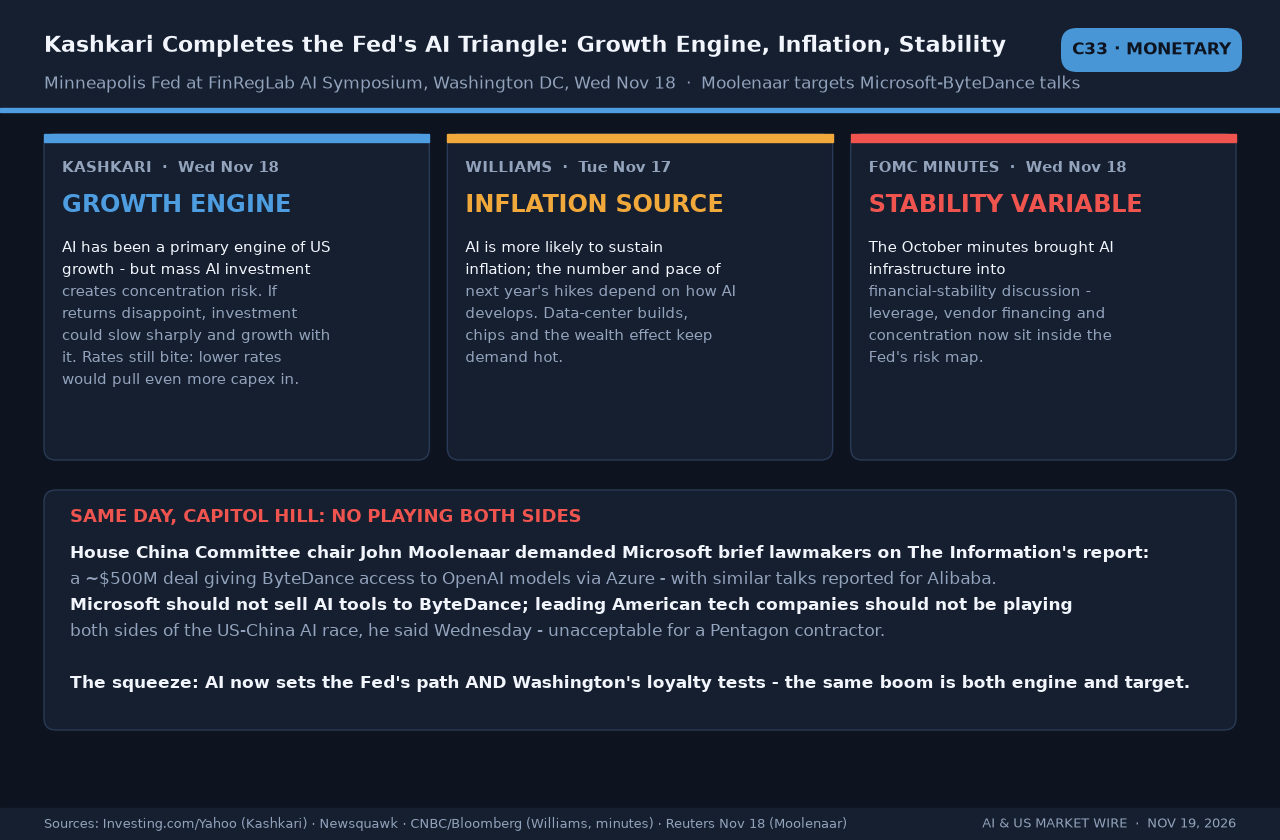
Speaking Wednesday, November 18 at the FinRegLab AI Symposium in Washington, Minneapolis Fed President Neel Kashkari called AI “a primary engine of growth” for the US economy — completing, within 48 hours, a three-part institutional framing alongside Williams’s inflation warning (Tuesday) and the FOMC minutes’ financial-stability discussion (Wednesday afternoon) — but added the crucial caveat: the scale of AI investment creates concentration risk, and if those investments fail to deliver expected productivity or returns, spending “could slow, possibly sharply,” dragging growth with it; he insisted rates still work on tech investment (lower rates would pull in even more capex), admitted the Fed is “clearly missing” on inflation, and noted markets expect more hikes than officials project. The same day on Capitol Hill, House China Committee chair John Moolenaar demanded Microsoft brief lawmakers on The Information’s report of a ~$500 million deal giving ByteDance access to OpenAI models through Azure — with similar talks reported for Alibaba — declaring “Microsoft should not sell AI tools to ByteDance” and “leading American technology companies should not be playing both sides of the US-China AI race,” calling it unacceptable for a Pentagon contractor. The bind is now explicit: the same AI boom is simultaneously the Fed’s growth engine, its inflation problem, and Washington’s loyalty test.