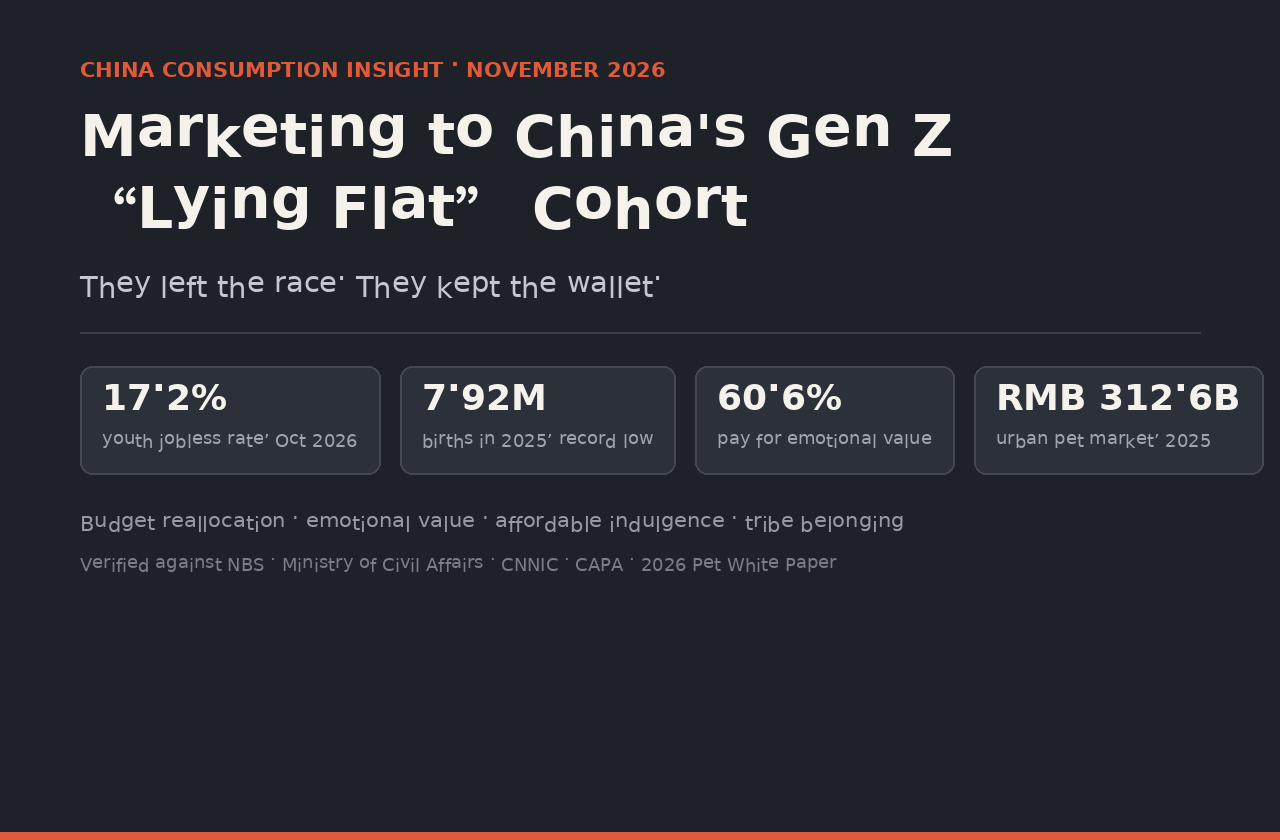
Somewhere in your dashboard, China’s Gen Z looks like a dead segment. Engagement down. Conversion down. The aspirational campaign you ran last quarter — the one about climbing, achieving, upgrading your life — landed with a thud. The easy explanation is that these kids are broke, lazy, or both. They call it tang ping, “lying flat,” and if you’ve read the Western coverage, you’d think an entire generation had checked out of the economy.
Here’s the problem with that story: the spending data doesn’t agree. The cohort that supposedly gave up is buying concert tickets, character merchandise, specialty coffee and pet supplies in record volumes. They didn’t exit consumption. They exited the race — and moved the budget.
This piece walks through what actually happened, what the official numbers say, and how to rewrite your brief for a cohort that refuses to be sold ambition.
What “Lying Flat” Actually Names
The term went viral in 2021 after a post on Baidu Tieba, a Reddit-style forum, titled “Lying Flat Is Justice” struck a nerve. It names a refusal of neijuan, or “involution” — the condition where everyone works harder and harder while the rewards stay flat, like a cinema where the front row stands up and forces everyone behind them to stand too. Lying flat is the choice to sit back down.
What gets refused is specific: overtime culture, the house-marriage-child milestone package, consumption as a scoreboard. What does not get refused: pleasure, community, identity, comfort. Peer-reviewed research backs this reading. A 2025 narrative study in the Asian Journal of Social Science found that young people who identify with lying flat describe it as a reimagining of work, success and autonomy — not a withdrawal from life itself. A 2026 scoping review in PLOS ONE, screening 27 studies, reached a similar conclusion: for many, tang ping is a temporary retreat to conserve emotional resources, not a permanent abandonment of effort.
Keep that distinction in mind. It is the whole article in one sentence: the cohort dropped the ladder, not the wallet.
The Structural Backdrop: A Milestone Funnel Under Pressure
The attitude didn’t appear from nowhere. Three official data series explain why the milestone package stopped feeling like a promise and started feeling like a trap.
Births at a record low
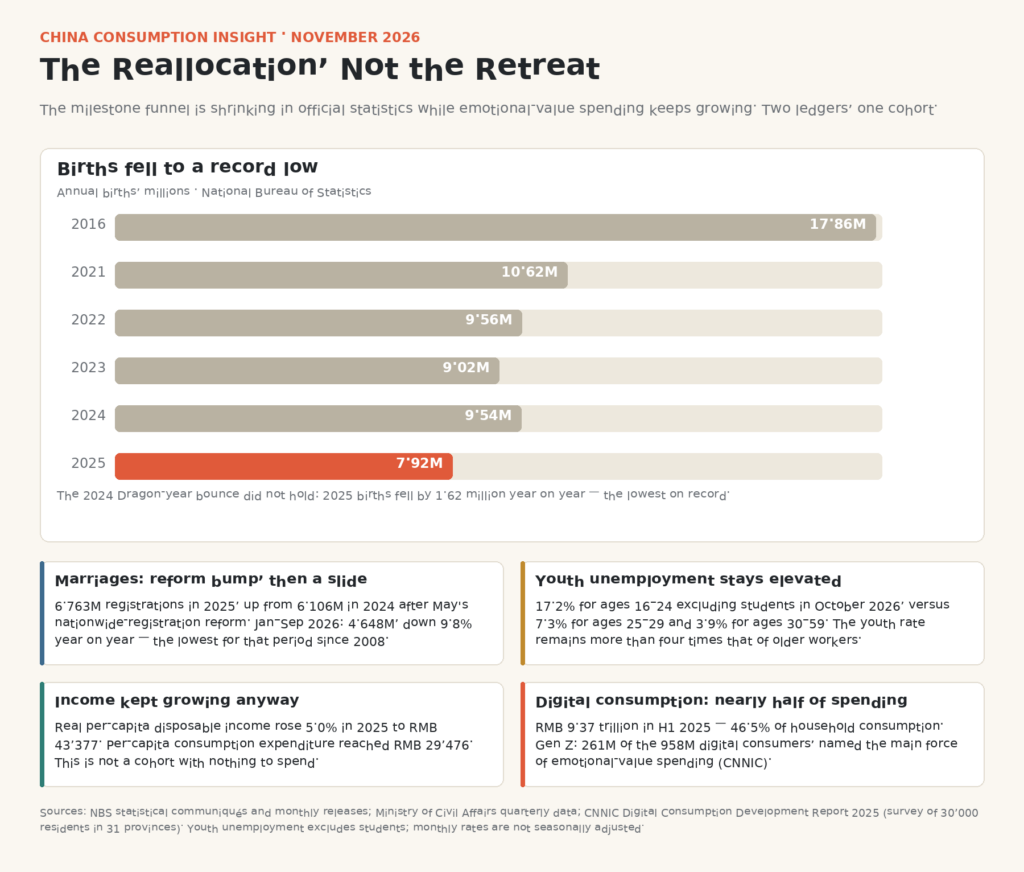
The National Bureau of Statistics reported 7.92 million births in 2025 — the lowest on record, down 1.62 million from 2024’s 9.54 million. The Dragon-year bump of 2024 proved to be a pulse, not a trend. Total population fell by 3.39 million for the fourth consecutive year. The family-formation funnel is shrinking demographically, not just attitudinally.
Marriages: a reform bump, then a slide
Marriage registrations tell a more interesting story than “young people won’t marry.” In 2025, registrations actually rose to 6.763 million couples from 6.106 million in 2024 — largely because a revised regulation effective May 2025 made registration possible anywhere in the country, without the household booklet. Remove the friction, and some deferred demand showed up. Then it faded: in the first three quarters of 2026, registrations fell to 4.648 million, down 9.8% year on year and the lowest for that period since quarterly records began in 2008. The decline accelerated through the year — roughly 6% in Q1, 9% in Q2, 15% in Q3. Making marriage easier to register didn’t make it easier to afford.
Youth unemployment that refuses to normalize
On November 18, 2026, the statistics bureau released October’s age-band figures: unemployment for urban 16–24-year-olds excluding students stood at 17.2%, versus 7.3% for ages 25–29 and 3.9% for ages 30–59. The youth rate had peaked at 18.9% in August — the highest since the current statistical caliber began — and has eased for two straight months, but it remains more than four times the rate of older workers. When effort reliably fails to convert into a stable adult life, opting out of the effort isn’t irrational. It’s arithmetic.
But the Wallet Is Still Open
Now the other ledger. In the same year that births hit a record low, per-capita disposable income grew 5.0% in real terms to RMB 43,377, according to the NBS 2025 statistical communique. This is not a cohort with nothing to spend.
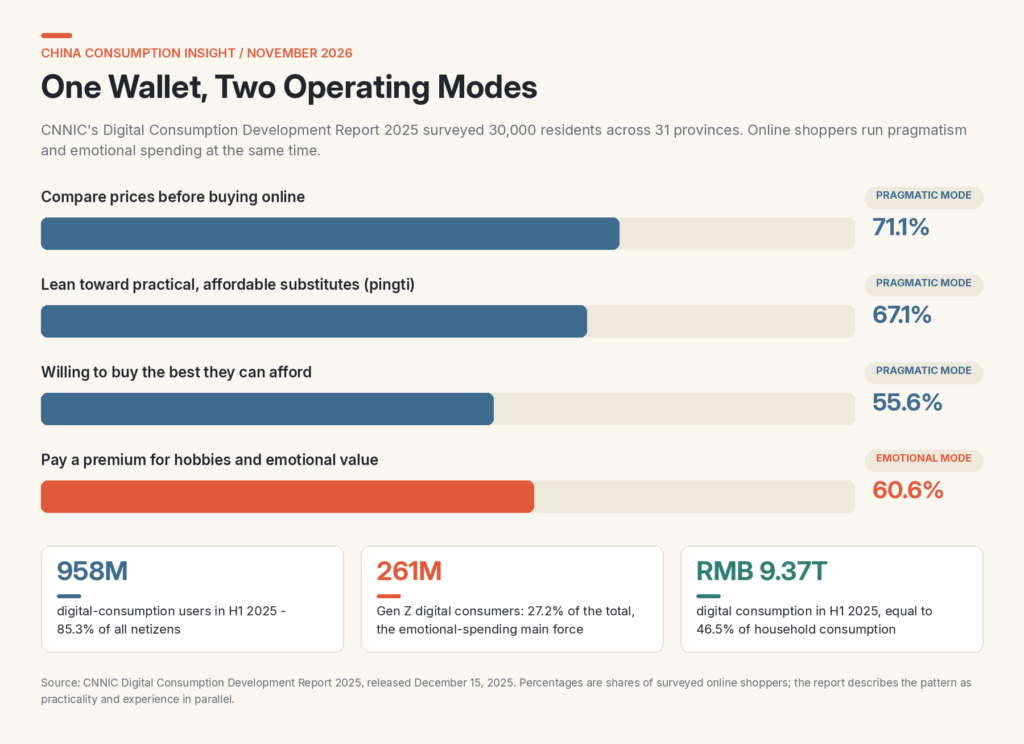
CNNIC’s Digital Consumption Development Report 2025 — a telephone survey of 30,000 residents across 31 provinces, released in December 2025 — found that digital consumption reached RMB 9.37 trillion in the first half of 2025, equal to 46.5% of all household consumption expenditure. Of the 958 million digital consumers, Gen Z accounts for 261 million (27.2%), and the report explicitly names them the main force of smart-device, digital-content and emotional consumption.
The cohort is online, employed enough, and spending. What changed is what the money is for.
The Low-Desire Consumption Structure: Four Reallocation Rules
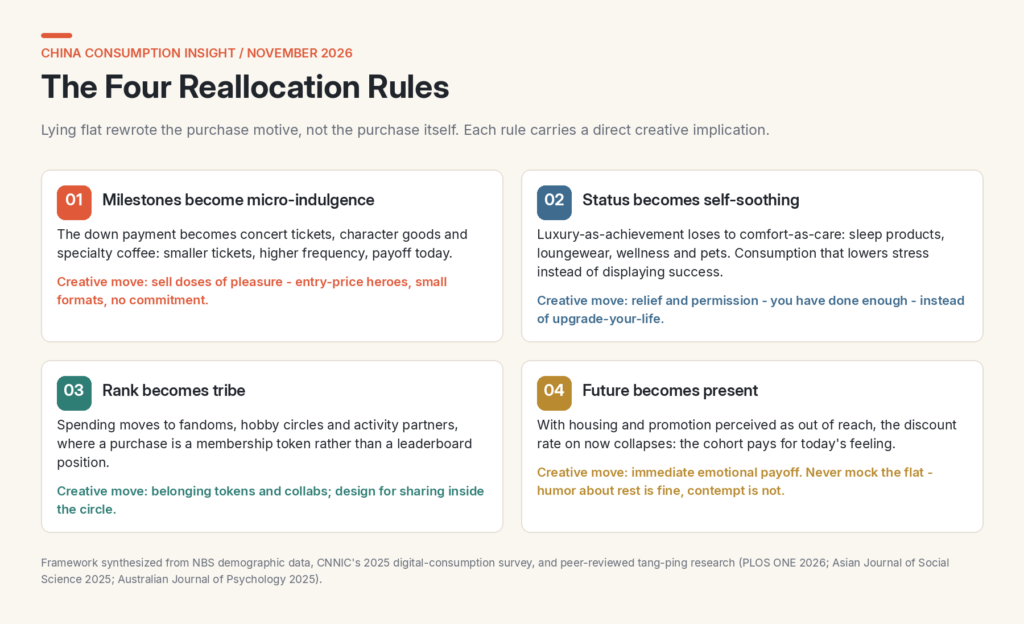
Here is the mechanism. Lying flat doesn’t delete demand; it reroutes it along four rules. Each one has a direct creative implication.
Rule 1: Milestone deferral becomes micro-indulgence
The mortgage down payment doesn’t sit in a savings account gathering resolve. It fragments into concert tickets, character goods, a better coffee, a weekend trip. Smaller tickets, higher frequency, immediate payoff. CNNIC found 60.6% of online shoppers willing to pay a premium for hobbies and emotional value. The cohort buys doses of pleasure, not commitments — because commitments are the part of the contract that broke.
Rule 2: Achievement signaling becomes self-soothing
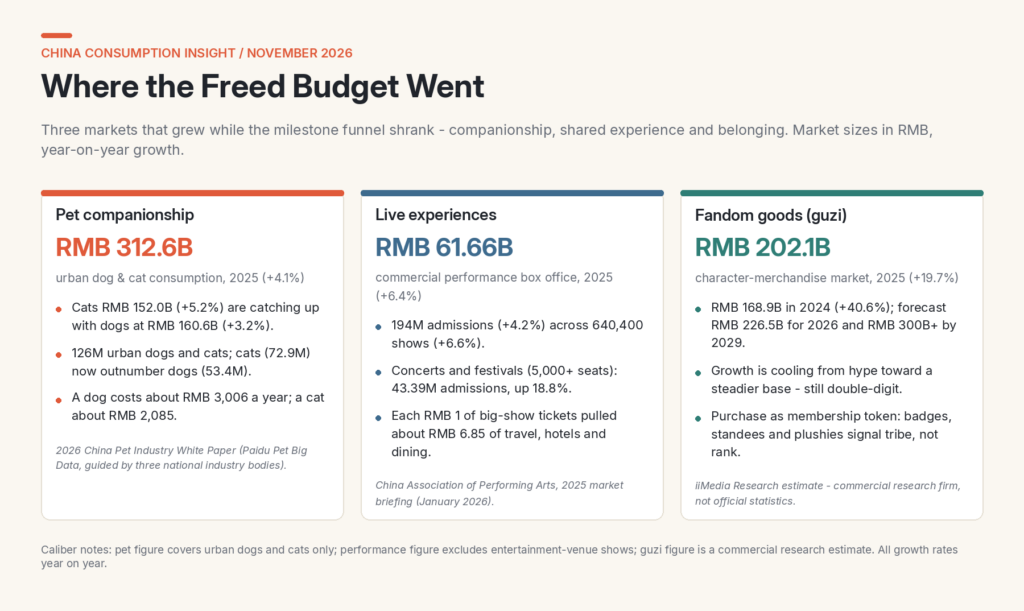
Luxury-as-status loses to comfort-as-care. Sleep products, loungewear, wellness, pets: consumption whose job is to lower stress rather than display success. The pet economy is the clearest case. The 2026 China Pet Industry White Paper — an industry-platform study by Paidu Pet Big Data, guided by three national industry bodies — put urban dog-and-cat consumption at RMB 312.6 billion in 2025, up 4.1%, across 126 million pets. A dog costs about RMB 3,006 a year. That is not a cohort that stopped caring; it’s a cohort that moved its care budget to a recipient that doesn’t demand a down payment.
Rule 3: Social competition becomes tribe belonging
Spending shifts toward fandoms, hobby circles and dazi — low-commitment activity partnerships, from meal buddies to gym pairs — where a purchase is a membership token rather than a rank marker. The guzi economy — character merchandise, badges, standees, plushies — reached an estimated RMB 202.1 billion in 2025, up 19.7%, according to iiMedia Research, a commercial research firm whose figures are estimates, not official statistics. Growth is cooling from its 40%-plus hype phase, and state media reported a wave of guzi store closures in 2026 — the market is maturing, not dying. CNNIC counted more than 90 million people buying blind boxes, IP merchandise and anime-style collectibles online. The purchase says “I belong here,” not “I am above you.”
Rule 4: Future discounting becomes present weighting
When housing and promotion feel unreachable, the discount rate on “later” collapses. Why save for a future you distrust when today’s feeling is purchasable? Live experience is where this shows up most loudly. The China Association of Performing Arts reported 2025 box office of RMB 61.66 billion across 640,400 commercial shows, with 194 million admissions. Large concerts and festivals (5,000+ seats) grew admissions 18.8% to 43.4 million, and each RMB 1 of big-show tickets pulled about RMB 6.85 of transport, hotels and dining — over RMB 220 billion of adjacent spending. One night of feeling, fully funded.
What Everyone Misunderstands
The “they’re broke” fallacy
Real incomes grew 5.0%. The rejection is of your category’s claim on the budget, not of spending itself. Low desire is selective.
The lazy-cohort moralization
The academic literature is consistent: tang ping tracks effort–reward imbalance, not character failure. Campaigns that scold or motivate — the striving narrative — read as tone-deaf to people who already ran the experiment and found the reward missing. A 2025 study in the Australian Journal of Psychology adds a caution worth respecting: passive withdrawal doesn’t durably satisfy autonomy needs either. This cohort isn’t happy about the trap. Don’t sell them a pep talk about it.
The anti-consumption misread
The same CNNIC survey found 67.1% of online shoppers lean practical and choose affordable substitutes — the pingti, or “dupe,” culture — while 71.1% compare prices before buying. Read those numbers next to the 60.6% emotional-premium figure and the picture snaps into focus: one wallet, two operating modes. Ruthless pragmatism on commodities, generous spending on feelings. That’s not anti-consumption. That’s a consumer who refuses to pay the status tax and insists on paying the joy tax.
The monolith error
Lying flat coexists with striving inside the same person — the “45-degree youth” who lean but don’t fall. Nobody is flat at every moment. Segment by context and occasion, not by identity label: the same user who hunts a dupe for laundry detergent will queue two hours for a limited character plush.
What This Means for Your Creative Brief
Rewrite the brief from aspiration to relief
The emotional job is permission, not motivation. “You’ve done enough; this is for you” converts where “achieve more” misfires. Sell the exhale, not the climb.
Price for the dose, not the commitment
Small formats, entry-price hero SKUs, trial without subscription lock-in. The cohort buys units of pleasure. An annual contract is a milestone in disguise, and it will be read as one.
Sell belonging, not rank
Community-token products, fandom collaborations, formats designed for two friends or a dazi pair. Design for sharing inside the circle, not for showing off outside it.
Never mock the flat
The tonal line is precise. Humor about rest is welcome — the cohort makes it themselves. Humor about giving up is contempt, and it is the fastest brand-kill trigger this segment has. If your joke’s punchline is “these kids quit,” you are the punchline.
The Counterarguments, and Where They Stop
“It’s just internet slang.” Discourse isn’t census, true. But the claim here rests on behavioral correlates — record-low births, the post-reform marriage slide, dupe culture, emotional-value spending — all measurable, all directionally consistent. The meme is the label; the reallocation is the evidence.
“They’ll re-enter the race when the economy improves.” Possibly; attitudes are partly cyclical, and youth unemployment has already eased two months running. But habits formed in flat years — micro-doses, emotional value, tribe purchases — persist as consumption structure even if ambition returns. Plan for the structure, not the mood.
“It’s just global Gen Z burnout.” The quiet-quitting and soft-life parallels are real. The difference is density: the gaokao-to-996 pipeline — a single college-entrance exam feeding into 9am-to-9pm, six-day workweeks — and the house-marriage-child package bundled into one expectation make the Chinese race heavier, and the opt-out more structural. Import the sympathy; don’t import the wrong playbook.
Conclusion: The End of the Aspiration Ladder as Default Brief
China’s lying-flat Gen Z didn’t exit consumption — they exited the race and moved the budget: from deferred milestones to immediate emotional returns, from status signals to self-soothing, from rank to tribe. The demographic data and the spending data tell one story of reallocation, not withdrawal. Brands still selling ambition to the exhausted are pitching a ladder the cohort deliberately dropped. Brands selling relief, small joys and belonging — at micro-indulgence prices, without mockery — inherit the spending the race used to claim.
The customer didn’t disappear. The funnel’s assumptions did.