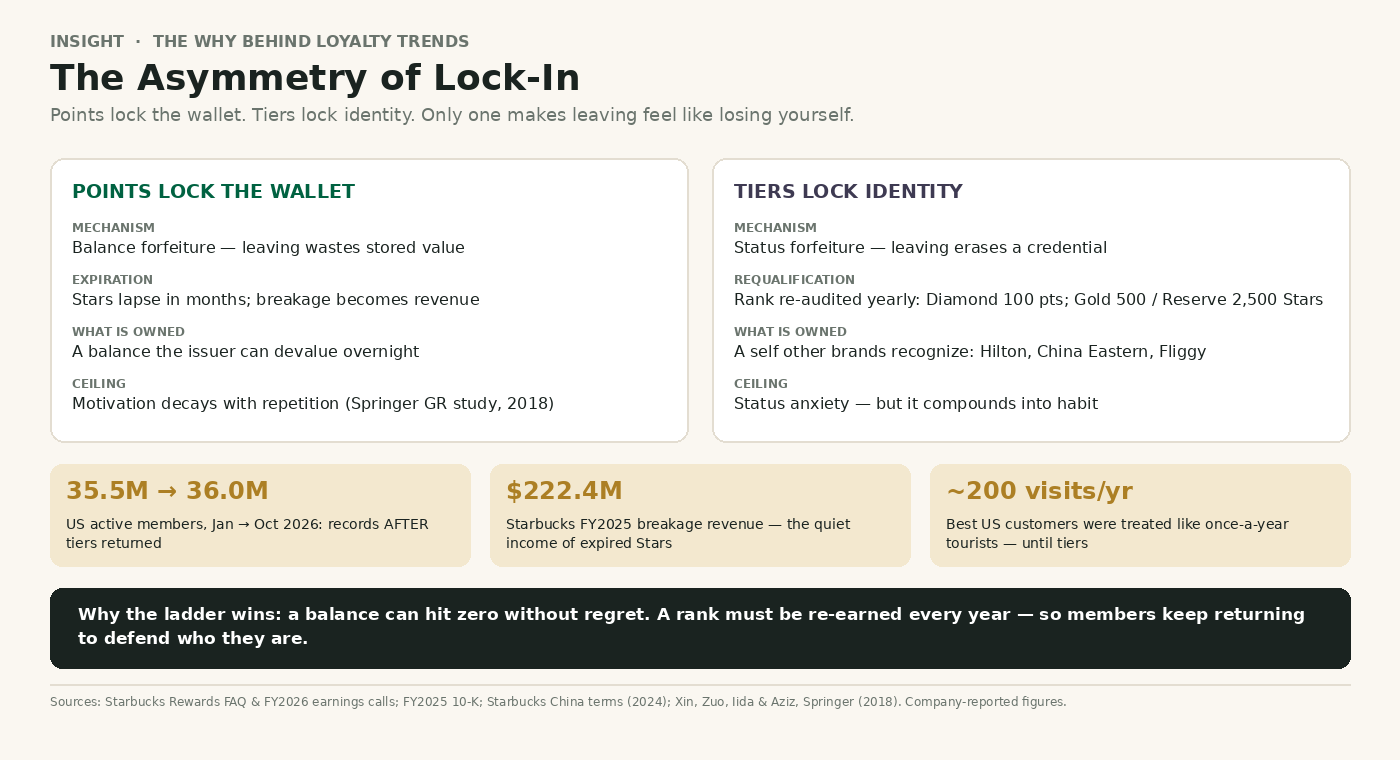
Here is a puzzle worth sitting with. In January 2026, Starbucks told its American members something no loyalty program wants to say out loud: your Stars can now expire slower, your birthday freebie lasts longer — and, by the way, we are ranking you. Green, Gold, Reserve. Tiers, back from a seven-year exile. Conventional wisdom says customers hate being sorted. Yet active membership did not dip. It climbed from a record 35.5 million to 36 million within two quarters. Why would adding a ladder make people more loyal, not less?
The answer is that points and tiers lock different things. Points lock the wallet: leave, and you forfeit a balance. Tiers lock identity: leave, and you forfeit a self. And the two forfeitures do not hurt equally.
A balance is spendable. You can burn it down to zero with a free latte and walk away whole — nothing about you was lost. A rank cannot be spent. It can only be defended, and defense requires repetition. Starbucks China’s official terms make the mechanism brutally clear: growth value resets at every account anniversary, and Diamond must re-earn 100 points a year — roughly ¥5,000 of coffee — or fall back to Gold, or Jade. The American redesign copies the logic: 500 Stars a year to hold Gold, 2,500 to hold Reserve. Status is not a prize you win once. It is a lease you renew with your behavior.
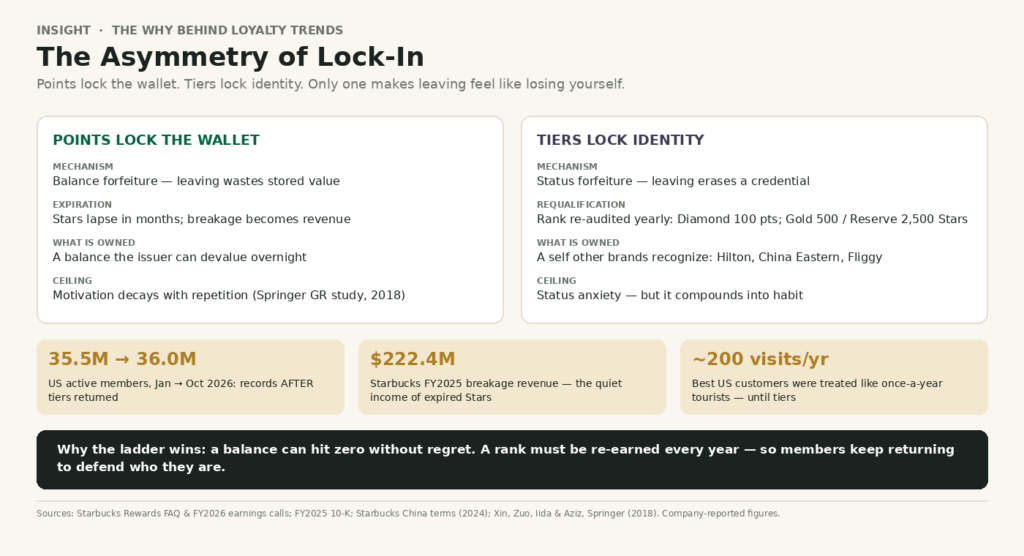
There is a second asymmetry, and it is financial. Points that expire are not a bug; they are revenue. Starbucks recognized $222.4 million of breakage in fiscal 2025 — money customers paid for value they never collected. A points-only program quietly profits from your forgetting. But a 2018 Springer study by Xin, Zuo, Iida and Aziz, applying game-refinement theory to Starbucks Rewards, found that points-only motivation decays with repetition. The wallet-lock is real but fading; the issuer earns breakage today at the cost of enthusiasm tomorrow. Tiers invert the trade: Gold and Reserve Stars never expire — the company gives up breakage on its best customers — in exchange for an annual identity audit that keeps them coming back. Giving up forfeiture revenue to buy frequency is not generosity. It is arithmetic: half of active members visiting one extra time a year is worth roughly $150 million, by the company’s own Investor Day math.
And identity, unlike a balance, is portable. Starbucks China’s Diamond maps to Hilton Silver, China Eastern lounge coffee, Atour Gold, Fliggy F4. Every partner that recognizes the rank raises the cost of abandoning it — a network effect a private points balance can never replicate.
So the ladder wins for a reason the wallet cannot match: you can empty a balance without regret, but you cannot let a rank lapse without feeling demoted. The 2026 tier revival was not gamification theater. It was Starbucks discovering that the strongest lock on a customer is not what they own — it is who they have become.