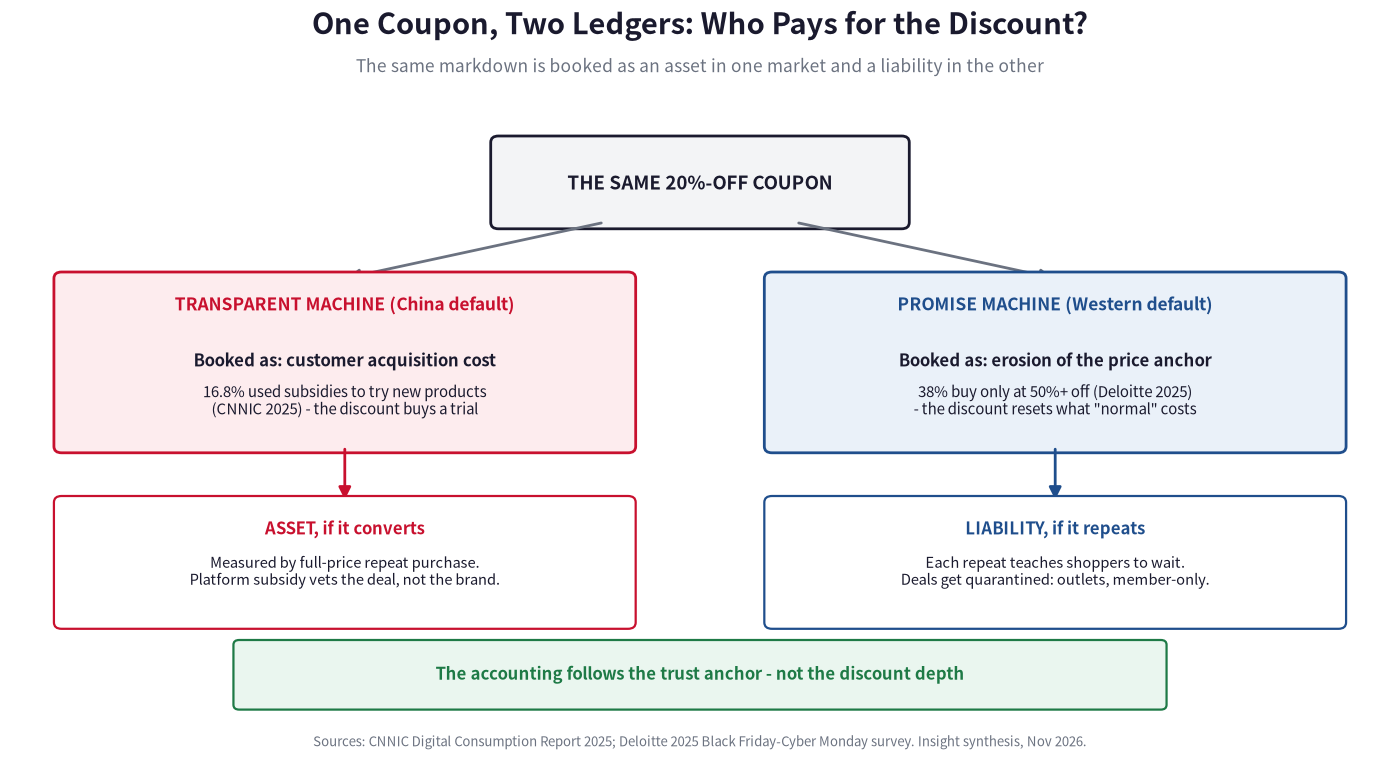
Here is a puzzle that pricing textbooks rarely explain. A 20%-off coupon is mathematically identical in Shanghai and Seattle. Yet one market’s CFO treats it as an investment and the other’s treats it as a wound. Same instrument, opposite balance-sheet treatment. Why?
The answer isn’t culture. It’s accounting — and the accounting follows the trust anchor.
The discount buys different things
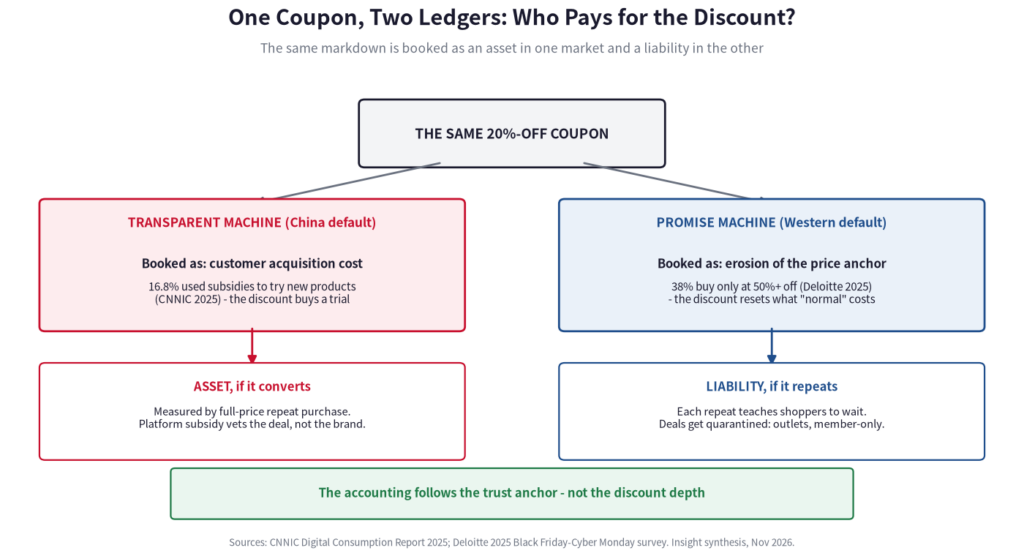
In China’s transparent machine, the reference price is the market-clearing real price, and everyone knows it. A discount therefore cannot damage an anchor that nobody believed in the first place. What it can do is buy attention and trial. CNNIC’s 2025 digital consumption report found that 16.8% of online shoppers used consumption subsidies specifically to try new products. Read that as a ledger entry: the subsidy is customer acquisition cost, and the asset it purchases is a first relationship. Pinduoduo built an entire platform on this logic — its Ten Billion Subsidy entrance passed 100 million daily active users within months of launch, because the deal, not the brand, was the destination.
In the Western promise machine, the reference price is the brand’s pledge. Stability is the product. So a discount doesn’t buy a trial — it sells off a piece of the anchor. Deloitte’s 2025 Black Friday survey shows the downstream effect with uncomfortable precision: 38% of shoppers said they would only buy items marked down at least 50%, and 60% had already parked items in carts, waiting. Each bounded event teaches a cohort to wait for the next one. The discount is booked as a liability because it compounds: the more you run it, the more “normal price” becomes a fiction your customers no longer accept.
Why the same CFO signs both checks
This is the part that surprises people. The difference is not risk appetite; it is what the discount is collateralized against. In the transparent machine, the platform’s subsidy section vets the deal, so the brand’s promise is not the collateral — the market’s verification is. The coupon can be aggressive because something else carries the trust. In the promise machine, the brand itself is the collateral, so every markdown is a drawdown on the only asset that matters. Costco understood this so completely that it inverted the model: cap markups at 14–15%, move the profit into membership fees, and let the cap itself become the promise. The discount stops being a weapon and becomes a policy.
The test that travels
So the strategic question is never “how deep should the discount be?” It is “what is this discount collateralized against, and will it convert?” In transparent markets, measure the coupon by full-price repeat purchase — if the trial never converts, the asset was imaginary. In promise markets, measure it by what happens to willingness-to-pay at full price afterward — if the anchor slips, the liability is real. And in both, the emerging rule is the same: a discount framed as recognition (a trial, a loyalty thank-you, a calendar event) survives; a discount that reads as your true price all along does not.
The coupon was never one object. It was two ledger entries wearing the same costume.



