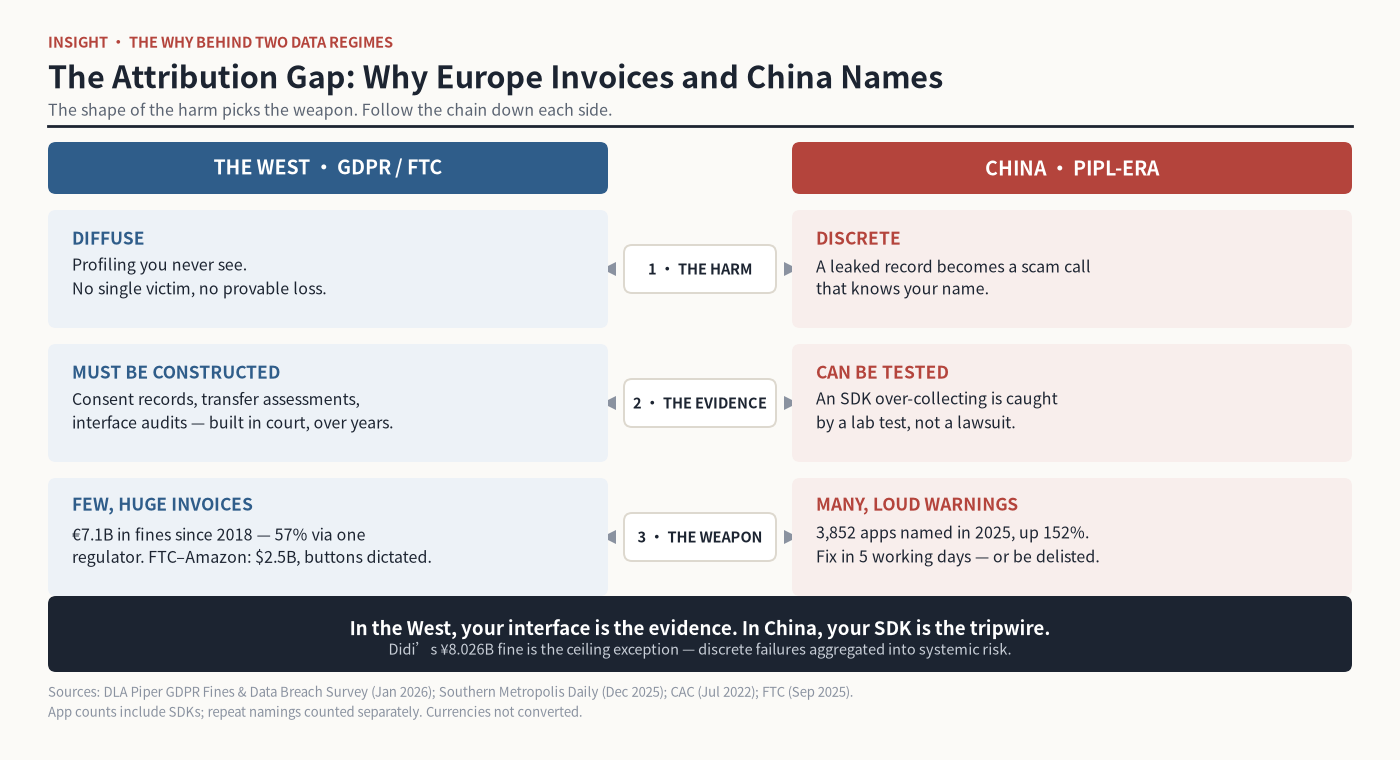
Why does Europe fine a handful of companies billions while China publicly names thousands of apps a year? The answer isn’t ideology. It’s the geometry of the harm.
Every comparison of GDPR and PIPL eventually reaches the same puzzle. Europe’s enforcement produces a few enormous invoices — €7.1 billion since 2018, 57% of it flowing through a single Irish regulator, individual cases litigated for half a decade. China’s produces a flood of cheap warnings: 3,852 apps and SDKs publicly named in 2025 alone, each given as little as five working days to fix the problem or vanish from app stores. Same subject matter. Radically different enforcement units. Why?
The standard answers — legal tradition, state capacity, political system — are true but shallow. They describe the machinery, not the constraint that shaped it. Here is the deeper mechanism: the shape of the injury determines what can count as evidence, and what counts as evidence determines the weapon.
Diffuse harm demands invoices
The injury Western privacy law fights is profiling: one more data point joined to a shadow dossier you will never see. No single victim can price the loss. No single act caused it. The harm is real but diffuse — spread across millions of people, invisible at the individual level, impossible to attribute to one collection event.
When harm cannot be traced, a regulator cannot simply point at it. It must construct the violation out of procedure: was consent valid, was the transfer assessment adequate, was the interface honest? That construction requires adversarial process — discovery, appeals, years of argument. And because each case is so expensive to build, the system economizes: few cases, maximum deterrence per case, fines calibrated to global turnover. The €1.2 billion Meta fine and the FTC’s $2.5 billion Amazon settlement — which dictates the placement of buttons — are not excesses. They are the rational output of a system where evidence is the scarce resource. You cannot name-and-shame a harm nobody can see; you can only invoice it, enormously, and hope the price teaches.
Discrete harm accepts warnings
The injury Chinese enforcement fights is the leak-to-fraud pipeline: a stolen record becomes a scam call that recites your name. The harm is discrete — a specific victim, a specific loss, a traceable chain back to a specific holder. And the regulatory failure mode is directly observable: an SDK harvesting contacts without consent can be caught by a lab test, not a lawsuit.
When the failure is testable, the warning itself becomes the sanction. A public naming imposes immediate reputational cost, a five-day deadline imposes operational cost, and delisting imposes existential cost — no courtroom required. Because each unit of enforcement is cheap, the system scales by the thousand and moves in campaign waves. The Didi penalty (¥8.026 billion) looks like a Western-style invoice, but read its framing: national data security, evasion of supervision. It is the ceiling reserved for when discrete failures aggregate into systemic risk — the exception that proves the rule.
What this predicts
The mechanism has teeth beyond description. It predicts that Western enforcement will keep drifting toward design — buttons, defaults, dark patterns — because design is the one place diffuse harm becomes observable. It predicts China’s campaigns will keep expanding to new observable surfaces: SDKs, then smart hardware, as MIIT did in October 2025. And it predicts convergence where the harm geometry converges: AI training data is diffuse harm manufactured at discrete scale, which is exactly why both regimes are suddenly writing the same rules about provenance.
For marketers, the operational translation is one sentence: in the West, your interface is the evidence; in China, your SDK is the tripwire. Budget your audits accordingly.



