Most markets grow their digital demand the way a garden grows: slowly, season by season, with brands spending decades teaching consumers to browse, compare, tap and pay. Saudi Arabia did something else. It commissioned the garden. Under Vision 2030, the state treated connectivity, payment rails, entertainment categories and even consumer segments as infrastructure projects — and delivered them on a national schedule, before most brands ever bought a riyal of media.
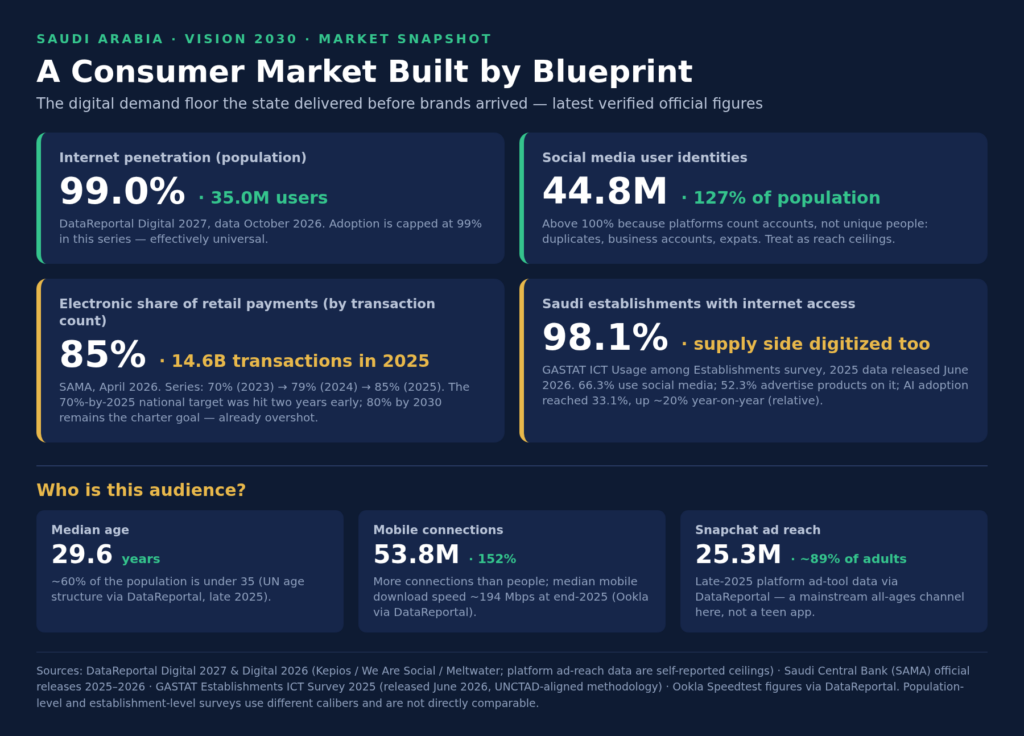
Here is the part that should make every marketer sit up. By late 2026, DataReportal counted 35.0 million internet users in the Kingdom — 99% of the population, a figure the report series deliberately caps because adoption is effectively universal. Social media user identities reached 44.8 million, or 127% of the population. Yes, more accounts than people: platforms count duplicates, business profiles and expatriate audiences, so treat that as a reach ceiling, not a headcount. The direction is unmistakable. This is one of the most connected consumer markets on earth, and it did not get there organically.
The thesis of this piece is simple. Saudi demand carries a hidden state subsidy. The audience was built, connected, payment-enabled and culturally permitted by policy before brands arrived. The opportunity is real and the entry window is still open — but a policy-built market is not a policy-independent one, and confusing the two is the most expensive mistake an entrant can make.
The Phenomenon: A Consumer Market Built by Blueprint
The connectivity floor brands normally wait decades for
In most emerging markets, the addressable digital audience accumulates one household at a time. In Saudi Arabia it arrived like utilities. The latest DataReportal snapshot (October 2026 data) shows 53.8 million mobile connections — 152% of the population — and median mobile download speeds around 194 Mbps at the end of 2025, per Ookla figures carried in the Digital 2026 report. When your video ad loads instantly on a phone in downtown Riyadh and one in a rural town outside it alike, the infrastructure excuse for weak digital performance disappears.
The supply side digitized alongside demand
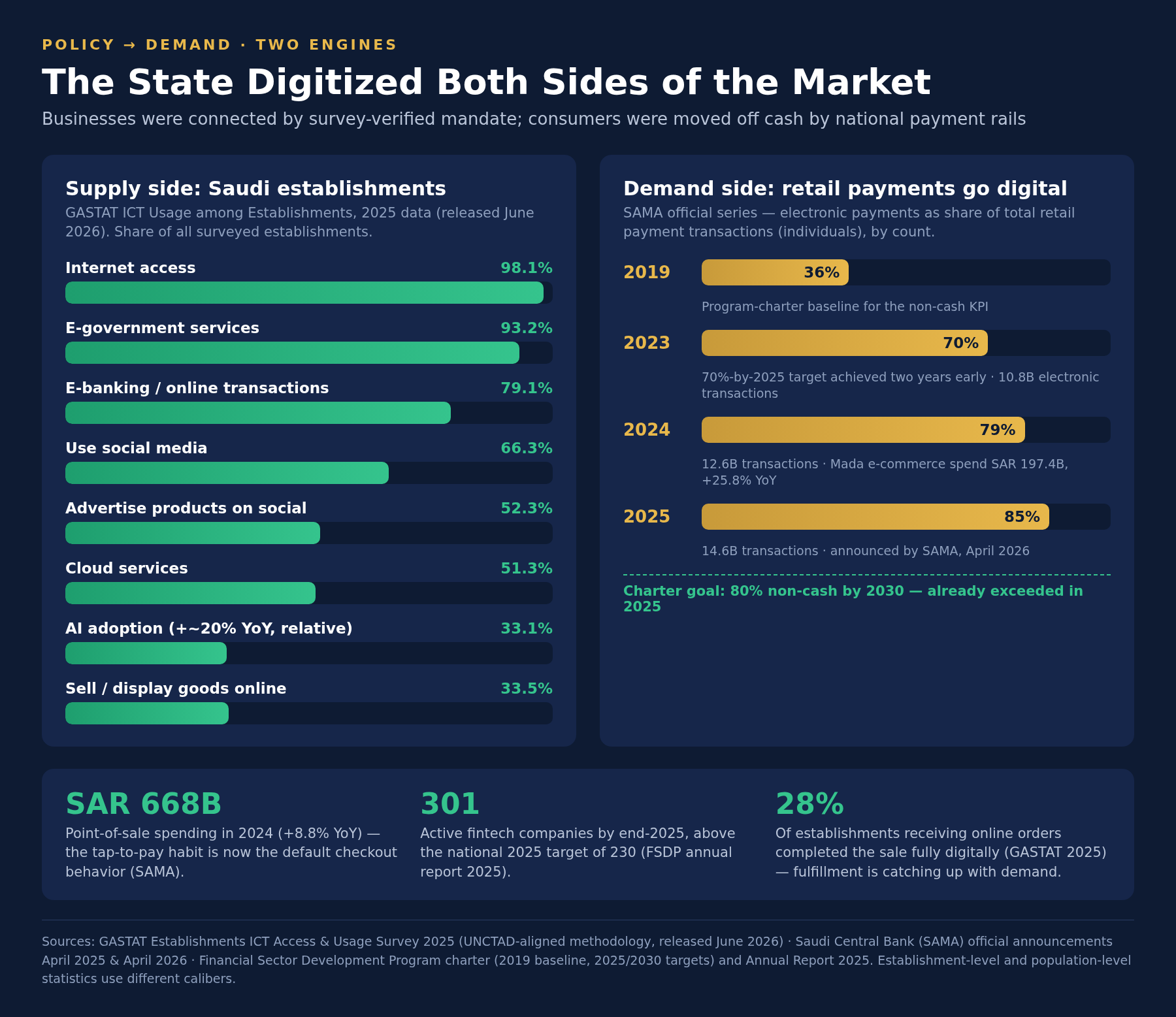
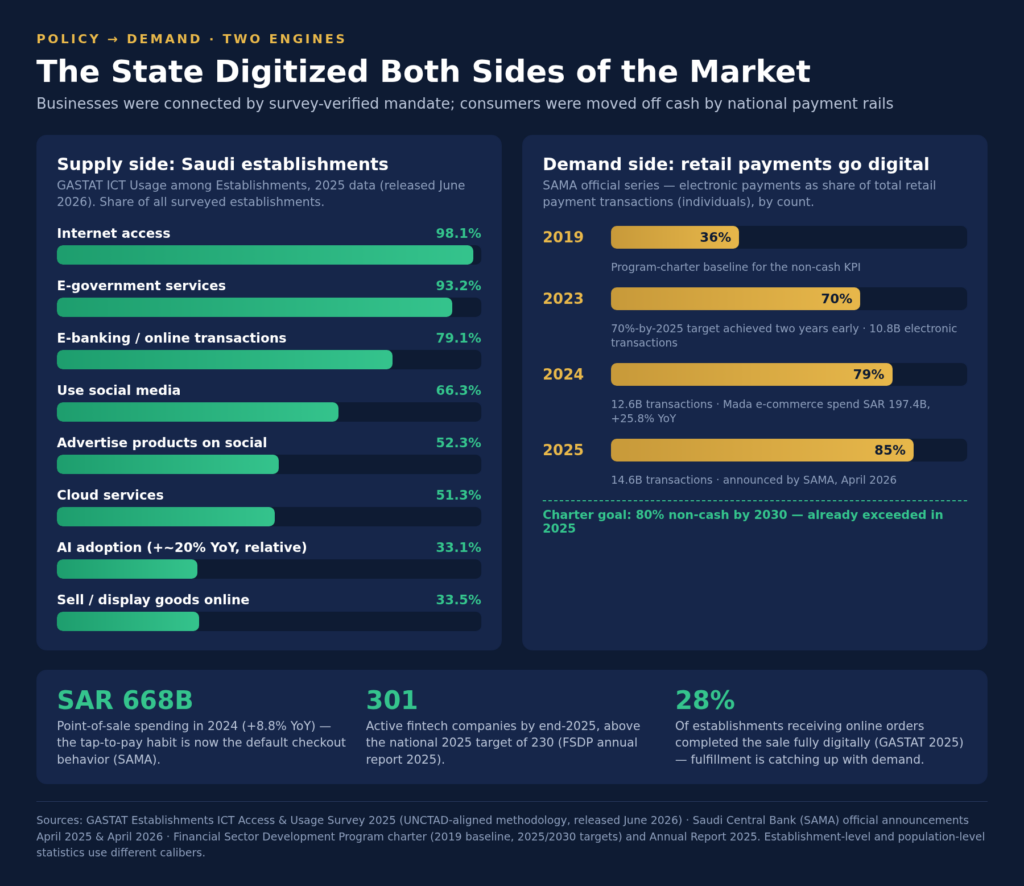
This is not just a story about consumers scrolling. The General Authority for Statistics (GASTAT) released its 2025 ICT Access and Usage survey of establishments in June 2026, built on a methodology aligned with UNCTAD standards. The numbers: 98.1% of Saudi establishments have internet access, 93.2% rely on e-government services, 66.3% use social media, and 52.3% actively advertise products on it. AI adoption reached 33.1% of establishments — up roughly 20% year-on-year in relative terms, not twenty percentage points, a distinction worth keeping straight. Cloud usage sits at 51.3%. Your B2B buyers, your retail partners, your distributors: they are already digital. The market’s plumbing works on both sides of the counter.
Payments: the checkout barrier was removed by national policy
The Saudi Central Bank (SAMA) reports that electronic payments accounted for 85% of all retail payment transactions in 2025 — 14.6 billion transactions, up from 12.6 billion in 2024, when the share was 79%. In 2023 it was 70%, which means the Kingdom hit its 70%-by-2025 national target two years early and has already blown past the charter’s 80%-by-2030 goal. Mada, the national payment scheme, processed SAR 197.4 billion in e-commerce spending in 2024 alone, up 25.8% year-on-year. If you have read our pieces on India’s UPI or Brazil’s Pix, you know the pattern: when the state builds the rails, checkout friction collapses and entire business models become viable overnight. This is the sovereign edition of that lesson.
The Deep Mechanism: Four Channels of State-Funded Demand
Channel one — infrastructure as audience construction
Broadband, 5G and payment rails built by national mandate mean the addressable audience was pre-assembled. In organically evolved markets, early digital advertisers pay an education tax: consumers must first learn to trust online checkout, then to browse, then to buy. Saudi brands inherit consumers who already tap-to-pay for groceries. We would argue customer acquisition in a freshly connected, state-enabled market starts structurally cheaper than in markets where every habit had to be purchased with media spend. That is an inference from the data, not a measured CAC study — but the mechanism is sound.
Channel two — sector creation as category creation
Vision 2030 did not grow entertainment, tourism and gaming. It legislated them into existence. Cinemas were banned for roughly 35 years until the December 2017 decision; the first AMC screen opened in Riyadh in April 2018 with Black Panther. Tourist e-visas launched in 2019. The result, per the Ministry of Tourism’s 2025 annual statistical report: about 123 million visitors (29.3 million inbound, 93.3 million domestic) and record spending of roughly SAR 304 billion — about $81 billion. The original 100-million-visitors-by-2030 target was passed in 2023; the revised goal is 150 million. Brands entering these categories face thin legacy competition and demand events the state itself funds and schedules.
Channel three — demographic policy as demand expansion
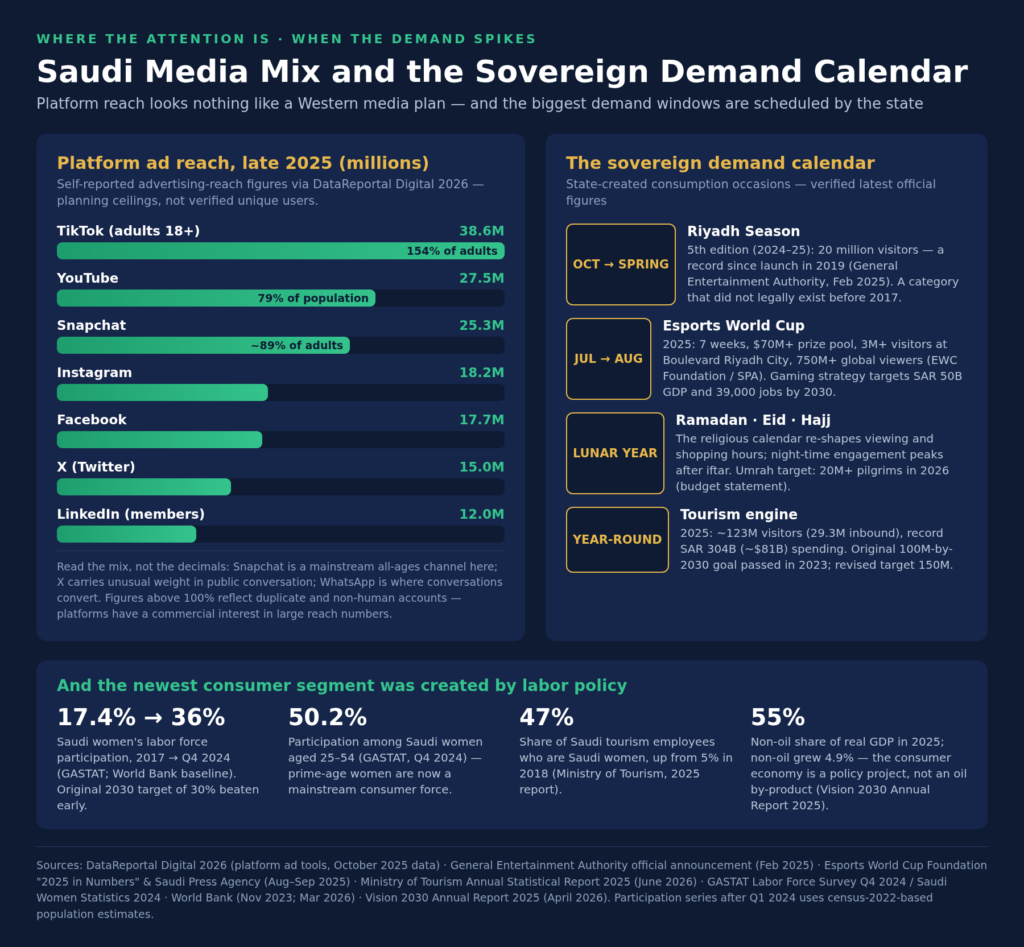
Here is the channel most market-entry decks miss entirely. Saudi women’s labor force participation rose from 17.4% in early 2017 (the World Bank’s baseline) to 36.0% in Q4 2024 per GASTAT — smashing the original Vision 2030 target of 30% years ahead of schedule. Among prime-age women (25–54), participation reached 50.2%. The latest quarterly reading, Q4 2025, eased to 34.5%; note that GASTAT rebased its population estimates on the 2022 census starting in 2024, so treat quarter-to-quarter wiggles with care rather than declaring a trend reversal. The structural point stands: millions of women now earn independent income. New consumer segments appeared by policy, not by marketing segmentation. In tourism, Saudi women went from 5% of Saudi employees in 2018 to 47% in 2025. That is a demand-side earthquake.
Channel four — the sovereign-capital loop
The Public Investment Fund (PIF) is simultaneously infrastructure, advertiser and competitor. It seeded noon.com with $500 million for a 50% stake at the 2016 announcement. Its Savvy Games Group, created with a roughly $38 billion mandate, bought Scopely for $4.9 billion in 2023; Scopely then acquired Niantic’s games business for $3.5 billion in 2025; and a PIF-led consortium completed the $55 billion take-private of Electronic Arts in August 2026. Riyadh Air, wholly PIF-owned, was unveiled in March 2023 and began commercial service in 2026. When you buy media, sponsor events or list products in this market, sovereign fingerprints are on many of the surfaces. The state funds both sides of the market — which is an opportunity if you align with it, and a squeeze if you try to outspend it.
What Everyone Misunderstands
The oil-money stereotype
Yes, the fiscal engine still runs on hydrocarbons — we will get to that. But the consumer economy is no longer just an oil by-product. The Vision 2030 Annual Report 2025 (published April 2026) puts non-oil activities at roughly 55% of real GDP, growing 4.9% in 2025, with the private sector contributing 51% and 93% of tracked KPIs meeting or exceeding their targets. One honesty note: GASTAT’s comprehensive GDP revision in May 2025 lifted the measured non-oil share by 5.7 percentage points to 53.2% on the revised basis — part of the jump is better measurement, not just real transformation. Both things are true at once. Plan for a structurally diversifying economy, and read the calibers before quoting the headline.
The conservative-market assumption
If your creative brief still imagines an austere, media-shy audience, you are briefing for a country that no longer exists. The median age is 29.6 years and roughly 60% of the population is under 35. Snapchat — a teen app in most Western plans — reaches about 89% of Saudi adults, making it a mainstream, all-ages channel. TikTok’s adult ad reach exceeds the entire adult population on paper (a counting artifact, but a telling one). This is among the world’s most content-hungry audiences. Austerity-toned creative misreads the actual media diet.
The translate-and-launch shortcut
Arabic-first is table stakes, but Saudi-specific is the actual bar. Khaleeji dialect nuance, local cultural references, and a platform mix that weights Snapchat and X far above Western defaults decide conversion. Machine-translated Arabic reads as machine-translated Arabic, and it damages exactly the trust the campaign was meant to build. The state built the audience; brands still have to earn it, in its own register.
What It Means for Brands and Marketers
Enter category-first, not channel-first
The legislated categories — entertainment, gaming, tourism, women’s lifestyle — come with state-funded demand events and thin legacy competition. Riyadh Season’s fifth edition drew 20 million visitors, a record announced by the General Entertainment Authority in February 2025. The 2025 Esports World Cup ran seven weeks with a prize pool above $70 million, drew more than 3 million visitors to Boulevard Riyadh City and reached over 750 million viewers globally, per the foundation and the Saudi Press Agency. Position inside these categories early. The window logic is the classic emerging-market one: enter while demand is subsidized and competition is thin — not after the auctions mature.
Ride the sovereign calendar
Ramadan and Eid reshape viewing and shopping hours; National Day, Riyadh Season and EWC create scheduled demand spikes; the Hajj and Umrah economy is itself a policy target (the 2026 budget aims for 20 million-plus Umrah pilgrims). Campaign planning here is calendar engineering with governmental precision. Build production timelines six to eight weeks ahead of the lunar peaks, and stop running a fixed Western week against a Hijri-shaped audience.
Localize to Saudi, not to the GCC
The regional headquarters (RHQ) program tells you what the state rewards: commitment. Launched in 2021, it has attracted more than 600 multinationals — the 2030 target of 500 was already exceeded by October 2025 — with incentives including zero corporate income and withholding tax on qualifying RHQ activities for 30 years and a 10-year Saudization exemption. The message generalizes to marketing: substantive local presence, local creative, local data handling. A superficial GCC-generic campaign is the marketing equivalent of a paper headquarters.
Budget for the compliance texture — it is also your moat
Three layers matter. First, influencer licensing: since October 2022, individuals earning advertising revenue on social media need the Mawthooq license from the General Authority of Media Regulation (GAMR) — SAR 15,000 for three years, ads only from registered accounts, and foreign creators generally must work through licensed local agencies. Verify license numbers before contracting; the regulator has referred businesses for using unlicensed advertisers. Second, content norms: GAMR’s September 2025 guidelines restrict wealth-flaunting, featuring children in lifestyle content, and immodest dress — creative staples elsewhere that are off the table here. Third, data: the Personal Data Protection Law (PDPL) has been fully enforceable since September 2024, applies extraterritorially to any processing of data of individuals in the Kingdom — your marketing database included — and carries fines up to SAR 5 million. Formalization is the entry fee. It also protects committed brands from casual entrants who will not pay it.
The Counterargument — and Its Limit
It is still an oil-fiscal economy
The subsidy is real, and so is its contingency. The 2025 fiscal deficit came in around SAR 277 billion — roughly 5.6% of GDP per NBK’s research — against an original budget of SAR 101 billion, as lower oil prices and production cuts bit. The 2026 budget forecasts a narrower SAR 165 billion gap (about 3.3% of GDP), with the finance minister describing a deliberate deficit-by-design stance until 2028 and both the government and PIF recalibrating gigaproject timelines toward measurable returns. A sustained oil downturn compresses the state-funded demand engine. The limit of this counterargument: the floor persists. Connectivity, cashless habits and women’s employment are largely irreversible even if spending slows. The acceleration is contingent; the foundation is not.
Sovereign competition crowds out private brands
True — PIF entities dominate platforms, events and now global game publishers. The practical answer is not to outspend the sovereign ecosystem but to partner with it: sponsor its events, list on its platforms, serve its giga-projects. The market rewards alignment. And remember the reform pace itself is a policy variable: build for the current permission set with scenario plans, rather than extrapolating liberalization in a straight line.
How to Read the Numbers Without Fooling Yourself
One last practical note, because this market punishes sloppy dashboards. Three calibers get confused constantly. Population penetration (DataReportal, platform ad tools) is a planning ceiling that can exceed 100% — never present it as unique humans. Establishment statistics (GASTAT) survey businesses, not consumers, and follow UNCTAD-aligned methods — strong official data, different denominator. Payment shares (SAMA) count transactions, not value: 85% of transactions being electronic does not mean 85% of spending is cashless, since cash still skews toward small-ticket purchases. Keep the three columns separate in your market-entry model, cite the measurement date next to every figure, and refresh platform numbers each reporting cycle — the ad tools revise history quietly. Do that, and Saudi Arabia becomes one of the most legible growth markets in the world: a place where the demand was commissioned, the receipts are public, and the only missing input is your commitment.
Conclusion: The Gift and Its Terms
Saudi Arabia demonstrates something no organic market can: demand commissioned by blueprint. Connectivity at 99%, payment digitization at 85% and ahead of every target, categories legislated into existence, and new consumer segments created by workforce policy. For marketers it is a rare gift — an audience pre-built and pre-paid by the state, with the entry window still open. The discipline is remembering the gift’s terms: Arabic-first commitment, sovereign-calendar planning, compliance as moat, and scenario awareness that policy-built demand is policy-contingent. The state funded the market’s construction. Brands still have to earn its loyalty.