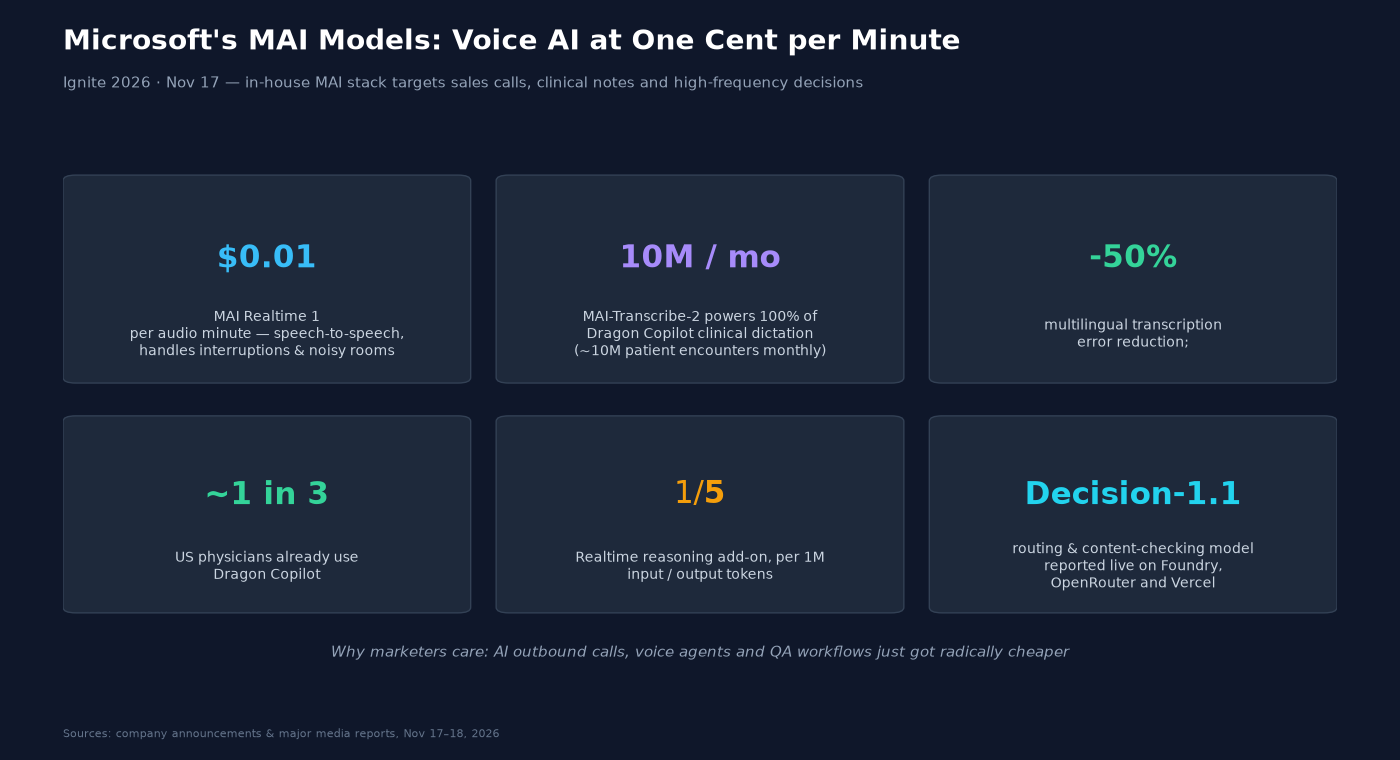
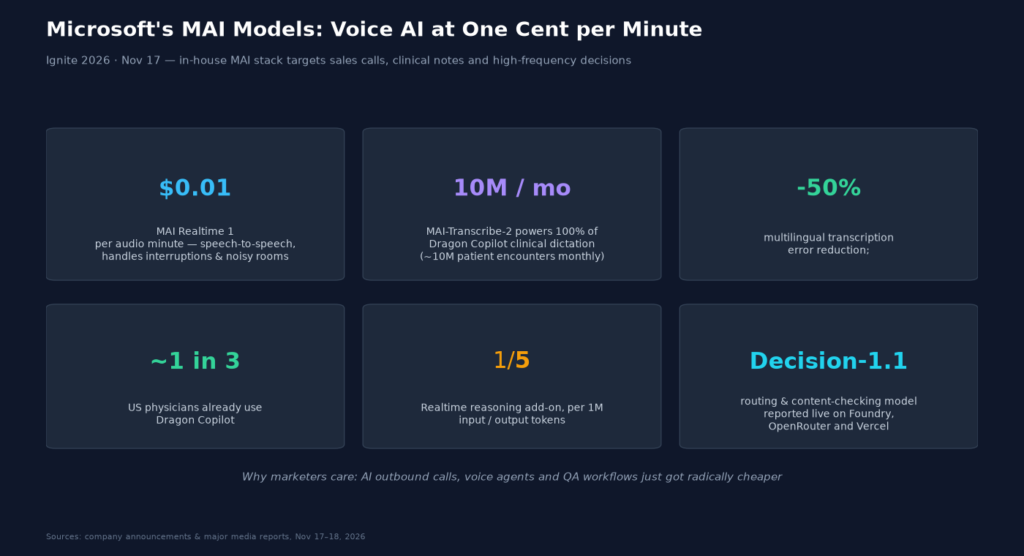
The most disruptive price announced at Microsoft’s Ignite conference on November 17 was not for a flagship model. It was for a minute of conversation. MAI Realtime 1, Microsoft’s first speech-to-speech model, costs $0.01 per audio minute — a cent for sixty seconds of AI that can listen and speak simultaneously, handle interruptions, wait for a hesitant speaker to finish, and parse a request in a noisy room with multiple people talking. When reasoning is involved, tokens bill separately at $1 per million input and $5 per million output, but the conversational substrate itself is now priced like a utility.
For anyone who buys, builds, or competes with call centers, the arithmetic is immediate. A ten-minute AI-handled call costs a dime of voice compute. Even with telephony, orchestration, and margin layered on top, the underlying cost of a natural spoken interaction has fallen by orders of magnitude against human staffing — and Microsoft is not selling a research preview. It is selling infrastructure, built in-house, part of a deliberate MAI family that now spans code, transcription, decisioning, and voice.
The proof point is already running at national scale
Skeptics of cheap AI voice have a fair objection: demos are not deployments. Microsoft’s answer sits in healthcare, where the same MAI program shipped Transcribe-2 as the engine behind 100% of Dragon Copilot’s clinical dictation — roughly 10 million patient encounters a month, with about 50% lower error rates in multilingual workflows, used by approximately one in three US physicians. Whatever one thinks of AI in medicine, that is not a pilot. It is a regulated, high-stakes, accent-diverse, noise-filled production environment running the company’s in-house speech stack at a scale few consumer products reach.
The strategic read: Microsoft spent two years being resold OpenAI’s intelligence at OpenAI’s prices, and is now systematically indigenizing the layers it needs most. Code (MAI Code 2 in GitHub Copilot), clinical speech (Transcribe-2), high-frequency decisions (Decision-1.1, which Chinese tech media report is available on Foundry, OpenRouter, and Vercel — platform availability that Microsoft’s English materials describe less specifically), and now realtime voice. Each launch pressures the margin structure of every vendor building on someone else’s model — including, notably, OpenAI itself.
Where the cent-a-minute wave lands in marketing
Three markets reprice first.
Outbound and qualification calls. AI SDR products already dial, pitch, and book meetings; their gross margins were hostage to per-minute voice-model costs. At a cent a minute, the cost floor collapses, competition intensifies, and the differentiator shifts from “can it talk” to “should it call” — targeting quality, consent compliance, and brand-tone control. Expect a flood of cheap AI calling tools, and expect telephone regulators and carriers to respond to the volume. Marketers deploying voice agents should document consent flows and honor do-not-call regimes with the seriousness of a compliance team, because the enforcement optics of a million cheap robocalls are terrible even when each call is lawful.
Customer service and post-purchase. Voice has been the stubborn holdout of support automation — the channel customers flee to when chatbots fail. Natural interruption handling is precisely the capability that made prior voice bots unbearable. Brands should pilot voice agents on bounded, high-volume flows (order status, returns, appointment changes) with clean human handoff, and measure containment rate against customer satisfaction jointly, not separately.
Voice-of-customer intelligence. Cheap, accurate transcription of every sales and support call turns conversations into a queryable dataset: objection mining, competitor mention tracking, churn-signal detection, message-testing feedback in days rather than quarters. With clinical-grade multilingual accuracy demonstrated, the technical excuse for not mining call data is gone; what remains is the privacy work — notice, consent, retention limits — that must precede it.
The buyer’s checklist
Before signing any voice-AI vendor this quarter, ask four questions. Which underlying model does the product use, and does its pricing pass through the new cost floor or pocket it? How does the system behave on interruption, crosstalk, and accents — tested on your call recordings, not the vendor’s demo? What is the human-handoff path, and what does a failed call cost you in brand terms? And where do recordings live, for how long, and under whose training rights? The last question is newly answerable — Google shipped granular training opt-outs for Gemini the same week — which means “we can’t control that” is no longer an acceptable vendor answer.
A cent a minute does not make every call worth automating. It makes the decision of which calls to automate — previously settled by cost — a pure judgment call. Judgment, as ever, is the part your team still owns.