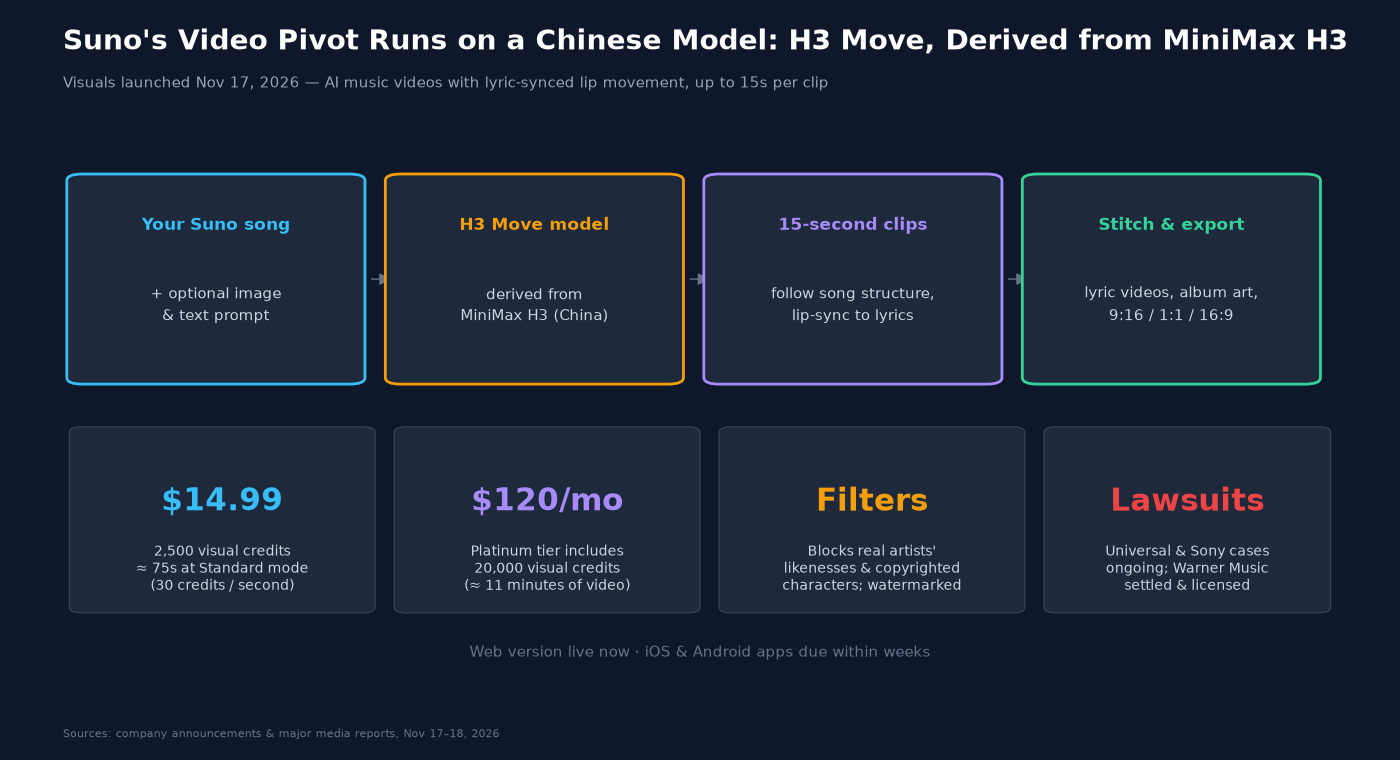
Suno, the AI music company that went from industry pariah to Warner-licensed partner in under a year, launched Visuals on November 17: a tool that turns songs made on its platform into lyric videos, album art, and short clips with characters who lip-sync to the words. Clips run up to 15 seconds, follow the song’s structure, and can be stitched into full music videos. The web version is live; mobile apps arrive within weeks. Coverage focused, reasonably, on the creative leap. But the most consequential line in the announcement was technical: Visuals runs on H3 Move, a model derived from H3 — built by MiniMax, the Shanghai-founded, Hong Kong-listed AI company.
A consumer product with tens of millions of music-making users just routed its video generation through Chinese model infrastructure. And it did so openly, in a FAQ, while MiniMax itself faces a copyright lawsuit from Disney, Universal, and Warner Bros. Discovery over its Hailuo service. The globalization of China’s AI stack is no longer happening through geopolitics-inflected infrastructure deals. It is happening through a teenager making a lyric video.
Why Suno chose H3, and what it says about the model market
Suno’s chief product officer Jack Brody gave the honest explanation: until recently, video generation was too slow and too expensive for anyone but enterprises. A new generation of models changed the threshold. MiniMax’s H3, released in July with native stereo sound and up to 2K output, then partially open-weighted in August, offered frontier-adjacent video capability at a cost structure a consumer subscription could absorb. Suno says it optimized the model with its own data for music-video behavior — clips that track song structure, catch lyrics, and sync mouths.
Note the architecture of the choice. Suno did not need the single best video model in the world; it needed the best cost-capability point for a specific, bounded task, with weights it could tune. That is precisely the slot Chinese open-weight models have been engineered to occupy, and precisely the slot where Western frontier labs — pricing for enterprise API margins — have left room. MiniMax’s open-weights license notably excludes the US, EU, UK, and South Korea from automatic download rights, but the restriction covers downloadable weights, not commercial arrangements; Suno’s deployment shows the commercial path stays open. The pattern for 2027: American labs sell intelligence at the frontier; Chinese models power the volume layer underneath consumer products, often invisibly. Suno just made it visible.
The economics creators will actually feel
Visuals introduces a second meter. Visual credits are separate from song credits: $14.99 buys 2,500 of them, good for roughly 75 seconds of Standard-quality video (30 credits per second; Fast mode halves the burn). The new $120-per-month Platinum tier bundles 20,000 visual credits — about eleven minutes of output. A three-minute music video means a dozen clips, plus retries, plus edits. The all-in cost lands around ten dollars per finished minute before counting the generations you throw away. For hobbyists that’s a toy budget; for brands eyeing AI-made social video, it is startlingly cheap — and the gap between “cheap generation” and “finished, on-brand, rights-clean asset” is where the real production cost still lives.
Suno, scarred by litigation, built the guardrails into the pitch. New text and visual filters block prompts and uploads attempting to depict real artists, public figures, or copyrighted characters — Brody’s line, “prompts that work on other video platforms may not work on Suno, and that’s by design,” is a product philosophy aimed squarely at a courtroom. Outputs carry embedded watermarks before off-platform sharing. The context: Universal and Sony suits remain live, the Elvis estate and an Eminem publisher filed claims in recent weeks, and Warner Music’s settled-and-licensed relationship is the exception Suno is trying to generalize.
What brands and agencies should take from this
Three things. First, AI music video is now a legitimate line item for social content testing — hooks, lyric visuals, sonic branding experiments — at costs that justify volume experimentation, provided legal reviews the licensing chain of both the music and the underlying model. Second, provenance diligence now extends below the product layer: your vendor’s vendor matters. A brand-safe wrapper around a model facing Hollywood litigation is a contract question, not just a technology question — ask who indemnifies what. Third, watch the watermark-and-filter approach as the emerging template for AI content compliance; it mirrors the guardrails ByteDance added to Seedance and rhymes with the transparency standards enterprise vendors announced the same week. The industry is converging, from both the consumer and enterprise ends, on the same principle: generation is cheap, provenance is the product.
The headline was “Suno makes videos now.” The footnote was “the video engine is Chinese.” Both sentences will matter — and the footnote may matter longer.