Nvidia’s earnings report on November 17 was, by any conventional measure, extraordinary. Revenue of $115.8 billion for the fiscal third quarter, up 103% from a year earlier. Data center revenue of $107.6 billion. Guidance of roughly $130 billion for the current quarter, plus or minus 3%. All of it delivered under an interim chief executive, CFO Colette Kress, after the sudden resignation of founder Jensen Huang — the first report of the post-Huang era, and shares rose as much as 4% in after-hours trading.
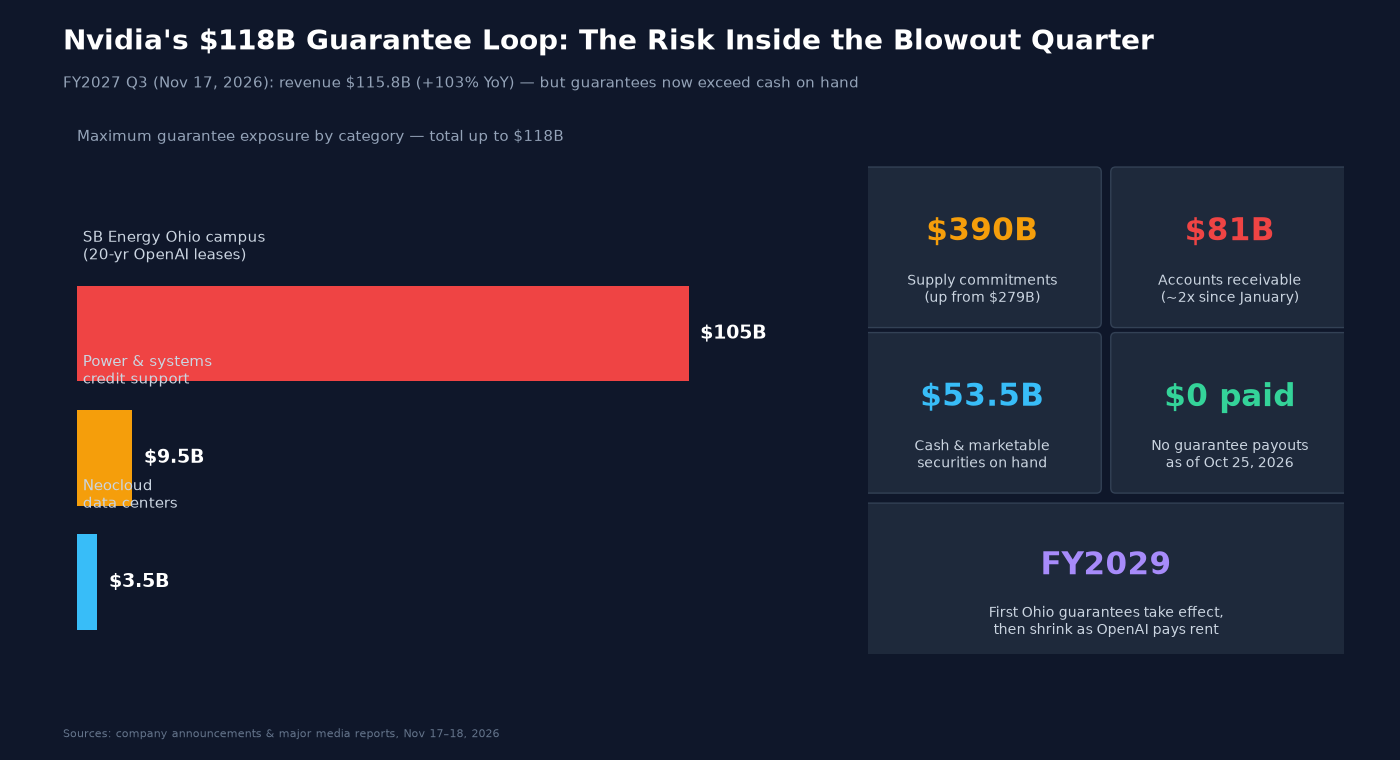
And yet the most important disclosure in the filing was not in the headline numbers. It was in the commitments footnote: Nvidia now carries up to $118 billion in guarantees backing its partners’ data center projects. That figure exceeds the company’s entire $53.5 billion pile of cash and marketable securities — twice over. The world’s most successful chipmaker is no longer just selling into the AI boom. It is underwriting it.
Anatomy of the guarantee loop
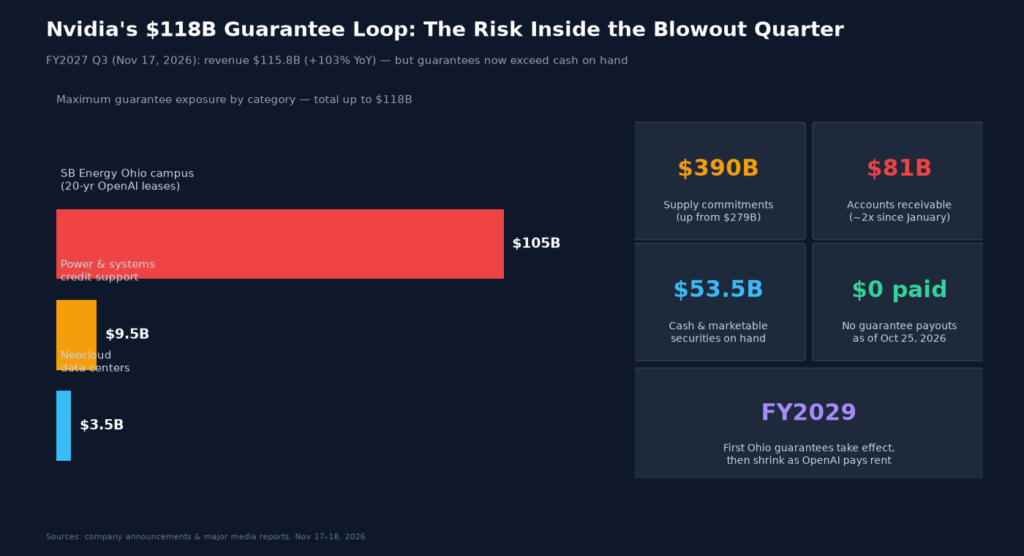
The structure deserves a careful look, because it is both less alarming and more revealing than the headline suggests. Of the $118 billion maximum, $105 billion supports a single project: SB Energy’s PORTS-Pike Technology Campus in Ohio, a facility that will exclusively host Nvidia infrastructure under 20-year leases to OpenAI. Another $9.5 billion covers power and systems credit support, and $3.5 billion backs smaller “neocloud” data centers.
Crucially, these are contingent promises, not debts. The Ohio guarantees activate phase by phase as each building is completed and ready — the first is not expected until fiscal 2029 — and the exposure then shrinks over the life of the leases as OpenAI pays rent. As of October 25, Nvidia had paid nothing on any guarantee. On the earnings call, Kress was explicit that if a partner stalls before a building is ready, “our guarantee doesn’t exist anymore.”
Why do this at all? Nvidia answered with unusual candor in the filing: many AI clouds and AI labs “are seeing extraordinary demand for AI infrastructure, yet many are growing faster than their balance sheets and long-term credit profiles can support.” Translation: Nvidia’s customers want more compute than banks will finance on their credit alone. So Nvidia lends them its own AAA-grade balance sheet — backing land, power, and buildings — and the chips that fill those buildings are, of course, Nvidia’s. Demand is no longer just discovered; it is partially manufactured, with the manufacturer holding the tail risk.
The same pattern appears elsewhere in the accounts. Supply commitments jumped from $279 billion to $390 billion in a single quarter, mostly multi-year memory purchases locking up DRAM and HBM output from suppliers like Samsung and SK Hynix. Separate neocloud commitments of $32 billion let Nvidia share in its smaller customers’ rental revenue once they secure financing. And accounts receivable reached $81 billion — roughly double the level at the end of January — partly reflecting extended payment terms for large investment-grade customers. Cash collection, in other words, is stretching out even as revenue compounds.
The bull case and the bear case are the same fact
Optimists will argue this is what category leadership looks like. Nvidia is recycling unmatched profits into ecosystem financing, exactly as aircraft makers and telecom equipment vendors have done in past infrastructure supercycles, and the conditions attached — phased activation, financing contingencies, approval rights — show real discipline. If AI demand persists, most guarantees will never trigger, and Nvidia will have converted financing support into decades of locked-in chip demand plus revenue-sharing upside.
Pessimists will note that every element of the structure correlates with the same variable. If AI spending cools, Nvidia does not merely sell fewer chips: its receivables collect slower, its neocloud partners default, its guarantees activate against stranded buildings, and its $390 billion of supply commitments keep arriving anyway. The company has engineered deeper exposure to a single scenario at the precise moment its governance is in transition — the commitments in this filing were signed under Huang, while Kress inherits their management and says she is “rigorously evaluating future investments, commitments and guarantees.”
Both readings are defensible. What is not defensible is ignoring the footnote. The guarantee total, receivables trend, and supply commitments are now the three most informative numbers Nvidia reports for anyone assessing AI-cycle risk — more informative, arguably, than the revenue beat itself.
Why marketers should care about a chipmaker’s footnote
It is tempting to file this under “investor news.” Don’t. The guarantee loop is the financial substrate of every AI marketing tool your team uses. When a model vendor prices inference below cost to win share, when an AI ad platform offers generous credits, when a startup agent product undercuts incumbents — that pricing is downstream of compute financing structures like this one. Cheap AI marketing capability in 2026 is partly a financed subsidy, and financed subsidies have terms.
Two practical takeaways follow. First, vendor durability belongs in martech due diligence: prefer providers whose economics survive a compute-price normalization, and avoid deep workflow dependence on vendors whose survival assumes perpetual cheap capital. Second, treat this quarter’s disclosures as a cycle indicator. If guarantee exposure keeps climbing faster than revenue in coming quarters — the pattern to watch — it signals Nvidia increasingly paying to create its own demand, and the prudent planning assumption becomes firmer AI pricing ahead, not softer.
The blowout was real. So is the promise tucked inside it.